
Illinois Security Officer Defends Janus Rights Amidst Union Discrimination
The following article is from the National Right to Work Legal Defense Foundation’s bi-monthly Foundation Action Newsletter, March/April 2023 edition. To view other editions of Foundation Action or to sign up for a free subscription, click here.
Union officials sought to coerce membership by preventing non-members from defending their jobs
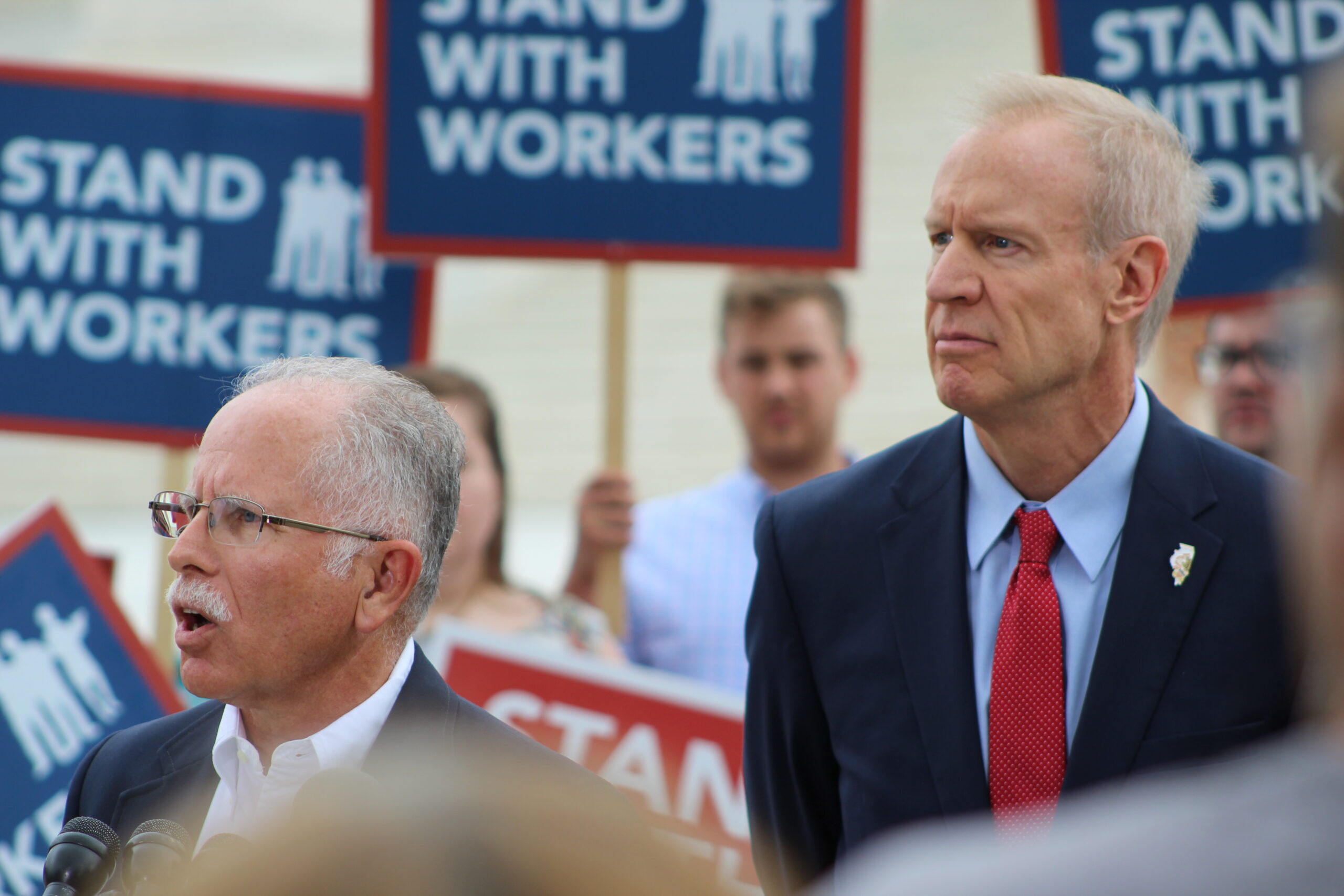
Foundation attorneys aided Illinois public employee Mark Janus with former Illinois Governor Bruce Rauner (right) in his landmark First Amendment victory. But Foundation attorneys often must fight to enforce Janus rights, as in Chris Logan’s case.
CHICAGO, IL – The National Right to Work Foundation’s landmark Supreme Court victory in Janus v. AFSCME was a milestone for public sector workers. For the first time, the Court recognized that every American public sector worker had the constitutional right to cut off dues to a union they oppose.
Even with this important First Amendment protection, however, union bosses unfortunately still wield an enormous amount of power over workers who have ended their affiliation with the union. Because of laws that authorize monopoly union “representation” in the public sector, union officials still have significant control over independent-minded employees’ working conditions, pay, benefits, and more.
City of Chicago aviation security officer Chris Logan discovered just how painful Illinois Council of Police (ICOP) union bosses could make life for him after he exercised his Janus rights. In 2020, following a dispute about his job performance, Logan took action to protect his job under the terms of his employment contract, only to have union bosses exploit the opportunity to attack Logan. The union would not allow Logan to file a grievance to protect his job unless he joined the union.
Officer Challenges Discriminatory Grievance Scheme with Foundation Aid
“ICOP union officials basically tried to force me to join and pay dues to the union by making it impossible for me to defend my job otherwise,” commented Logan. “I exercised my Janus rights and left the union because I didn’t think that ICOP officials were good ‘representatives’ of me or my coworkers.”
“Instead of trying to win back my support voluntarily, union bosses used their power to deprive me of all options when I tried to defend my job — I couldn’t even file or arbitrate a grievance myself,” Logan added. “In my mind, that simply confirms I made the right decision when I left this union.”
However, with free legal representation from National Right to Work Legal Defense Foundation staff attorneys, Logan won a decision from the Illinois Labor Relations Board (ILRB) in late 2022 that decisively declared ICOP officials’ “members only” grievance scheme illegally discriminatory against non-members.
Logan first exercised his Janus rights in October 2019, telling the union by letter that he no longer wished to pay union dues. Throughout 2020, Logan faced allegations about his job — possibly instigated by union militants. Per the union monopoly agreement he was subjected to, he tried to get union officials to fulfill their role, as monopoly “representatives” of the workplace, to file grievances challenging the City of Chicago’s disciplinary actions against him.
Union officials who maintain “monopoly bargaining power” in a workplace can legally impose their control over every worker, even those who have disaffiliated with the union. Because of this privilege, however, they are also legally obligated not to discriminate against non-members when it comes to grievances or other matters. However, as Logan discovered, union officials regularly ignore this “duty of fair representation.”
Union Officials Completely Ignored ‘Fair Representation’ Legal Obligation
ICOP union officials summarily rejected all of Logan’s requests to file grievances, and even told him that he could not file grievances himself. At one point, after an ICOP union official sent Logan an email falsely claiming the union had no legal obligation to participate because Logan had exercised his Janus rights, the ICOP lawyer chimed in to tell Logan, “I concur. Good luck.” The union stated it would not file grievances for Logan simply because he was a non-member.
Logan filed unfair labor practice charges against ICOP and the City of Chicago in August 2020, maintaining that the union’s actions were illegal. An ILRB Administrative Law Judge agreed with Logan’s charges in May 2022, declaring that ICOP “violated [Illinois labor law] when its agents restrained or coerced the Charging Party in the exercise of rights . . . by threatening to deny the Charging Party equal representation in the disciplinary and grievance matters.” The ILRB later adopted this ruling, leading to Logan’s Foundation-won victory when union officials did not attempt to appeal the decision to Illinois state court.
Monopoly Bargaining Powers Open Door to Corruption
“Union bosses maintain unilateral control over workers under a ‘monopoly bargaining’ regime,” commented National Right to Work Foundation Vice President and Legal Director Raymond LaJeunesse. “For public sector workers across the country, Janus is the only check they can use against this power, and even then they could face retaliation for doing so.”
“Cases like Mr. Logan’s, where union bosses used their bargaining powers to discriminate against a worker who exercised Janus rights, ought to make our elected leaders reconsider how much privilege our laws grant unions,” LaJeunesse added.
Foundation Asks Supreme Court to Hear Janus Case Again, Seeking Return of Forced Fees
The following article is from the National Right to Work Legal Defense Foundation’s bi-monthly Foundation Action Newsletter, May/June 2020 edition. To view other editions or to sign up for a free subscription, click here.
Case could set precedent for hundreds of millions of dollars in refunds to Big Labor’s victims
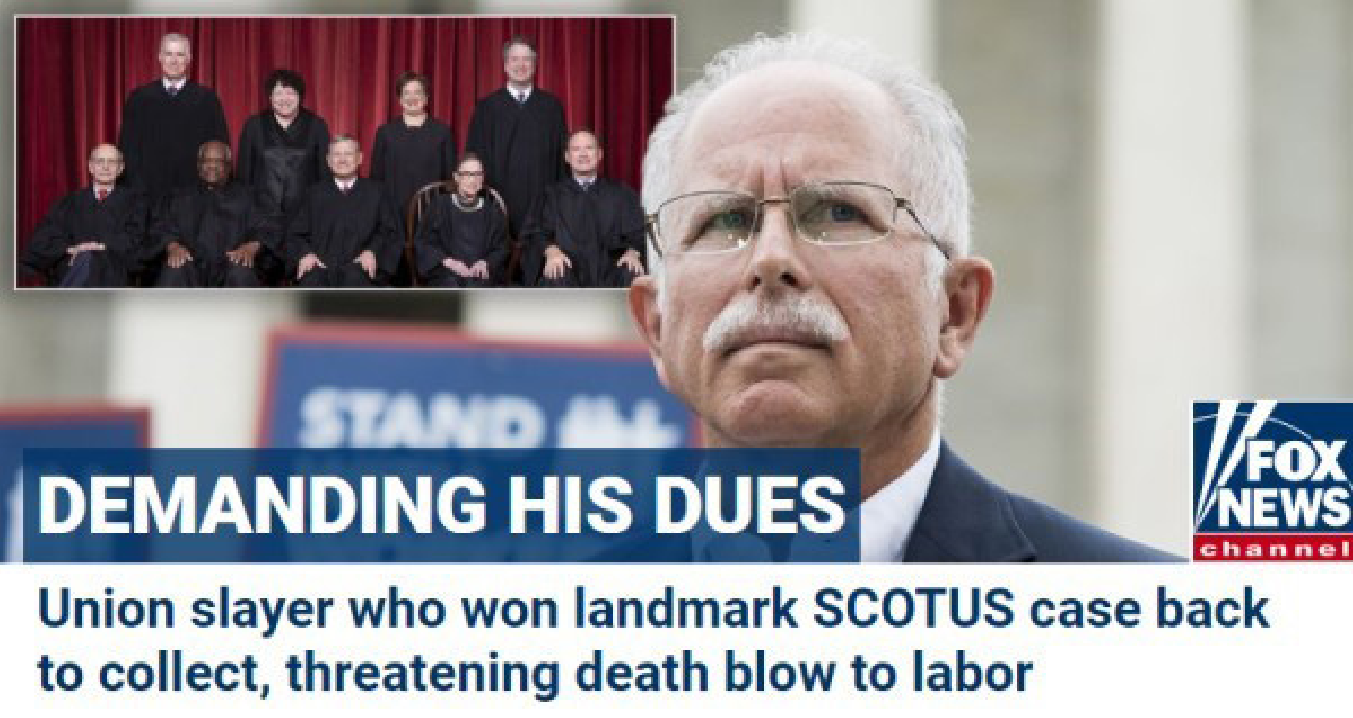
Mark Janus’ second Foundation-backed appeal to the Supreme Court landed the top spot on Fox News’ website. If Janus prevails again, hundreds of millions of dollars in unconstitutional union dues could be returned to public sector employees.
WASHINGTON, DC – Mark Janus is returning to the U.S. Supreme Court, this time asking the Justices to hear the continuation of Janus v. American Federation of State, County, and Municipal Employees (AFSCME), Council 31. Janus seeks repayment of the thousands of dollars in fees the union took from his paycheck in violation of his First Amendment rights. Another Supreme Court victory for Janus could set a precedent resulting in the return of hundreds of millions of dollars seized by union officials in violation of workers’ constitutional rights.
The original Janus v. AFSCME was argued successfully before the Supreme Court by veteran National Right to Work Foundation staff attorney William Messenger. In a landmark victory, the Court sided with Janus on June 27, 2018, and declared it illegal to force public employees to subsidize a union as a condition of employment. The Court recognized that compelling public workers to pay fees to a union violates their First Amendment rights.
Illinois Child Support Public Servant Intervenes in Lawsuit with Foundation Aid
As a result of Janus, more than five million public sector employees across the country are no longer required to pay union dues or fees to keep their jobs. However, Janus’ case continues as he seeks the return of the fees that AFSCME seized from his paycheck without his permission from June 27, 2018, to March 23, 2013, representing the two-year statute of limitations from the date his case started in March 2015 through the Supreme Court’s 2018 decision in his favor.
The Janus case began in February 2015, when then-newly elected Illinois Governor Bruce Rauner issued an executive order prohibiting state agencies from requiring employees who had abstained from formal union membership to pay union fees, based on a Right to Work Foundation U.S. Supreme Court victory in 2014 in another Illinois case. Rauner also filed a federal lawsuit seeking a declaratory judgment that forced union fees violate the First Amendment rights of public workers.
Staff attorneys from the Foundation, in partnership with the Illinois-based Liberty Justice Center, filed a motion for Mark Janus and two other plaintiffs to intervene in the case in March 2015, and have represented Janus ever since. The U.S. District Court for the Northern District of Illinois granted Janus’ motion to file a complaint in intervention, which allowed the suit to move forward even after the court ruled that Rauner lacked standing to pursue the lawsuit.
The Supreme Court permitted union bosses to impose forced union fees on public workers in the 1977 Abood v. Detroit Board of Education decision. However, before the Janus victory, Foundation staff attorneys secured several victories for workers which called the constitutionality of forced fees into question. In 2012, the court ruled in Knox v. SEIU that union officials must obtain affirmative consent from workers before using workers’ forced union fees for special assessments or risk infringing on their First Amendment rights. In 2014, the court ruled in Harris v. Quinn that requiring home healthcare providers who receive a subsidy from the government to pay union dues is a First Amendment violation.
Following Janus’ groundbreaking win at the Supreme Court in June 2018, Foundation attorneys continued his case in Illinois federal courts, arguing that the Supreme Court’s ruling is retroactive and that AFSCME should be required to return dues they seized unconstitutionally before the decision. In this and similar cases, union bosses have made a so-called “good faith” argument to defend their seizing of dues before Janus was issued. The U.S. Seventh Circuit Court of Appeals in Chicago ruled in 2019 that AFSCME could keep the unconstitutional dues, prompting Janus’ petition to the Supreme Court.
Hundreds of Millions of Dollars Potentially At Stake
“The Supreme Court agreed that the union taking money from non-members was wrong but the union still has the money it illegally garnished from my paycheck,” commented Janus. “It’s time for AFSCME to give me back the money they wrongfully took.”
Foundation staff attorneys are currently fighting for thousands of workers in about 20 cases which seek refunds of dues seized unconstitutionally before Janus was decided. While Janus is seeking the return of $3,000 of his own money, a favorable decision for him would set a precedent that could result in the return of over $120 million to public servants just in Foundation-backed cases. Other cases brought by workers could bring that total to hundreds of millions of dollars.
Workers Already Winning Refunds of Illegal Dues with Foundation Legal Aid
“The Supreme Court has already sided with the Foundation arguments for Mark Janus and ruled that forcing public employees to fund union activities violates the First Amendment,” said National Right to Work Foundation Vice President and Legal Director Raymond LaJeunesse. “The Supreme Court should take this case again to ensure that public sector union bosses are not permitted to profit from their widespread violation of workers’ First Amendment rights.”
Foundation staff attorneys in July 2018 secured the nation’s first-ever refund of dues seized unconstitutionally before Janus for Debora Nearman, an Oregon state wildlife employee. SEIU bosses were forced to settle and give back to Nearman over $3,000 in illegal fees they had seized from her over two years, during which they had sponsored an aggressive political campaign against her own husband, who ran successfully for the Oregon Legislature in 2016.
Check out the lead article in the January/February 2017 Foundation Action Newsletter “Foundation Cases Poised to Challenge Forced Dues at Supreme Court”
Foundation Cases Poised to Challenge Forced Dues at Supreme Court
Cases to overturn forced dues could quickly reach Supreme Court with new Trump Justice
To read the rest of the January/February 2017 issue, please click here.
Washington, D.C. – Over the past few months, Foundation staff attorneys have been busy litigating hundreds of cases on the behalf of independent-minded workers across the country. Two of those cases have the potential to reach the Supreme Court this year and answer the unresolved questions left in the wake of the 4-4 split in the Fredrichs v. California Teachers Association.
One of those cases, Janus v. AFSCME, stems from an executive order from Illinois Governor Bruce Rauner that placed any union fees that nonunion members were forced to pay into an escrow account until the constitutionality of those fees was resolved. Governor Rauner subsequently filed a lawsuit in U.S. District Court for the Northern District of Illinois and argued that collecting forced dues or fees from state employees as a condition of employment violated the First Amendment of the Constitution.
Foundation staff attorneys then filed a motion to intervene as plaintiffs for Mark Janus and other state employees who are forced to pay union fees as a condition of employment. A Judge eventually ruled that Governor Rauner did not have standing in court but let the Foundation-represented employees continue to challenge the constitutionality of forced fees.
After the Supreme Court reached a 4-4 deadlock in a similar case earlier this year, Friedrichs v. CTA, a District Judge ruled against Janus and the other state employees. Foundation attorneys immediately filed an appeal to the Seventh Circuit Court of Appeals and are awaiting a decision. It is possible that a petition for a writ of certiorari could be filed with the Supreme Court later this year.
The second case, Serna v. Transportation Workers Union (TWA), is a class-action lawsuit brought by several American Eagle Airlines and Southwest Airlines employees U.S. District Court for the Northern District of Texas was pending with the Supreme Court as this issue of Foundation Action went to press. That suit challenges the constitutionality of the Railway Labor Act’s sanction of agreements that require compulsory union fees as a condition of employment.
Even though these employees work in the private sector, the Supreme Court has previously ruled that because the Railway Labor Act (RLA) effectively mandates forced fees for railway and airline workers, it effectively fosters the same Constitutional issues as were raised for government employees in Friedrichs. Therefore, success in Serna on the First Amendment claims against forced dues would effectively overturn forced dues for public sector workers.
After the Fifth Circuit Court of Appeals ruled against the airline employees citing the Friedrichs deadlock, Foundation staff attorneys filed a petition for a writ of certiorari with the Supreme Court. The Court was scheduled to consider the petition on January 6 and a decision whether to take the case or not could follow shortly after, or the Justices may decide to hold the case in light of the potential for a 4-4 tie until a ninth Justice is seated.
“Both of these cases have the potential to answer the ultimate question that was left unresolved by Friedrichs and that is whether or not it is constitutional to force workers to pay union bosses tribute to get or keep a job,” National Right to Work Foundation President Mark Mix said.
In addition to Serna and Janus, National Right to Work Foundation staff attorneys have two additional cases working their way through the courts – one on behalf of university professors in Massachusetts and one for school employees in Kentucky – that directly challenge the constitutionality of mandatory union dues. More cases directly challenging the constitutionality of government-mandated forced union dues are expected to be filed by Foundation staff attorneys in 2017.





