
DC-Area Union Kitchen Employees Overwhelmingly Vote to Remove UFCW Union
Workers requested decertification vote amid contentious boycott and picket ordered by union officials against rank-and-file workers
Washington, DC (January 8, 2024) – Employees of five Union Kitchen locations in the Washington, DC, metro area have voted to remove United Food and Commercial Workers (UFCW) Local 400 union officials from power at the chain. The final vote tally was 24-1 in favor of ending UFCW Local 400’s monopoly bargaining power over the workers. Pending certification of the vote result by National Labor Relations Board (NLRB) Region 5 in Baltimore, the employees will be free of the union.
The effort to oust the UFCW union began in July 2023 when Union Kitchen employee Ashley Silva submitted a petition asking the NLRB to hold a union decertification vote among her coworkers, the vast majority of whom backed the petition. She received free legal aid from National Right to Work Foundation staff attorneys.
Because the District of Columbia lacks Right to Work protections for its private sector workers, UFCW union officials had the power to force Silva and her coworkers at the four DC Union Kitchen locations to pay union dues or fees as a condition of keeping their jobs. In contrast, in Right to Work jurisdictions like Virginia (home to one of the affected Union Kitchen locations), union membership and financial support are strictly voluntary. However, in both Right to Work and non-Right to Work jurisdictions, union officials can use their monopoly bargaining power to dictate the work conditions of all employees in a work unit, even those who voted against or otherwise oppose the union. A union decertification vote ends that union monopoly power.
Employees Voted to Remove Divisive Union Despite Union Attempts to Delay Vote Count
Silva and her coworkers’ effort began amid union boss-ordered pickets and boycotts against Union Kitchen Grocery locations, which inflamed tensions among workers. In some instances, union picketers endangered workers by blocking exits, requiring the intervention of police.
“The vast majority of the workers at Union Kitchen are sick and tired of the UFCW’s picketing, harassment of employees, and constant disruptions of our day-to-day work life,” Silva said at the time. “If the union cares at all about what we want, they will respect our wishes and immediately disclaim their interest in representing workers who have overwhelmingly rejected them.”
While Silva and her coworkers cast ballots in the union decertification election in October 2023, tension increased when UFCW union officials used “blocking charges” to stop the votes from being counted. “Blocking charges” are often unverified or unrelated charges of employer misconduct that union officials can manipulate to stall a ballot tally in a union decertification case.
However, as per NLRB rules, if the NLRB does not issue a complaint based on union officials’ allegations within 60 days of a decertification election, the ballots must be counted. NLRB Region 5 did not issue a complaint based on UFCW lawyers’ allegations within the 60-day window, thus allowing the ballot count to proceed.
However, despite the overwhelming 24-1 vote against the union, UFCW officials may still try to manipulate their charges to stop certification of the vote result. The union also challenged eight employee ballots (meaning that 32 workers total likely voted against further union presence), but the number of challenged ballots is not enough to alter the final result of the vote.
“We’re happy that Ms. Silva and her coworkers were finally able to exercise their right to vote out a union that actively worked against their interests,” commented National Right to Work Foundation President Mark Mix. “What’s concerning, however, is the fact that UFCW union officials could still prop up questionable allegations to stall the certification of an election that the very employees they claim to ‘represent’ asked for.”
“That, combined with the fact that UFCW officials’ combative tactics made life harder for Union Kitchen employees, again shows why all American employees deserve the freedom to abstain from funding a union they disapprove of,” Mix added.
“We call on union officials to withdraw their allegations and let the decision of the Union Kitchen workers stand,” Mix concluded.
Full Foundation Action September/October 2023 Newsletter Now Online
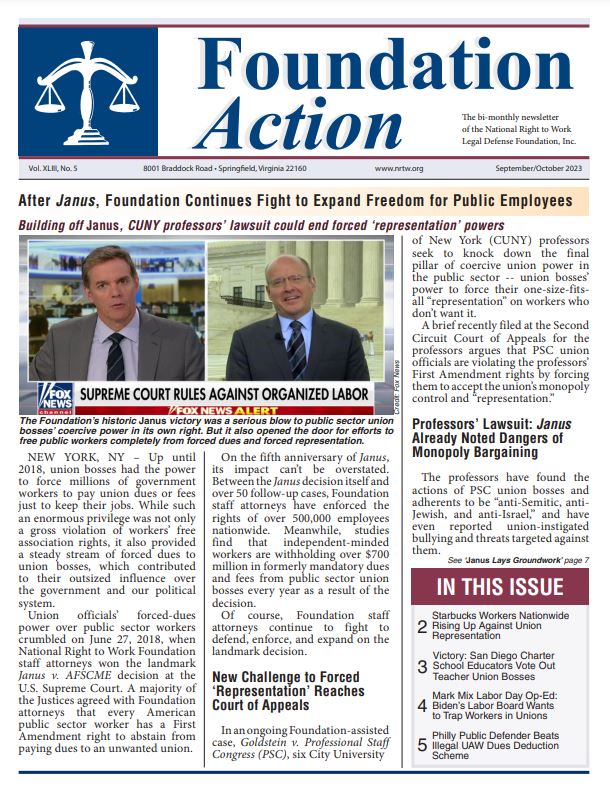 All articles from the September/October issue of Foundation Action are now online.
In this issue:
- After Janus, Foundation Continues Fight to Expand Freedom for Public Employees
- Starbucks Workers Nationwide Rising Up Against Union Representation
- Victory: San Diego Charter School Educators Vote Out Teacher Union Bosses
- Mark Mix Labor Day Op-Ed: Biden’s Labor Board Wants to Trap Workers in Unions
- Philly Public Defender Beats Illegal UAW Dues Deduction Scheme
Recent articles can be found here. To sign up for a free copy of the newsletter via mail please see the form at the bottom of this page.
Philly Public Defender Beats Illegal UAW Dues Deduction Scheme
The following article is from the National Right to Work Legal Defense Foundation’s bi-monthly Foundation Action Newsletter, September/October 2023 edition. To view other editions of Foundation Action or to sign up for a free subscription, click here.
UAW boss threatened to reduce workers’ wages for not signing dues card
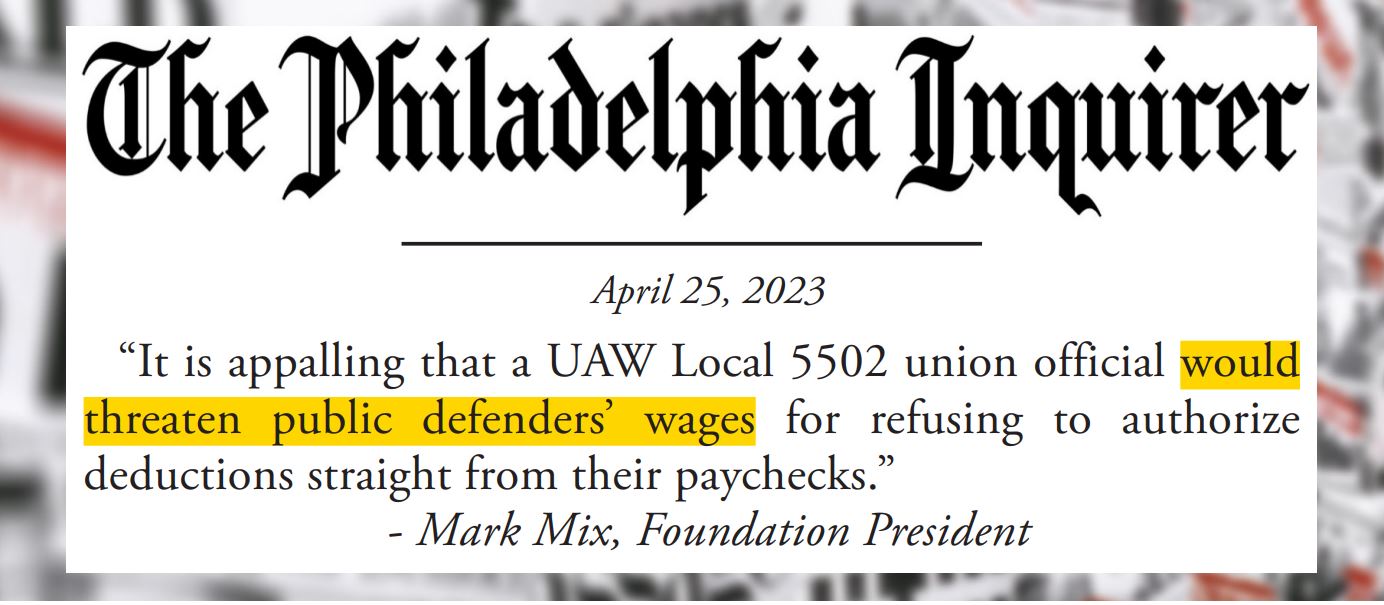
Philly Public Defender Brunilda Vargas surely didn’t feel “represented” by UAW bosses when they sought to reduce her and her colleagues’ pay just for not signing dues cards. Mark Mix expressed the outrageousness of this scheme to The Philadelphia Inquirer.
PHILADELPHIA, PA – Brunilda Vargas, a public defender for the City of Philadelphia, staunchly objected when United Auto Workers (UAW) Local 5502 union bosses sought to gain power over her and her colleagues at the Defender Association of Philadelphia.
After UAW union officials were installed in her workplace, things only got worse for her. A UAW union official threatened Vargas and her coworkers that, if they didn’t sign cards authorizing the direct deduction of union dues from their paychecks, their wages would be reduced. This threat was a blatant violation of federal law.
Vargas challenged UAW officials’ illegal demands with free legal aid from the National Right to Work Legal Defense Foundation. Union bosses quickly backed down, and in June entered into a settlement approved by National Labor Relations Board (NLRB) Region 4 which fully vindicates Vargas’ and her coworkers’ rights.
Public Defender Hits UAW with Federal Charges Following Intimidation
On April 18, 2023, Vargas filed her federal unfair labor practice charge with NLRB Region 4 for the threats made against her and her colleagues at the Defender Association of Philadelphia. UAW officials issued these threats against public defenders who chose not to sign automatic dues deduction authorization forms.
Even though Vargas works in the non-Right to Work state of Pennsylvania and can be forced to pay some union dues as a condition of employment, federal law prohibits forcing workers to authorize automatic dues deductions from their paychecks. Had Vargas lived in a Right to Work state, not only would she have the right to refrain from automatic dues deductions from her paycheck, but she could also refrain from financially supporting the union altogether. In Right to Work states, workers are fully protected from mandatory union membership and financial support, both of which must be completely voluntary.
Settlement Forces Union Bosses to Fully Abandon Illegal Threats
Now, pursuant to settlements, the UAW must email and post notices informing workers that the union will not work with the workers’ employer to reduce wages of nonmembers that do not sign automatic dues deductions forms. The union must also not suggest failure to sign a dues deduction card could lead to a worker’s termination. Finally, the union must not coerce or restrain individuals from expressing their rights under Section 7 of the National Labor Relations Act.
“[UAW] will not threaten objecting non-members that we will notify the Employer it can seek refunds of their contractual salary increases if they do not sign a dues deduction authorization form. Neither employees nor members are legally required to execute a dues deduction authorization form,” the notice reads.
“While we are happy that we were able to help Vargas and her coworkers fight UAW misconduct, this instance is but the tip of the iceberg when it comes to UAW malfeasance,” commented National Right to Work Foundation Vice President Patrick Semmens. “The recent federal probe into UAW officials stealing and misusing workers’ money has sent multiple top UAW bosses to jail, and uncovered a shocking culture of contempt for workers’ rights.”
“Fortunately, the numerous victims of UAW boss abuses need not fight alone,” continued Semmens. “They have an ally in the National Right to Work Foundation.”
Victory: San Diego Charter School Educators Vote Out Teacher Union Bosses
The following article is from the National Right to Work Legal Defense Foundation’s bi-monthly Foundation Action Newsletter, September/October 2023 edition. To view other editions of Foundation Action or to sign up for a free subscription, click here.
SDEA officials stonewalled vote at charter school for years with “blocking charges” and pressure from elected officials
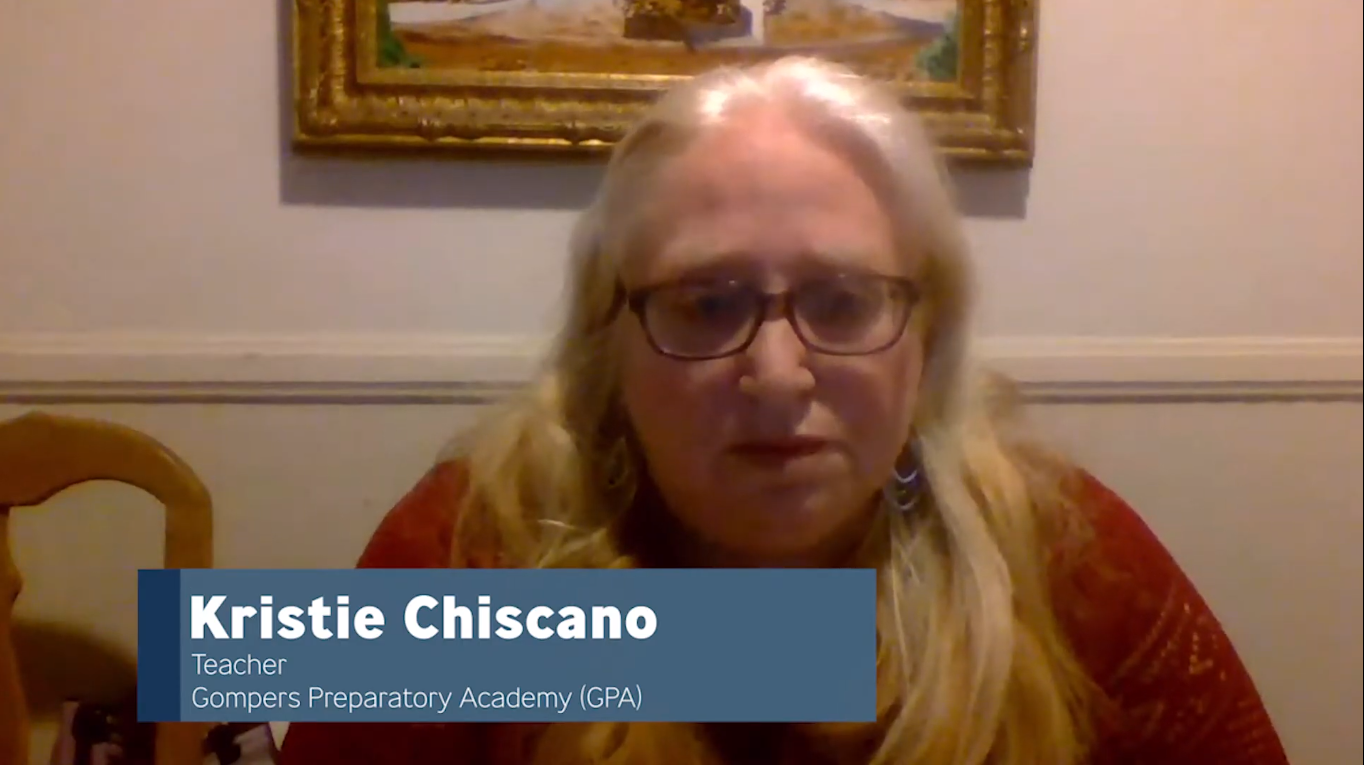
Kristie Chiscano kick-started the first effort at Gompers to remove the SDEA union. She witnessed firsthand that union control was ruining the independent nature of the charter school.
SAN DIEGO, CA – When San Diego Education Association (SDEA) union officials rose to power in 2019 at Gompers Preparatory Academy (GPA), educators and parents were rightfully concerned about what impact it would have on students’ progress and well-being.
Gompers had made an impressive transition to being a union-free charter school in 2005 after years of being plagued by unresponsive union bureaucracies, violence, high teacher turnover, and poor academic achievement. Teachers who feared that union monopoly control would allow such problems to creep back into Gompers quickly began an effort to vote out the union.
“I chose to work at a school that didn’t have a union, and now they’ve come in and they’re running everything about my contract and my work,” Kristie Chiscano, then a Gompers chemistry teacher and proponent of the decertification effort, said at the time.
While union stall tactics derailed Gompers educators’ 2019 effort to oust the union, Gompers educators didn’t give up. A majority of Gompers teachers backed another petition asking the California Public Employment Relations Board (PERB) for a vote to remove the union in 2023. Now, after years of legal maneuvers from union officials, Gompers educators have successfully ousted the SDEA with free legal aid from the National Right to Work Foundation.
SDEA Officials Used Spurious Charges to Block Earlier Teacher Effort
“There is definitely a lot more joy that’s going to be in classrooms now, instead of a burden with the union,” Cynthia Ornelas, a sixth grade Gompers teacher, told KPBS. “The union was making decisions for us, oh my goodness! We never knew what they were deciding because they didn’t communicate with teachers.”
Gompers teachers’ first effort to eliminate the SDEA union stemmed from an October 2019 petition that had the backing of a significant number of teachers, more than required by state law. However, SDEA union bosses averted the election by filing so-called “blocking charges” containing allegations of employer misconduct.
Union officials often manipulate “blocking charges” at the PERB and other state and federal labor relations agencies to stifle worker attempts to eliminate unpopular union “representation.”
As Foundation attorneys defended Gompers educators’ first petition, they also challenged a regulation requiring PERB agents and attorneys to accept union bosses’ “blocking charge” allegations as true. This regulation almost guarantees union defeat of any worker attempt to vote a union out.
Despite the PERB never holding a hearing into whether SDEA union bosses’ claims had any merit or whether they were related to the workers’ dissatisfaction with the union, PERB officials denied a decertification election to Gompers educators in October 2020.
Aside from legal maneuvers, union officials used intimidation and pressure to avoid being voted out. Chiscano and another Gompers educator filed charges maintaining that SDEA agents targeted them on social media for opposing the union hierarchy. California law makes it illegal for union officials to intimidate or retaliate against employees who exercise their right to refrain from union membership. Union-label California legislator Lorena Gonzalez, then an assemblywoman and now a top California AFL-CIO official, even wrote a screed to Gompers management that attacked the National Right to Work Foundation for simply providing legal aid to Gompers educators.
Teachers’ Long Struggle Exposes Massive Power of CA Public Sector Unions
Gompers educators submitted the March 2023 petition at the earliest time permitted by California labor regulations, which immunize union officials from employee-led decertification efforts for all but a tiny window while union contracts are active. Now, nearly four years after their original effort began, Gompers educators are finally free from union control.
“Gompers educators witnessed that SDEA union officials were not acting in the best interests of the students or the school community at large, and they fought courageously to bring back the independent environment that made Gompers a success,” commented National Right to Work Foundation President Mark Mix. “However, Gompers teachers shouldn’t have had to fight as long or as hard as they did simply to exercise their rights. No special interest group in California, or in America, should wield this kind of power over teachers and the public education system.
Support Staff at St. Christopher’s Hospital for Children Vote to Eject AFSCME Union Officials
Large unit of over 270 medical assistants, office coordinators, and others will now be free of union control
Philadelphia, PA (December 20, 2023) – Support staff at St. Christopher’s Hospital for Children in Philadelphia have successfully voted American Federation of State, County, and Municipal Employees (AFSCME) union officials out of power at their facility. The victory follows hospital employee Shidiah Jackson’s submission of a petition to the National Labor Relations Board (NLRB), which contained signatures from enough of her coworkers to trigger a union decertification vote under NLRB rules.
National Right to Work Foundation staff attorneys provided Jackson with free legal advice during the decertification process. The approximately 277-person work unit contains medical assistants, office coordinators, medical secretaries, and many other support employees, and the tally of ballots showed nearly 60% of those participating in favor of ousting AFSCME. The vote occurred on November 30, and the NLRB certified the results of the election earlier this month.
The NLRB is the federal agency responsible for enforcing federal labor law, which includes administering elections to install or remove unions. Under NLRB rules, a union decertification petition must contain the signatures of at least 30% of the employees at a workplace to trigger a decertification election.
If a majority of workers vote against a union in a decertification vote, the union is removed from the workplace and loses its monopoly bargaining power. Such power permits union officials to dictate the contract provisions of all employees in a unit, even those who oppose or voted against the union.
Because Pennsylvania lacks Right to Work protections for its private sector workers, AFSCME union bosses had the power to enter into contracts with hospital management that forced Jackson and her coworkers to pay union dues or fees just to keep their jobs. In contrast, in Right to Work states, union membership and all union financial support are strictly voluntary.
Healthcare Employees Across the U.S. Reject Union Control
“AFSCME union officials were taking money from many employees’ paychecks but didn’t advocate effectively for me or my colleagues,” Jackson commented. “I’m glad that we were able to exercise our right to remove the AFSCME, and I think we will be able to serve the hospital’s medical staff and patients better with the union gone.”
In Minnesota, support staff at Mayo Clinic in Austin are currently seeking to boot Steelworkers union officials from their facility as well. Foundation staff attorneys earlier this month filed an NLRB union decertification petition for patient care specialist Erin Krulish, which contains signatures from a majority of other support staff at the clinic. Krulish’s effort is the latest in a string of Foundation-backed union decertification efforts in the Gopher State, with nurses and support staff at Mankato’s Mayo Clinic and St. James Mayo Clinic nurses all voting successfully to remove unions in 2022 alone.
“It seems that American medical employees are discovering that union officials’ one-size-fits-all ‘representation’ doesn’t always work to their benefit, nor does it help them take better care of their patients,” commented National Right to Work Foundation President Mark Mix. “It’s easy to see why healthcare workers would want to avoid compulsory dues payments, or being ordered to strike and abandon their patients during a busy time.”
“Those in the healthcare industry should know that they have a right to petition the NLRB for a vote to remove a union, and that National Right to Work Foundation staff attorneys can assist them through this daunting process,” Mix added.
Right to Work Foundation Brief: 2018 Janus Decision Means Union “Release Time” Violates AZ Constitution’s Gift Clause
Brief supports challenge pending at Arizona Supreme Court against Phoenix’s scheme to subsidize inherently political union activities with tax dollars
Phoenix, AZ (December 14, 2023) – The National Right to Work Foundation has just filed an amicus brief in Mark Gilmore v. Kate Gallego, a case currently pending before the Arizona Supreme Court. In the case, Phoenix city employees Mark Gilmore and Mark Harder are suing Phoenix Mayor Kate Gallego for engaging in a scheme that redirects taxpayer funds intended for public employees’ compensation toward political advocacy conducted by American Federation of State, County and Municipal Employees (AFSCME) Field II agents on so-called “release time.”
Specifically, the plaintiffs’ lawsuit argues the Arizona Constitution prohibits the use of taxpayer dollars to fund four full-time positions for union officials for the purpose of conducting union business, in addition to a bank of over 3,000 paid hours to be used by other union officials for union purposes, and multiple other perks for union agents.
The Foundation’s brief argues that the release time scheme violates Arizona’s Gift Clause, which forbids government transactions that bestow benefits on private entities while serving no public purpose. The brief points out that the U.S. Supreme Court’s ruling in the Foundation-won Janus v. AFSCME case demonstrates that, under the First Amendment, all government union activities are a form of lobbying designed to influence public policy for the benefit of the union. That means taxpayer subsidies of such activities inherently violate the Arizona Constitution’s Gift Clause.
Brief: “Release Time” Funnels Tax Dollars Unconstitutionally to Union Bosses
The policies unions lobby for “often are matters of substantial public concern, such as how much money the government expends on wages and benefits,” the brief reads. “With its release time policy, the City is effectively paying individuals to lobby the City for a private advocacy organization and its members. The notion that this political advocacy serves a public purpose is untenable.”
In the Janus decision, the U.S. Supreme Court ruled that forcing public sector workers to fund any union activities as a condition of employment constitutes forced political speech barred by the First Amendment.
The Foundation’s brief also deconstructs a proposition that the City of Phoenix’s ability to impose one-size-fits-all union contracts on entire swaths of employees somehow counts as a “public benefit” that the City receives in exchange for enforcing the release time scheme. Foundation attorneys instead argue that the municipal labor code already imposes this obligation on both the union and the City, and thus isn’t a benefit that union bosses are giving the City.
“Given the code already requires the City and AFSCME to impose uniform terms of employment on unit employees, union member and nonmember alike, it necessarily follows that the City did not need to provide AFSCME agents with release time to comply with its pre-existing legal obligations,” the brief contends.
“Union bosses, who will often screech about ‘corporate welfare,’ are more than happy to arrange so-called ‘release time’ schemes in which taxpayer dollars are funneled toward supporting their massive lobbying efforts,” stated National Right to Work Foundation President Mark Mix. “Janus made it plain and simple that compelling public sector employees to fund union activities constitutes forced political speech, and the Arizona Supreme Court has an obligation to declare unlawful compulsion foisted on taxpayers.”
L’Oréal Employee Hits Union with Federal Charges for Illegal Dues Deductions, Threats for Seeking to Oust Union
According to charge, union agent threatened: “The union is like a big mafia…something bad is going to happen to you”
Piscataway, NJ (December 6, 2023) – Piscataway L’Oréal USA employee Ana Maria Hoyos Lopez has slammed the Retail, Wholesale, and Department Store Union (RWDSU/UFCW) Local 262 with federal charges, which assert that RWDSU made illegal threats against her for opposing the union. She filed the charges at Region 22 of the National Labor Relations Board (NLRB) with free legal aid from National Right to Work Foundation staff attorneys.
In September, Hoyos Lopez submitted a petition to the NLRB in which she and her coworkers requested a vote to remove the union (or “decertification vote”). She asserts in her charges that union agents targeted her as she was circulating the petition. In particular, Hoyos Lopez stated that a L’Oréal employee told her on September 6, 2023, that “the union is like a big mafia” and “something bad is going to happen to you if the union leaves.”
Hoyos Lopez’s charges also recount a September 22 union meeting in which union officials, including the RWDSU Local 262 President and shop steward, shouted her and other employees down after they brought up shortcomings in the union’s performance. The union officials demanded the pro-decertification employees leave the union’s meeting.
Even after Hoyos Lopez and other employees voluntarily departed the meeting, the charges state, the union president “chased after” Hoyos Lopez and threatened to call the police on her if she did not completely leave the public park in which the meeting took place. The charges also state that union officials approached pro-decertification L’Oreal employee Jarry Moreno at the same meeting and told him to convince Hoyos Lopez to withdraw the petition.
Hoyos Lopez’s charges indicate that she experienced more illegal activity than just intimidation from union agents. RWDSU union officials also refused to honor or respond to emails she sent resigning her union membership and opting out of dues payments for union political expenses. New Jersey lacks Right to Work protections for its private sector employees, and thus allows union officials and management to enforce contracts in which workers are forced to pay union fees as a condition of getting or keeping a job. However, the Foundation-won CWA v. Beck Supreme Court decision guards workers from being forced to pay any dues that go toward union politics or other expenses unrelated to the union’s bargaining functions.
“As such, RWDSU/UFCW Local 262 must honor [Hoyos Lopez’s] resignation request, and given there is no collective bargaining agreement in place, cease all further deductions from [her] paycheck,” the charges state.
Illegal Union Threats Continue After Contested Election
The election to decertify RWDSU, which took place October 19 and 20, is currently the subject of objections from Hoyos Lopez. The objections assert that union officials unlawfully interfered with the election through their intimidating actions during the September 22 meeting, as well as through campaign misrepresentations and racially-charged tactics.
Hoyos Lopez’s federal charges, which she filed after submitting her election objections, state that employees she believed were acting on behalf of the union targeted her after she attempted to defend the integrity of the election. On November 27, “a L’Oréal contractor…intimidated [Hoyos Lopez]” and told her that “people say you have to leave because you have problems with the union.”
The charges argue that all of these actions by RWDSU union officials and alleged union agents are clear violations of Hoyos Lopez’s rights under Section 7 of the National Labor Relations Act (NLRA), the federal law the NLRB is charged with enforcing. Section 7 protects workers’ right to refrain from union activities.
“It appears abundantly clear that RWDSU union officials at the L’Oréal USA plant leveraged threats, intimidation, and a host of other divisive tactics in order to demonize any worker who went against their agenda,” commented National Right to Work Foundation President Mark Mix. “The union’s focus was clearly on maintaining their forced-dues power over L’Oréal employees, even at the expense of steamrolling the rights of the workers they claim to ‘represent’ – they were deprived of a fair election, and couldn’t even voice legitimate concerns about the union without fear of retaliation.”
“Foundation staff attorneys will continue to fight for Ms. Hoyos Lopez and her coworkers until they can exercise their right to vote on whether RWDSU bosses deserve to stay in a free and uncoerced environment,” Mix added.
Buffalo Starbucks Baristas Blast National Labor Relations Board’s Move to Trap Workers in Union at Court of Appeals
NLRB lawyers claim workers’ opposition to union “justifies” union being imposed on unwilling employees
Buffalo, NY (November 28, 2023) – Ariana Cortes and Logan Karam, Starbucks partners in the Buffalo area, have just filed an amicus brief in the Second Circuit Court of Appeals case Leslie v. Starbucks Corp. In the case, NLRB officials are attempting to prosecute Starbucks for misconduct alleged by SEIU-affiliated Workers United union officials. The NLRB cites a petition that Cortes and her coworkers filed seeking a vote to remove the union as a reason why Starbucks management should be subjected to a court-ordered injunction.
Cortes and Karam, who are represented for free by National Right to Work Legal Defense Foundation staff attorneys, challenge this legal maneuver in their brief. The employee’s brief argues that the NLRB’s strategy treats workers as if they have no agency of their own and have no independent reasons for wanting to get rid of a union.
“Given the biases of the current Board, it is disheartening ― but not surprising ― to see the NLRB claim Cortes’ petition is the product of Starbucks’ alleged unfair labor practices,” the brief states. “Its own records show that nothing could be further from the truth. In reality, Cortes collected her petition because of the Union’s anti-employee behavior.”
The employees’ brief also contends that the relief NLRB lawyers are seeking from the Second Circuit – a 10(j) injunction under the National Labor Relations Act (NLRA) that will force Starbucks managers into working with SBWU union bosses to craft a monopoly bargaining contract – is extreme. Such injunctions can only be ordered when the harm done to workers in their absence would be “irreparable.” Foundation attorneys argue that the fact that Cortes and other employees have attempted to decertify does not make any injuries suffered by the union “irreparable.”
“The NLRB’s argument it needs an injunction to suppress decertification efforts already underway―which have already garnered majority support―is a tacit admission it is seeking to alter the status quo, not preserve it,” states the brief.
Cortes is also receiving Foundation legal aid in a case challenging the constitutionality of the NLRB’s structure. That case, currently pending at the D.C. District Court, argues that the structure of the NLRB is unconstitutional.
Dangerous Precedent Set If Court Grants Anti-Worker Injunction
If the Second Circuit grants the NLRB’s request for an injunction on behalf of SBWU union bosses, it would be the first time that a federal court has ordered a Starbucks store to engage in bargaining with union bosses on the basis of an employee’s decertification petition. This would be a horrendous precedent for independent-minded Starbucks workers across the country.
Starbucks workers all across the country have submitted decertification petitions seeking votes to remove SBWU union bosses, including at least nine groups of employees who are utilizing free Foundation legal aid. The NLRB would be able to use the federal court precedent to make the dubious argument that union bargaining should be mandated simply because employees want a chance to oust the union.
“The NLRB is digging an even deeper grave for employees trying to exercise their rights to remove an unwanted union from their workplace,” commented National Right to Work Foundation President Mark Mix. “The Board’s attempt to twist employees’ desire to exercise their right to throw out a union into a reason to force a union upon them is a new low.”
“Ariana Cortes and Logan Karam are taking a courageous stand to ensure their coworkers aren’t disenfranchised and trapped under a union hierarchy they oppose, and we’re proud to support them,” Mix added.





