
Full Foundation Action September/October Newsletter Now Online
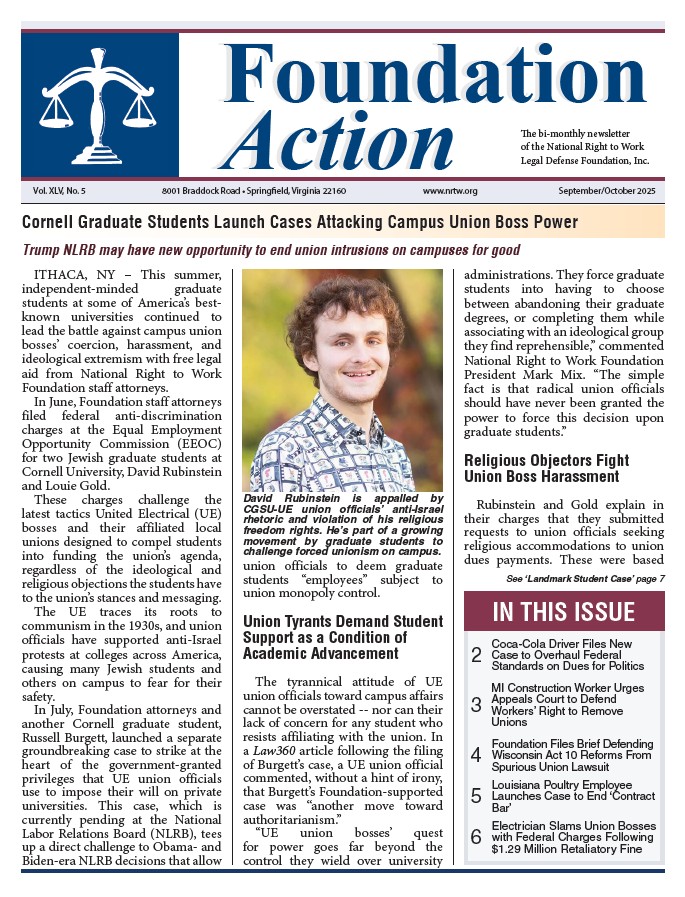
All articles from the September/October issue of Foundation Action are now online.
In this issue:
- Cornell Graduate Students Launch Cases Attacking Campus Union Boss Power
- Coca-Cola Driver Files New Case to Overhaul Federal Standards on Dues for Politics
- MI Construction Worker Urges Appeals Court to Defend Workers’ Right to Remove Unions
- Foundation Files Brief Defending Wisconsin Act 10 Reforms From Spurious Union Lawsuit
- Louisiana Poultry Employee Launches Case to End ‘Contract Bar’
- Electrician Slams Union Bosses with Federal Charges Following $1.29 Million Retaliatory Fine
- Join Today to End Forced Unionism in the Workplace
Recent articles can be found here. To sign up for a free copy of the newsletter via mail please see the form at the bottom of the page.
Full Foundation Action November/December Newsletter Now Online
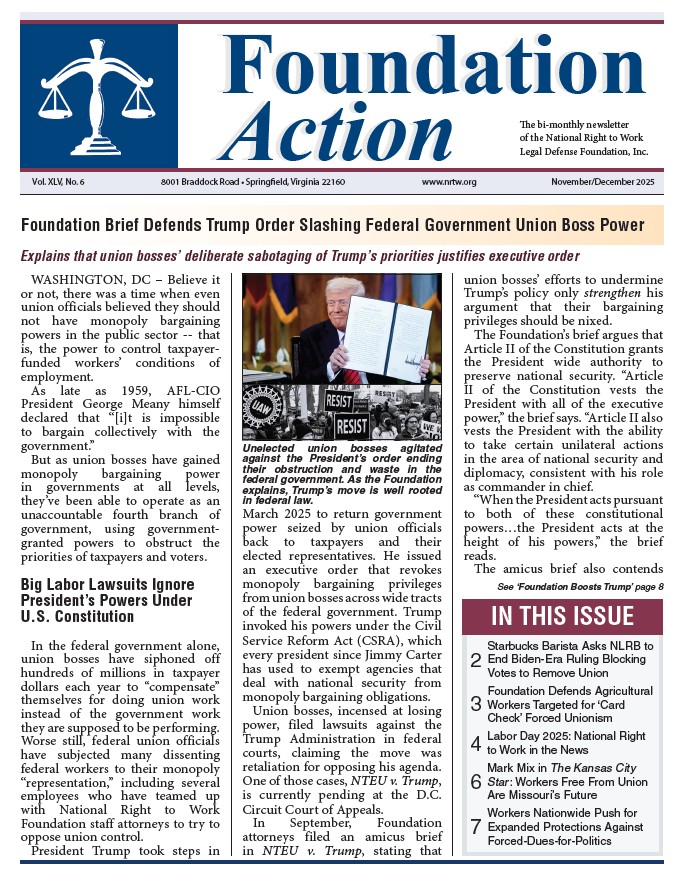
All articles from the November/December 2025 issue of Foundation Action are now online.
In this issue:
- Foundation Brief Defends Trump Order Slashing Federal Government Union Boss Power
- Starbucks Barista Asks NLRB to End Biden-Era Ruling Blocking Votes to Remove Union
- Labor Day 2025: National Right to Work in the News
- Dispensary employees free from a union are the future for Missouri
- Workers Nationwide Push for Expanded Protections Against Forced-Dues-for-Politics
Recent articles can be found here. To sign up for a free copy of the newsletter via mail please see the form at the bottom of the page.
Electric Utility Worker Asks Trump NLRB to Prosecute IBEW’s Restrictive Policies That Compel Workers to Fund Union Politics
Electric utility worker asks NLRB General Counsel to seek Board ruling against union policies that force nonmembers to fund union political spending
Benson, MN (September 23, 2025) – Theresa Klassen, an employee of Agralite Electric Cooperative, is asking the National Labor Relations Board (NLRB) to expedite consideration of Big Labor schemes that force workers to pay dues for union political activities. Klassen has filed an appeal with the NLRB’s Acting General Counsel, asking him to issue a complaint in her case after an NLRB Regional Director let International Brotherhood of Electrical Workers (IBEW) union officials off the hook for violating her rights. Klassen is receiving free legal aid from National Right to Work Foundation staff attorneys.
Klassen originally filed charges against both the IBEW international union and IBEW Local 160 to defend her rights under Communications Workers of America v. Beck. In this Foundation-won landmark U.S. Supreme Court decision, the Court ruled that union officials cannot force workers who abstain from membership to pay dues for anything beyond the union’s monopoly bargaining functions – including politics.
Even though Klassen successfully resigned her union membership, union bosses continued to demand full dues payments from her – including dues for union political expenditures. When she invoked her Beck rights with assistance from Foundation staff attorneys, union bosses then claimed that she could only opt out of dues payments for politics within a narrow 30-day “window period” each year in the month of November.
Brief: IBEW Union Clearly Violating National Labor Relations Act
Klassen’s appeal argues that it would violate the National Labor Relations Act (NLRA) “for a union to demand payment for any dues beyond what Section 8(a)(3) requires unless that employee affirmatively consented to pay full union dues.” Under the Beck decision, Section 8(a)(3) only permits union bosses to demand dues for union expenses that are directly related to bargaining.
Now, Klassen is asking the NLRB to uphold this interpretation and end all opt-out requirements, so that union officials must obtain explicit permission from employees to take payments for non-bargaining-related functions, including union political and lobbying activities.
Klassen is also asking the NLRB to end window period practices for becoming Beck objectors, as they similarly violate the NLRA by preventing workers from exercising their rights. Window period restrictions on when employees can exercise their Beck rights allow union officials to extract money from workers after they’ve already objected to financially supporting union political activities.
“The IBEW should be respecting my rights, not throwing up roadblocks so they can continue to use my paycheck dollars to fund their own agenda,” said Klassen. “The NLRB needs to recognize that union officials are violating the law; otherwise, these rights are not rights at all.”
Union Officials Use Restrictive Policies to Consolidate Power
Because Minnesota lacks Right to Work protections for its private sector workers, IBEW union officials can impose contracts that force Klassen and her coworkers to pay union dues as a condition of keeping their jobs, though this amount is limited by the Beck decision. In contrast, in Minnesota’s neighboring Right to Work states, union officials cannot force workers to pay any dues or fees just to keep their jobs.
“Free association is a right of every American, including workers who don’t want to associate with a union,” commented National Right to Work Foundation President Mark Mix. “It’s telling that IBEW officials are using a legally suspect policy to make it needlessly difficult for workers to stop supporting the union’s political activities.
“While the NLRB General Counsel should urge the agency to address these illicit schemes swiftly, ultimately Minnesotans and all Americans deserve Right to Work protections, which would make all union financial support strictly voluntary,” Mix added.
Columbia GRADS (Graduate Researchers Against Discrimination and Suppression) Hit UAW Union With Federal Labor Board Charges
Graduate student group argues union bosses are illegally using bad faith bargaining to demand political concessions from Columbia administration
New York, NY (September 22, 2025) – The Graduate Researchers Against Discrimination and Suppression (GRADS), a group of graduate students at Columbia University, has just filed federal charges against officials of the Student Workers of Columbia, a union on campus affiliated with the United Auto Workers (UAW). GRADS filed its charges at the National Labor Relations Board (NLRB) with free legal representation from National Right to Work Legal Defense Foundation staff attorneys.
The members of GRADS, who have requested anonymity due to widespread harassment stemming from union agitation on campus, are charging the union with abusing its monopoly bargaining powers. They contend that union officials are bargaining in bad faith to extract concessions from the university on a number of radical policy proposals, instead of focusing on improving graduate students’ academic and research environment.
The NLRB’s controversial 2016 decision in Columbia University categorized graduate students at private universities as “employees” subject to federal labor law. In doing so, the Obama NLRB granted union bosses the ability to launch campus unionization campaigns and gain monopoly bargaining power over graduate students. Under monopoly bargaining, every employee in a work unit must accept the workplace “representation” of union bosses, even if they voted against the union or disagree with its agenda.
While federal law conditions union bosses’ monopoly bargaining powers on a nebulous “duty of fair representation,” union officials often ignore this duty and discriminate against those who oppose the union’s control.
Charges: UAW Union Demands University Take Action Against Israel, Crack Down on Police
GRADS’ charges list a number of outrageous bargaining items from UAW union officials, including: “proposals to force Columbia to limit campus police, security, and NYPD from doing their jobs;” “bargain[ing] over…so-called ‘Boycott, Divest & Sanction’ policies…of the entire university;” “termination of a dual-degree program between Columbia and Tel Aviv University;” and undoing discipline for students who have been suspended for “destroy[ing] campus property and disrupt[ing] the unit’s working conditions for extended periods.”
“These and similar actions constitute bad faith bargaining…and violate the duty of fair representation that respondent union owes to all represented graduate students,” the charges state.
Foundation attorneys are defending a number of other graduate students who seek to resist the radical – and often discriminatory – ways that union officials are wielding their monopoly bargaining powers on campus. Foundation attorneys are currently representing Jewish students at Cornell University in challenging the CGSU-UE union’s failure to respect their rights as religious objectors to union affiliation. Another Cornell student is pursuing a Foundation-backed case attacking union officials’ bargaining powers granted in the questionable 2016 Columbia University ruling.
“Far from facilitating a more harmonious relationship between graduate students and the Columbia administration, UAW union bosses are simply ramping up radical extremism at a university that has already seen more than its share of chaos,” commented National Right to Work Foundation President Mark Mix. “While it’s wrong from the start that any student is forced to accept union boss ‘representation’ they oppose, it’s even less acceptable that UAW union officials are trying to use their monopoly bargaining privileges to enforce their divisive politics on the entire campus, including undergraduate students.”
Kentucky Construction Industry Workers File Petitions to Oust Teamsters Local 89 Union from their Workplaces
IMI – Irving Materials drivers already free of Teamsters officials’ so-called “representation” while Builders FirstSource workers await vote
Scottsville & Louisville, KY (September 22, 2025) – Chris Smith, an employee of IMI Kentucky in Scottsville, KY, and Kenneth Moore, an employee of Builders FirstSource in Louisville, KY, each filed petitions seeking to end Teamsters Local 89 union officials’ “representation” at their respective workplaces. IMI workers already secured victory in their effort to remove the Teamsters, while the effort to remove the Teamsters at Builders FirstSource is still ongoing.
Both Smith and Moore filed their petitions with the National Labor Relations Board (NLRB) with free legal aid from National Right to Work Foundation staff attorneys. The NLRB is the federal agency tasked with enforcing federal labor law and with adjudicating disputes between employers, unions, and individual workers. Workers are able to initiate an election administered by the NLRB if their petition gathers the signatures of 30% or more of their fellow employees.
Smith and Moore’s respective petitions garnered the necessary signatures from their coworkers to trigger an NLRB-administered secret ballot election to vote on the Local 89’s continued control. After employees demonstrate sufficient support for a decertification, in most cases the NLRB will schedule a secret ballot election. That process is ongoing for the employees of Builders FirstSource in Louisville.
However, in Smith’s case the employee support for removing the union was so overwhelming that Teamsters union bosses decided to save themselves the humiliation of being formally voted out, and instead disclaimed their status as the workers’ “exclusive representative” the very same day Smith’s petition was filed. The next day the NLRB Regional Director certified that the employees are officially free of Teamsters Local 89.
The employees at IMI Kentucky and Builders FirstSource join a long list of workers who have recently banded together to remove the Teamsters from their workplaces. In fact, NLRB statistics for the past 12 months show that over 20% of all decertification cases involved the Teamsters union.
“More and more, American workers across the country are deciding they are better off without Teamsters union bosses who prioritize their own interests over that of the workers they claim to ‘represent,’” stated National Right to Work Foundation President Mark Mix. “As Teamsters bosses attempt to cozy up to those in the halls of power, elected officials should remember that despite the claims of dishonest union bosses, union officials do not speak for the workers under their so-called ‘representation,’ many of whom would like to remove the Teamsters if given the choice. In fact, statistics show that over 90% of employees have never had a vote on the union that purports to represent them.
“That one in five decertification petitions filed last year involved the Teamsters only drives home the point that workers are increasingly rejecting union bosses’ coercive agenda,” added Mix.
National Right to Work Foundation Files Appeals Court Brief in Support of Trump Order Cutting Federal Union Bosses’ Coercive Power
Brief emphasizes President’s authority under both Constitution and federal law to reduce scope of union monopoly bargaining control
Washington, DC (September 18, 2025) – The National Right to Work Foundation has filed an amicus brief at the D.C. Circuit Court of Appeals defending the Trump Administration’s efforts to reduce union bosses’ control within the federal government. The Foundation filed its brief in the case NTEU v. Trump, in which National Treasury Employees Union (NTEU) officials are attacking President Trump’s March 2025 executive order titled “Exclusions from Federal Labor-Management Relations Programs”. That order ended union officials’ monopoly bargaining privileges over a substantial number of federal agencies, citing union officials’ interference with the President’s national security objectives.
“Since 1968, the National Right to Work Legal Defense Foundation, Inc., has been the nation’s leading advocate for employee freedom to choose whether to associate with unions,” the brief says. “To this end, Foundation staff attorneys have represented individual employees before the Supreme Court in groundbreaking free speech and association cases.”
The brief explains that Foundation attorneys have represented many federal employees in resisting union bosses’ attempts to impose their agenda in the workplace. Such workers include Department of Justice employee Jeffrey Morrison, whose ongoing case challenging unionization campaigns in various divisions of the Department has been granted and stayed pending the result of NTEU v. Trump.
Lower Federal Court Used Flawed Interpretations of Federal Law to Rule Against Trump EO
The Foundation’s brief argues that a lower federal court was wrong to enjoin President Trump’s cancellation of monopoly bargaining in certain agencies. The brief explains that Article II of the Constitution grants the President wide authority to preserve national security. Furthermore, the brief says, in the Civil Service Reform Act (CSRA), Congress granted the president specific powers to exempt entire agencies from the obligation to accept union boss bargaining power if national security concerns require it.
“This statutory provision authorizes the President to exclude ‘any agency or subdivision thereof’ if the President determines [CSRA] Section 7103(b)(1)’s conditions are met,” the brief says. “The President’s determination that certain agencies or their subdivisions satisfy Section 7103(b)’s criteria is not subject to judicial review.”
The amicus brief also contends that the Trump Administration was justified in reconsidering which agencies should be exempt from monopoly bargaining requirements, primarily due to union officials’ unabated attempts to undercut Trump’s policy goals. “The District Court found the President’s exclusions under Section 7103(b) to be invalid because they supposedly were motivated by NTEU’s and other unions’ resistance to the administration’s policies,” the brief explains. “However, this proposition supports a finding that the President acted reasonably when determining that being forced to deal with NTEU as an exclusive bargaining agent at certain federal agencies would interfere with national security considerations.
“[T]he President does not have to tolerate unions abusing their powers under [federal law] to stymie his agenda when it may implicate national security,” the brief states.
Unaccountable Union Bosses Should Not Wield Special Influence Over Government Policies
“President Trump’s executive order rightly stops union officials from using their government-granted monopoly bargaining privileges to undermine the national security objectives that voters put President Trump into office to accomplish,” commented National Right to Work Foundation President Mark Mix. “The DC Circuit Court should not let union bosses commandeer the levers of the executive branch in violation of both the Constitution and longstanding federal law.
“However, Trump’s executive order should be the first step toward eliminating union bosses’ monopoly bargaining privileges throughout the whole federal government,” Mix added. “Such power gives unelected union bosses control over the services that American citizens fund with their taxes and elect representatives to oversee. It also forces federal employees – many of whom have never even voted for the union in their workplace – to accept workplace ‘representation’ from union bosses that they may bitterly disagree with.”
Vanderbilt Grad Students Free From Aggressive UAW Campaign
The following article is from the National Right to Work Legal Defense Foundation’s bi-monthly Foundation Action Newsletter, March/April 2025 edition. To view other editions of Foundation Action or to sign up for a free subscription, click here.
Foundation-assisted students challenged union-backed NLRB demand for private info

Notorious UAW President Shawn Fain saw his union rebuffed by many Vanderbilt students concerned about the union’s intrusive organizing methods. Facing legal and political headwinds, UAW bosses dropped their campaign.
NASHVILLE, TN – Union monopoly bargaining creates barriers to freedom for people across the country. It requires workers to accept self-motivated union bosses as their sole “voice” on issues in their workplace. But, in the private sector, it’s unfortunately the law of the land.
That’s not as clear when it comes to colleges and universities. Although the National Labor Relations Board (NLRB) under President Obama upended existing precedent to dubiously let union officials impose monopoly arrangements on graduate students — a ruling continued by the Biden NLRB — the Family Educational Rights and Privacy Act (FERPA) generally bans universities from sharing student information without student permission. This puts FERPA and federal labor law at odds, as such information is something employers are required by the NLRB to produce during a unionization campaign.
After the United Auto Workers (UAW) union launched a campaign in late 2024 to sweep Vanderbilt University’s graduate students under their monopoly power, NLRB officials required the college to fork over the info of thousands of students. But three courageous students stood up with free legal aid from the National Right to Work Legal Defense Foundation, arguing that disclosure without any procedure violated their privacy rights under FERPA.
Now, union officials have backed down and withdrawn the entire union campaign at the college. The three students and others are free from being forced into UAW union monopoly ranks and from the disclosure of their FERPA-protected information.
“The withdrawal of UAW organizers’ petition seeking a vote to unionize us against our will is a welcome victory for us in our defense of our rights and the rights of our fellow graduate students,” commented one of the Foundation-assisted Vanderbilt graduate students, identified as Jane Doe 1 in legal filings to protect her identity.
Students: FERPA Lets Us Protect Private Info From Unionization Scheme
The students’ effort to protect their privacy began in October 2024, when two students identified in filings as John Doe 1 and John Doe 2 moved to intervene in the NLRB case. They argued that FERPA’s language permits students to seek “protective action” if a university receives a subpoena seeking their personal information, as Vanderbilt had from the NLRB. A regional NLRB official denied their motion to intervene. Foundation attorneys submitted an emergency appeal for John Doe 1 and John Doe 2 to the NLRB in Washington, DC, emphasizing that the students needed an opportunity to “address the serious privacy issues raised by the Region’s subpoena.”
Foundation attorneys additionally filed an updated motion to intervene that included Jane Doe 1 as another student seeking to intervene in the case. Several other graduate students also submitted less-formal objections urging the agency not to enforce a subpoena divulging their private information. The District Court for the Middle District of Tennessee issued a ruling on November 22, 2024, temporarily releasing Vanderbilt from its obligation to comply with the NLRB subpoenas. A few weeks later, UAW union officials announced they were withdrawing their petition to unionize Vanderbilt graduate students, meaning the subpoenas seeking student information are effectively null and void.
Foundation Fights Union Malfeasance at Colleges Nationwide
Meanwhile, Foundation attorneys are assisting graduate students at Dartmouth and MIT with fighting attempts by United Electrical (UE)- affiliated unions to demand dues payments from students against their will and in violation of their rights. Kara Rzasa, a Dartmouth graduate student, and Michael Fernandez, an MIT graduate student, have each hit UE local and national affiliates with charges for illegal polices UE officials are utilizing nationwide when demanding forced dues payments.
“While we’re happy that the private information of Vanderbilt grad students is now secure, it’s clearer than ever that the biased NLRB decisions granting union bosses the ability to foist union monopolies over graduate students were wrong,” commented National Right to Work Foundation Vice President and Legal Director William Messenger. “In Foundation cases, we’ve seen union bosses put students’ academic freedom, religious freedom, and privacy protections all at risk, which is why the new appointees to the NLRB need to clarify that students are off-limits to union monopoly power schemes.”
More Minnesota Nurses Send MNA Union Bosses Packing
The following article is from the National Right to Work Legal Defense Foundation’s bi-monthly Foundation Action Newsletter, March/April 2025 edition. To view other editions of Foundation Action or to sign up for a free subscription, click here.
Politics-motivated union faces string of successful decertification votes in Minnesota

Brittany Burgess (front, center) and her coworkers at Mayo Clinic’s Mankato, Minnesota, branch sparked a wave of Foundation-backed efforts across Minnesota to declare independence from union bosses, with the most recent success in Fairmont, Minnesota.
FAIRMONT, MN – In 2022, then-President of the Minnesota Nurses Association (MNA) union Mary Turner expressed to the Minnesota Reformer her ambition to continue pushing the MNA’s political agenda in the Minnesota state legislature and eventually vie for the presidency of the National Nurses United (NNU) union, MNA’s parent.
The NNU is also known for its ardent political activity — in 2016, the union’s super PAC spent roughly $1 million on promoting self-proclaimed socialist Bernie Sanders for president.
When asked whether the union’s politics played a role in the fact hundreds of nurses, backed by the National Right to Work Foundation, had just voted MNA union bosses out of power at Mayo Clinic in Mankato, Minnesota, Turner had this to say: “They’re going to have to prove to us that they want the union because they lost it.”
Fast-forward to 2025, and the MNA’s obsession with politics hasn’t changed — and neither has nurses’ opposition to the alienating nature of the union. This January, with free Foundation legal aid, nurses at Mayo Clinic’s Fairmont, Minnesota, location voted by over 60% to remove MNA union officials from their facility.
“The MNA was a very divisive force in our workplace, and I think we’ll be able to better serve our patients and the community without the union,” commented nurse Jamie Campbell on the vote.
Foundation Backs Another Grassroots Effort to Nix MNA
Campbell kick-started the union removal effort by submitting a petition to the National Labor Relations Board (NLRB) in December 2024 requesting a union decertification vote.
The NLRB is the federal agency responsible for enforcing federal labor law, which includes administering elections to install (or “certify”) and remove (or “decertify”) unions. Campbell’s union decertification petition contained well over the number of employee signatures needed to trigger a decertification vote under NLRB rules.
Because Minnesota lacks Right to Work protections for its private sector workers, MNA union officials had the legal power to require all the Fairmont Mayo nurses to pay at least a portion of union dues as a condition of keeping their jobs. In contrast, in Right to Work jurisdictions, union membership and all union financial support are voluntary and the choice of each individual worker.
However, in both Right to Work and non-Right to Work states, union officials are able to impose one-size-fits-all contracts on all employees in a work unit, even those who voted against or otherwise oppose the union.
Fairmont Victory Follows Others in Mankato, St. James
The election took place in January, and within a week, the NLRB certified the nurses’ successful ouster of the union.
Since 2022, several sizable units of healthcare workers in Minnesota have sought out Foundation legal aid to obtain removal votes against the MNA and other unions, and have often been successful in freeing themselves. After Mankato Mayo Clinic nurses voted MNA out, nurses at Mayo’s St. James branch did the same with AFSCME Council 65 in August 2022. Support staff at the Mankato facility kicked out American Federation of State, County, and Municipal Employees (AFSCME) Local 1856 union officials in 2023.
“MNA union bosses’ influence and political connections did not shield them from suffering another defeat by rank-and-file nurses at the ballot box,” commented National Right to Work Foundation Vice President Patrick Semmens.
“Ironically, Minnesota’s lack of Right to Work protections — which are vociferously opposed by the MNA — likely removed an important accountability tool from the relationship between the MNA and the nurses they claim to ‘represent.’ It’s no surprise that union bosses who can force workers to pay union dues or fees on pain of termination wind up being far less effective and more out-of-touch than union officials who must earn the voluntary financial support of each worker.”
Full Foundation Action July/August Newsletter Now Online
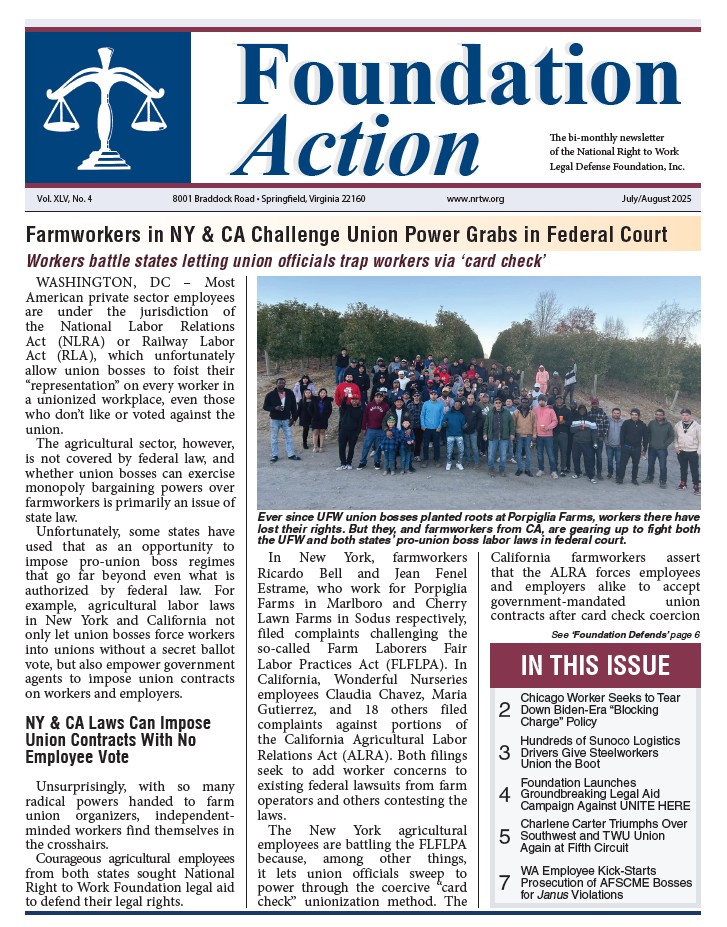
All articles from the July/August 2025 issue of Foundation Action are now online.
In this issue:
- Farmworkers in NY & CA Challenge Union Power Grabs in Federal Court
- Chicago Worker Seeks to Tear Down Biden-Era ‘Blocking Charge’ Policy
- Hundreds of Sunoco Logistics Drivers Give Steelworkers Union the Boot
- Foundation Launches Groundbreaking Legal Aid Campaign Against UNITE HERE
- Charlene Carter Triumphs Over Southwest and TWU Union Again at Fifth Circuit
- WA Employee Kick-Starts Prosecution of AFSCME Bosses for Janus Violations
Recent articles can be found here. To sign up for a free copy of the newsletter via mail please see the form at the bottom of the page.





