
National Right to Work Foundation In the Wall Street Journal: “Trapped by the Teamsters”
Recently the Wall Street Journal published a piece by National Right to Work Legal Defense Foundation President Mark Mix titled “Trapped by the Teamsters.”
The op-ed describes the numerous NLRB policies, doctrines and “bars” workers across the country face when merely attempting to hold a vote to oust Teamsters bosses and other union officials as their monopoly bargaining so-called “representative.” The article illustrates these coercive policies through recent examples faced by workers who have turned to the Foundation for free legal aid:
A majority of workers at a Wisconsin trucking company experienced this over the past two years. First, they were blocked from removing their union by the so-called voluntary-recognition bar. This stops workers from decertifying a union for up to a year after the union is installed through “card check”—a procedure that avoids the need for a secret ballot and makes workers vulnerable to union intimidation.
Then, after waiting a year for that bar to expire, the Wisconsin workers found they had been merged by Teamsters officials into a multicompany nationwide bargaining unit of about 24,000 workers. Suddenly the petition to oust the local union was 7,000 signatures short—for a workplace with fewer than 10 union workers. Last month the NLRB declined the Wisconsin workers’ appeal, though a majority of voting board members signaled they would revisit the “merger doctrine” policy in the future.
Other workers face other hurdles: The “settlement bar” blocks a decertification vote because of an NLRB settlement to which the workers weren’t a party; the “successor bar” blocks a vote for up to a year after a company is acquired; the “contract bar” blocks a vote for up to three years after a union contract is forged; and a “blocking charge” blocks a vote while union allegations against a company are pending. None of these are required by law.
The NLRB is addressing the voluntary-recognition bar and blocking charges through the current rule-making process, but the other policies are similarly destructive of workers’ legal right to vote out a union that lacks majority backing. Congress should act to protect workers from being trapped in union ranks they oppose, but in the meantime the NLRB has the authority to eliminate these barriers.
Union officials unable to win the support of a majority of the workers they purport to represent shouldn’t maintain power solely because of bureaucratic rules. Instead, whenever enough workers file a petition to remove a union they oppose, the NLRB should simply let them vote.
Read the whole piece here.
Flint-Area Nurse Hits Teamsters Union Bosses and Genesys Hospital with Lawsuit for Violating Michigan’s Right to Work Law
State court lawsuit: Teamsters union bosses and Genesys Regional Medical Center illegally rejected six different requests by nurse to end union dues deductions
Flint, MI (December 17, 2019) – With free legal aid from the National Right to Work Legal Defense Foundation, Flint-area nurse Madrina Wells has sued the Teamsters Local 332 union, after union bosses illegally demanded she pay them union fees as a condition of keeping her job. Her employer, Genesys Regional Medical Center, is also named as a defendant in the lawsuit for seizing union fees from her paycheck at the behest of Teamsters officials. Wells’ lawsuit, filed in state court, says that both actions violate her rights under Michigan’s Right to Work law.
According to the complaint filed in Genesee County Circuit Court, Wells resigned her union membership in February 2018 and requested that Teamsters officials cease all dues deductions from her paycheck in December of the same year. Notwithstanding her request, Teamsters bosses sent her a letter in January 2019 demanding that she pay them nonmember “agency fees” after she returned from a stint on medical leave, which she had begun in December 2018.
Though a reduced amount of union dues is legally chargeable to private sector employees who abstain from formal union membership in non-Right to Work states, in Right to Work states like Michigan no public or private sector employee is required to pay any amount of union fees as a condition of employment.
When Wells resumed work in July 2019, the complaint notes, she sent Teamsters officials another notice “renewing her objection” to tendering any dues or fees whatsoever to the Teamsters hierarchy. Teamsters bosses again rebuffed her request, insisting that she was required to pay them a portion of union fees as a condition of employment.
According to the complaint, Teamsters officials subsequently demanded forced fees from Wells for July through December of 2019, all in clear violation of her rights under Michigan’s Right to Work law. Wells responded to each demand by reiterating her objection to the illegal fees, but submitted the fees demanded by Teamsters bosses under protest. On top of that, Genesys Regional Medical Center forcibly deducted the Teamsters’ so-called “agency fee” from Wells’ paycheck in August 2019, and seized the full amount of union dues from her paycheck in October.
Wells seeks a ruling from the Genesee County Circuit Court that will make Teamsters officials end all illegal dues demands and pay “damages and/or equitable restitution” to her for all the dues that they seized from her, plus interest.
Michigan has been a hotbed for litigation brought for workers with Foundation legal aid since the state enacted its Right to Work law in 2013. Recently, Foundation staff attorneys won a settlement for Port Huron-area public school employees Tammy Williams and Linda Gervais, ending dues demands made by the Michigan Education Association union (MEA) in violation of the Right to Work law. As a result of that settlement, more than a dozen teachers were freed from illegal dues demands.
“Once again Michigan union bosses have been caught shamelessly violating Michigan’s Right to Work law,” commented National Right to Work Foundation President Mark Mix. “Foundation staff attorneys have litigated more than 100 cases in the Wolverine State since its Right to Work law was enacted, and will continue the fight until all Michigan workers can freely exercise their right not to fund unions with which they disagree.”
Newark Courthouse Security Guards Win Settlement Forcing Union Bosses to Refund Illegal Dues and Stop Retaliatory Lawsuit
Union bosses filed collection suit illegally demanding dues payments from nonmember employee for period when there was no union contract in effect
Newark, NJ (December 11, 2019) – With free legal aid from the National Right to Work Legal Defense Foundation, Newark, New Jersey-based security guards Andrei Bobev and William Sona have won a settlement against United Government Security Officers of America (UGSOA) union bosses, whom they charged with illegally demanding union dues from them while there was no contract in effect between the employer and union. The settlement was approved by the National Labor Relations Board (NLRB) Region 22 in Newark.
As part of the settlement, UGSOA officials are required to refund to Sona and six coworkers more than $4,000 in dues and fees that were taken from them illegally, and notify Bobev that they will not continue a civil lawsuit they filed against him to force him to pay illegal union dues after he refused to do so. Bobev and Sona are not members of the UGSOA.
Bobev first sought the aid of Foundation staff attorneys after Paragon Systems took over the federal contract for security services at the U.S. Courthouse in Newark. USGOA bosses, who under the old contractor had monopoly bargaining power over the security guards at the courthouse, demanded that employees continue to pay them dues and fees even though a contract had not yet been finalized between the union and Paragon. Bobbev declined to pay the illegally-demanded dues, and filed federal charges with the NLRB against UGSOA officials with National Right to Work Foundation legal aid.
NLRB Region 22 officials dismissed Bobev’s charges, and UGSOA officials shortly after retaliated against him with a civil lawsuit in an attempt to force him into paying the illegal dues. However, the NLRB General Counsel in Washington reversed Region 22’s dismissal and instructed regional officials to prosecute Bobev’s charge.
Sona and other nonmembers were misled by union officials and started paying illegal dues and fees while there was no monopoly bargaining contract in effect between Paragon and the UGSOA union. With the current settlement, he and six of his fellow security guards will receive back all the money that they paid to UGSOA bosses during that period, plus interest.
UGSOA officials are also required by the settlement to post notices at union headquarters and at all of Paragon Systems’ Newark locations. The notices declare that union bosses “will not threaten to cause [the] employer to discharge [employees] for failure to pay dues and/or service fees” when there is no monopoly bargaining contract in effect, and “will not threaten to enforce [the union’s] by-laws and constitution against non-members by threatening to institute civil proceedings” to force them to pay dues or fees.
“Although this settlement finally provides Mr. Bobev, Mr. Sona, and their coworkers with remedies for illegal union boss actions, it is outrageous that UGSOA officials believed they could enforce their coercive bylaws on workers without having legal power over any one of them in the absence of a contract,” commented National Right to Work Foundation President Mark Mix. “A Right to Work law would stop coercive union boss activity in New Jersey by giving workers the right to voluntarily choose whether or not to join or financially support a union.”
Alaska School Bus Drivers Win Three Year Battle to Kick Unpopular Teamsters Union Bosses Out of Their Workplace
Multi-year legal fight to remove union opposed by majority of workers shows need for reform of NLRB rules that allow unions to block workers’ from holding decertification votes
Anchorage, AK (December 9, 2019) – A group of Alaskan school bus drivers have just prevailed in their years-long effort to remove an unpopular Teamsters union from their workplace. The union’s ouster comes after National Right to Work Legal Defense Foundation staff attorneys provided free legal aid to Elizabeth Chase, the bus driver leading the charge to hold a decertification election so workers could vote out the union.
After workers sought for almost three years to remove the union, Teamsters Local 959 union officials finally stopped fighting the workers’ efforts by filing a disclaimer of interest with the National Labor Relations Board (NLRB) Region 19 in Seattle. The disclaimer came after the Region dismissed the union’s latest unfair labor practice charge following Chase’s fifth request for review to the full NLRB in Washington, DC, contesting the Regional Director’s continued block of a decertification vote at the behest of Teamsters bosses.
Chase is an employee of Apple Bus Company near Anchorage, Alaska. In July 2017, she submitted a decertification petition to NLRB Region 19 asking for a secret ballot election to remove the Teamsters as the monopoly bargaining representative in her workplace. Under the National Labor Relations Act (NLRA), if a decertification petition garners signatures from at least 30 percent of the employees in a bargaining unit, the NLRB is supposed to conduct a secret-ballot election to determine whether a majority of the employees wish to decertify the union. Chase’s initial petition was signed by more than 50 percent of the workers in the bargaining unit, far more than necessary to trigger a decertification vote.
The NLRB Regional Director blocked the decertification vote later that year, citing the Obama Labor Board-backed “successor bar,” which prohibits workers from removing an unwanted union simply because the ownership of an employer has changed hands. That “successor bar” is not mandated by the NLRA, which the NLRB is charged with enforcing.
Despite that setback, Chase and her coworkers continued their efforts to remove the Teamsters from their workplace, filing another decertification petition in 2018. This time, Teamsters officials moved to prevent the vote by filing successive “blocking charges” with the Regional Director, alleging unfair labor practices by Apple Bus. The Regional Director repeatedly allowed union officials to block a vote despite Chase’s pointing out that the Region failed to “explain specifically what causal connection(s) exist” between the petition and the union bosses’ allegations that made it necessary to stop the vote. All told, Chase requested five times that the full NLRB in Washington, DC, reverse the Regional Director’s decisions and let the vote proceed.
The NLRA, the federal law that the NLRB is tasked with enforcing, grants all workers the right to remove an unpopular union. Most restrictions manipulated by union bosses to halt decertification votes (such as the “successor bar” and “blocking charges”) are not established in its text but have been read into it by Big Labor-friendly Board Members under the Clinton and Obama administrations. Foundation staff attorneys have been fighting for workers for decades to eliminate these unfair, non-statutory limitations on workers’ rights to hold a vote to remove a union that has lost most workers’ support.
The NLRB is currently accepting comments on reforming the “blocking charge” doctrine and another non-statutory bar to decertification elections, the “voluntary recognition” bar. In comments to the Labor Board, Chase’s Apple Bus coworker Donald Johnson blasted the union’s ability to game the NLRB’s system to delay a decertification vote for years as “the most unfair and anti-democratic event I have been involved with in my entire life.” The window for submitting comments to the NLRB ends on January 9, 2020. Foundation attorneys have prepared comments they will file urging the Board to end both the “blocking charge” policy and “voluntary recognition” bar.
“The NLRB is tasked with protecting the right of employees to remove a union that is opposed by a majority of workers, but as this case shows us that right is undermined by non-statutory NLRB policies that allow workers to be trapped in union ranks for years at a time without even a decertification vote,” observed National Right to Work Foundation President Mark Mix. “Though Ms. Chase and her coworkers are finally free from the coercive reign of a plainly unpopular Teamsters union, the NLRB must act quickly to roll back the undemocratic election bars and blocking charge policies that undermined their rights for almost three years.”
Wisconsin Packaging Employee Hits United Steelworkers Union Officials with Charge for Illegal Dues Deduction Policies
Worker has challenged union’s dues deductions in federal court as violating federal law and Wisconsin’s Right to Work law; Attorney General Kaul has refused to defend Wisconsin law
Burlington, WI (December 2, 2019) – Wisconsin-based Packaging Corporation of America (PCA) employee Martin Carter filed federal charges against United Steelworkers (USW) union bosses at his plant for refusing to respond to his membership resignation and request to cut off union dues, and for maintaining a dues deduction policy which violates federal labor law. The charges were filed at the National Labor Relations Board (NLRB) with free legal aid from National Right to Work Legal Defense Foundation staff attorneys.
Carter submitted to USW officials his union membership resignation and request to end union dues deductions from his paycheck late last year. His new amended charge asserts that, for a year now, USW union bosses have refused to accept his resignation, and have never informed him of the time period in which they would accept the revocation of his dues checkoff authorization. The charge states that all of these actions are violations of the National Labor Relations Act (NLRA).
Carter’s charge also maintains that the dues checkoff authorization policy USW officials enforced itself violates the NLRA by limiting when an employee can cut off dues deductions to just a short period after the expiration of a monopoly bargaining contract, rather than at any time after a contract expires.
USW officials’ dues policy is already the subject of a lawsuit for Carter pending in the U.S. District Court for the Eastern District of Wisconsin, also filed by Foundation staff attorneys. That lawsuit argues that the union’s dues checkoff rules not only violate federal law, but also Wisconsin’s Right to Work law, by not permitting employees to stop dues deductions at any time with a 30-day notice.
The part of Wisconsin’s Right to Work law that allows employees to stop dues deductions with 30 days’ notice is currently in jeopardy, following Wisconsin Democratic Attorney General Josh Kaul’s refusal to defend it. In July, Kaul withdrew the state’s petition asking the U.S. Supreme Court to review a lower federal court’s divided ruling that the provision was preempted by federal law. Carter’s lawsuit brings this issue back to federal court, potentially giving the U.S. Supreme Court an opportunity to weigh in on the issue.
Kaul’s capitulation belies the promise he made while he was campaigning to be the Badger State’s top lawyer in 2018 that he would defend all state laws, even those that were passed on the watch of former Gov. Scott Walker, a Republican. Public records show that union affiliates were the seven largest contributors to Kaul’s campaign, pitching in over $400,000.
“If Attorney General Kaul were doing his job and defending the laws of Wisconsin, rank-and-file employees like Mr. Carter would not have to file federal charges at the NLRB to challenge illegal dues deduction schemes,” commented National Right to Work Foundation President Mark Mix. “Union bosses must not be allowed to block the exercise of rights guaranteed to workers under Wisconsin’s popular Right to Work law.”
Foundation Winning Protections Against Forced Unionism at Trump NLRB
The following article is from the National Right to Work Legal Defense Foundation’s bi-monthly Foundation Action Newsletter, September/October 2019 edition. To view other editions or to sign up for a free subscription, click here.
Series of victories adds protections against illegal forced dues, being trapped in union ranks
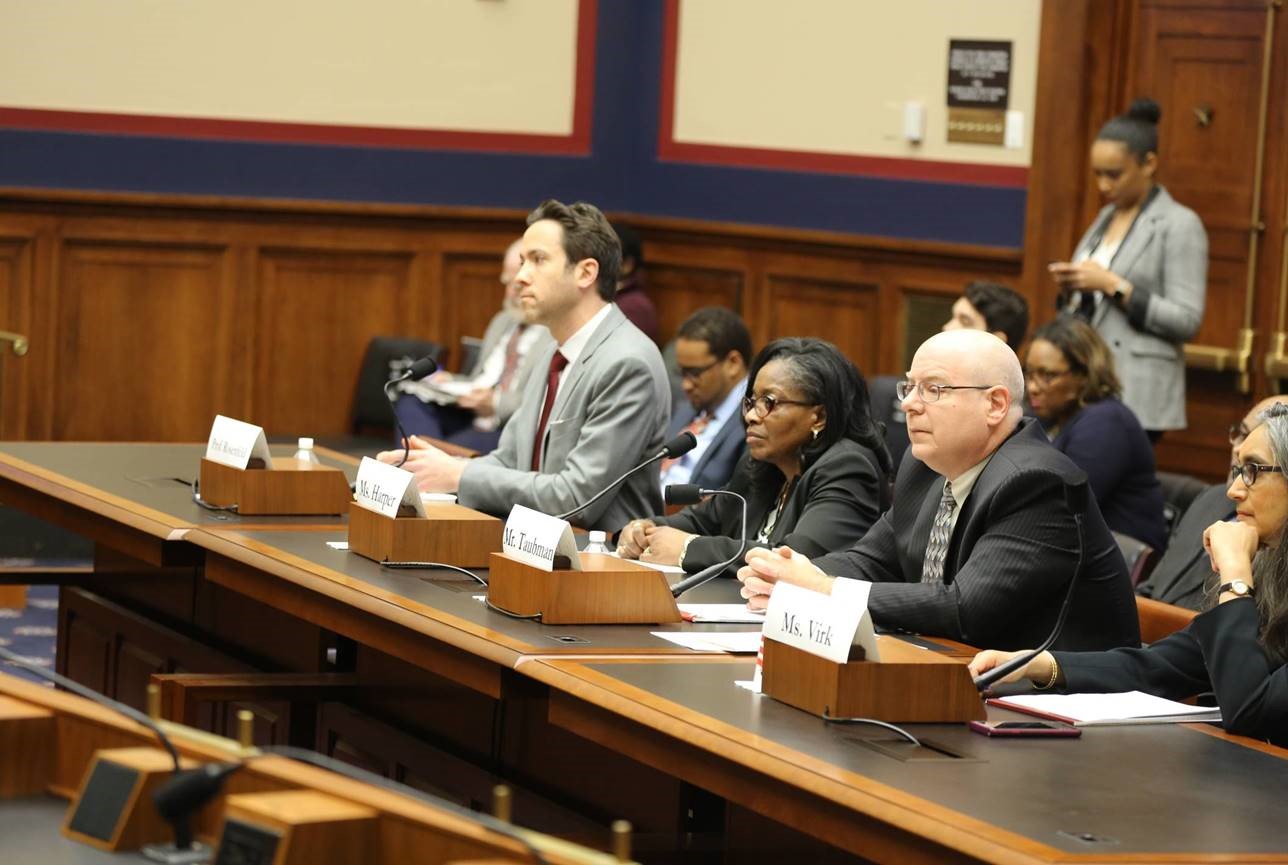
Staff attorney Glenn Taubman testified before Congress in July that existing NLRB rules wrongly favor union bosses over workers.
WASHINGTON, D.C. – In a series of recent victories, the National Labor Relations Board (NLRB) ruled in favor of workers challenging coercive union official practices, with free legal aid provided by the National Right to Work Foundation. The rulings are a stark departure from the Obama NLRB, which regularly stymied the rights of independent-minded employees opposed to associating with union bosses.
Foundation Wins Appeals in Dues Checkoff Cases
In separate cases brought by Foundation staff attorneys for Kacy Warner, a hospital worker, and Shelby Krocker, a Kroger grocery employee, the NLRB General Counsel ruled for the workers and ordered Regional Directors to prosecute union officials’ actions related to language in union dues checkoff forms.
The General Counsel’s decision to sustain Warner’s appeal concerning the checkoff authorized even more additions to the charges, saying the National Nurses Organizing Committee (NNOC) union violated the NLRA by “maintaining confusing and ambiguous dual-purpose authorization forms that unlawfully restrained employees in the exercise of their Section 7 rights.”
The General Counsel noted that the union’s forms failed to tell workers they can revoke authorizations for dues deductions after the union’s contract expires, failed to give workers adequate time to revoke authorizations, unlawfully required workers to use certified mail to send revocation requests, and failed to give “any indication to employees that payroll deduction authorization is voluntary.”
This came just a week after the General Counsel sustained another Foundation-led appeal for Krocker, who charged United Food and Commercial Workers (UFCW) union officials with illegally forcing her to sign a dues checkoff authorization. In both cases, the NLRB General Counsel authorized even more charges against union officials for misleading and confusing language regarding union dues deductions.
NLRB Regions Instructed to Prosecute Beck Violations
Also in July, the NLRB Division of Advice and General Counsel instructed regional directors to issue complaints against unions when union officials fail to inform employees of the amount of reduced union fees they can pay by objecting under the Communication Workers of America v. Beck U.S. Supreme Court decision.
The memos instruct NLRB Regional Directors to more stringently enforce workers’ Beck rights which protect workers from being forced to fund nonchargeable union activities such as union political activities. A memo issued to the Director of NLRB Region 32 read in part that “it is difficult for an employee to make an informed decision about whether to become a Beck objector without knowing the amount of savings that would result from the decision.”
“The Foundation is proud to have represented the California employee whose charge against the UFCW resulted in this Advice Memo, as well as necessitating this heightened disclosure standard by winning the Beck decision at the Supreme Court and the Penrod decision at the D.C. Circuit Court of Appeals,” National Right to Work Foundation Vice President and Legal Director Ray LaJeunesse said. Foundation staff attorneys are currently litigating several additional cases to secure and expand workers’ protections under Beck.
Ruling Aids Workers Trapped in Union Ranks They Oppose
In another Foundation victory for independent-minded workers in July, the NLRB issued a decision that limits union officials’ ability to game the NLRB system to trap workers in monopoly union ranks. The ruling allows employers to withdraw recognition from a union when a majority of its workers sign statements opposing unionization.
Foundation staff attorneys represented two workers, Brenda Lynch and Anna Marie Grant, who spearheaded the collection of signatures from a majority of workers opposed to union representation. Their employer complied with their wishes and sent the union bosses packing. After United Auto Workers (UAW) union officials sought to foist the union back onto the workers despite their clear opposition, Foundation staff attorneys persuaded the NLRB to uphold the UAW’s ouster.
“Instead of union lawyers playing legal games for months or even years to block the removal of a union that lacks majority support, the Board majority takes the common sense approach of asking union officials to prove their claim of support in a secret ballot vote of the workers,” said LaJeunesse.
Federal Board Adopts Foundation-Advocated Reform to Union Decertification Rules
The following article is from the National Right to Work Legal Defense Foundation’s bi-monthly Foundation Action Newsletter, September/October 2019 edition. To view other editions or to sign up for a free subscription, click here.
National Mediation Board simplifies process for workers under Railway Labor Act to remove a union they oppose
At the Foundation’s urging, the NMB removed unnecessary hurdles and simplified the process for rail and airline employees to remove unpopular unions from their workplaces.
WASHINGTON, D.C. – In late July the National Mediation Board (NMB) issued its final rule simplifying decertification procedures under the Railway Labor Act (RLA). The change enables workers in the airline and railway industries to more easily vote to remove a union that lacks the support of a majority of workers.
Before the decision to simplify the process, the NMB used a confusing process that required individual employees to create a fake “straw man” union to replace the incumbent union as the monopoly representative. The decertification process is particularly important because under federal law RLA unions can force workers to pay union dues or fees as a condition of employment even where state Right to Work laws protect other employees from forced union dues.
New Straightforward Rule Vindicates Foundation Campaign for Reform
“The Foundation has long advocated this type of change in the union decertification process and we are pleased the NMB has – as we called upon it to do in comments filed earlier this year – finally made this commonsense reform,” National Right to Work Foundation Vice President Patrick Semmens said at the time.
The NMB’s final decision provides a straightforward procedure for the decertification of a union, meaning workers who do not want union representation won’t have to jump through the hoops of creating and voting for a “straw man” union just to decertify the union that currently has monopoly bargaining power over their workplace.
The NMB’s final rulemaking notice reads: “The Board believes this change is necessary to fulfill the statutory mission of the Railway Labor Act by protecting employees’ right to complete independence in the decision to become represented, to remain represented, or to become unrepresented.”
“This change will ensure that each employee has a say in their representative and eliminate unnecessary hurdles for employees who no longer wish to be represented,” the NMB continued.
The National Right to Work Foundation has long called for these rules to be updated. Foundation attorneys participated in the formal comment period process and appeared at a public hearing to address the NMB and deliver the Foundation’s position. The final rule specifically references the Foundation’s comments, vindicating its efforts in the rulemaking process.
Board Eliminates Confusing ‘Straw Man’ Election Rules
“The National Right to Work Legal Foundation (Right to Work) stated that the proposed change is ‘long overdue,’ and the [Notice of Proposed Rulemaking] is ‘needed to ensure that all employees have an equal and fair choice regarding union representation. The Board has statutory authority to adopt the proposed rules, and should do so as soon as possible,’” the NMB final rule reads.
The confusing rules previously forced individual employees to concoct a “straw man” union to replace the incumbent union as the monopoly representative. Once elected by a majority of the workers, the new “straw man” representative could disclaim collective representation, but was not legally required to do so.
“At long last the National Mediation Board is providing airline and railroad workers covered by the Railway Labor Act a straightforward way to remove unwanted union ‘representation’ through a direct decertification vote,” Semmens said.
“The previous system – in which workers had to create a ‘straw man’ union just to challenge an incumbent union – only served to stymie workers’ rights and demonstrated the historic bias of the NMB in favor of compulsory unionism,” said Semmens. “It wasn’t until the Foundation-won case of Russell v. NMB in 1983 that workers even had an established legal right to throw off their union ‘representative,’ albeit only through the unnecessarily complicated “straw man” system which is finally being replaced with a simplified process to allow workers to exercise that right.”
In addition to submitting the formal comments in May, veteran Foundation staff attorney Glenn Taubman testified in favor of the rule change at the NMB hearing in late March.
AT&T Employee Hits CWA Union with Unfair Labor Practices Charges for Violating Rights During Military Leave
Union officials refused to allow worker to resign his union membership and attempted to fine him for exercising his legal rights
Jacksonville, FL (November 25, 2019) – With free legal aid from the National Right to Work Legal Defense Foundation, AT&T employee Jared Brewer has filed unfair labor practice charges at the National Labor Relations Board (NLRB) against Communications Workers of America (CWA) Local 3106 for violating his legal rights. Brewer charges that CWA union officials illegally refused to accept Brewer’s legitimate request to resign his union membership and later used that as grounds to fine Brewer after he had resigned from the union.
Brewer was on military leave when union officials called for a strike in August 2019. He sent an email to union officials in which he resigned his union membership. Instead of respecting his legal right to resign at any time, a union representative falsely told him that his resignation letter was “untimely.” Brewer returned to work and sent a certified letter containing the same resignation language.
Then in an October letter, union officials told Brewer that they were bringing charges against him in an internal union “trial” for exercising his right to work despite the union-initiated work stoppage. Brewer did not attend the November 7 “trial” because he had already resigned his union membership and therefore could not legally be subject to union disciplinary procedures.
Union officials notified Brewer on November 15 that the union had found him guilty at its “trial” and imposed a fine of more than $700. Union officials threatened him with legal action if he did not pay the fine within 21 days.
Brewer’s unfair labor practice charge alleges that union officials violated his legal rights under the National Labor Relations Act (NLRA) by attempting to discipline and fine him as a nonmember, in addition to denying his resignation of union membership. Under the NLRA, union officials are prohibited from requiring union membership as a condition of employment and workers are free to resign their union membership.
“CWA union bosses are blatantly violating longstanding law by denying Mr. Brewer’s request to resign his union membership,” said National Right to Work Foundation President Mark Mix. “Federal labor law is crystal clear: Workers have an absolute right to resign their union membership if they so choose and once a worker has exercised that right they cannot be subject to fines levied by any internal union boss kangaroo court.”





