
Legal Victory: West Virginia Supreme Court Unanimously Upholds Right to Work
The following article is from the National Right to Work Legal Defense Foundation’s bi-monthly Foundation Action Newsletter, July/August 2020 edition. To view other editions or to sign up for a free subscription, click here.
Foundation attorneys filed 10 legal briefs defending Right to Work from union boss legal attack
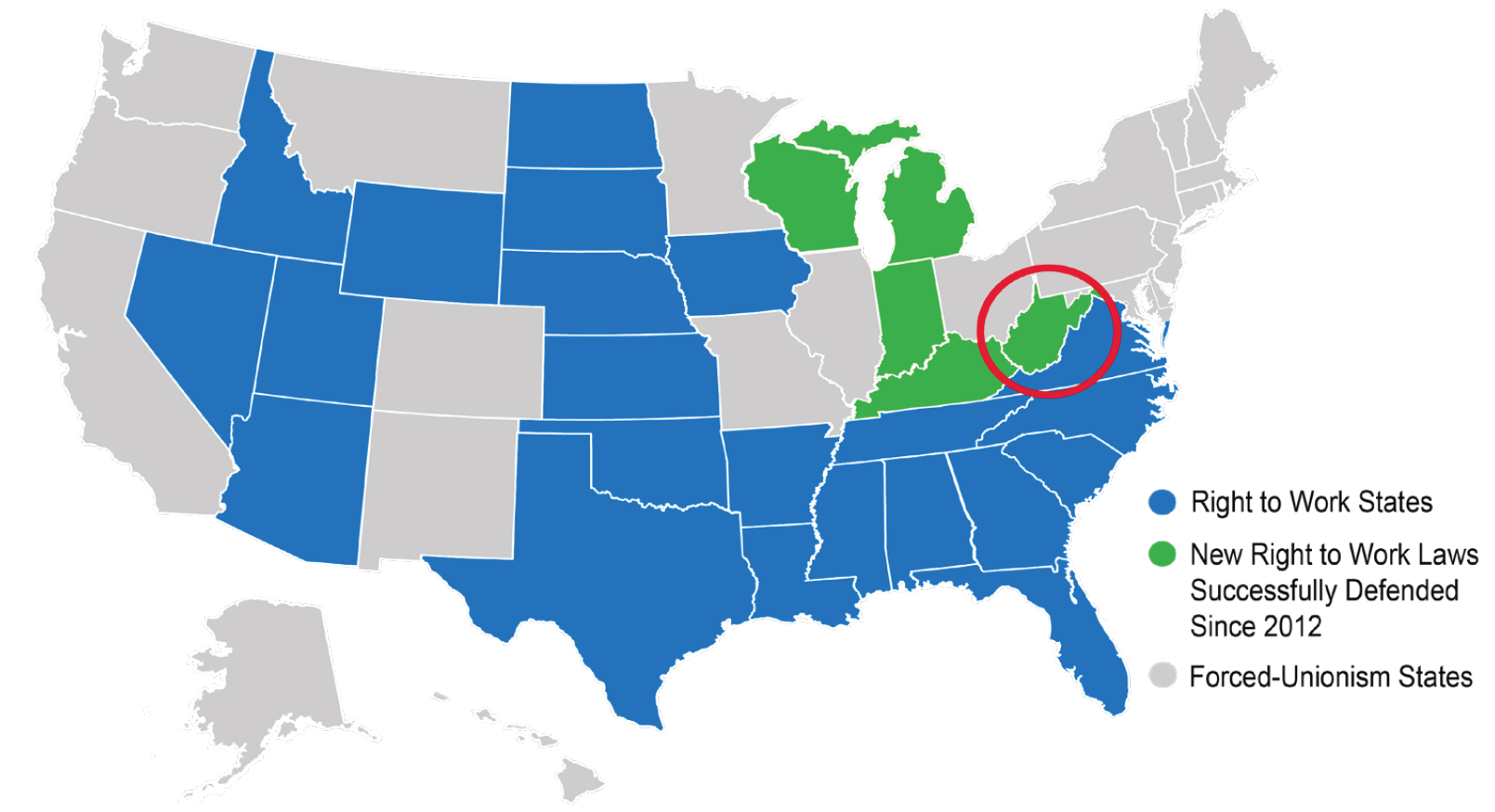
The Foundation added West Virginia to the list of states where it has successfully helped defend Right to Work since 2012. Now the state’s motto, “Montani Semper Liberi” (“Mountaineers are Always Free”) applies to the state’s workers.
CHARLESTON, WV – The West Virginia Supreme Court closed the book on a case brought by union lawyers seeking to overturn the state’s popular Right to Work Law, which protects Mountain State workers from being forced to pay dues or fees to a union as a condition of employment. Foundation staff attorneys filed 10 briefs in defense of Right to Work, including briefs submitted for pro-Right to Work employees who wanted the freedom to cut off financial support for unions in their workplace.
Ultimately, the West Virginia Supreme Court rejected outrageous arguments from union lawyers that union hierarchies have a legal “right” to a portion of a worker’s paycheck because that worker is also forced to accept their so-called “representation.” In their ruling, the justices repeatedly cited the landmark 2018 Foundation-won Janus v. AFSCME decision in which the U.S. Supreme Court ruled that requiring public sector employees to pay union dues as a condition of employment is a First Amendment violation.
In the decision, Justice Evan Jenkins wrote for the majority that West Virginia’s Right to Work Law “does not violate constitutional rights of association, property, or liberty” and that states are “expressly authorized under federal law” to prohibit union bosses from requiring dues or fees as a condition of employment. Justice Jenkins also maintained that Janus provides strong support for the law.
The West Virginia Legislature passed Right to Work over then-Governor Earl Ray Tomblin’s veto in February 2016, making West Virginia the 26th Right to Work state. The Foundation immediately offered free legal assistance to employees who had questions about exercising their rights.
Foundation Attorneys Spring into Action as Soon as Protections Enacted
The Foundation also created a special task force to defend the West Virginia law, which began applying to collective bargaining agreements that were entered into, modified, renewed or extended after July 1, 2016.
On June 27, 2016, lawyers for several state unions brought a case (later renamed West Virginia AFL-CIO, et al. v. Governor James C. Justice, et al.) in an attempt to overturn the popular law. Polling consistently shows that Americans overwhelmingly back Right to Work laws. A poll of union households even found that 80 percent of union members supported the Right to Work principle that union membership and dues payment should be voluntary and not required as a condition of employment.
Despite decades of precedent upholding such laws, Judge Jennifer Bailey of the Kanawha County Circuit Court issued a February 2017 order at the behest of union lawyers, granting a preliminary injunction that purported to block the law. The union lawyers’ primary arguments in this case for why the Right to Work protections for workers should be overturned had already been rejected by a Federal Court of Appeals and the Indiana Supreme Court. They also ran counter to nearly 70 years of legal precedent, including U.S. Supreme Court decisions, upholding the constitutionality of state Right to Work laws.
Foundation staff attorneys filed legal briefs for Reginald Gibbs, who worked as a lead slot machine technician with the Greenbrier Hotel in White Sulphur Springs, West Virginia, and Donna Harper, who worked as a laundry aide and nursing assistant at the Genesis HealthCare Tygart Center in Fairmont, West Virginia. Harper’s brief explained that because she had exercised her right under the Right to Work protections to refrain from subsidizing the Teamsters union at her workplace, killing those protections would result in her being fired.
Union Boss Attacks on Right to Work in Other States Successfully Turned Back
“The West Virginia Supreme Court’s unanimous decision to safeguard the right to freely choose whether or not one will financially support a union marks a great victory for Mountain State employees,” observed National Right to Work Foundation President Mark Mix. “Workers who disapprove of union boss activities can rest assured that they cannot be terminated for refusing to tender dues to a union, and those who want to support union activities may do so uninhibited.”
In addition to West Virginia, Foundation staff attorneys have successfully pursued legal action in recent years to defend and enforce new Right to Work laws in Indiana, Michigan, Wisconsin and Kentucky, all of which have passed Right to Work protections for employees since 2012.
West Virginia Supreme Court Cites Foundation-Won Janus Case in Decision to Uphold Right to Work Law
In April the West Virginia Supreme Court upheld West Virginia’s Right to Work law, ending a multi-year union boss legal challenge.
National Right to Work Foundation Vice President and Legal Director Raymond LaJeunesse wrote an article for The Federalist Society analyzing the decision in the case: Morrisey v. West Virginia AFL-CIO. LaJeunesse just published piece highlights how the justices relied heavily on the Foundation-won Janus v. AFSCME U.S. Supreme Court decision to uphold the law protecting workers against being forced to subsidize union activities:
“Four of the five Justices concluded in Morrisey that the United States Supreme Court’s decision in Janus v. AFSCME, 138 S. Ct. 2448 (2018), required that result. Janus held that forcing nonmembers to pay union fees as a condition of public employment violates the First Amendment. As Justice Workman put it, concurring in the judgment of the Court in Morrisey, ‘there is no principled basis on which to conclude that under the legal analysis upon which Janus is based, a prohibition on the collection of agency fees is constitutional for public employees’ unions but unconstitutional for private employees’ unions.'”
Foundation staff attorneys filed 10 legal briefs in Morrisey in defense of West Virginia’s Right to Work law. Foundation President Mark Mix hailed the decision as a “a great victory for Mountain State employees.”
Since 2012, Foundation staff attorneys have defended and enforced five newly passed Right to Work in states including West Virginia.
Healthcare Worker Sues Teamsters Union and Healthcare Facility for Violating West Virginia Right to Work Law
Former Tygart Center employee says union officials and employer violated her legal rights by demanding she join the union and pay union dues and fees to keep her job
Fairmont, WV (December 24, 2019) – With free legal aid from the National Right to Work Legal Defense Foundation, healthcare worker Donna Harper filed a lawsuit against Teamsters Local 175 and the Tygart Center for violating her rights under the State of West Virginia’s Right to Work law.
West Virginia’s Right to Work law prohibits requiring workers to pay union dues or fees just to get or keep a job. In defiance of West Virginia’s Right to Work law, Tygart Center and Teamsters union officials entered into a collective bargaining agreement that required employees to pay union dues and fees as a condition of employment.
When Harper was hired, Tygart Center officials informed Harper that she must become a union member and pay union dues as a condition of employment in violation of her legal rights. Tygart Center officials deducted full union membership dues and fees from Harper’s paycheck and remitted this money to Teamsters union officials.
In March 2019, Harper successfully exercised her legal rights by resigning her union membership. Even then union officials continued taking union dues from her paycheck. Union officials also never fully refunded the union dues unlawfully seized from her wages.
Foundation staff attorneys filed the suit against the Tygart Center and the Teamsters union for Harper in Marion County Circuit Court. Harper worked at the Tygart Center from February 2018 until September 2019 as a Laundry Aide and as a Certified Nursing Assistant.
Foundation staff attorneys also filed an amicus brief for Harper with the West Virginia Supreme Court defending the state Right to Work law against a protracted lawsuit brought by several unions seeking to overturn the law and restore union officials’ power to have workers fired for refusing to pay union dues or fees. That case is scheduled for oral arguments in the Supreme Court on January 15. That court has already rejected the unions’ arguments once, overturning a preliminary injunction against the Right to Work law.
“Teamsters union bosses demonstrated a blatant disregard for the law by illegally demanding Ms. Harper and her coworkers pay union dues and fees just to get or keep their jobs,” said National Right to Work Foundation President Mark Mix. “Contrary to Big Labor’s wishes, West Virginia’s Right to Work law is in full effect, meaning all union dues for workers covered by the law must be completely voluntary.”





