
Hydra-Lock Employees Win Decertification Vote, Oust UAW Union
After corruption scandal and Right to Work Repeal, Michigan workers win their freedom from UAW bosses and forced union dues
Detroit, MI (October 29, 2024) – Production and maintenance employees at Hydra-Lock Corp. a hydraulic tooling company based in Mt. Clemens, Michigan, have voted to remove United Auto Workers (UAW) Local 155 union officials from their workplace. The National Labor Relations Board (NLRB) conducted the vote following Hydra-Lock employee Keith Woody’s submission of a petition in which his colleagues requested an election to “decertify,” or remove, the union. Woody received free legal aid from National Right to Work Foundation staff attorneys.
The NLRB is the federal agency responsible for enforcing federal labor law, which includes administering elections to install and remove unions. Woody’s petition contained signatures from the majority of his colleagues in support of having a decertification election, well over the threshold of employee signatures needed to trigger such a vote under NLRB rules.
Michigan legislators’ 2023 repeal of the state’s Right to Work protections went into effect this February, meaning UAW union officials had the legal power to enforce job conditions that required Woody and his coworkers to pay dues or fees just to keep their jobs. In Right to Work states, in contrast, union membership and financial support are strictly voluntary.
The decertification win means Woody and his coworkers are no longer obligated to pay union dues as a condition of employment, and are officially free from UAW union officials’ one-size-fits-all monopoly “representation.”
Michigan Legislators Repealed Right to Work Despite Massive UAW Scandal
In March 2023, a bare majority of Michigan legislators voted along partisan lines to repeal Right to Work at the behest of union special interests, ending workers’ ability to decide for themselves whether or not union officials deserve their dues money. The imposition of union bosses’ power to force employees to “pay up or be fired” came despite polling showing Michiganders, including those in union households, overwhelmingly opposed the elimination of workers’ Right to Work protections.
After the repeal became effective this February, workers from across the Great Lakes State sought help from National Right to Work Foundation staff attorneys in escaping union bosses’ forced-dues demands. The total cases that Foundation attorneys have filed for Michigan workers in 2024 is already well more than double the number for all of 2023. Foundation-backed workers from across the state have recounted a wide variety of union boss misdeeds since the repeal, including forcing workers with religious objections to join and pay dues, taking dues money directly from workers’ paychecks without their permission, coercing workers into contributing to union Political Action Committees (PACs), and more.
The Michigan Right to Work repeal also came after a years-long federal probe revealed massive corruption within the UAW hierarchy. Over a dozen UAW officials received jail sentences for embezzling and spending millions in workers’ dues money on luxury goods, vacations, and other personal items. A federal monitor is still overseeing the Detroit-based union, and reportedly are investigating current UAW President Shawn Fain for misappropriating union funds and abusing his power.
“Michigan’s repeal of Right to Work left many workers forced to fund union bosses that were ineffective, divisive, or outright corrupt, which is outrageous considering Michigan legislators had just witnessed the implosion of the Detroit-based UAW over corruption and embezzlement,” commented National Right to Work Foundation President Mark Mix. “Hydra-Lock employees, like many others across the state, are nonetheless fighting to regain control of their workplaces from unwanted union hierarchies. We are proud to support their efforts to stand up against union coercion
“Michigan workers should not hesitate to contact National Right to Work Foundation attorneys for free assistance in standing up for what rights they still have in this new legal environment,” Mix added.
Citing Federal Student Privacy Law, Vanderbilt Graduate Students Move to Block UAW Union Organizers from Obtaining Their Personal Info
“John Doe” grad students resist Labor Board claim that labor law can override Family Educational Rights and Privacy Act
Nashville, TN (October 23, 2024) – Two graduate students at Vanderbilt University are seeking to intervene in a federal case in which Vanderbilt Graduate Workers United (VGWU, an affiliate of the United Auto Workers union, UAW) union officials are demanding personal information that the students wish to keep private. The students, who identify themselves in legal documents as “John Doe 1” and “John Doe 2,” have obtained free legal aid from the National Right to Work Legal Defense Foundation to challenge a union subpoena demanding their personal information.
The students’ motion to intervene is now before the National Labor Relations Board (NLRB) in Washington, DC, following a special appeal from an NLRB Region 10 decision that tossed the motion on the specious ground that the students are “not a labor organization” and consequently have no interest in the case.
VGWU union bosses are seeking the students’ personal information as part of the union campaign to place Vanderbilt graduate students under UAW union monopoly bargaining control. NLRB Region 10 in Atlanta has issued a subpoena at the union’s behest seeking to force Vanderbilt University to hand over this information to union officials. However, the graduate students argue that the Family Educational Rights and Privacy Act (FERPA) forbids the Vanderbilt administration from disclosing this information to any third parties without their permission, including the UAW.
“The…subpoena to Vanderbilt is an attempt to violate FERPA’s protections, privileging union interests over the graduate students[’] privacy rights,” reads the graduate students’ appeal. “The Graduate Students seek to provide the Region legal arguments in support of their privacy interests, and against the…subpoena of Vanderbilt.”
Students Want Stop in Subpoena Enforcement So They Can Defend Their Privacy
The students’ original motion to intervene notes that FERPA’s language permits students to seek “protective action” if a university receives a subpoena seeking their personal information, as in this case. In light of that, the students are asking for a halt in the subpoena’s enforcement so they can properly defend their privacy interests. While the motion notes that the NLRB’s standards for allowing intervention have been unclear over the years, it argues that the students’ goal to defend their privacy interests provides a solid ground for intervention.
The VGWU union is an affiliate of the UAW union, which has a penchant for ignoring or violating employee rights in pursuit of gaining greater power over workers, businesses, and other institutions. The union is still under federal monitoring following a years-long embezzlement probe that uncovered millions of dollars in workers’ dues money misspent on luxury items, gambling, vacations, and more. The probe resulted in the convictions of about a dozen top UAW bosses.
“UAW officials are seeking to override college students’ federal privacy protections, which in addition to having no basis in law also treats students as pawns in the union’s ascent to power at the university,” commented National Right to Work Foundation President Mark Mix. “The NLRB under both Obama and Biden has twisted longstanding labor law to give union bosses the power to force students into dues-paying union ranks. But graduate students across the country are increasingly discovering that heavy-handed union monopoly bargaining power means less freedom both in and out of the classroom and more inefficiency, disruption, and radical political activism.
“Union monopoly bargaining is a system particularly ill-suited to an academic environment. But it also forces workers all over the country to associate with and pay dues to union bosses they never wanted and may have explicitly voted against,” Mix added. “The Vanderbilt students we represent are right to resist this kind of compulsion and we will defend their right to privacy.”
Philly Public Defender Beats Illegal UAW Dues Deduction Scheme
The following article is from the National Right to Work Legal Defense Foundation’s bi-monthly Foundation Action Newsletter, September/October 2023 edition. To view other editions of Foundation Action or to sign up for a free subscription, click here.
UAW boss threatened to reduce workers’ wages for not signing dues card
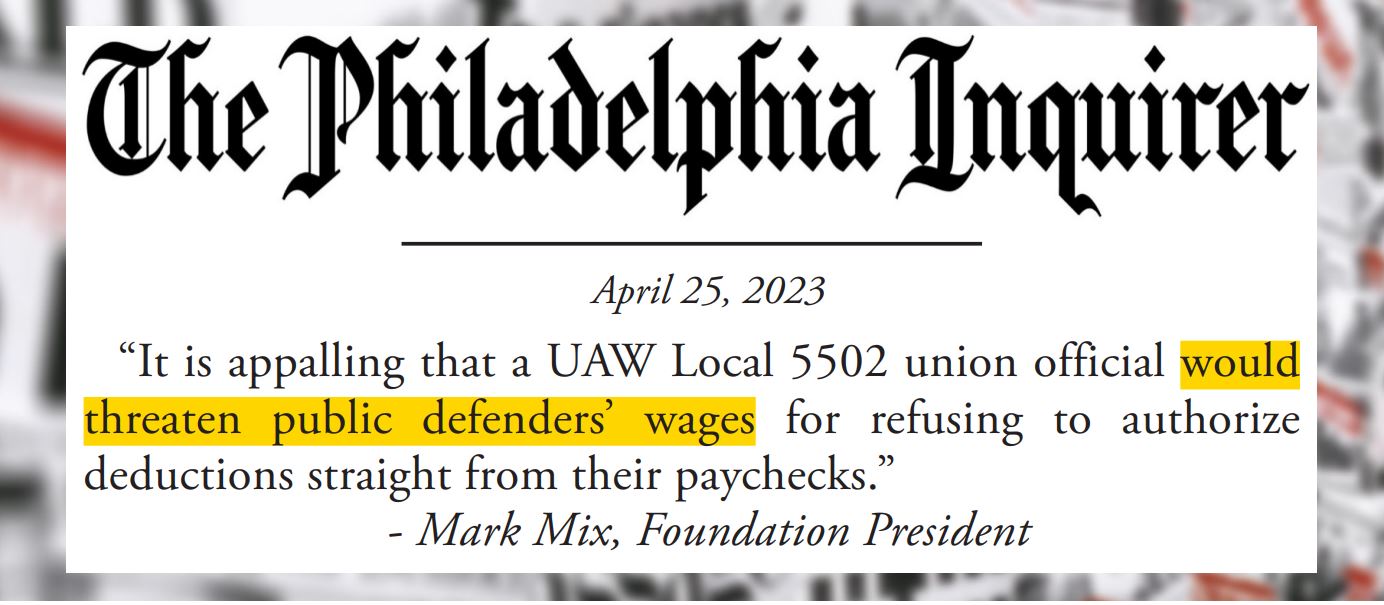
Philly Public Defender Brunilda Vargas surely didn’t feel “represented” by UAW bosses when they sought to reduce her and her colleagues’ pay just for not signing dues cards. Mark Mix expressed the outrageousness of this scheme to The Philadelphia Inquirer.
PHILADELPHIA, PA – Brunilda Vargas, a public defender for the City of Philadelphia, staunchly objected when United Auto Workers (UAW) Local 5502 union bosses sought to gain power over her and her colleagues at the Defender Association of Philadelphia.
After UAW union officials were installed in her workplace, things only got worse for her. A UAW union official threatened Vargas and her coworkers that, if they didn’t sign cards authorizing the direct deduction of union dues from their paychecks, their wages would be reduced. This threat was a blatant violation of federal law.
Vargas challenged UAW officials’ illegal demands with free legal aid from the National Right to Work Legal Defense Foundation. Union bosses quickly backed down, and in June entered into a settlement approved by National Labor Relations Board (NLRB) Region 4 which fully vindicates Vargas’ and her coworkers’ rights.
Public Defender Hits UAW with Federal Charges Following Intimidation
On April 18, 2023, Vargas filed her federal unfair labor practice charge with NLRB Region 4 for the threats made against her and her colleagues at the Defender Association of Philadelphia. UAW officials issued these threats against public defenders who chose not to sign automatic dues deduction authorization forms.
Even though Vargas works in the non-Right to Work state of Pennsylvania and can be forced to pay some union dues as a condition of employment, federal law prohibits forcing workers to authorize automatic dues deductions from their paychecks. Had Vargas lived in a Right to Work state, not only would she have the right to refrain from automatic dues deductions from her paycheck, but she could also refrain from financially supporting the union altogether. In Right to Work states, workers are fully protected from mandatory union membership and financial support, both of which must be completely voluntary.
Settlement Forces Union Bosses to Fully Abandon Illegal Threats
Now, pursuant to settlements, the UAW must email and post notices informing workers that the union will not work with the workers’ employer to reduce wages of nonmembers that do not sign automatic dues deductions forms. The union must also not suggest failure to sign a dues deduction card could lead to a worker’s termination. Finally, the union must not coerce or restrain individuals from expressing their rights under Section 7 of the National Labor Relations Act.
“[UAW] will not threaten objecting non-members that we will notify the Employer it can seek refunds of their contractual salary increases if they do not sign a dues deduction authorization form. Neither employees nor members are legally required to execute a dues deduction authorization form,” the notice reads.
“While we are happy that we were able to help Vargas and her coworkers fight UAW misconduct, this instance is but the tip of the iceberg when it comes to UAW malfeasance,” commented National Right to Work Foundation Vice President Patrick Semmens. “The recent federal probe into UAW officials stealing and misusing workers’ money has sent multiple top UAW bosses to jail, and uncovered a shocking culture of contempt for workers’ rights.”
“Fortunately, the numerous victims of UAW boss abuses need not fight alone,” continued Semmens. “They have an ally in the National Right to Work Foundation.”
Foundation-Backed Workers Notch Victories Over Dues-Hungry UAW Bosses
The following article is from the National Right to Work Legal Defense Foundation’s bi-monthly Foundation Action Newsletter, July/August 2023 edition. To view other editions of Foundation Action or to sign up for a free subscription, click here.
UAW caught using threats and coercion to illegally seize workers’ dues
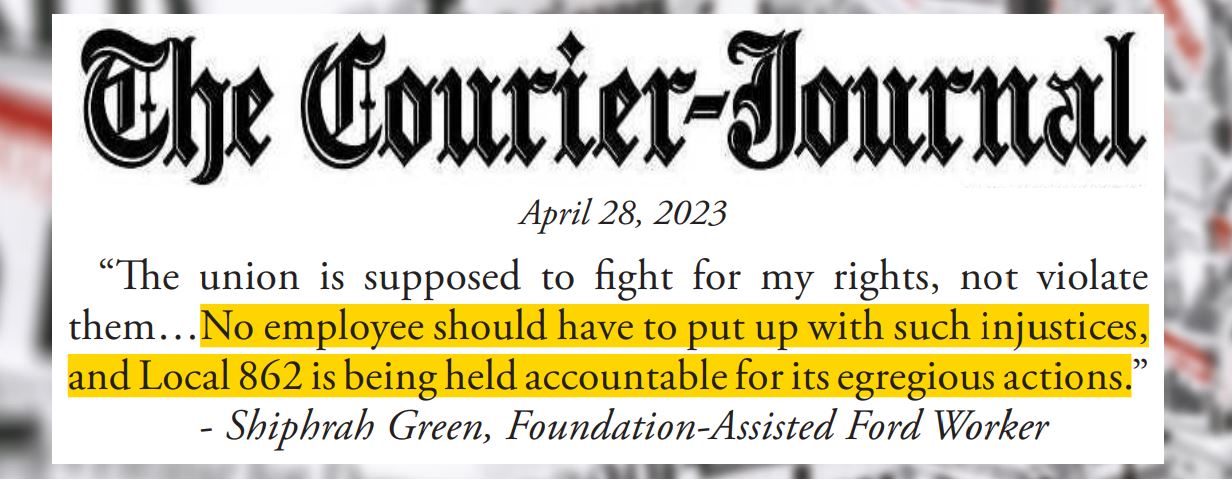
Ford employee Shiphrah Green excoriated UAW bosses in the Louisville Courier Journal over their blatant disregard for her rights. Foundation attorneys are helping her and others battle the notoriously corrupt union.
LOUISVILLE, KY – United Auto Workers (UAW) union officials have a well-deserved reputation for looking out for their own interests while throwing rank-and-file workers under the bus. The most prominent recent example is the corruption and embezzlement scandal, in which federal investigators revealed that UAW officials had siphoned millions of dollars in workers’ money to fund opulent golf vacations in luxury condos and private villas, spa and amusement park visits, $60,000 cigar-buying sprees, and much more.
But the federal corruption probe that led to eleven top UAW bosses pleading guilty, including former union presidents Gary Jones and Dennis Williams, is hardly the only time greedy UAW bosses abused their government-granted monopoly bargaining powers.
In a series of recent cases brought by National Right to Work Foundation staff attorneys against the UAW, workers are utilizing the Foundation’s free legal aid to vindicate their rights in the face of illegal dues demands by UAW officials.
Foundation-won Settlements Force UAW to Return Money to KY, IA Workers
Shiphrah Green, an employee of Ford Motor Company’s Louisville Assembly Plant, prevailed over UAW Local 862 bosses with free Foundation legal aid in April. UAW bosses were forced to settle and return money they had unlawfully taken from Green’s pay.
Green’s federal charges against the union maintained not only that UAW officials had made her jump through unnecessary hoops to exercise her right to cut off union dues, but also that UAW bosses made threats against her job when she tried to resign, with one union official warning her “if it were up to me, you’d lose your job for leaving the union.” Green’s settlement also forced UAW officials to refrain from such illegal threats in the future.
Meanwhile in Iowa, four employees of air filter manufacturer Donaldson won a recent settlement in which UAW officials were required to return over $1,000 in illegally-seized dues.
In each Donaldson worker’s case, UAW bosses had either refused to stop dues deductions despite producing no original documentation showing the workers had consented to such deductions in the first place, or had kept seizing money after an employee resigned union membership and revoked authorization to deduct dues, which should have been effective in stopping the flow of dues.
Because Ms. Green and the Donaldson workers reside in Right to Work states, the Foundation-won cases mean they will be free from all union financial support going forward.
Philly Public Defender Hits UAW with Charges
Even in non-Right to Work states where union officials have the power to compel workers to pay some fees under threat of termination, UAW bosses still go far beyond what is legal in their greedy forced-dues demands.
For example, Foundation staff attorneys recently filed a case for Philadelphia public defender Brunilda Vargas. Vargas, a vocal opponent of the UAW’s unionization drive, was told by UAW organizers that the union would reduce her and her coworkers’ wages if they did not grant the union the power to automatically deduct union dues directly from their paychecks.
Not only is the threat illegal, but further, employees can never be required to authorize automatic dues deductions from their paychecks under long-established federal law. This is true even in a state like Pennsylvania where workers lack the protection of a Right to Work law. Vargas’ charge, filed in June, is now being investigated.
“American workers likely have a plethora of reasons for wanting nothing to do with UAW union officials, including but not limited to the dizzying corruption in the union that has led to so many union officials going to prison,” commented National Right to Work Foundation Vice President Patrick Semmens. “As Foundation attorneys have experienced, UAW officials will often resort to clearly illegal methods to squeeze money out of dissenting workers in violation of federal law.”
“Union bosses who cannot convince workers to pay union dues voluntarily should not be allowed to seize union dues under threat of termination,” Semmens added.





