
Final Briefs Filed at Appeals Court in Continuation of Janus v. AFSCME
The following article is from the National Right to Work Legal Defense Foundation’s bi-monthly Foundation Action Newsletter, September/October 2019 edition. To view other editions or to sign up for a free subscription, click here.
Foundation seeks first-in-nation appellate court ruling to order non-member dues refunded
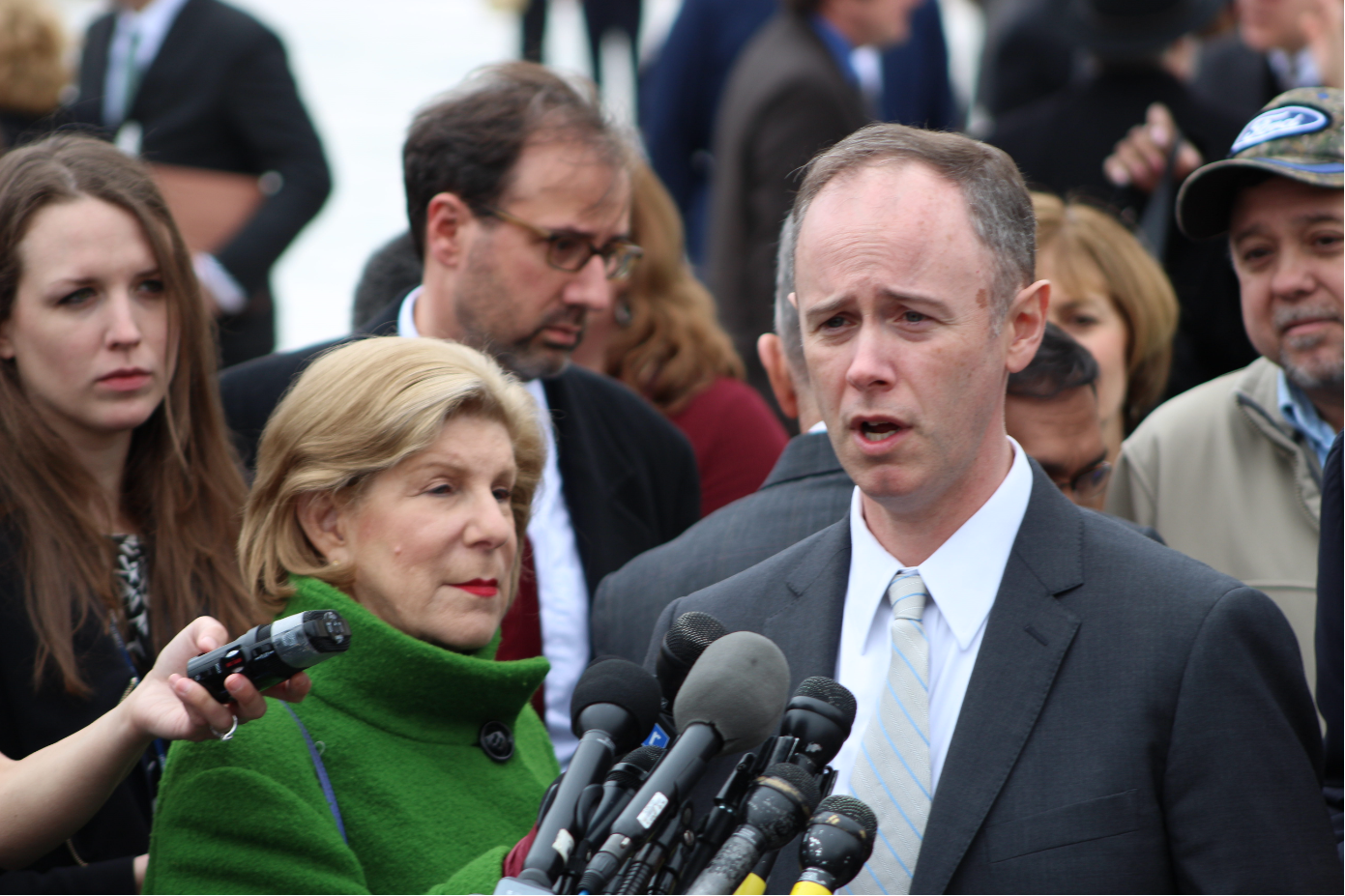
Veteran Foundation staff attorney William Messenger, seen here speaking to reporters after Supreme Court oral arguments in Janus, leads the Foundation’s Janus enforcement task force.
CHICAGO, IL – Although Janus v. AFSCME secured a landmark victory at the U.S. Supreme Court for government employees’ First Amendment rights, Mark Janus’ case is not over because AFSCME union bosses have refused to return the funds taken from him in violation of the First Amendment.
Janus’ attorneys from National Right to Work Foundation and Illinois-based Liberty Justice Center have completed briefing with the Seventh Circuit Court of Appeals on the issue of whether union officials can keep money they seized from non-members in violation of their constitutional rights. The case is likely to mark the first time an appellate court will rule on the issue, potentially establishing a precedent that could result in the return of hundreds of millions of dollars seized by union bosses in violation of the Janus precedent.
Janus Secured Workers’ First Amendment Rights
Mark Janus was an Illinois child support specialist whose case was successfully argued at the Supreme Court by National Right to Work Foundation staff attorney William Messenger.
The Supreme Court’s June 27, 2018, decision in Janus’ favor found that any union fees taken from workers like Mark Janus – who was not a member of AFSCME – without the workers’ affirmative and knowing consent violate the First Amendment. Justice Samuel Alito wrote for the majority that compulsory fees “[violate] the free speech rights of non-members by compelling them to subsidize private speech on matters of substantial public concern.”
The Supreme Court sent the case back to the lower courts to determine, among other things, whether Janus is entitled to all the union fees he was forced to pay since March 23, 2013.
Janus’ appeal comes after a district court judge ruled that union officials are not required to refund forced fees seized from non-member workers prior to the Janus decision.
“Just like a thief would not be allowed to keep the money he stole, union bosses must be forced to return funds unlawfully seized from workers,” said National Right to Work Foundation Vice President and Legal Director Ray LaJeunesse. “It would be a massive injustice to deny workers victimized by Big Labor the refunds to which the Supreme Court made clear they are entitled.”
Seventh Circuit Likely First Appeals Court to Rule on Non-member Refunds
Janus will likely be the first case in which an appellate court will evaluate the so-called “good faith” defense that union lawyers have asserted in response to worker lawsuits seeking refunds, arguing that union officials should be allowed to keep funds seized prior to the Janus decision.
This contention has generally succeeded in lower courts despite the Supreme Court asserting that union bosses have been “on notice” for years that mandatory fees likely would not comply with the heightened level of First Amendment scrutiny articulated in the Supreme Court’s earlier Knox v. SEIU decision, also won by Foundation staff attorneys.
Mark Janus is asking the Seventh Circuit to rule that he is entitled to refunds of approximately $3,000 in fees he was forced to pay since March 23, 2013, as the statute of limitations permits. In addition, the case has significant implications for dozens of other cases being litigated around the country for hundreds of thousands of other workers seeking the return of forced fees seized unlawfully by union officials.
Janus Refund Efforts Continue Nationwide
Foundation staff attorneys are currently litigating over a dozen such cases that collectively seek over $120 million in refunds for non-members forced to pay union fees before Janus. Other ongoing lawsuits and potential cases could result in half a billion dollars or more returned to government workers from union treasuries.
“The Janus case is a milestone of worker freedom, but union bosses continue to block workers from exercising their rights and deny workers refunds for dues and fees seized against their wishes,” said LaJeunesse. “We hope the Seventh Circuit Court of Appeals will follow the clear logic of the Supreme Court’s decision in Janus and establish that union bosses cannot profit from violating workers’ First Amendment rights.”
Wall Street Journal Highlights Foundation Litigation to Enforce Janus v. AFSCME
In June 2018, National Right to Work Foundation staff attorneys won the landmark Janus v. AFSMCE case at the U.S. Supreme Court. The Janus decision established that the First Amendment protects public-sector workers from being forced to pay dues or fees to a union against their wishes.
Union bosses have widely blocked public employees from exercising their Janus rights using a variety of coercive tactics, requiring Foundation staff attorneys to pursue dozens of follow-up cases to enforce Janus.
Recently The Wall Street Journal published an article highlighting this ongoing litigation and heavily cited veteran Foundation staff attorney Bill Messenger:
The opt-out window is a favorite post-Janus union tactic for retaining members. More than 40 lawsuits against these “escape period” requirements are pending across the country, according to Bill Messenger, an attorney with the National Right to Work Foundation who argued Mark Janus’s case at the Supreme Court. …
Mr. Messenger and lawyers at LJC argue that these opt-out window requirements flout the Janus ruling, which clarified that a worker must give affirmative consent to become a union member. Before Janus, they argue, workers couldn’t give free, knowledgeable consent because they faced an unconstitutional choice between being a member or an agency-fee payer. Unions are violating the free-speech rights of members like Ms. Callaghan, who joined before Janus, by forcing them to wait for opt-out windows to leave. …
More than 80 lawsuits are challenging union efforts to hang on to unwilling members. Often handled by nonprofits like the LJC and NRTW Foundation, these suits fall into four main camps: challenging opt-out window restrictions, seeking compensation for pre-Janus agency fees paid by nonmembers, fighting exclusive union representation, and extending Janus to the private sector. These cases aren’t litigating the merits of unions; they’re seeking to codify workers’ freedom to choose whether they want to be in one.
Read the complete column from The Wall Street Journal here.
Ventura County Professor Files Class Action Lawsuit Challenging Union “Window Period” Scheme to Unlawfully Seize Dues
Union officials violate hundreds of public workers’ constitutional rights under the Supreme Court’s Janus decision by deducting unauthorized forced dues
Los Angeles, CA (January 15, 2019) – With free legal aid from National Right to Work Foundation staff attorneys, a math professor from Ventura Country, California, is challenging an illegal “window period” scheme to forcibly seize union membership dues from his paycheck without his consent and in violation of his constitutional rights.
Plaintiff Michael McCain filed a class action lawsuit on Thursday in the U.S. District Court for the Central District of California against the American Federation of Teachers (AFT); Ventura County Federation of College Teachers, AFT Local 1828, AFL-CIO; and Ventura County Community College School District.
A public employee who works for the Ventura County Community College School District, plaintiff Michael McCain attempted to exercise his First Amendment rights by resigning his union membership following the landmark U.S. Supreme Court decision in Janus v. AFSCME, a case Foundation attorneys argued and won.
The High Court ruled on June 27, 2018, that union bosses may not forcibly seize dues from public sector workers. Instead, government employees must knowingly waive their First Amendment right not to subsidize a union and affirmatively authorize deductions before union officials can collect membership dues or fees.
However, AFT union officials never informed McCain of his First Amendment rights, making it impossible for him to have waived them. Union officials continue seizing membership dues from McCain’s hard-earned wages, even after McCain resigned his union membership and made it clear in a letter sent to the union just weeks after the Janus decision that he does not consent to dues deductions. Union officials claim that McCain can only cut off dues deductions during a union-created 15-day “window period” each year.
McCain’s class action lawsuit asks the court to strike down this unlawful “window period” scheme and order union officials to stop deducting unauthorized dues. His complaint also seeks a refund of membership dues that were wrongfully taken from him and hundreds, if not thousands, of other public employees.
“Union officials have a long history of manipulating ‘window period’ schemes, arbitrary union-enacted limitations trapping workers into forced dues, and other obstacles designed to block individuals from exercising their constitutional rights,” said Mark Mix, president of the National Right to Work Foundation. “Despite what union bosses say, First Amendments rights cannot be limited to just 15 days out of the year.”
“The Supreme Court affirmed the rights of public workers in the Foundation’s victory in Janus, but Michael’s case shows union bosses are determined to defy the High Court and continue their abusive practices,” Mix added.





