
National Right to Work Foundation Files Brief in Support of Grad Students’ Legal Challenge to Being Forced to Fund Radical Campus Union
Amicus brief at Seventh Circuit Court of Appeals argues NLRB coercion over bargaining means mandatory union dues requirement violates First Amendment
Chicago, IL (July 16, 2026) – The National Right to Work Legal Defense Foundation has filed an amicus curiae brief with the Seventh Circuit Court of Appeals in support of University of Chicago graduate students who are challenging the requirement that they pay fees to a union they oppose. Currently, these students must pay the union in order to keep their research and teaching jobs, which are a requirement of completing their graduate program.
The lawsuit, Graduate Students for Academic Freedom, Inc. v. United Electrical, Radio and Machine Workers of America, was brought by a group that includes Israeli and Jewish graduate students who oppose being forced to fund the union, especially due to UE union officials’ “virulent anti-Israel advocacy.”
The Foundation’s brief, filed on Wednesday, July 15, supports the graduate students by arguing that the compulsory fee requirement they are subjected to violates the First Amendment, because it is the direct result of extensive and coercive bargaining requirements mandated by the National Labor Relations Board (NLRB):
“[T]he First Amendment prohibits the government from coercing one private party to infringe on the speech rights of another private party. This is what the NLRB does when it requires employers to bargain over forced fee requirements—the NLRB coerces one private party (an employer) to agree to compel other private parties (employees) to subsidize union speech.
The NLRB would violate the First Amendment by directly compelling employees to pay for union speech. Three times in the last 25 years the Supreme Court has struck down compelled subsidies for third-party speech… There is no constitutionally meaningful distinction between the compelled payments invalidated in those cases and the compulsory union fees at issue.”
The brief notes that in multiple decisions, including Janus v. AFSCME and Harris v. Quinn (both argued by Right to Work Foundation staff attorneys), the Supreme Court held that the government violates the First Amendment by compelling employees to subsidize union speech. More recently, in the 2024 NRA v. Vullo decision, the court reiterated the “principle that a government official cannot do indirectly what she is barred from doing directly.”
The Foundation amicus brief argues that, under those Supreme Court precedents, the NLRB’s highly coercive requirements that force employers in non-Right to Work states to bargain with union officials over forced fee requirements mean that the resulting mandatory dues requirement is unconstitutional government-compelled speech. As the brief points out, employers face NLRB prosecution for refusing to consider such a requirement, and even seeking to defend the conscience rights or academic freedom of those subjected to forced dues does not allow an employer to escape this requirement.
“Union bosses’ forced dues powers are the direct result of government coercion, and it is past time that federal courts take a closer look at how this results in compelled funding of radical speech in violation of the First Amendment,” commented National Right to Work Foundation President Mark Mix. “These students would have never been forced to fund union boss speech they find abhorrent if it weren’t for the NLRB’s actions, which first controversially subject graduate students to monopoly unionism and then require bargaining with union officials over a forced dues requirement.”
National Right to Work Foundation Files Brief Defending Law to Protect Teachers’ First Amendment Rights
Court of Appeals reviewing teacher union bosses’ lawsuit against Indiana law to ensure compliance with Foundation-won Janus 2018 Supreme Court precedent
Chicago, IL (July 24, 2023) – The National Right to Work Legal Defense Foundation has just submitted a brief at the Seventh Circuit Court of Appeals in Anderson Federation of Teachers, et al. v. Rokita, defending an Indiana Law that protects teachers’ First Amendment rights against a lawsuit brought by teacher union bosses. The case is an appeal of a District Court judge’s preliminary injunction issued at the behest of union lawyers to stop the bill from going into effect.
At the District Court, the Anderson Federation of Teachers challenged Indiana’s State Enrolled Act 251 and 297. Those Acts require written consent from teachers, including an acknowledgement of their constitutional right to refrain from financially supporting a union, before taxpayer-funded government payroll systems can be used to deduct union dues from teachers’ paychecks.
The U.S. Supreme Court recognized that employees have a First Amendment right to refrain from subsidizing union speech in the 2018 Janus v. AFSCME Supreme Court decision. That case was argued and won by National Right to Work Foundation staff attorneys.
In Janus, the Court ruled that forcing public sector workers to subsidize union activities as a condition of employment violates the First Amendment. The Court also held that no union dues or fees can be taken from a public worker’s wages without a knowing and intelligent waiver of that employee’s First Amendment right not to pay, and that such a waiver “cannot be presumed.”
The brief filed by National Right to Work attorneys defends the Indiana law and urges the Seventh Circuit Court of Appeals to overturn the injunction, arguing the lower court ruling made three critical errors in justifying its ruling.
“It is outrageous that teacher union bosses in Indiana apparently believe they are entitled to use taxpayer-funded payroll systems to seize money directly from teachers’ paychecks – without the State taking steps to ensure that those teachers’ constitutional rights are protected,” said Mark Mix, President of the National Right to Work Legal Defense Foundation. “Precedents in the Seventh Circuit and elsewhere make it clear that the injunction should be rejected, and this law should be allowed to take immediate effect.”
“It would be fully within the prerogative of Indiana lawmakers to ban union officials from deducting dues from government workers’ paychecks all together, or ban all monopoly bargaining to ensure individual teachers are not subjected to unwanted union so-called ‘representation,’” Mix continued. “If anything, Indiana teacher union bosses should count themselves lucky lawmakers have so far not been more proactive in protecting teachers’ First Amendment free speech and freedom of association rights.”
Rehearing in Continuation of Landmark Janus Case
The following article is from the National Right to Work Legal Defense Foundation’s bi-monthly Foundation Action Newsletter, January/February 2020 edition. Foundation staff attorneys are currently asking the U.S. Supreme Court to review the continuation of Mark Janus’ case. To view other editions or to sign up for a free subscription, click here.
Union bosses refuse to return dues seized in violation of First Amendment

A favorable decision for Mark Janus at the Seventh Circuit could be the next step toward public employees getting back millions of dollars that were seized from them by union bosses in violation of their First Amendment rights.
WASHINGTON, D.C. – Mark Janus won a landmark victory for American workers in 2018 when the Supreme Court acknowledged in Janus v. American Federation of State, County, and Municipal Employees (AFSCME) Council 31 that requiring public sector workers to pay union fees as a condition of employment infringed their First Amendment rights.
However, the coffers of the AFSCME union bosses who once had monopoly bargaining power over Janus — and the coffers of countless other unions around the country — are still flush with dues money that was seized from employees without their “affirmative and knowing” consent as the decision requires.
National Right to Work Foundation staff attorneys who represent Janus, along with attorneys from the Illinois-based Liberty Justice Center, have filed a petition to the Seventh Circuit Court of Appeals for a rehearing en banc in the continuation of his case. Janus seeks a ruling that will make AFSCME union officials return thousands of dollars in dues that were taken from his paycheck in violation of Janus since March 23, 2013. If the rehearing is granted, Janus’ case will be heard before 12 judges of the Seventh Circuit.
A three-judge panel of the Seventh Circuit refused to remedy AFSCME bosses’ unconstitutional conduct last November despite the High Court’s noting in Janus that union officials have been “on notice” for years that mandatory fees likely would not comply with the heightened level of First Amendment scrutiny articulated in the 2012 Knox v. SEIU Supreme Court decision, also won by Foundation staff attorneys.
“Mark Janus is simply asking the Seventh Circuit to remedy the years of unconstitutional conduct AFSCME bosses have perpetrated at his and other public sector workers’ expense,” observed National Right to Work Foundation Vice President Patrick Semmens.
At stake for Mark Janus is over $3,000 of his money that was seized by union officials in violation of his First Amendment rights. But a ruling in his favor could have a nationwide impact, setting a federal precedent that would be cited in dozens of other cases seeking refunds of dues taken unlawfully by public sector union bosses. Foundation staff attorneys are currently litigating more than 30 Janus-related cases that collectively seek more than $120 million in refunds.
Final Briefs Filed at Appeals Court in Continuation of Janus v. AFSCME
The following article is from the National Right to Work Legal Defense Foundation’s bi-monthly Foundation Action Newsletter, September/October 2019 edition. To view other editions or to sign up for a free subscription, click here.
Foundation seeks first-in-nation appellate court ruling to order non-member dues refunded
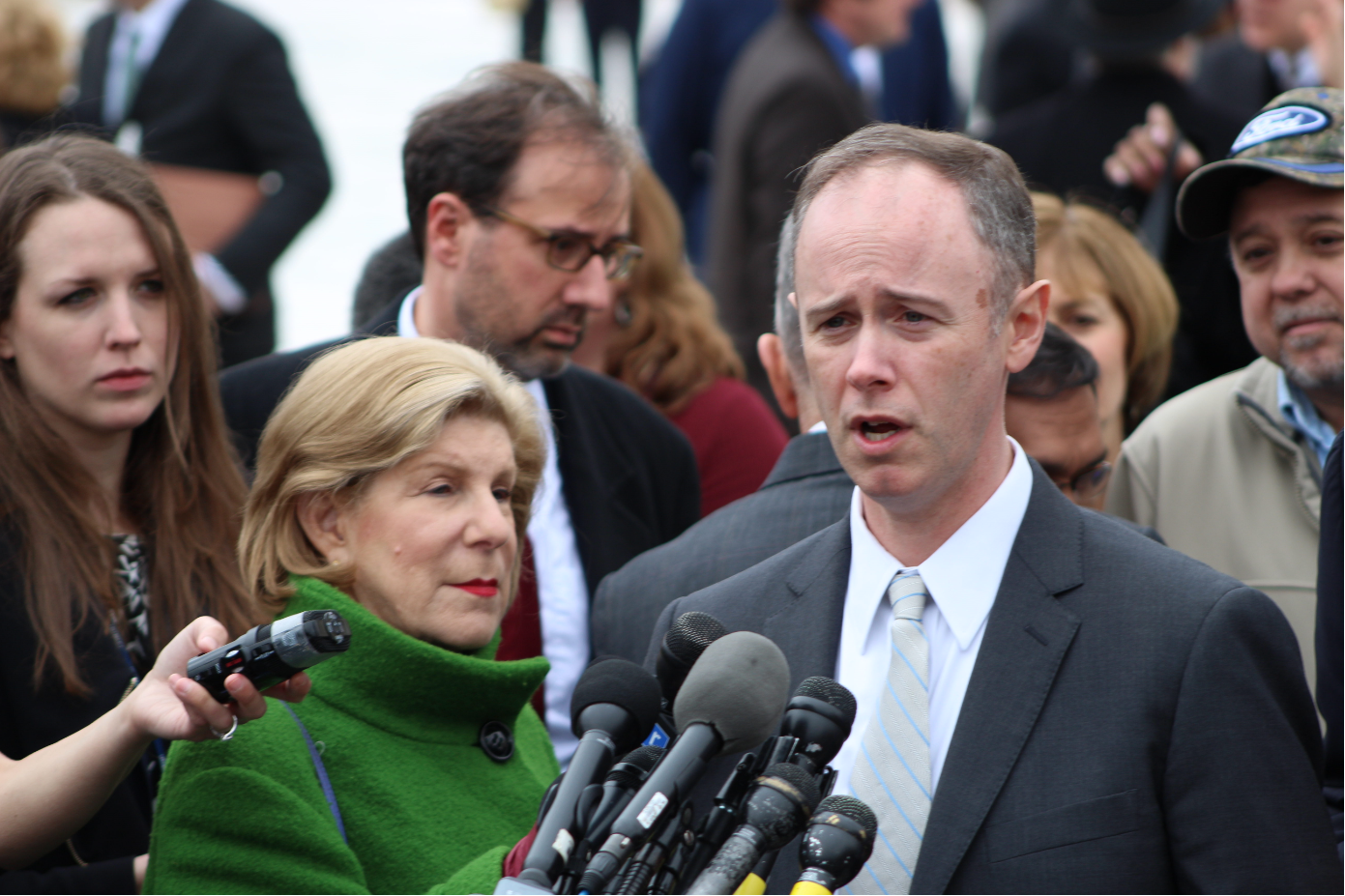
Veteran Foundation staff attorney William Messenger, seen here speaking to reporters after Supreme Court oral arguments in Janus, leads the Foundation’s Janus enforcement task force.
CHICAGO, IL – Although Janus v. AFSCME secured a landmark victory at the U.S. Supreme Court for government employees’ First Amendment rights, Mark Janus’ case is not over because AFSCME union bosses have refused to return the funds taken from him in violation of the First Amendment.
Janus’ attorneys from National Right to Work Foundation and Illinois-based Liberty Justice Center have completed briefing with the Seventh Circuit Court of Appeals on the issue of whether union officials can keep money they seized from non-members in violation of their constitutional rights. The case is likely to mark the first time an appellate court will rule on the issue, potentially establishing a precedent that could result in the return of hundreds of millions of dollars seized by union bosses in violation of the Janus precedent.
Janus Secured Workers’ First Amendment Rights
Mark Janus was an Illinois child support specialist whose case was successfully argued at the Supreme Court by National Right to Work Foundation staff attorney William Messenger.
The Supreme Court’s June 27, 2018, decision in Janus’ favor found that any union fees taken from workers like Mark Janus – who was not a member of AFSCME – without the workers’ affirmative and knowing consent violate the First Amendment. Justice Samuel Alito wrote for the majority that compulsory fees “[violate] the free speech rights of non-members by compelling them to subsidize private speech on matters of substantial public concern.”
The Supreme Court sent the case back to the lower courts to determine, among other things, whether Janus is entitled to all the union fees he was forced to pay since March 23, 2013.
Janus’ appeal comes after a district court judge ruled that union officials are not required to refund forced fees seized from non-member workers prior to the Janus decision.
“Just like a thief would not be allowed to keep the money he stole, union bosses must be forced to return funds unlawfully seized from workers,” said National Right to Work Foundation Vice President and Legal Director Ray LaJeunesse. “It would be a massive injustice to deny workers victimized by Big Labor the refunds to which the Supreme Court made clear they are entitled.”
Seventh Circuit Likely First Appeals Court to Rule on Non-member Refunds
Janus will likely be the first case in which an appellate court will evaluate the so-called “good faith” defense that union lawyers have asserted in response to worker lawsuits seeking refunds, arguing that union officials should be allowed to keep funds seized prior to the Janus decision.
This contention has generally succeeded in lower courts despite the Supreme Court asserting that union bosses have been “on notice” for years that mandatory fees likely would not comply with the heightened level of First Amendment scrutiny articulated in the Supreme Court’s earlier Knox v. SEIU decision, also won by Foundation staff attorneys.
Mark Janus is asking the Seventh Circuit to rule that he is entitled to refunds of approximately $3,000 in fees he was forced to pay since March 23, 2013, as the statute of limitations permits. In addition, the case has significant implications for dozens of other cases being litigated around the country for hundreds of thousands of other workers seeking the return of forced fees seized unlawfully by union officials.
Janus Refund Efforts Continue Nationwide
Foundation staff attorneys are currently litigating over a dozen such cases that collectively seek over $120 million in refunds for non-members forced to pay union fees before Janus. Other ongoing lawsuits and potential cases could result in half a billion dollars or more returned to government workers from union treasuries.
“The Janus case is a milestone of worker freedom, but union bosses continue to block workers from exercising their rights and deny workers refunds for dues and fees seized against their wishes,” said LaJeunesse. “We hope the Seventh Circuit Court of Appeals will follow the clear logic of the Supreme Court’s decision in Janus and establish that union bosses cannot profit from violating workers’ First Amendment rights.”





