
Case Closed: Nurse Prevails in 11-Year Legal Fight Over Forced Dues
The following article is from the National Right to Work Legal Defense Foundation’s bi-monthly Foundation Action Newsletter, January/February 2022 edition. To view other editions of Foundation Action or to sign up for a free subscription, click here.
100 Rhode Island hospital employees win refund of dues illegally seized for union lobbying

After over a decade of battling power-hungry UNAP union bosses in court, Jeanette Geary has secured not only refunds of dues seized for union politics, but a First Circuit decision clarifying non-members can never be charged for union lobbying.
WARWICK, RI – Jeanette Geary finally achieved a total victory in her 11-year legal battle against union bosses. She and 99 other current and former nurses at Kent Hospital in Rhode Island received refunds of forced dues that were illegally used to support union lobbying in state legislatures. Foundation attorneys represented Geary throughout her fight.
Geary’s journey began when she grew frustrated with United Nurses and Allied Professionals (UNAP) union bosses in her workplace. “I realized what the union was doing,” Geary explained. “The union leadership had no interest in nurses or our professional work. Their only interest was collection of dues and fees.”
Geary resigned her union membership, but union dues were still extracted from her paycheck because Rhode Island is a forced unionism state that lacks Right to Work protections. However, thanks to the Foundation-won CWA v. Beck Supreme Court decision, nonmember workers can only be forced to pay fees for union activities “germane” to union monopoly bargaining. They cannot be forced to pay the portion of dues that funds activities like union lobbying.
Nurse Harassed for Standing Up to Union Bosses
Geary demanded a breakdown of the union’s expenditures, but union bosses refused to give her a legally required independent auditor’s verification of how they calculated non-members’ reduced forced fees. Like many who speak up against union bosses, Geary became a target for union harassment. “They laughed at me. They had their workplace reps ridicule me on the job and tell me I could file grievances that would be thrown away and said so with a big smile,” Geary recalled.
In 2009, Geary filed federal charges against union officials. The trial revealed UNAP officials were charging non-member nurses for lobbying in state legislatures. Despite the Supreme Court’s clear mandate in Beck that non-members’ money could not be used to fund political causes, union lawyers argued the lobbying was “germane” to the union’s monopoly bargaining.
Thanks to delays caused by President Obama’s illegal recess appointments to the National Labor Relations Board (NLRB), Geary had to file two petitions with the U.S.
Court of Appeals in Washington, D.C., and didn’t get a final NLRB ruling for nearly a decade. Finally, in March 2019, the NLRB ruled 3-1 that union officials cannot charge non-members for lobbying of any kind. It also ruled that union officials must provide independent verification that the union expenses they force non-members to pay have been audited.
Union Bosses Ridiculously Claimed Some Union Lobbying Wasn’t Political
Union officials still wouldn’t abandon their argument that nonmembers could be forced to pay for some union lobbying as a condition of employment. Union lawyers appealed the NLRB’s decision to the U.S. Court of Appeals for the First Circuit. A three-judge panel that included retired Supreme Court Justice David Souter ruled unanimously in Geary’s favor, saying “we see no convincing argument that legislative lobbying is not a ‘political’ activity.”
Union officials made a last-ditch attempt to overturn the decision, requesting an en banc hearing by the entire Court of Appeals, but that request was denied. In September 2021, union bosses finally paid back, with interest, thousands of dollars taken from Geary and 99 other current and former Kent Hospital nurses who were not union members but were charged for the union’s lobbying, bringing the decade-long case to a close.
“Jeanette Geary faced workplace ridicule for her decision to stand up to union bosses, yet she persevered for eleven years,” said National Right to Work Foundation Vice President and Legal Director Raymond LaJeunesse. “In the process, she won important legal precedents that will protect thousands of other workers from having their money illegally used to fund union politics.”
Rhode Island Officers Win Over $110,000 in Lawsuits Ending Forced-Dues Scheme
The following article is from the National Right to Work Legal Defense Foundation’s bi-monthly Foundation Action Newsletter, May/June 2020 edition. To view other editions or to sign up for a free subscription, click here.
Foundation-won settlements also reinstate officers fired after challenging outrageous dues deductions
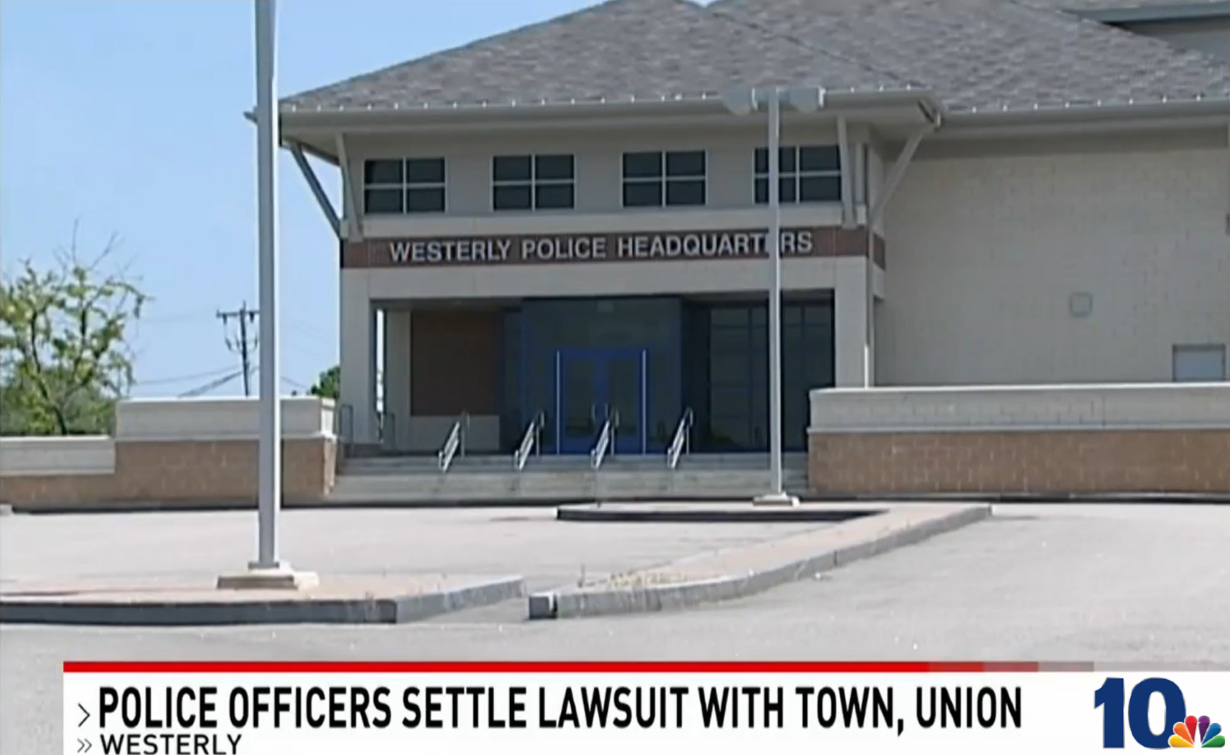
IBPO union bosses and Town of Westerly officials thought they could get away with seizing $5 per hour illegally from five non-union officers. As the result of Foundation-won settlements, all five officers have now had their rights vindicated.
WESTERLY, RI – Reserve Officers Scott Ferrigno, Darrell Koza, Raymond Morrone, Anthony Falcone and Thomas Cimalore have won favorable settlements in their cases challenging a forced union dues scheme between International Brotherhood of Police Officers (IBPO) Local 503 union bosses and Town of Westerly officials. The officers also won favorable settlements for retaliation claims they brought after publicly challenging the unlawful arrangement.
The lawsuits were filed with free legal aid from the National Right to Work Legal Defense Foundation and the Rhode Island-based Stephen Hopkins Center for Civil Rights. Under the settlements, IBPO and the Town of Westerly agreed to pay almost $65,000 in refunds of union fees seized from the officers through the illegal scheme and compensation for the officers’ other claims. Officers Koza and Ferrigno will also be reinstated as police officers and receive nearly $48,000 in back pay from the Town for the period after they were terminated.
“The Foundation is proud to stand with Officers Ferrigno, Koza, Morrone, Falcone, Cimalore, and all public servants who are targeted with intimidation, misinformation, threats of firing, and other illegal tactics simply to keep dues money flowing into the bank accounts of self-interested union officials,” commented National Right to Work President Mark Mix.
According to the lawsuits, IBPO bosses and the Town of Westerly began seizing $5 per hour from each of the five officers’ hourly pay without authorization in April 2014. IBPO and the Town perpetrated this scheme against the officers even though they were classified as “nonpermanent police officers” outside the so-called “representation” of union bosses.
Lawsuit: IBPO Union Bosses and Town Officials Violated First Amendment Rights
Over the next six months, in an attempt to stop the flow of illegal fees in this “backroom deal,” the officers repeatedly sought meetings with Town officials, including the Town of Westerly’s payroll department, the Westerly Chief of Police, the Town Manager and the Town Council, only to be rebuffed. According to the lawsuit, the Chief of Police warned the officers they could be “easily replaced” if they sought publicity for their cause.
The Reserve Officers finally managed to present their objections to the Town Council, but it refused to stop the compulsory fees. On October 20, 2014, within a week of hearing that the Reserve Officers arranged a meeting with the Town Council to argue their objections to the forced-fee scheme, the chief emailed the Town Manager informing her of his plan to terminate Koza and downgrade reserve officers’ priority level for taking on new traffic detail assignments. The five officers contended that this limited the hours they could work and the pay they could earn.
Town Official Assumed Officers Wouldn’t Have Money to Pursue Cases
Records disclosed during the litigation revealed that during a November 2014 meeting between the Town Council and other town and union officials to discuss the potential of litigation in this situation, one official opined, “It’s going to cost thousands and thousands of dollars . . . They’d have to take this money out of their pockets. I don’t think [their attorney] is going to represent them for free.” Another official at the time asserted, “If we say no, they’re probably going to back down.” When the officials considered whether the Reserve Officers would keep working for the Town, one council member commented, “They can always go to McDonald’s.”
In December 2014, the Town fired Koza, who had never been disciplined by the Town before these events. According to Koza’s lawsuit, the Town attempted to justify his termination on the grounds that he had not immediately left his position directing traffic in a busy intersection to move his police cruiser for an officer attempting to drive through a restricted lane. The Town also cited Koza’s calling himself a “police officer” rather than a “reserve police officer” in his application for a handgun carry permit. Koza’s lawsuit points out that the Town’s charter then gave “nonpermanent police officers” like Koza the powers of regular police officers while on duty, and all of Koza’s references in his application called him a “reserve officer,” “reserve police officer,” and “reserve officer with the Westerly Police Department.”
The Town fired Ferrigno in May 2016. According to Ferrigno’s lawsuit, the Town alleged that he left a bicycle race detail assignment early. But Ferrigno contended that he actually stayed five minutes later than he was instructed to by his supervisor while waiting for his replacement to arrive. As further evidence that his firing was unconstitutional retaliation, Ferrigno’s lawsuit also noted that the officer who arrived late to relieve him was a union official, who was never even disciplined for his lateness.
The five filed a lawsuit in the United States District Court for the District of Rhode Island, arguing that IBPO and Town of Westerly officials had violated their First Amendment rights by forcing them to financially support the union when they were outside its contract. The officers’ lawsuit also alleged that Town officials seized union dues without their individual written authorization in violation of Rhode Island’s wage deduction laws. The lawsuit additionally charged that the town retaliated against them when they spoke out publicly about the malfeasance.
Reserve Officers Win Refunds of Seized Dues and Reinstatement
Officers Koza and Ferrigno filed their own complaints in the same court, charging the Town with firing them for exercising their First Amendment rights. All the lawsuits also sought punitive damages. Ultimately, rather than face the officers and their attorneys at trial, Town and Union officials agreed to settle the cases. The settlements order union officials to compensate the officers almost $20,000 and Town officials to pay $45,000 for dues that were seized illegally under the “$5 per hour” policy and for other damages and claims. The settlements in Koza’s and Ferrigno’s cases, on top of requiring the Town to reinstate the two officers and pay back wages, require that all references related to the discipline forming the basis of their lawsuits be removed from their personnel records.
The U.S. District Court for the District of Rhode Island later entered a consent judgment in the case which forbids IBPO Local 503 from forcing any constable or reserve officer to pay union dues or fees without his or her affirmative consent.
“The Town and the IBPO could have avoided the years and expense of litigation if they had only listened in 2014 when we first tried to tell them that they cannot just take $5 per hour from our pay and give it to the Union without our permission,” Officer Cimalore said. “After unsuccessfully trying more than a year to resolve the matter, we were forced to go to federal court.”





