
AT&T-BellSouth Workers Challenge Union-Concocted ‘Window Period’ Restrictions on Ending Dues
The following article is from the National Right to Work Legal Defense Foundation’s bi-monthly Foundation Action Newsletter, May/June 2025 edition. To view other editions of Foundation Action or to sign up for a free subscription, click here.
CWA officials trap dissenting workers, but case asks NLRB to declare ‘window period’ restrictions illegal

Jennifer Abruzzo went straight from being a top CWA union lawyer to being General Counsel of the Biden NLRB. Though President Trump fired her, that doesn’t mean that workers don’t still have to battle the anti-freedom policies she advanced.
MIAMI, FL – In August 2024, Communications Workers of America (CWA) union bosses ordered thousands of AT&T employees across the Southeast to abandon their jobs and go on strike. Unsurprisingly, despite union officials’ propaganda surrounding the strike, many workers disagreed with the decision.
“CWA union officials ordered us to abandon our jobs when many of us just wanted to keep working and supporting ourselves and our families,” commented Amanda Marc, a Miami-based worker for AT&T-BellSouth. “That’s bad enough, but now they’re putting up all these roadblocks to try to prevent those of us who don’t like the union’s agenda from stopping our money from flowing to them.”
Marc is referring to a situation that South Florida AT&T-BellSouth workers have been increasingly dealing with in the aftermath of the strike, which came to an end in September 2024. With free legal aid from National Right to Work Legal Defense Foundation staff attorneys, Marc and her coworker Sofia Hernaiz filed unfair labor practice charges against CWA union officials, detailing that the union hierarchy has ignored their requests to cut off dues payments and has continued to siphon money from their paychecks illegally. Additional charges for other AT&T-BellSouth workers are also being filed.
Dues Kept Flowing to Union After Workers Requested Stop
Marc and Hernaiz’s charges point out that CWA officials are imposing a “window period” scheme on workers who want to end financial support, limiting to just ten days per year the time in which workers can demand that dues deductions cease from their paychecks.
“This kind of behavior makes me feel like they’re really just interested in having control over us and taking our money,” Marc added. Marc and Hernaiz filed their charges with the National Labor Relations Board (NLRB), the agency responsible for enforcing federal labor law.
Marc’s charge in particular challenges the practice of imposing “window periods” as violating the National Labor Relations Act (NLRA): While the NLRA unfortunately allows union officials to prevent a worker from revoking his or her dues authorization card for the first year after it is initially signed, Marc’s charge notes that any further restrictions are unlawful.
“The unions have no statutory license to create tricky and arbitrary ‘window periods’ to force unwilling employees to keep paying dues,” Marc’s charges say.
Because Marc, Hernaiz, and their colleagues work in the Right to Work state of Florida, CWA union bosses are forbidden from forcing workers to pay any union dues or fees as a condition of keeping their jobs, though CWA union officials are trying to limit the exercise of this freedom with their window period scheme. In states that lack Right to Work protections, in contrast, union officials can force employees to pay fees to the union or be terminated, meaning even perfect “compliance” with a union boss’s arbitrary window period restriction would not get a worker out of forced union payments.
Marc and Hernaiz’s charges state that they, and many of their coworkers, resigned their union memberships in August 2024, which was around when CWA union officials ordered AT&T-BellSouth workers out on the strike. Despite the women’s requests to end union membership and stop financial support for the union, the charges read, CWA agents never responded to their requests to stop dues deductions, and never even informed them of the window period dates in which they would consider their requests valid.
Even worse, Hernaiz details in her charge that union officials tried to subject her to internal union discipline for not participating in the strike. Under federal law, union bosses cannot impose union proceedings on workers who are not union members. Foundation attorneys are in the process of aiding other AT&T-BellSouth workers targeted by such illegal discipline.
No Legal Justification for ‘Window Periods,’ New NLRB Should Toss Policy
“Federal labor law is supposed to protect the right of workers to decide freely whether they want to join or financially support a union,” commented National Right to Work Foundation President Mark Mix. “So-called ‘window periods’ exist only to restrict this freedom just so union officials can continue to funnel dues money from workers’ pockets straight into union agendas.
“The NLRB under the new Administration should recognize that this practice contradicts both worker freedom and federal law, and end it accordingly,” Mix added.
Full Foundation Action March/April Newsletter Now Online

All articles from the March/April 2025 issue of Foundation Action are now online.
In this issue:
- Following Foundation Legal Arguments, Trump Fires Biden-Appointed NLRB Bureaucrats
- Hundreds of OH Workers Exit Teamsters as Union Bosses’ Amazon ‘Strike’ Stunt Flounders
- DOJ Attorney Battles Biden Admin Union Power Grab Over Justice Department
- St. Louis-Area Worker Battles Illegal Union Threats to Get Non-Members Fired
- More Minnesota Nurses Send MNA Union Bosses Packing
- Vanderbilt Grad Students Free From Aggressive UAW Campaign
Recent articles can be found here. To sign up for a free copy of the newsletter via mail please see the form at the bottom of the page.
DOJ Attorney Battles Biden Admin Union Power Grab Over Justice Department
The following article is from the National Right to Work Legal Defense Foundation’s bi-monthly Foundation Action Newsletter, March/April 2025 edition. To view other editions of Foundation Action or to sign up for a free subscription, click here.
Foundation attorneys challenge last minute DOJ unionization in violation of FLRA case law

NTEU union bosses backed Kamala Harris for President, but when voters rejected her, NTEU union officials and the Biden-Harris Administration hastily moved to install the union at the DOJ in an apparent attempt to obstruct Trump’s priorities.
WASHINGTON, DC – In states across the country, union officials go to great lengths to gain more political influence, and will often violate established law to do so.
As veteran Department of Justice attorney Jeffrey Morrison is discovering, federal agencies are no exception. Morrison is challenging a last-minute attempt by National Treasury Employees Union (NTEU) bosses to gain monopoly bargaining control over attorneys at both the DOJ Civil Rights Division (CRT, where Morrison is employed) and the DOJ Environment and Natural Resources Division (ENRD).
The unionization campaign was fast-tracked just days after Trump’s November election victory, in an apparent attempt to formally hand NTEU union officials power over the divisions prior to inauguration day. Morrison’s legal action asks the Federal Labor Relations Authority (FLRA) to formally review the actions by the Biden DOJ and NTEU officials. The FLRA is the federal agency responsible for adjudicating disputes between federal employees, union officials, and agencies within the federal government.
Brief: DOJ Holdovers and NTEU Bosses Colluded to Flout Existing Law
Morrison, who is receiving free legal aid from the National Right to Work Foundation, contends in filings before the FLRA that the NTEU’s scheme violates an existing FLRA decision in which the agency ruled that CRT attorneys did not comprise a work unit appropriate for unionization.
DOJ management raised this exact concern about the CRT unit with the FLRA after NTEU union bosses began their campaign, but the DOJ dropped its opposition just days after the November federal elections.
Morrison is asking the FLRA to review the decision of the Regional Director to allow the election to go forward in the CRT and ENRD divisions without properly considering if these divisions are an appropriate unit under the law.
Morrison’s filings (called “Applications for Review”) came after DOJ management and NTEU union officials agreed that the CRT and ENRD were work units appropriate for unionization. His Applications for Review point out that a prior FLRA decision, Antitrust Division, held that CRT lawyers “did not have a separate and distinct community of interest from other DOJ trial attorneys” and for that reason couldn’t stand as a distinct bargaining unit.
“[T]he Authority determined this very unit to not be an appropriate unit…The Regional Director’s failure to comply with current, binding Authority precedent is in error and must be reversed,” the Application for Review says regarding the CRT attorneys. This same argument is applied to the ENRD division because it is similarly situated to CRT in the DOJ hierarchy.
FLRA Failed to Conduct Investigation Into NTEU’s Union Scheme
Morrison’s applications also contend that the FLRA “fail[ed] to conduct an independent investigation into the appropriateness of the unit,” despite the law requiring that the FLRA make such a finding.
“An agency agreeing with a union that a unit is appropriate does not mean that unit is actually appropriate. Agencies, like DOJ here, cannot usurp the Authority’s role in deciding unit appropriateness…” say the Applications for Review.
“Right before power changed hands in Washington, DC, NTEU union bosses and DOJ bureaucrats appear to have colluded to flout longstanding precedent that says Justice Department attorneys cannot legally be unionized division by division,” commented National Right to Work Foundation President Mark Mix.
“The FLRA has ignored established precedent to let this hasty unionization attempt go through, and our attorneys are proud to assist Mr. Morrison in opposing this maneuver.”
Hundreds of OH Workers Exit Teamsters as Union Bosses’ Amazon ‘Strike’ Stunt Flounders
The following article is from the National Right to Work Legal Defense Foundation’s bi-monthly Foundation Action Newsletter, March/April 2025 edition. To view other editions of Foundation Action or to sign up for a free subscription, click here.
Teamsters O’Brien tried to take away Christmas cheer, but couldn’t take away Ohio workers’ freedom

Daniel Caughhorn led a scrappy group of his coworkers in voting Teamsters bosses out of their workplace, a scrap metal processing facility in Toledo, OH. They also beat back union bosses’ attempts to overturn their vote.
WASHINGTON, DC – This past December, Teamsters President Sean O’Brien announced the “largest-ever strike against Amazon,” claiming that thousands of workers would heed his strike order, abandon their delivery vehicles and hit the picket lines. O’Brien threatened that Christmas gifts would be delayed unless his demands were met.
Those who took O’Brien’s rhetoric at face value would have thought he was a veritable Grinch stealing Christmas (even though he tried to explain it was Amazon’s fault that the strike had to occur). But even reporting from pro-Big Labor outlets soon revealed that the order was more story than substance: According to Labor Notes, only about 600 employees obeyed the strike order despite Teamsters honchos claiming to “represent” some 7,000 to 10,000 Amazon employees.
Even the small number who did cease work on O’Brien’s command are arguably not employees of Amazon, and likely aren’t under Teamsters control at all: They work primarily for independent contractors that carry out some delivery functions for Amazon. Even if O’Brien’s dubious theory claiming he had control over those delivery drivers was correct, it would have only affected 10 out of the roughly 110 Amazon centers nationwide. Still, National Right to Work Foundation staff attorneys put a special legal notice out to delivery drivers nationwide informing them of their rights if they were illegally coerced to strike.
Workers Defeat Cynical Attempt by Teamsters to Overturn Vote
The December 2024 Teamsters “strike” against Amazon may go down in history as a strained publicity stunt. But the more significant Teamsters news that month was that hundreds of Foundation-backed workers across Northern Ohio took real action by voting to free themselves from unwanted Teamsters officials’ so-called “representation.”
Dusty Hinkle, an employee for Frito-Lay’s plant in Wooster, OH, and Daniel Caughhorn, a worker at scrap metal firm Omnisource’s facility in Toledo, OH, paved the way to freedom for their coworkers by submitting petitions asking the National Labor Relations Board (NLRB) to hold votes among their coworkers to remove or “decertify” Teamsters unions at their facilities. They submitted these in October and August 2024, respectively, with free Foundation legal assistance.
Because Ohio lacks Right to Work protections for its private sector workers, Teamsters officials enforced contracts that required Hinkle, Caughhorn, and their colleagues to pay union dues or fees as a condition of keeping their jobs. In contrast, in Right to Work states, union membership and all union financial support are strictly voluntary.
The NLRB, the federal agency that enforces federal labor law, administered decertification votes at Hinkle’s and Caughhorn’s workplaces after finding that both petitions contained enough employee signatures to trigger a vote under agency rules. Even though clear majorities of workers voted against Teamsters union control in both votes, Teamsters union officials filed objections alleging misconduct by Frito-Lay and Omnisource management in an attempt to overturn the election results.
However, in both cases regional NLRB officials tossed the union objections and certified the workers’ votes. The Omnisource and Frito-Lay employees — over 430 in total — thereby cut all ties with the Teamsters unions. Now both sets of employees are free both of union bosses’ forced-dues demands and their ability to impose one-size-fits-all contracts on the workplace.
In the final months of 2024, Foundation attorneys assisted a number of other workers from across industries with efforts to remove unwanted Teamsters officials. From just October to December 2024, truck drivers from Georgia, California, Virginia, and New Jersey successfully booted out Teamsters union officials or initiated removal efforts with Foundation aid. These cases came despite increasingly hostile rulemaking from the outgoing Biden Administration’s NLRB bureaucrats in 2024, which undid key Foundation-backed reforms that made it easier for workers to request decertification elections.
Teamsters Schemes to Steal Christmas and Workers’ Rights Both Failed
“Sean O’Brien’s Christmas publicity stunt might have made him seem like an attempted stealer of gifts and holiday cheer, but these two Foundation cases from Ohio demonstrate what Teamsters bosses really are: stealers of workers’ rights and freedom,” commented National Right to Work Foundation Vice President Patrick Semmens.
“That Teamsters officials in both these cases attempted to disenfranchise workers who opposed them shows why workers are turning against their power-hungry tactics, and why American workers deserve the Right to Work choice to withhold financial support from union officials who aren’t serving their interests.”
Dartmouth, MIT, Vanderbilt Graduate Students Challenge Forced Unionism
The following article is from the National Right to Work Legal Defense Foundation’s bi-monthly Foundation Action Newsletter, January/February 2025 edition. To view other editions of Foundation Action or to sign up for a free subscription, click here.
Foundation-backed students defend rights as union bosses seek more power at universities

Ben Logsdon is a Ph.D. student in mathematics at Dartmouth College. But it doesn’t take a genius to realize that union officials’ refusals to accommodate his religious objections just don’t add up.
HANOVER, NH – Just weeks after National Right to Work Foundation staff attorneys triumphed in anti-discrimination cases for Jewish Massachusetts Institute of Technology (MIT) graduate students who sought to stop forced dues payments to a radically anti-Israel union, union officials began creating other problems for university students.
In nearby New Hampshire, Dartmouth graduate student Benjamin Logsdon sought free Foundation legal aid against Graduate Organized Laborers of Dartmouth (GOLD-UE) union officials. The GOLD union — which is an affiliate of the same United Electrical (UE) union involved in the Foundation’s MIT cases — is forcing Logsdon to accept the union’s monopoly “representation” powers against his will, even after he voiced his religious objections to the union’s radical stances on the conflict against Israel.
Grad Students Exposed to Union Coercion & Privacy Violations
Meanwhile, several graduate students at Vanderbilt University in Nashville, TN, are pushing back against an attempt by Vanderbilt Graduate Workers United (VGWU, an affiliate of United Auto Workers) union bosses to impose union control over them and their colleagues. Specifically, three students are seeking to intervene in a federal case in which VGWU union officials are illegally demanding the university hand over the students’ private information to aid in their unionization campaign. Foundation staff attorneys filed motions for intervention for these students in October 2024.
Foundation attorneys are arguing that union officials severely violate students’ rights in both of these cases. However, the reason that union officials are in power on college campuses at all traces back to flawed rulings from the National Labor Relations Board (NLRB) under both the Obama Administration and Biden Administration. These rulings subject graduate students to pro-Big Labor provisions of the National Labor Relations Act (NLRA), which create issues for students’ freedom both inside and outside the classroom.
Logsdon, a Christian Ph.D. student in mathematics at Dartmouth, slammed the GOLD union with federal anti-discrimination charges in September 2024 at the Equal Employment Opportunity Commission (EEOC). According to those charges, shortly after the GOLD union finalized its first monopoly bargaining contract with the Dartmouth administration, he sent a letter to United Electrical General Secretary-Treasurer Andrew Dinkelaker explaining that he objected to being affiliated with GOLD on religious grounds and needed an accommodation.
“I sought to be removed from the UE and GOLD-UE bargaining unit as a reasonable accommodation,” Logsdon’s Foundation-backed charges say.
Dinkelaker refused to offer Logsdon an accommodation that “satisf[ied] [his] religious conscience or beliefs,” according to the charges, which violated his rights under Title VII of the Civil Rights Act of 1964.
Courts have recognized a variety of Title VII religious accommodations over the years for men and women who have religious objections to union affiliation, including paying an amount equivalent to union dues to a charity instead of union bosses. However, Logsdon seeks a different accommodation: to remove himself from union bosses’ control entirely.
At Vanderbilt, three students who identify themselves in legal documents as “John Doe 1,” “John Doe 2,” and “Jane Doe 1” are contending in their Foundation-backed motions for intervention that the Family Educational Rights and Privacy Act (FERPA) forbids the Vanderbilt administration from disclosing their personal information to any third parties without their permission, including the VGWU union.
At the union’s behest, NLRB Region 10 has already hit the Vanderbilt administration with a pair of subpoenas demanding personal student info, while ignoring objections from several students expressing concern at the disclosure.
So far Vanderbilt has resisted the NLRB’s subpoenas, and fortunately a federal court has temporarily allowed the university to refuse to comply with them.
The Foundation-backed students’ motions to intervene argue that the subpoenas “are an attempt to violate FERPA’s protections, privileging union interests over the graduate students[’] privacy rights.” It also points out that FERPA allows students to seek “protective action” if a university receives a subpoena seeking their personal information, as in this case.
The Vanderbilt students and their Foundation attorneys are demanding an opportunity to properly defend their privacy interests under FERPA. Foundation attorneys have already filed Requests for Review asking the NLRB in Washington, DC, to weigh in on the matter.
Union Monopoly Power Has No Place at Universities
“Graduate students around the country are discovering that union bosses don’t respect their individual rights and would rather use students as pawns to force their demands on a university administration, or advance an extreme political agenda,” commented National Right to Work Foundation Vice President and Legal Director William Messenger.
“Union monopoly bargaining is a system particularly ill-suited to an academic environment. Indeed, it is wrong for anyone to have a union monopoly imposed on them against their will and then be forced to pay union dues under threat of termination.”
Full Foundation Action September/October 2024 Newsletter Now Online
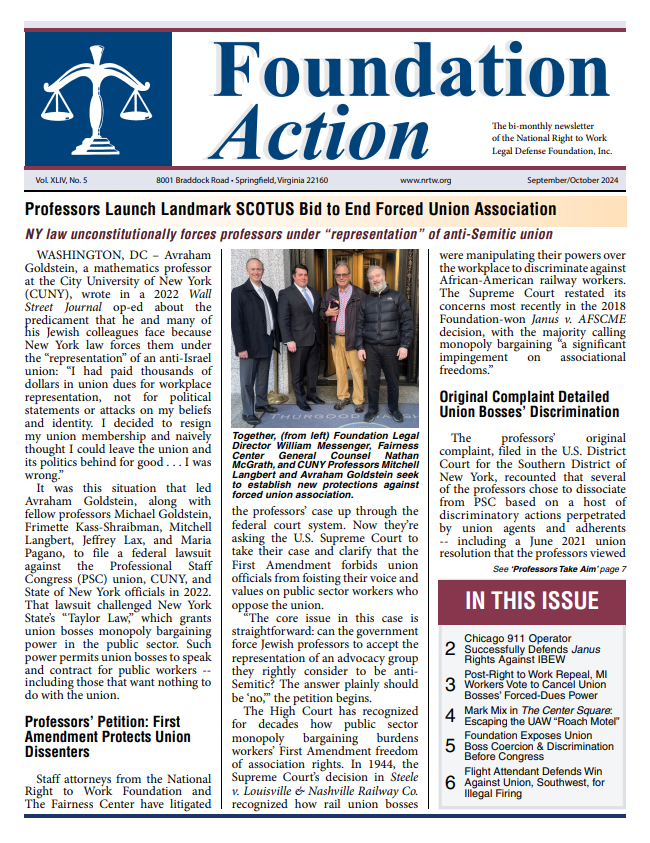 All articles from the September/October 2024 issue of Foundation Action are now online.
In this issue:
- Professors Launch Landmark SCOTUS Bid to End Forced Union Association
- Chicago 911 Operator Successfully Defends Janus Rights Against IBEW
- Post-Right to Work Repeal, MI Workers Vote to Cancel Union Bosses’ Forced-Dues Power
- Mark Mix in The Center Square: Escaping the UAW “Roach Motel”
- Foundation Exposes Union Boss Coercion & Discrimination Before Congress
- Flight Attendant Defends Win Against Union, Southwest, for Illegal Firing
Full Foundation Action May/June 2024 Newsletter Now Online
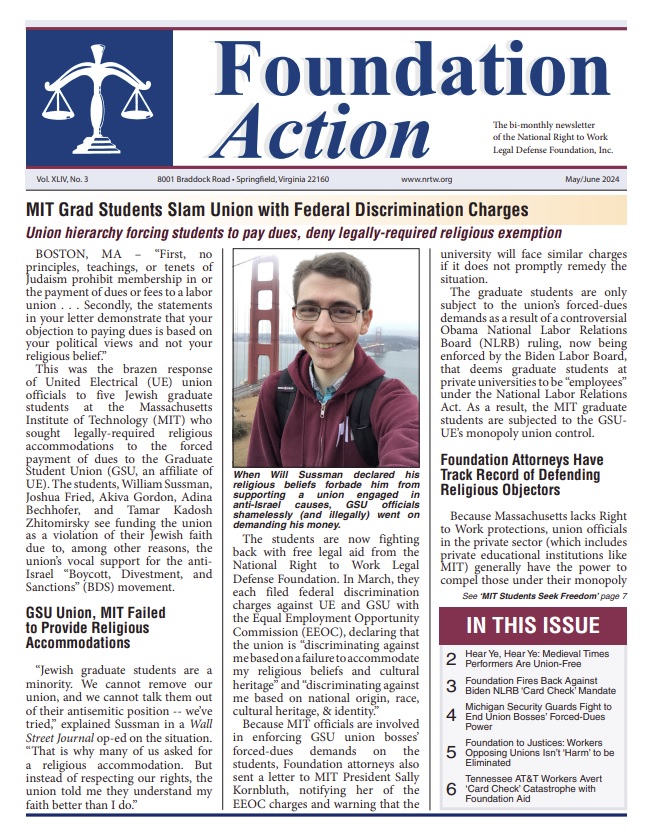 All articles from the May/June 2024 issue of Foundation Action are now online.
In this issue:
- MIT Grad Students Slam Union with Federal Discrimination Charges
- Hear Ye, Hear Ye: Medieval Times Performers Are Union-Free
- Foundation Fires Back Against Biden NLRB ‘Card Check’ Mandate
- Michigan Security Guards Fight to End Union Bosses’ Forced-Dues Power
- Foundation to Justices: Workers Opposing Unions Isn’t ‘Harm’ to be Eliminated
- Tennessee AT&T Workers Avert ‘Card Check’ Catastrophe with Foundation Aid
Recent articles can be found here. To sign up for a free copy of the newsletter via mail please see the form at the bottom of this page.
Puerto Rico Union Bosses Try to Dodge Consequences of Janus Lawsuit
The following article is from the National Right to Work Legal Defense Foundation’s bi-monthly Foundation Action Newsletter, January/February 2024 edition. To view other editions of Foundation Action or to sign up for a free subscription, click here.
Worker still battling scofflaw union officials who tried to saddle him with restraining order

PRASA employee Reynaldo Cruz didn’t back down after UIA union officials tried to foist a specious restraining order on him. He isn’t backing down in the face of UIA union officials’ Janus violations either.
SAN JUAN, PR – When Reynaldo Cruz, an employee of the Puerto Rican Aqueduct and Sewer Authority (PRASA), made a Facebook post referring to a chapter president of the Authentic Independent Union of Water and Sewer Authority Employees (UIA) as “lazy,” the chapter president tried to hit him with a restraining order.
“A UIA union official targeted me with a restraining order for daring to speak out against the union, which is my free speech right,” commented Cruz. “That’s ridiculous coming
from union officials who claim to ‘represent’ me and my coworkers.”
National Right to Work Foundation staff attorneys in October 2023 defeated the UIA official’s specious argument that the court should issue a restraining order against Cruz because he
would have had to “stalk” him to know of his laziness. But Cruz’s battle against the UIA union is far from over.
District Court Refuses to Crack Down on Obvious Janus Violations
Cruz is currently challenging a decision by the District Court of Puerto Rico in his years-long case to reclaim dues money that UIA union officials took unconstitutionally from his paycheck.
The District Court made the puzzling move of dismissing Cruz’s suit as “moot” after UIA officials deposited money due to Cruz with the Clerk of the District Court of Puerto Rico. In his motion to alter and amend the judgment, Cruz argues that because the court has not decided any of his underlying claims or entered a judgment in his favor, he has no entitlement to and cannot seek or obtain that money. Cruz is also appealing the District Court’s dismissal of his suit to the First Circuit Court of Appeals in Boston, MA.
“Until the Court enters a declaratory judgment for Cruz, Cruz’s injury-in-fact will persist because Cruz has not received monetary relief and the Court has not entered judgment for Cruz entitling him to the UIA deposit,” Cruz’s motion reads.
Cruz argues in his suit that various provisions of the Puerto Rico Labor Relations Act, which UIA union bosses relied upon to take money from his paycheck, violate the First Amendment. In 2018, the Supreme Court ruled in the landmark Foundation-won Janus v. AFSCME case that public employees have a First Amendment right to opt-out of dues payments to
an unwanted union, and that public employees must waive this right before any dues are deducted from their paychecks.
Cruz’s Janus lawsuit began in 2017, after UIA officials responded to his request to end his union membership and stop dues payments by telling him that he could only cut ties with the union if he left his current job. In addition to naming the UIA, Cruz’s lawsuit also names the Governor of Puerto Rico in his official capacity as Cruz is also challenging the constitutionality of Puerto Rico’s laws authorizing mandatory dues and so-called “maintenance of membership” agreements.
The Janus case was decided as Cruz’s case was ongoing. The Justices definitively ruled that requiring public sector employees to pay union dues as a condition of employment violates their First Amendment free association rights.
The Puerto Rico District Court issued its ruling on October 17, 2023. In addition to not entering a judgment for Cruz deciding his entitlement to the unconstitutionally seized money, the Court also didn’t reach a conclusion on the constitutionality of the Puerto Rico law authorizing mandatory dues payment and membership, nor did it require the UIA union to abandon anti-Janus contract provisions.
Union Bosses Must Be Made to Comply with Janus
“The ruling in Mr. Cruz’s case poses serious issues for public employees across Puerto Rico and across the country,” commented National Right to Work Foundation Vice President Patrick Semmens. “If allowed to stand, it creates a precedent in which workers get no relief when union bosses seize money unconstitutionally from their hard-earned pay, and in which laws that authorize such illegal dues deductions are allowed to stand despite Janus unambiguously prohibiting them.
“Foundation staff attorneys will continue to fight for Mr. Cruz until his rights are vindicated and he gets a judgment awarding him the money he is constitutionally entitled to,” Semmens added.
Victory: San Diego Charter School Educators Vote Out Teacher Union Bosses
The following article is from the National Right to Work Legal Defense Foundation’s bi-monthly Foundation Action Newsletter, September/October 2023 edition. To view other editions of Foundation Action or to sign up for a free subscription, click here.
SDEA officials stonewalled vote at charter school for years with “blocking charges” and pressure from elected officials
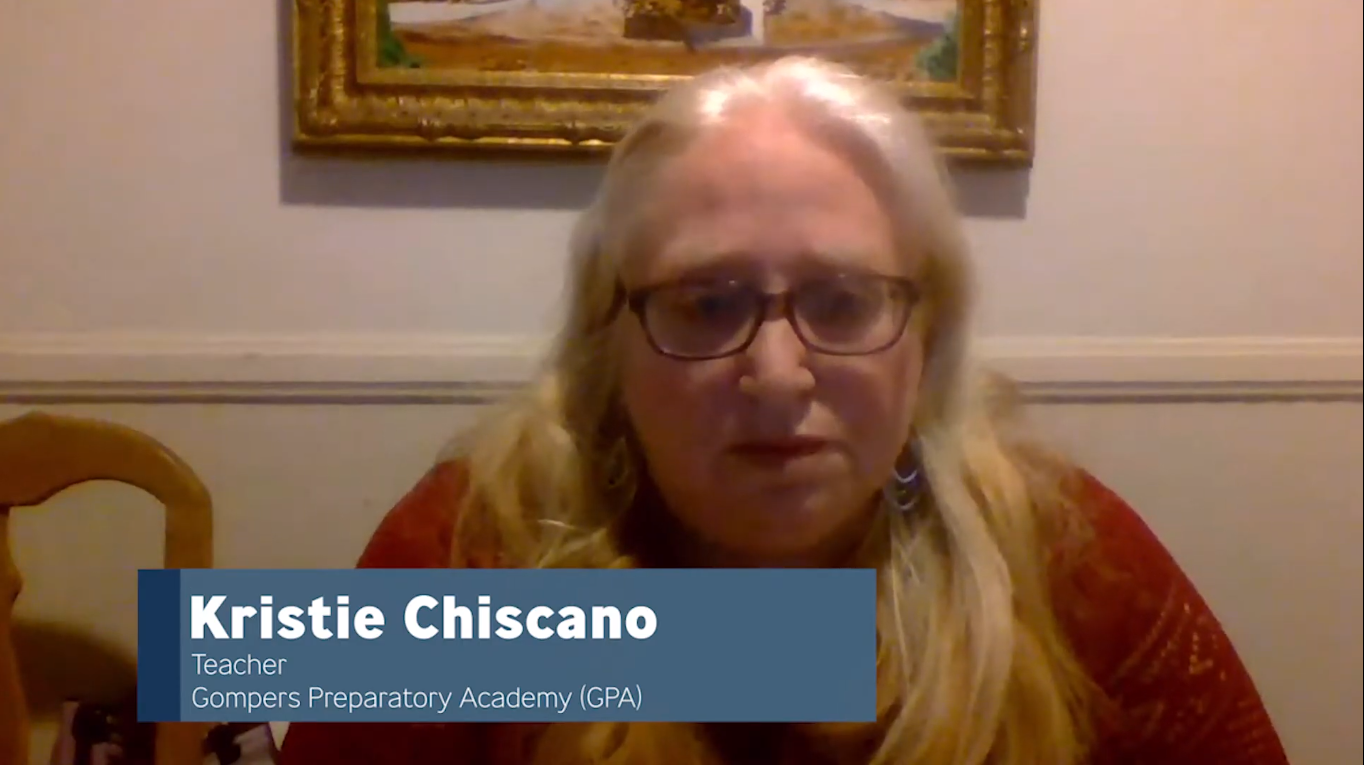
Kristie Chiscano kick-started the first effort at Gompers to remove the SDEA union. She witnessed firsthand that union control was ruining the independent nature of the charter school.
SAN DIEGO, CA – When San Diego Education Association (SDEA) union officials rose to power in 2019 at Gompers Preparatory Academy (GPA), educators and parents were rightfully concerned about what impact it would have on students’ progress and well-being.
Gompers had made an impressive transition to being a union-free charter school in 2005 after years of being plagued by unresponsive union bureaucracies, violence, high teacher turnover, and poor academic achievement. Teachers who feared that union monopoly control would allow such problems to creep back into Gompers quickly began an effort to vote out the union.
“I chose to work at a school that didn’t have a union, and now they’ve come in and they’re running everything about my contract and my work,” Kristie Chiscano, then a Gompers chemistry teacher and proponent of the decertification effort, said at the time.
While union stall tactics derailed Gompers educators’ 2019 effort to oust the union, Gompers educators didn’t give up. A majority of Gompers teachers backed another petition asking the California Public Employment Relations Board (PERB) for a vote to remove the union in 2023. Now, after years of legal maneuvers from union officials, Gompers educators have successfully ousted the SDEA with free legal aid from the National Right to Work Foundation.
SDEA Officials Used Spurious Charges to Block Earlier Teacher Effort
“There is definitely a lot more joy that’s going to be in classrooms now, instead of a burden with the union,” Cynthia Ornelas, a sixth grade Gompers teacher, told KPBS. “The union was making decisions for us, oh my goodness! We never knew what they were deciding because they didn’t communicate with teachers.”
Gompers teachers’ first effort to eliminate the SDEA union stemmed from an October 2019 petition that had the backing of a significant number of teachers, more than required by state law. However, SDEA union bosses averted the election by filing so-called “blocking charges” containing allegations of employer misconduct.
Union officials often manipulate “blocking charges” at the PERB and other state and federal labor relations agencies to stifle worker attempts to eliminate unpopular union “representation.”
As Foundation attorneys defended Gompers educators’ first petition, they also challenged a regulation requiring PERB agents and attorneys to accept union bosses’ “blocking charge” allegations as true. This regulation almost guarantees union defeat of any worker attempt to vote a union out.
Despite the PERB never holding a hearing into whether SDEA union bosses’ claims had any merit or whether they were related to the workers’ dissatisfaction with the union, PERB officials denied a decertification election to Gompers educators in October 2020.
Aside from legal maneuvers, union officials used intimidation and pressure to avoid being voted out. Chiscano and another Gompers educator filed charges maintaining that SDEA agents targeted them on social media for opposing the union hierarchy. California law makes it illegal for union officials to intimidate or retaliate against employees who exercise their right to refrain from union membership. Union-label California legislator Lorena Gonzalez, then an assemblywoman and now a top California AFL-CIO official, even wrote a screed to Gompers management that attacked the National Right to Work Foundation for simply providing legal aid to Gompers educators.
Teachers’ Long Struggle Exposes Massive Power of CA Public Sector Unions
Gompers educators submitted the March 2023 petition at the earliest time permitted by California labor regulations, which immunize union officials from employee-led decertification efforts for all but a tiny window while union contracts are active. Now, nearly four years after their original effort began, Gompers educators are finally free from union control.
“Gompers educators witnessed that SDEA union officials were not acting in the best interests of the students or the school community at large, and they fought courageously to bring back the independent environment that made Gompers a success,” commented National Right to Work Foundation President Mark Mix. “However, Gompers teachers shouldn’t have had to fight as long or as hard as they did simply to exercise their rights. No special interest group in California, or in America, should wield this kind of power over teachers and the public education system.
Full Foundation Action May/June 2023 Newsletter Now Online
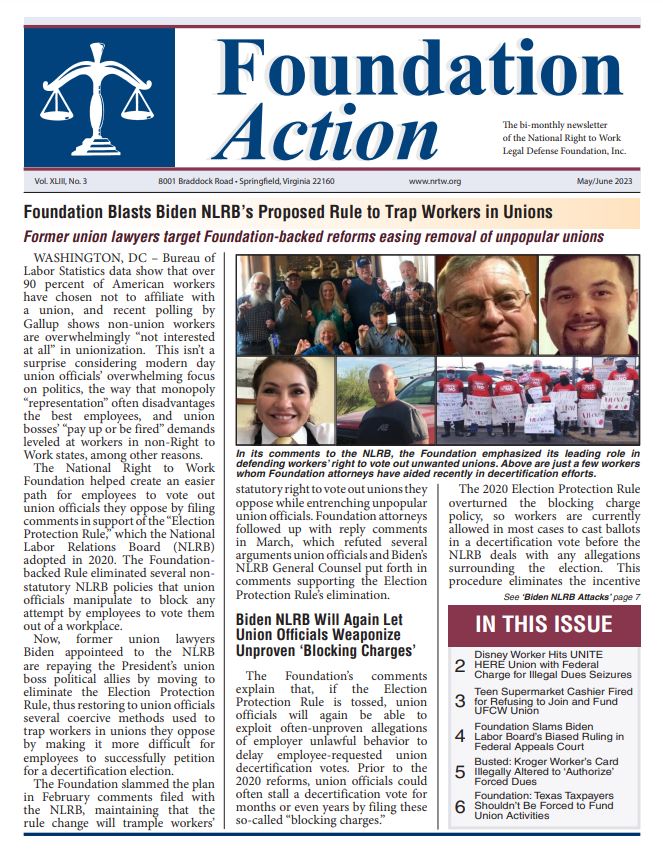
All articles from the May/June issue issue of Foundation Action are now on the website.
In this issue:
- Foundation Blasts Biden NLRB’s Proposed Rule to Trap Workers in Unions
- Disney Worker Hits UNITE HERE Union with Federal Charge for Illegal Dues Seizures
- Teen Supermarket Cashier Fired for Refusing to Join and Fund UFCW Union
- Foundation Slams Biden Labor Board’s Biased Ruling in Federal Appeals Court
- Busted: Kroger Worker’s Card Illegally Altered to ‘Authorize’ Forced Dues
- Foundation: Texas Taxpayers Shouldn’t Be Forced to Fund Union Activities
- Fight for Worker Freedom with an IRA Gift
Recent articles can be found here. To sign up for a free copy of the newsletter via mail please see the form at the bottom of this page.





