
Foundation-Aided Employees Tell Congress: All Workers Need Right to Work
The following article is from the National Right to Work Legal Defense Foundation’s bi-monthly Foundation Action Newsletter, March/April 2024 edition. To view other editions of Foundation Action or to sign up for a free subscription, click here.
Workers’ real-life battles against union bosses emphasize need to end forced union dues
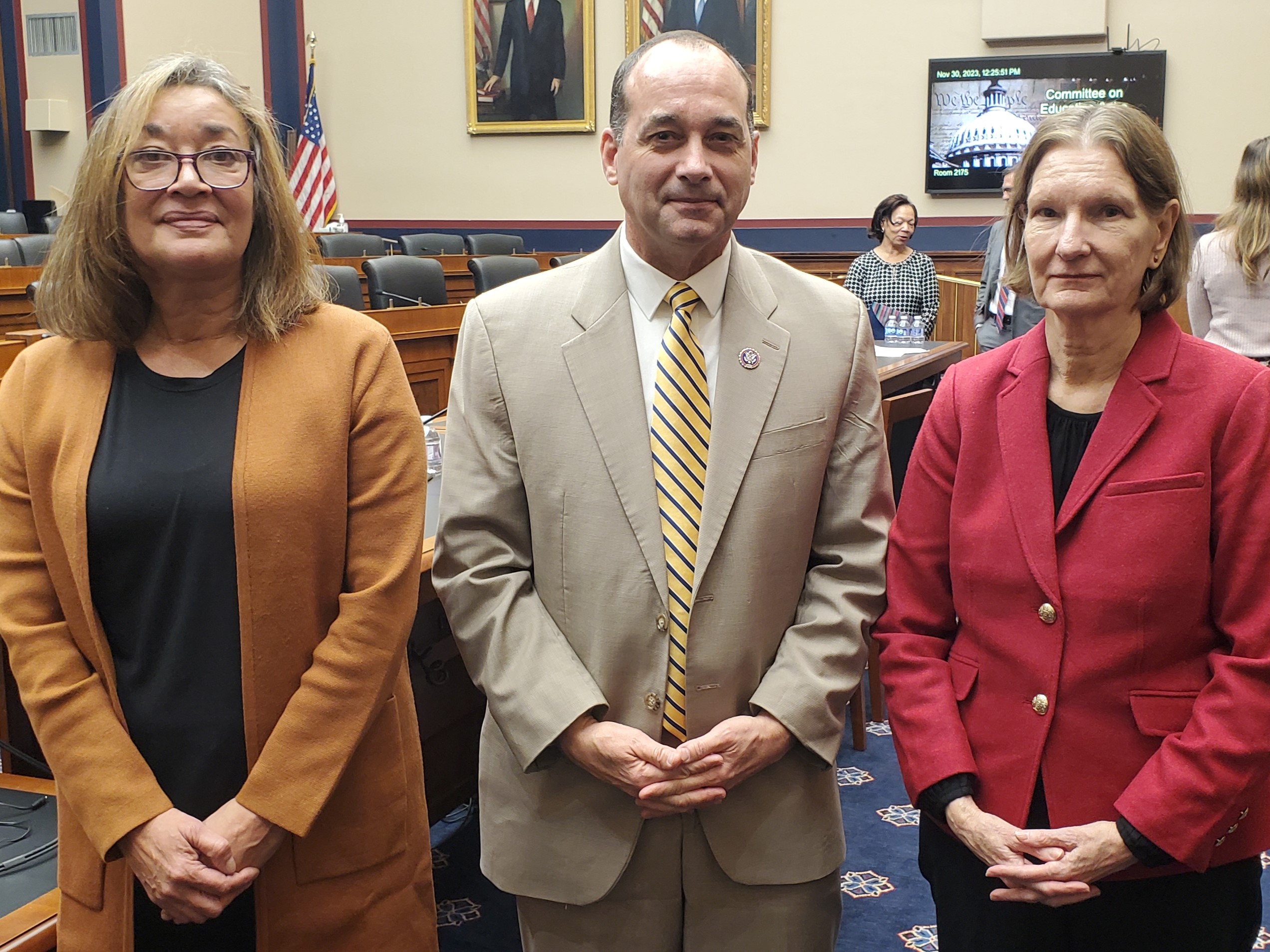
Foundation clients Brunilda Vargas (left) and Jeanette Geary (right) testified to Rep. Bob Good (center) and other members of the House Education and Workforce Committee about the danger forced dues still pose to America’s workers.
WASHINGTON, DC – In November, two recipients of National Right to Work Foundation free legal representation went to Capitol Hill to testify before the U.S. House Committee on Education and the Workforce about their battles against union bosses.
This was the first-ever congressional hearing on the National Right to Work Act, legislation that will safeguard American private sector workers’ freedom to refrain from paying dues to an unwanted union.
Jeanette Geary, a retired nurse, and Brunilda Vargas, a Philadelphia-based public defender, both successfully challenged illegal forced-dues demands with Foundation aid. Their testimony at the hearing, alongside Foundation President Mark Mix, gave policymakers stark examples of how union officials often manipulate their forced-dues powers to advance coercive agendas over the objections of workers.
Vargas, Geary Share Stories of Union Coercion
The current federal law governing most private sector workers in America — the National Labor Relations Act (NLRA) — grants union bosses the power to force workers to pay union dues just to keep their jobs. Only by passing Right to Work laws can states protect workers covered by the NLRA from forced dues.
Meanwhile, airline and railroad employees covered by the Railway Labor Act (RLA) can be required to pay union dues no matter where they work because federal law prevents them from being covered by state Right to Work laws. The one-page National Right to Work Act discussed in the hearing would repeal the portions of both the RLA and NLRA that authorize union officials to require union payments as a condition of employment.
“We’re proud and thankful that Ms. Geary and Ms. Vargas both agreed to testify before Congress on the struggles independent-minded workers face every day because of federal law’s lack of protection for worker freedom,” Mix commented. “Union bosses and their allied politicians don’t want to hear it, but the truth is rank-and-file workers are the victims of Big Labor’s government-granted coercive powers, which makes the stories of those victims especially powerful.”
Geary discussed her struggle against United Nurses and Allied Professionals (UNAP) union bosses, who subjected her and her fellow nurses in Rhode Island to an illegal scheme in which they were compelled to pay for union political expenditures, including lobbying in state legislatures. Geary fought UNAP union officials over the illegal dues demands for 12 years with free legal representation from Foundation staff attorneys. She finally prevailed in 2021, when the First Circuit Court of Appeals unanimously ruled in her favor and rejected a union appeal.
Vargas and Geary: Unions Purposely Hide Rights from Employees
“Unions do not tell employees about their rights because union officials have no incentive to do so, and regular employees without lawyers . . . are left to fend for themselves,” Geary testified before the House Committee. “This is America, and membership in a union and payment of dues should be strictly voluntary.”
Vargas testified about her case against United Auto Workers (UAW) union officials, who threatened to dock the salary of her and any other public defender in her office who refused to let the union seize money directly from their paychecks. Under federal law, even in forced-dues states, union officials must obtain express consent from workers before taking dues money by direct deduction. With Foundation legal aid, Vargas secured a favorable finding from the National Labor Relations Board (NLRB) that initiated a formal prosecution against the union. Eventually, UAW union bosses were forced to settle the matter and end their illegal conduct.
“As attorneys, we do have a level of sophistication when it comes to the law and legal processes. However, I cannot imagine a lay person having to face this type of pressure. I believe that most people sign union membership and authorization cards because they believe they have no choice, and they are often told that,” Vargas testified.
Labor Day Media Round Up: National Right to Work Commentaries Highlight Injustices of Forced Unionism
On Labor Day, the National Right to Work Foundation generated significant coverage in both national and local media outlets, especially on newspaper opinion pages. Foundation President Mark Mix wrote a number of pieces for outlets around the country highlighting the injustices of compulsory unionism and what can be done to protect workers freedom.
Mix wrote for USA Today that no American should be forced to pay union dues just to get or keep a job and highlighted the prevalence of compulsory unionism despite Right to Work laws gaining ground:
Twenty-seven states have now enacted and implemented right-to-work laws, with five joining in the last eight years.
And on June 27 of last year, the U.S Supreme Court handed down one of the most significant employee rights legal victories in the history of the right-to-work movement with the Janus decision, which ended the forced payment of union dues or fees for millions of government workers nationwide.
Unfortunately, there are more private sector American workers in the 23 non-right-to-work states and others in the railway and airline industries who still work under compulsory unionism.
Mix also wrote a column for the Detroit News arguing that no worker should ever have to fear union violence just because they disagree with union tactics or thuggish strong-arming:
Violence, the threat of violence and the wrongful non-violent use of fear and intimidation by union thugs should be illegal. No exceptions.
The spreading UAW corruption scandal shows that union bosses often act as though they are above the law.
For the Lexington Herald-Leader, Mix wrote about how Kentucky’s Right to Work law benefits the state, and why they need to protect it from the attacks of Democrat and gubernatorial candidate Attorney General Andy Beshear, who wants to give power back to union bosses should he be elected to replace Governor Matt Bevin a friend of Right to Work:
Beshear wants to return the Commonwealth of Kentucky to the days of workers being forced to hand over a portion of their hard-earned paychecks to the union boss elites to get or keep a job. Meanwhile, the Bevin Administration has spearheaded record economic growth after passing Right to Work here in Kentucky.
Even putting that enormous economic growth aside, the fact is that one candidate favors allowing Big Labor to extract money from workers’ paychecks, and the other candidate has worked tirelessly to protect Kentucky workers’ right to hold onto their paychecks without union boss interference.
And for the Las Vegas Review-Journal, Mark wrote how Right to Work laws have benefitted Nevada’s workers and families for more than half a century, causing noticeable effects for the state’s economy:
There is a reason Tesla’s Gigafactory is located in Nevada and not California. A nationwide 2017 survey of business leaders conducted by Chief Executive magazine found that, by a 2-to-1 margin, CEOs prefer adding jobs in right-to-work states over other states.
Business owners correctly view states that have passed right-to-work laws as being more welcoming and business-friendly than high-tax, forced-dues states such as California. That is why federal Bureau of Labor Statistics data show that from 2013-18, factory employment growth in Nevada was more than three times greater than in Western forced-union states such as Colorado, Oregon and Montana.
Just a few days after Labor Day, the Daily Caller published a timely op-ed from Mix regarding the Trump Administration’s rules to make it harder for union officials, like those implicated in the unfolding UAW scandal, to spend worker’s money on themselves or fuel their corruption:
At the end of May, the Trump Labor Department unveiled a rule that, as a contemporaneous news account filed by the Law360 legal news service explained, imposes “financial disclosure requirements for certain trusts that unions set up, scrutiny the agency says will ‘deter fraud and corruption.”
The proposed rule would reestablish the Form T-1, which until it was scuttled by union-label Obama administration bureaucrats in 2010 blocked officers of unions with $250,000 or more in annual revenue from using trusts supposedly created to benefit rank-and-file members to circumvent the federal reporting requirements for such unions that Congress instituted in the Labor-Management Reporting and Disclosure Act.
In addition, Mix wrote two op-eds, one for Right to Work states and the other for non-Right to Work states, which were sent out across the country and printed in local newspapers. They highlight the benefits of Right to Work laws and the problems that forced unionism causes.





