
Louisiana ADT Security Services Workers Overwhelmingly Vote to Remove Communication Workers of America Union from Workplace
ADT employees across Pelican State vote nearly 2 to 1 in decertification election to boot CWA union officials
Baton Rouge, LA (June 17, 2024) – Employees at ADT Security Services across Louisiana have overwhelmingly voted to remove the Communication Workers of America (CWA) union from their workplace. ADT Security Services employee Jonathan Rentrop filed the decertification petition with free legal aid from the National Right to Work Legal Defense Foundation.
Rentrop filed the petition on May 7 with the National Labor Relations Board (NLRB), the federal agency responsible for enforcing federal labor law, which includes administering elections to install (or “certify”) and remove (or “decertify”) unions. Rentrop’s petition contained support from a majority of employees, more than enough to trigger a decertification vote under NLRB rules.
The election was held on Wednesday, June 12, and Thursday, June 13, at ADT Security Services locations in Shreveport, Lafayette, New Orleans (St. Rose), and Baton Rouge. According to the official NLRB vote tally, 30 employees voted for removal of the union, while just 17 votes in favor of keeping CWA union officials as their monopoly bargaining representative.
Because Louisiana is a Right to Work state, union officials can’t force employees like those at ADT Security Services to join the union or pay union dues as a condition of getting or keeping a job. In contrast, non-Right to Work states let union officials push for terms that force workers to pay dues as a condition of employment.
However, even in Right to Work states, federal law grants union officials the power to impose their “representation” on all workers in a unit, even those who oppose the union or voted against its presence. A successful decertification election strips union officials of that monopoly power over all employees in the bargaining unit.
“This vote is the latest example of workers across the country exercising their right to remove unwanted unions, with the NLRB’s own statistics showing more decertification elections held last year than in any year since 2017,” said Foundation President Mark Mix. “Louisiana’s popular Right to Work law provides fundamental protections for employees in the Pelican State against being forced to fund a union they oppose, but, right now, that law does not override federal law that forces workers under a union’s so-called ‘representation’ against their will.”
“While we are proud to assist workers in exercising their right to vote out unwanted unions in decertification elections, ultimately the choice of whether or not to be ‘represented’ by union officials should rest with each individual employee,” added Mix.
Detroit School Bus Driver Slams Teamsters Union With Federal Charges for Seizing Full Dues Illegally From Paycheck
Teamsters officials ignored First Student driver’s request to opt-out of funding union politics, similar cases increase after MI Right to Work repeal
Detroit, MI (June 14, 2024) – Frances Dennis, a Troy-based school bus driver for First Student, Inc., has just filed federal charges against Teamsters Local 299 union officials for seizing full union dues payments from her wages even though she resigned her membership in the union. Dennis filed the charges at National Labor Relations Board (NLRB) Region 7 in Detroit with free legal assistance from National Right to Work Foundation attorneys.
Dennis is seeking to defend her rights under the Foundation-won Communications Workers of America v. Beck Supreme Court decision, which forbids union officials from forcing employees who have abstained from union membership into paying dues or fees for anything beyond the union’s core bargaining functions. Union political expenditures, which often make up part of full membership dues, are among those expenses that Beck prevents union officials from forcing nonmember workers into funding. Nonmember workers who exercise their Beck rights are also entitled to an independent audit of the union’s finances and a breakdown of how union officials spend forced contributions.
In non-Right to Work states, including Michigan where Right to Work was repealed earlier this year, union officials’ privilege to force workers to pay dues or fees as a condition of employment is limited by the Beck ruling. Under federal law and U.S. Supreme Court precedents like General Motors v. NLRB, union officials also can’t compel workers to maintain formal union membership as a condition of getting or keeping a job.
In Right to Work states, in contrast, both union membership and all union financial support are strictly the choice of each individual worker.
Teamsters Continue to Take Money for Politics Unlawfully From School Bus Driver
According to the charges, in December 2023 Dennis sent a letter to Teamsters union officials exercising both her right to resign union membership and her right to cut off union dues deductions from her paycheck. At the time, Michigan’s Right to Work law was still on the books, meaning Teamsters union officials should have honored both of Dennis’ requests. However, her charges state that Teamsters agents “did not respond to this letter and continued to deduct dues from her wages.”
Knowing that the Michigan Legislature had set the Right to Work repeal for February 2024, Dennis sent another letter in January 2024 “objecting to the demand of any dues or fees without the protections guaranteed by Communications Workers of America v. Beck.” She also objected to union officials taking dues from her paycheck. Even where forced-dues arrangements are legal, federal law prohibits union bosses from requiring the payment of such dues through direct payroll deduction.
Dennis’ charges report that Teamsters union bosses have not responded to her letter, have not provided her with any of her Beck rights, and continue to seize full union dues out of her wages. Even worse, a union recording secretary told Dennis via text that “she was required…to complete and submit a dues checkoff form” authorizing direct dues deduction as a condition of keeping her job.
After MI Right to Work Repeal, Cases Challenging Forced Dues Pile Up
Dennis’ case is just the latest in a string filed by Foundation attorneys for Michigan workers seeking to challenge union bosses’ forced-dues arrangements in the wake of Michigan’s Right to Work repeal. Earlier this month, Sault Ste. Marie Meijer employee Joseph Arnold hit his employer with federal charges for compelling him to sign a United Food and Commercial Workers (UFCW) union membership form. In Milford, Kroger employee Roger Cornett levied federal charges against both a UFCW local and the store for jointly enforcing a scheme that forces employees to contribute to the union’s Political Action Committee (PAC) to stay employed. James Reamsma, a Grand Rapids-area security guard, is defending a “deauthorization vote” by security guards across Western Michigan to end the forced-dues power of a United Government Security Officers of America (UGSOA) union.
“The Michigan Legislature’s cynical and partisan repeal of Right to Work was a blatant power grab for union bosses across the state at the expense of workers’ right to freely decide whether union bosses have earned their financial support,” commented National Right to Work Foundation President Mark Mix. “As Ms. Dennis’ case and an increasing number of cases from around the state show, union bosses often seek to circumvent or flat out ignore workers’ free association rights, which is why those freedoms deserve stronger and not weaker protections.”
“Perhaps more unsettling is the fact that some of these cases involve union officials illegally funneling worker money into union politics – the same political machine that led to the demise of these workers’ free choice under Right to Work,” Mix added.
St. Louis KIPP Charter High School Educators’ Vote to Remove Unwanted AFT Union Bosses is Now Official
Federal Labor Board has now certified majority decertification vote to end AFT union officials’ “representation” at the school
St. Louis, MO (May 30, 2024) – Teachers, advisors, nurses, and other employees at KIPP St. Louis High School are officially free of the American Federation of Teachers (AFT) Local 420 union. Yesterday, the National Labor Relations Board (NLRB) certified the results of the educators’ May 17 decertification vote in which a majority voted to end AFT union officials’ monopoly bargaining powers at the charter high school.
KIPP teacher Robin Johnston filed a petition to decertify the union on May 2 with NLRB Region 14 in St. Louis using free legal aid from the National Right to Work Legal Defense Foundation. The petition included the signatures of enough employees at the school to trigger the decertification election, resulting in the 19-17 vote against the AFT.
Because Missouri lacks Right to Work protections for its private sector workers (which includes employees at public charter schools like KIPP), union officials have the legal privilege to enforce contracts that force workers to pay union dues or fees to get or keep their jobs. In contrast, in Right to Work states, union membership and union financial support are strictly voluntary.
However, in both Right to Work and non-Right to Work states, union officials in a unionized workplace are empowered by federal law to impose a union contract on all employees in the work unit, including those who oppose the union. The successful decertification vote at KIPP St. Louis High School strips AFT union officials of both their forced-dues and monopoly bargaining powers.
“AFT union officials never stood up for us and instead undermined our students’ success,” stated Johnston. “This was especially on display when union officials called a divisive strike to demand we abandon our classrooms and our students. I’m grateful for my colleagues who have decided to set our school on a better path without the union.”
The KIPP High School educators are not the only charter school employees who have removed unwanted unions with free legal aid from the National Right to Work Foundation. In 2023 in San Diego, CA, employees of Gompers Preparatory Academy prevailed in 2023 after a nearly four-year effort to vote out the San Diego Education Association (SDEA) union, an affiliate of the National Education Association (NEA).
“The decision by KIPP High School educators to remove the union from their school isn’t the first, nor will it be the last time charter school employees decide they are better off without teacher union officials,” commented National Right to Work Foundation President Mark Mix. “The fact is, if it were up to national teacher union bosses at the AFT and NEA, charter schools wouldn’t exist at all. So, it is hardly surprising that the educators at these schools, which provide an alternative to the public schools that are so often under union monopoly control, are choosing to kick out the union officials that oppose their very existence.”
Tire Wholesaler Employees Force RWDSU Union Out of 15 Locations
The following article is from the National Right to Work Legal Defense Foundation’s bi-monthly Foundation Action Newsletter, January/February 2024 edition. To view other editions of Foundation Action or to sign up for a free subscription, click here.
RWDSU union officials abandon 500+ employee unit ahead of vote at tire wholesaler
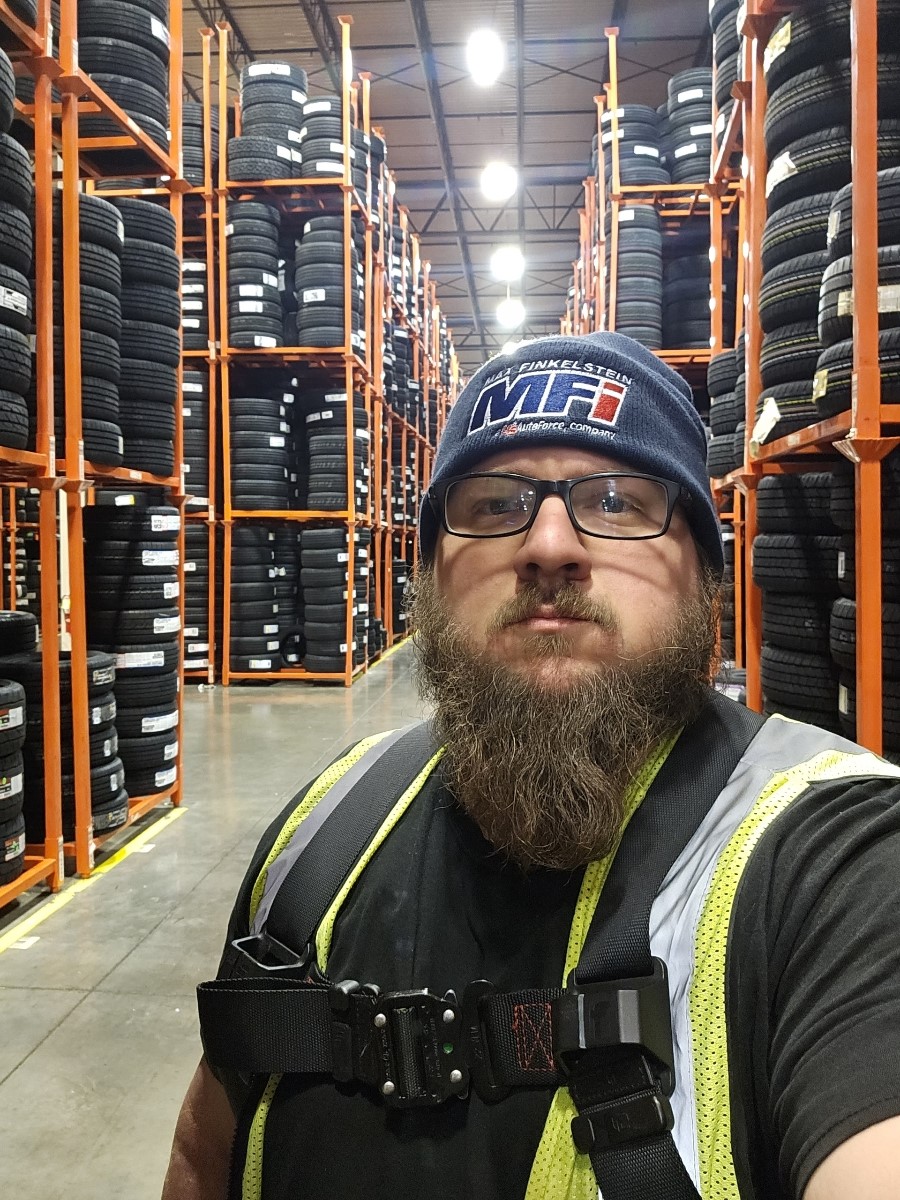
Tire-d of the RWDSU: Chris Dorney submitted a huge number of signatures from his coworkers at tire wholesaler Max Finkelstein when petitioning the NLRB for a vote to remove the RWDSU union.
WINCHESTER, VA – The Biden National Labor Relations Board (NLRB), which includes among its members two former union bosses from the Service Employees International Union (SEIU), is pursuing an agenda that hasn’t exactly been making it easy for workers to vote out a union they don’t want. But that hasn’t stopped workers across the country from going to extraordinary lengths to kick out unions that don’t serve their interests.
In October 2023, Chris Dorney, a Winchester, VA-based employee of tire wholesaler Max Finkelstein, kick-started a cross-country effort to vote the Retail, Wholesale and Department Store Union (RWDSU) out of 15 warehouse facilities across the eastern United States. This work unit included more than 500 employees across Virginia, Maryland, Massachusetts, Pennsylvania, New York, New Jersey, Vermont, Maine, and Connecticut.
Virginia Worker Mustered Strong Showing on Petition for Union Ouster Vote at Tire Wholesaler
With free legal aid from the National Right to Work Foundation, Dorney submitted a petition to the NLRB containing more than enough employee signatures to trigger a vote to remove the union from the large unit.
While Dorney and his fellow Virginia employees enjoyed the Right to Work freedom to opt-out of dues payments to the union, the same couldn’t be said for any of the other employees, all of whom hail from states where dues payments can be mandated as a condition of employment. But voting RWDSU bosses out of power entirely at the tire wholesaler would end the union’s forced-dues power.
“We warehouse workers and drivers at Max Finkelstein may be from many different facilities in many different states, but we are in agreement about one thing: RWDSU union officials don’t represent our interests,” Dorney said of the effort. “It’s our right under federal law to challenge RWDSU’s forced representation power.”
RWDSU Bosses Flee Unit as Union Officials Rack Up Losses Nationwide
However, before the vote could occur, RWDSU union officials disclaimed interest in continuing their monopoly representation powers over the unit, likely to avoid an embarrassing rejection by workers at the ballot box.
Unionized workers are increasingly requesting elections to remove unwanted unions — a potential reason for the Biden NLRB’s efforts to crack down on decertification votes. Additionally, union bosses are increasingly losing these contests. As of last year, filings for union decertification votes had shot up by over 40 percent since 2020. Of decertification elections that occurred, the number which resulted in union bosses losing went up by 72 percent.
“Mr. Dorney and his coworkers’ effort to kick out the RWDSU union, which spanned several states, 15 facilities, and hundreds of workers, is yet another example that workers often want to escape union officials’ one-size-fits-all agenda. It’s also a demonstration that workers will go to great lengths in order to exercise this right,” commented National Right to Work Foundation Vice President Patrick Semmens. “But the Biden NLRB, bent on empowering the President’s union boss political allies, plans to grant unions even more power to defeat workers’ will.”
Foundation Lawsuit: Biden NLRB Structure Violates the U.S. Constitution
The following article is from the National Right to Work Legal Defense Foundation’s bi-monthly Foundation Action Newsletter, November/December 2023 edition. To view other editions of Foundation Action or to sign up for a free subscription, click here.
Groundbreaking suit filed for Starbucks employee who was denied vote to oust unwanted union bosses
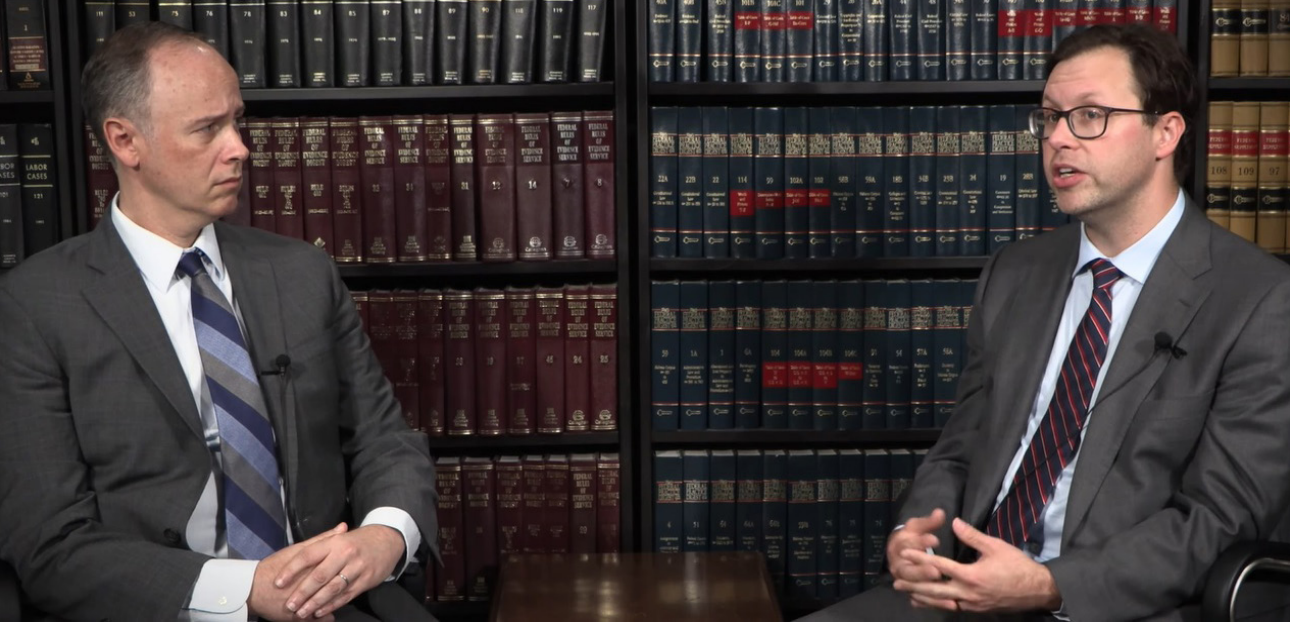
Starbucks employee Ariana Cortes’ Foundation attorney, Aaron Solem (right), is making a cutting-edge argument targeting the NLRB’s lack of accountability.
WASHINGTON, DC – The National Labor Relations Board (NLRB) is supposed to protect the right of workers to freely choose whether to associate with a union or not. The NLRB is also charged with holding unions and employers accountable when they violate worker rights. Too often, however, it has simply acted as an agency that generates policies to entrench union bosses’ power over workers while shielding union bosses from any kind of liability.
A new federal lawsuit from a National Right to Work Foundation-backed Starbucks employee, currently pending at the D.C. District Court, could upend the federal agency and result in a ruling that the current Labor Board’s structure violates the Constitution.
Employee Challenges NLRB Bureaucrats’ Protections from Presidential Removal
Ariana Cortes, a worker at the Buffalo, NY, “Del-Chip” Starbucks branch, hit the NLRB with the groundbreaking lawsuit in October, contending that the federal agency’s current structure violates the separation of powers mandated by the Constitution.
Cortes’ suit follows Foundation attorneys’ defense of her and her coworkers’ petition requesting a vote to remove Starbucks Workers United (SBWU) union officials from their workplace. Regional NLRB officials dismissed Cortes’ majority-backed petition based on SBWU allegations against Starbucks management that have no proven connection to Cortes and her coworkers’ desire for a union decertification vote.
Cortes’ lawsuit argues that because NLRB members cannot be removed at-will by the President, the NLRB’s structure violates Article II of the Constitution. Under Article II, the lawsuit contends, the President must have the power to remove officials that exercise substantial executive power.
Because the NLRB enforces federal labor law, manages union elections, and can issue legally binding rules and regulations, the lawsuit contends that the agency exercises substantial executive power. Therefore, it falls within the scope of the President’s power to remove officials at will. However, the National Labor Relations Act (NLRA), the law that established the NLRB, restricts the President’s ability to remove Board members except for neglect of duty or malfeasance.
“[T]hese restrictions are impermissible limitations on the President’s ability to remove Board members and violate the Constitution’s separation of powers. Thus, the Board, as currently constituted, is unconstitutional,” the complaint states.
Lawsuit: Unconstitutional NLRB Proceedings Must Stop
Cortes’ new federal lawsuit seeks a declaration from the District Court that the structure of the NLRB as it currently exists is unconstitutional.
“For too long the NLRB, especially the current Board, has operated as a union boss-friendly kangaroo court, complete with powerful bureaucrats who exercise unaccountable power in violation of the Constitution,” commented National Right to Work Foundation Vice President and Legal Director William Messenger. “The NLRB’s operation outside constitutional norms is easily exploited by Big Labor.”
“But as the story of Ms. Cortes shows, the NLRB’s unchecked power creates real harms for workers’ rights, especially when workers seek to free themselves from the control of union bosses they disagree with,” Messenger added.
Philly-Area Dometic Employees Slam UAW Union with Federal Charges for Illegal Threats Linked to Strike
Union steward threatened to fine and terminate any employee who chose to work during strike, seized money illegally from workers
Philadelphia, PA (March 11, 2024) – Seven employees of auto accessory manufacturer Dometic’s Philadelphia-area factory have filed federal charges against the United Auto Workers (UAW) Local 644 union, maintaining that union officials ignored their requests to resign union membership during a strike, and are now unlawfully imposing internal union discipline on them. The workers, Nancy Powelson, Eric Angell, Joseph Buchak, Mario Coccie, Md Rasidul Islam, James Nold, and Robert Haldeman, filed their charges at National Labor Relations Board (NLRB) Region 4 with free legal aid from the National Right to Work Legal Defense Foundation.
The NLRB is the federal agency responsible for enforcing the National Labor Relations Act (NLRA), the federal law that governs private sector labor relations in the United States. Under the NLRA, American private sector workers have a right to refrain from union activity, and the U.S. Supreme Court recognized in General Motors v. NLRB the right of employees to resign union membership during a strike.
All seven workers report in their unfair labor practice charges that a union steward told each of them during a September 8, 2023, meeting that a strike would begin the following week and any employee who crossed the picket line during the strike would be subject to internal union charges, fined, and ultimately terminated.
In October, each of the seven employees exercised their right to resign union membership, and returned to work shortly after doing so. However, on December 10, 2023, UAW union officials notified each worker that the union had started proceedings against them and their presence would soon be required at an internal union trial.
“The Union’s act of summoning Charging Party to attend an internal Union trial for post-resignation conduct interferes, restrains and coerces Charging Party in the exercise of…[NLRA] Section 7 rights, in violation of Teamsters Local 492 (United Parcel Service)…and Section 8(b)(1),” the employees’ charges explain.
After Threatening Illegal Discipline, Union Bosses Seized Money Illegally from Workers
According to the employees’ charges, UAW union bosses’ illegal behavior continued into the new year. Between October 2023 and January 2024, each worker invoked their right under the Foundation-won CWA v. Beck Supreme Court decision, asking the UAW to reduce their dues payments to only the amount that the union claims goes toward bargaining.
Because Pennsylvania lacks Right to Work protections for its private sector employees, union officials can impose contracts that force workers who have refrained from formal union membership to pay fees to the union as a condition of employment. However, as per Beck, this fee must exclude any money that funds a union’s political or lobbying activities, and can only include bargaining-related expenses. Beck also requires union officials to provide financial disclosures to workers who send a Beck notice.
Each charge states that “the [u]nion failed to respond or provide the required [Beck] financial disclosures for itself and its affiliated unions,” which is a violation of the NLRA.
UAW Union Officials Seek to Expand Power Despite Controversies
“The UAW is a repeat offender when it comes to union officials prioritizing their own power over the freedoms and well-being of workers,” commented National Right to Work Foundation President Mark Mix. “While we’re happy to help these Pennsylvania employees of Dometic, it’s likely the case that many more workers under UAW control across the country face similar illegal threats and rights violations.
“The UAW, which was also entangled in a years-long federal probe for embezzling workers’ money as recently as 2022, is currently spending millions to attempt to expand their monopoly bargaining power over additional workers,” Mix added. “Workers targeted by UAW officials for unionization have plenty of reasons to be skeptical of the union hierarchy’s motives and should seek Foundation aid in learning about and defending their rights.”
Right to Work Foundation SCOTUS Brief: Workers Exercising Right to Oppose Unions Isn’t “Harm” to Be Eliminated
In case to be heard by Court, Foundation argues NLRB wrongly asserts that independent-minded opposition to unions can justify injunctions
Washington, DC (February 29, 2024) – The National Right to Work Foundation has filed an amicus brief in Starbucks Corporation v. McKinney, a case set to be argued before the U.S. Supreme Court later this term that has major implications for the rights of workers who oppose union power in their workplaces.
In the brief, Foundation staff attorneys argue that federal courts should reject National Labor Relations Board (NLRB) requests for preliminary injunctions when the Labor Board claims employee discontent with a union is a “harm” that should be redressed. These injunctions, called 10(j) injunctions, are frequently used by the NLRB to force employers into certain union-demanded behavior, despite the NLRB not having fully adjudicated the underlying union allegations.
The brief points out that an employee’s decision not to support a union is not a harm that needs to be addressed, but rather a “legitimate choice employees have a right to make” under both the National Labor Relations Act (NLRA) and the First Amendment to the Constitution.
“Only if the NLRB can prove an employee was coerced by an employer to oppose a union against his or her will can that employee’s lack of support for the union be considered any sort of a harm to be redressed,” the brief says. “If the NLRB cannot muster such evidence, then the fact that employees are exercising their statutory and constitutional rights…provides no basis for [an] injunction.”
Foundation: Courts Shouldn’t Accept NLRB’s Assumption that Workers Want to Join Unions
In the Starbucks v. McKinney case, the NLRB sought an injunction at the behest of Starbucks Workers United (SBWU-SEIU) union officials against Starbucks for unfair labor practices the company allegedly committed at a location in Memphis, Tennessee. A major reason cited by the NLRB for the requested injunction was the fact that workers may choose to oppose the union if the injunction isn’t issued.
The case presents the question of what standard courts should use when evaluating whether to grant NLRB-requested injunctions under the NLRA. The Foundation brief opposes the lax standard that the NLRB and union officials are urging courts to use when deciding whether to issue injunctions.
That standard asks only whether alleged unfair labor practices could potentially coerce workers into not supporting a union. Foundation attorneys argue that “the Court must require the NLRB to prove employees were unlawfully coerced not to support a union because, absent such proof, employees have every right to make that choice” (emphasis added).
Foundation-Backed Starbucks Workers Disprove Specious NLRB Theory
Foundation staff attorneys are currently representing Starbucks employees at several locations across the country who seek to vote out (or “decertify”) the SBWU union. In the brief, Foundation attorneys point out that the NLRB in a similar case (Leslie v. Starbucks Corp.) cited a Foundation-backed union decertification case as a reason that an injunction should be issued against the company – despite the fact that the workers themselves say their opposition to the union had nothing to do with the conduct the union was challenging in that case.
“In taking this position, the NLRB has created a self-satisfying ‘heads I win, tails you lose’ dynamic for itself,” the brief reads. “Evidence that employees support a union is taken to mean they want to support the union. Evidence that employees oppose a union is taken to mean their employer must have wrongfully caused the employees not to support the union. All evidence conveniently leads to the conclusion desired by current NLRB leadership: employees should support unions.”
The case is set to be argued before the Supreme Court on Tuesday, April 23, with a decision expected by the end of the High Court’s term in June.
“The Biden NLRB is working hand in glove with unions to advance a standard that treats worker dissent from unions as a harm to be eradicated, rather than a decision made by competent adults,” commented National Right to Work Foundation President Mark Mix. “The Supreme Court in Starbucks v. McKinney must reject the idea that NLRB bureaucrats can simply twist evidence of legitimate worker discontent with unions into a tool to aid union bosses in gaining leverage over businesses and employees.”
National Right to Work Foundation Issues Notice to VW Chattanooga Employees: UAW Officials May Try to Grab Power Without Vote
Notice informs VW Team Members of their rights in light of threat posed by new NLRB rule for bypassing or overturning a secret ballot election
Chattanooga, TN (February 9, 2024) – The National Right to Work Legal Defense Foundation has released a special legal notice to thousands of autoworkers at Volkswagen’s production plant in Chattanooga, TN. The notice comes as officials of the United Auto Workers (UAW) union are making their third attempt to unionize the facility, despite workers voting down the union in both 2014 and 2019. The full notice is available at https://www.nrtw.org/vw/.
The Foundation’s legal notice informs autoworkers that, due to the National Labor Relations Board’s (NLRB) recent decision in Cemex Construction Materials Pacific, UAW officials can impose the union’s monopoly representation on employees through the so-called “card check” process and bypass the NLRB’s traditional secret ballot vote procedure. A card check drive lacks the security of a secret ballot vote and allows union officials to extract union authorization cards directly from workers, often through misleading or coercive tactics.
“Employees unionized under a card check are not allowed to vote on union representation in a secret-ballot election,” the notice reads. “However, prior to Cemex, employers could refuse to impose union representation on their workers based on a card check. That is why, in the past, Volkswagen employees were allowed to vote on (and reject) UAW representation.”
Union Could Skip Election Entirely or Nullify Unfavorable Election with “Authorization Cards”
The notice explains that Cemex upends the union election process. Now, if UAW union officials claim they have collected authorization cards from the majority of workers in the unit (news reports indicate UAW officials are already claiming this) the union can be granted bargaining power over every worker at the plant without a secret ballot election.
While VW management could request a secret ballot vote in such a circumstance, the NLRB doesn’t have to grant that request. Under the new Cemex standard, it is shockingly easy for the UAW to prompt the NLRB to cancel a vote, or alternatively, to overturn an employee election that doesn’t go in the union’s favor.
As the notice points out: “The UAW is already laying the groundwork for cancelling or nullifying a secret ballot election by filing unfair labor practice charges against Volkswagen.”
Foundation Notice: VW Workers Must Be Vigilant Against Underhanded UAW Tactics
“Volkswagen employees who do not want to be subject to UAW representation must be vigilant about their rights,” the notice reads. “If the UAW can collect authorization cards from a bare majority of Volkswagen workers, the UAW can impose itself on Volkswagen employees quickly and without them being able to vote on whether they actually want union representation.”
The notice reminds Volkswagen workers that they have the right not to sign a union authorization card, and a right to revoke authorization cards they’ve signed. It also advises workers of their right to campaign against the union and to circulate petitions against union representation.
Finally, the notice informs employees that they can contact National Right to Work Foundation staff attorneys for more information on their rights or for free legal aid in exercising them. The Foundation extends this help to workers especially if they are threatened or forced to accept unwanted union representation, or if they witness union agents misleading or coercing employees to sign union authorization cards.
In 2013, Foundation attorneys represented eight VW Chattanooga employees. The workers filed charges against the UAW for collecting cards using coercive and misleading tactics, and Foundation attorneys later defended the workers’ vote to reject the UAW after union officials sought to challenge the results of the 2014 vote.
“UAW union officials have returned to VW Chattanooga and appear to be laying the groundwork to bypass a secret ballot vote like the ones union officials lost during previous unionization attempts at the plant,” commented National Right to Work Foundation President Mark Mix. “The new NLRB Cemex card check unionization scheme is untested in federal court, but it appears that UAW officials may seek to make VW Chattanooga workers a ‘guinea pig’ for testing if union officials and NLRB partisans can impose the union on workers without a secret ballot vote.”
“If the UAW is to be believed, UAW officials already secured a sufficient number of union authorization cards to formally ask the NLRB to hold a secret ballot election at VW Chattanooga,” Mix continued. “So VW team members need to understand that additional cards are not needed to request an election, but can be used to bypass a secret ballot vote like the ones held in 2014 and 2019.”
Starbucks Workers Nationwide Rising Up Against Union Representation
The following article is from the National Right to Work Legal Defense Foundation’s bi-monthly Foundation Action Newsletter, September/October 2023 edition. To view other editions of Foundation Action or to sign up for a free subscription, click here.
Foundation provides free legal aid to Starbucks employees looking to remove unions
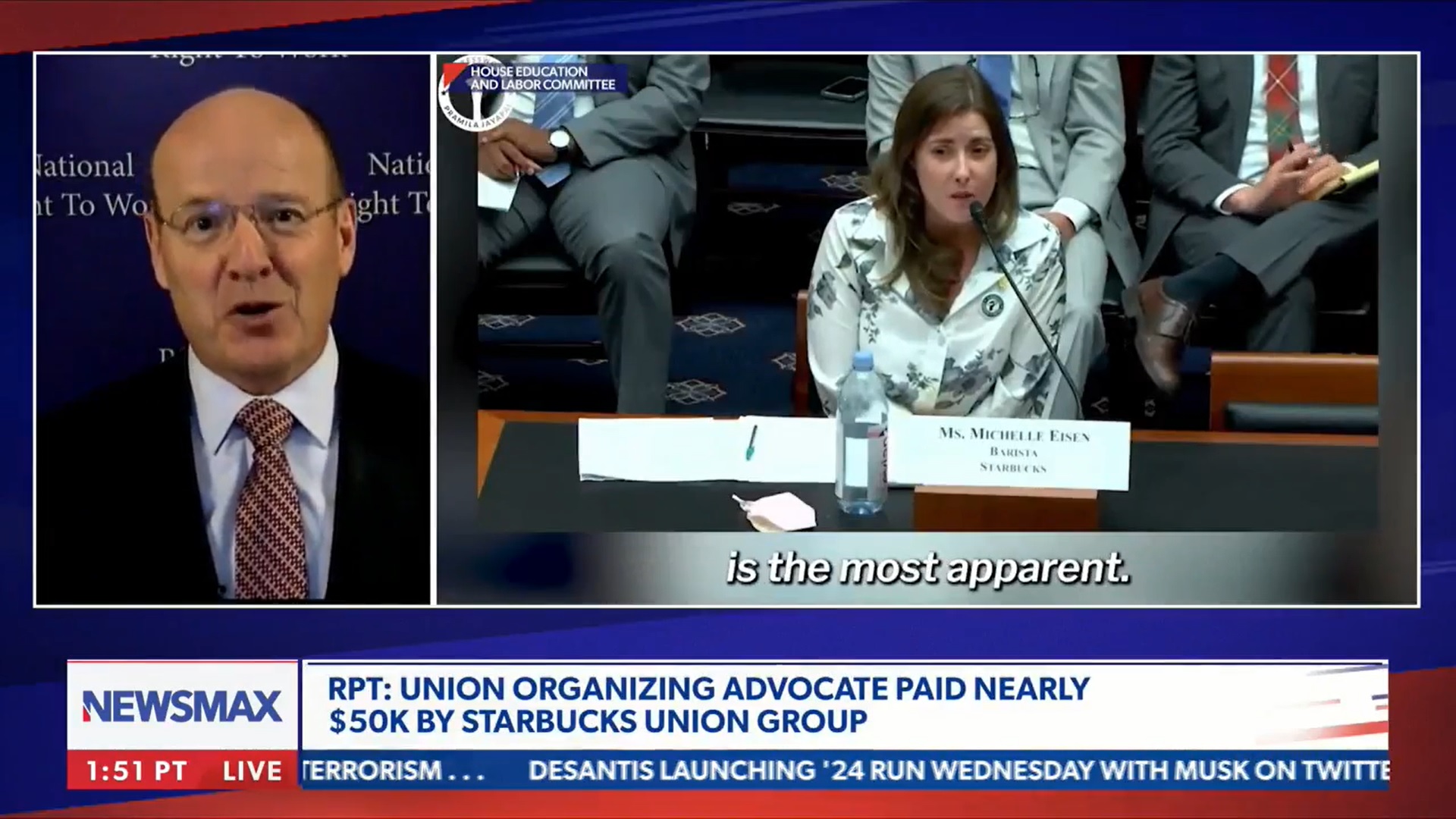
Mark Mix appeared on Newsmax TV this summer to discuss reports that union bosses spent millions to infiltrate Starbucks workforces with union agitators, many of whom hid their affiliations from their coworkers and even Congress.
WASHINGTON, DC – Union bosses and their bought-and-paid-for political allies like Sen. Bernie Sanders and Rep. Alexandria Ocasio-Cortez have been touting the unionization of some Starbucks locations as a breakthrough for Big Labor. But Starbucks employees under union control are increasingly realizing the drawbacks of having union bosses in the workplace and are banding together to say “NO” to union power.
In the last few months, employees at Starbucks locations in Manhattan and Buffalo, NY, Pittsburgh, PA, Minneapolis, MN, and Salt Lake City, UT, have all filed decertification petitions at the National Labor Relations Board (NLRB), requesting the agency hold elections at their stores to remove the Starbucks Workers United (SBWU) union. All have received free legal aid from National Right to Work Foundation attorneys.
But SBWU union officials — boosted by operatives from their notorious puppeteer, the Service Employees International Union (SEIU) — are fighting tooth and nail to remain in power at Starbucks locations where workers want them gone.
SBWU union officials are flooding the National Labor Relations Board (NLRB) with unrelated charges of alleged employer wrongdoing in an attempt to stall these decertification petitions.
Starbucks Worker’s Brief Blasts NLRB Double Standard on Elections
In June, Foundation staff attorneys filed a Request for Review with the NLRB in Washington, D.C., as a part of a case for Buffalo Starbucks worker Ariana Cortes. This request asks the Board to reverse an NLRB Regional Director’s order dismissing Cortes and her coworkers’ majority-backed petition for a decertification election on whether to remove SBWU.
The filing emphasizes that the employees want an election to remove a union that lacks the support of a majority of the workers. Employee free choice is a fundamental principle of the National Labor Relations Act (NLRA), and by denying these employees an election, the Board is undermining free choice.
The brief also observes the basis for blocking the vote is contradicted by the NLRB allowing union-backed certification elections to proceed with little or no delay. The result is that the SEIU is like a roach motel, easy to enter but impossible to leave.
Efforts to Boot SBWU Increasing Across Country
“They have treated us like pawns, promising us that we could remove them after a year if we no longer wanted their representation, and are now trying to stop us from exercising our right to vote,” Cortes said of SBWU union bosses. “It’s obvious they care more about power and control than respecting our individual rights.”
Cortes and her coworkers are not the only workers to become disillusioned with SBWU.
Foundation attorneys recently began representing employees at Starbucks branches at Pittsburgh’s Penn Center East, the Mall of America in Bloomington, MN, and Cottonwood Heights in the Salt Lake Valley, UT, who also submitted petitions demanding decertification votes on SBWU union officials.
“SBWU union bosses have not looked out for the interests of me and my fellow employees,” commented Pittsburgh Starbucks employee Elizabeth Gulliford. “We simply want to exercise our right to vote out a union that we don’t believe has done a good job, and both SBWU and Starbucks should respect that right and our final decision.”
The Starbucks employee-led decertification attempts all took place about one year after union power was installed at these stores — meaning workers seized the opportunity to decertify nearly as soon as legally possible. Federal labor law prevents workers from exercising their right to remove an unpopular union for at least one year after the union is installed.
Biden NLRB Propping Up Union Boss Attempts to Squash Votes
“It is becoming increasingly obvious that SBWU officials seek to extend their power over as many Starbucks workers as possible, with little regard for the employees they claim to ‘represent,’” commented National Right to Work Foundation Vice President and Legal Director William Messenger. “And as we’ve seen in Ms. Cortes’ case in Buffalo, Biden NLRB officials are more than willing to indulge union bosses’ legal maneuvers to cling onto power even when workers have clearly had enough.”
“SBWU officials should not seek to disenfranchise the Starbucks workers they claim to ‘represent’ as those workers try to flee the SBWU’s clutches,” Messenger added. “The union officials’ conduct shows why fundamental changes must be made to the NLRB’s election processes to better protect employee free choice.”





