
Airline Workers Ask Appeals Courts to Invalidate Union Dues Opt-Out Schemes
The following article is from the National Right to Work Legal Defense Foundation’s bi-monthly Foundation Action Newsletter, November/December 2020 edition. To view other editions or to sign up for a free subscription, click here.
Cases challenge requirement that workers opt out of union political spending or else pay full dues

Just “plane” wrong: United Airlines fleet service employee Arthur Baisley (left) and JetBlue Airways pilot Christian Popp (right) are fighting to end schemes that deduct union political expenses out of workers’ paychecks without their consent.
NEW ORLEANS, LA – With free legal representation from National Right to Work Legal Defense Foundation staff attorneys, two airline workers have filed cases challenging union boss policies that require workers to opt out in order to exercise their First Amendment right not to fund union political activities, as recognized in the Foundation-argued 2018 Janus v. AFSCME Supreme Court decision.
The two federal class-action lawsuits were brought for United Airlines fleet service employee Arthur Baisley and JetBlue Airways pilot Christian Popp. They are currently pending in the U.S. Courts of Appeals for the Fifth and Eleventh Circuits respectively.
Workers Challenge Compelled Political Speech
Baisley’s case against the International Association of Machinists (IAM) union has been fully briefed and is tentatively set for oral argument the week of November 30. Meanwhile, the opening brief for Popp’s case against the Air Line Pilots Association (ALPA) union was filed in early October.
The lawsuits contend that under Janus and the 2012 Knox v. SEIU Supreme Court cases — both argued and won by Foundation staff attorneys — no union dues or fees can be charged for union political activities without a worker’s affirmative consent.
Despite this, union officials at the IAM and ALPA enforce complicated opt-out policies that require workers to object to funding union political activities or else pay full union dues. Foundation staff attorneys argue that the Janus decision’s opt-in requirement applies to airline and railroad employees covered by the Railway Labor Act (RLA), taken together with longstanding precedent protecting private sector workers from being required to pay for union political and ideological activities.
Mr. Baisley and Mr. Popp both work in Right to Work states (Texas and Florida, respectively), but the RLA preempts state law. Consequently, they can be forced to pay union dues or fees or be fired. Even under the RLA, however, union bosses cannot legally force workers to pay for political activities.
Cases Could Expand Janus Protections to Private Sector
The lawsuits argue IAM and ALPA’s opt-out policies are designed to trap unwilling participants into full dues in violation of their First Amendment rights. This forces workers to subsidize union political activities against their will, including the part of full dues that union officials use to support their radical political agenda and handpicked candidates for office.
“IAM and ALPA union officials have demonstrated a blatant disregard for the rights of the very workers they claim to represent by creating complicated obstacles for independent-minded workers who want to exercise their right not to fund union ideological activities,” said National Right to Work Foundation Vice President Patrick Semmens. “Although Janus’ biggest impact was to secure the First Amendment rights of all public employees across the nation not to be required to fund Big Labor, these cases demonstrate that Janus’ implications can also protect the rights of private sector workers.”
Foundation Asks Supreme Court to Hear Janus Case Again, Seeking Return of Forced Fees
The following article is from the National Right to Work Legal Defense Foundation’s bi-monthly Foundation Action Newsletter, May/June 2020 edition. To view other editions or to sign up for a free subscription, click here.
Case could set precedent for hundreds of millions of dollars in refunds to Big Labor’s victims
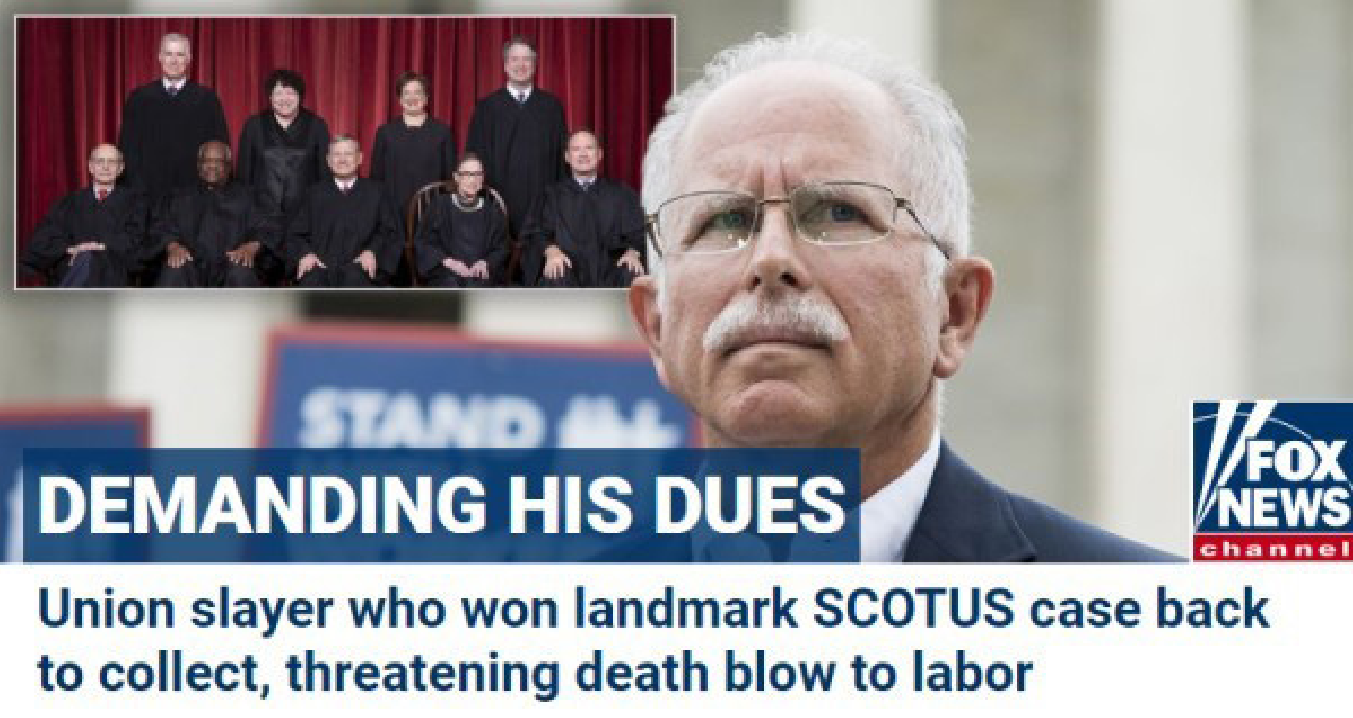
Mark Janus’ second Foundation-backed appeal to the Supreme Court landed the top spot on Fox News’ website. If Janus prevails again, hundreds of millions of dollars in unconstitutional union dues could be returned to public sector employees.
WASHINGTON, DC – Mark Janus is returning to the U.S. Supreme Court, this time asking the Justices to hear the continuation of Janus v. American Federation of State, County, and Municipal Employees (AFSCME), Council 31. Janus seeks repayment of the thousands of dollars in fees the union took from his paycheck in violation of his First Amendment rights. Another Supreme Court victory for Janus could set a precedent resulting in the return of hundreds of millions of dollars seized by union officials in violation of workers’ constitutional rights.
The original Janus v. AFSCME was argued successfully before the Supreme Court by veteran National Right to Work Foundation staff attorney William Messenger. In a landmark victory, the Court sided with Janus on June 27, 2018, and declared it illegal to force public employees to subsidize a union as a condition of employment. The Court recognized that compelling public workers to pay fees to a union violates their First Amendment rights.
Illinois Child Support Public Servant Intervenes in Lawsuit with Foundation Aid
As a result of Janus, more than five million public sector employees across the country are no longer required to pay union dues or fees to keep their jobs. However, Janus’ case continues as he seeks the return of the fees that AFSCME seized from his paycheck without his permission from June 27, 2018, to March 23, 2013, representing the two-year statute of limitations from the date his case started in March 2015 through the Supreme Court’s 2018 decision in his favor.
The Janus case began in February 2015, when then-newly elected Illinois Governor Bruce Rauner issued an executive order prohibiting state agencies from requiring employees who had abstained from formal union membership to pay union fees, based on a Right to Work Foundation U.S. Supreme Court victory in 2014 in another Illinois case. Rauner also filed a federal lawsuit seeking a declaratory judgment that forced union fees violate the First Amendment rights of public workers.
Staff attorneys from the Foundation, in partnership with the Illinois-based Liberty Justice Center, filed a motion for Mark Janus and two other plaintiffs to intervene in the case in March 2015, and have represented Janus ever since. The U.S. District Court for the Northern District of Illinois granted Janus’ motion to file a complaint in intervention, which allowed the suit to move forward even after the court ruled that Rauner lacked standing to pursue the lawsuit.
The Supreme Court permitted union bosses to impose forced union fees on public workers in the 1977 Abood v. Detroit Board of Education decision. However, before the Janus victory, Foundation staff attorneys secured several victories for workers which called the constitutionality of forced fees into question. In 2012, the court ruled in Knox v. SEIU that union officials must obtain affirmative consent from workers before using workers’ forced union fees for special assessments or risk infringing on their First Amendment rights. In 2014, the court ruled in Harris v. Quinn that requiring home healthcare providers who receive a subsidy from the government to pay union dues is a First Amendment violation.
Following Janus’ groundbreaking win at the Supreme Court in June 2018, Foundation attorneys continued his case in Illinois federal courts, arguing that the Supreme Court’s ruling is retroactive and that AFSCME should be required to return dues they seized unconstitutionally before the decision. In this and similar cases, union bosses have made a so-called “good faith” argument to defend their seizing of dues before Janus was issued. The U.S. Seventh Circuit Court of Appeals in Chicago ruled in 2019 that AFSCME could keep the unconstitutional dues, prompting Janus’ petition to the Supreme Court.
Hundreds of Millions of Dollars Potentially At Stake
“The Supreme Court agreed that the union taking money from non-members was wrong but the union still has the money it illegally garnished from my paycheck,” commented Janus. “It’s time for AFSCME to give me back the money they wrongfully took.”
Foundation staff attorneys are currently fighting for thousands of workers in about 20 cases which seek refunds of dues seized unconstitutionally before Janus was decided. While Janus is seeking the return of $3,000 of his own money, a favorable decision for him would set a precedent that could result in the return of over $120 million to public servants just in Foundation-backed cases. Other cases brought by workers could bring that total to hundreds of millions of dollars.
Workers Already Winning Refunds of Illegal Dues with Foundation Legal Aid
“The Supreme Court has already sided with the Foundation arguments for Mark Janus and ruled that forcing public employees to fund union activities violates the First Amendment,” said National Right to Work Foundation Vice President and Legal Director Raymond LaJeunesse. “The Supreme Court should take this case again to ensure that public sector union bosses are not permitted to profit from their widespread violation of workers’ First Amendment rights.”
Foundation staff attorneys in July 2018 secured the nation’s first-ever refund of dues seized unconstitutionally before Janus for Debora Nearman, an Oregon state wildlife employee. SEIU bosses were forced to settle and give back to Nearman over $3,000 in illegal fees they had seized from her over two years, during which they had sponsored an aggressive political campaign against her own husband, who ran successfully for the Oregon Legislature in 2016.
Final Briefs Filed at Appeals Court in Continuation of Janus v. AFSCME
The following article is from the National Right to Work Legal Defense Foundation’s bi-monthly Foundation Action Newsletter, September/October 2019 edition. To view other editions or to sign up for a free subscription, click here.
Foundation seeks first-in-nation appellate court ruling to order non-member dues refunded
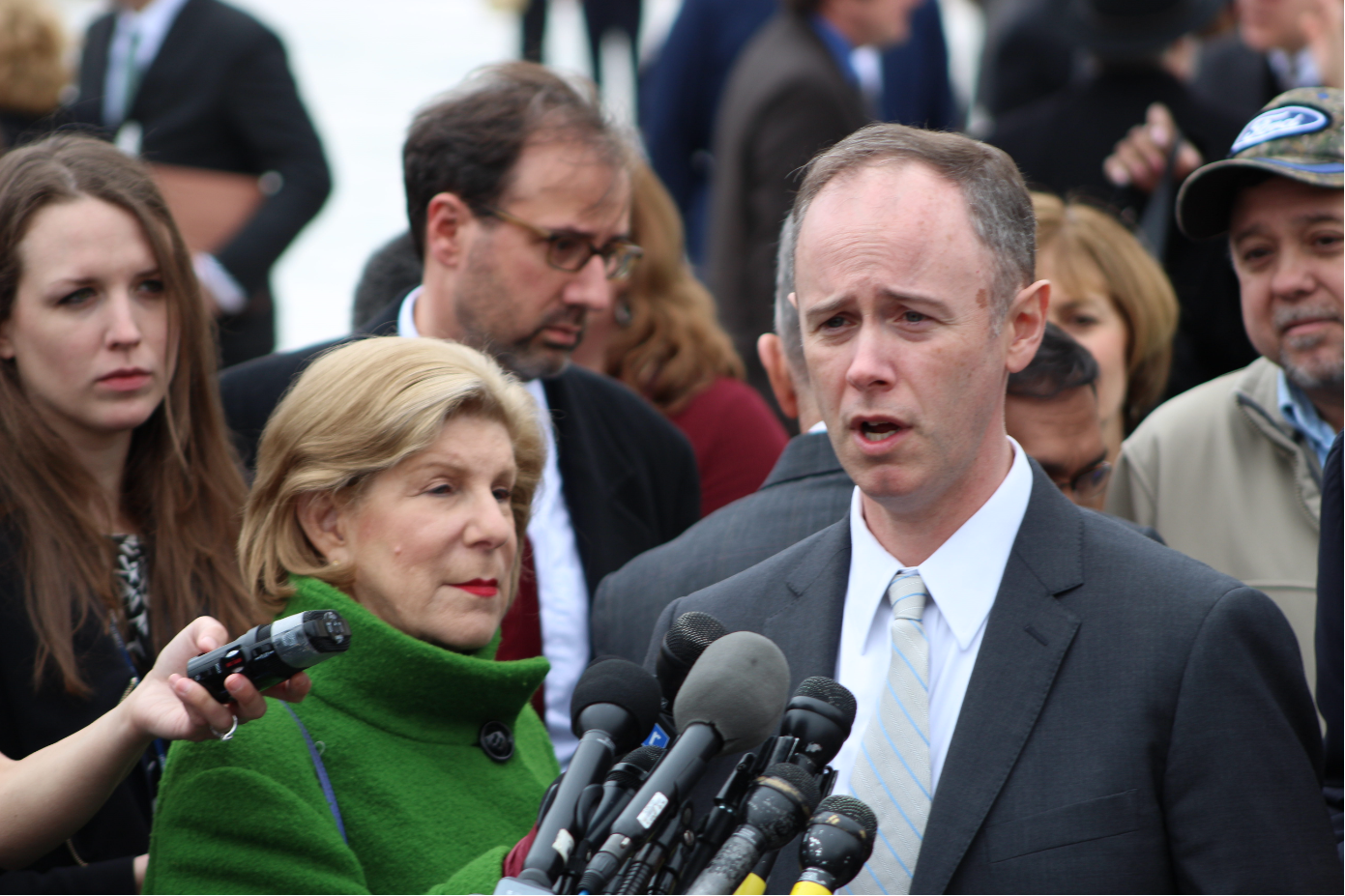
Veteran Foundation staff attorney William Messenger, seen here speaking to reporters after Supreme Court oral arguments in Janus, leads the Foundation’s Janus enforcement task force.
CHICAGO, IL – Although Janus v. AFSCME secured a landmark victory at the U.S. Supreme Court for government employees’ First Amendment rights, Mark Janus’ case is not over because AFSCME union bosses have refused to return the funds taken from him in violation of the First Amendment.
Janus’ attorneys from National Right to Work Foundation and Illinois-based Liberty Justice Center have completed briefing with the Seventh Circuit Court of Appeals on the issue of whether union officials can keep money they seized from non-members in violation of their constitutional rights. The case is likely to mark the first time an appellate court will rule on the issue, potentially establishing a precedent that could result in the return of hundreds of millions of dollars seized by union bosses in violation of the Janus precedent.
Janus Secured Workers’ First Amendment Rights
Mark Janus was an Illinois child support specialist whose case was successfully argued at the Supreme Court by National Right to Work Foundation staff attorney William Messenger.
The Supreme Court’s June 27, 2018, decision in Janus’ favor found that any union fees taken from workers like Mark Janus – who was not a member of AFSCME – without the workers’ affirmative and knowing consent violate the First Amendment. Justice Samuel Alito wrote for the majority that compulsory fees “[violate] the free speech rights of non-members by compelling them to subsidize private speech on matters of substantial public concern.”
The Supreme Court sent the case back to the lower courts to determine, among other things, whether Janus is entitled to all the union fees he was forced to pay since March 23, 2013.
Janus’ appeal comes after a district court judge ruled that union officials are not required to refund forced fees seized from non-member workers prior to the Janus decision.
“Just like a thief would not be allowed to keep the money he stole, union bosses must be forced to return funds unlawfully seized from workers,” said National Right to Work Foundation Vice President and Legal Director Ray LaJeunesse. “It would be a massive injustice to deny workers victimized by Big Labor the refunds to which the Supreme Court made clear they are entitled.”
Seventh Circuit Likely First Appeals Court to Rule on Non-member Refunds
Janus will likely be the first case in which an appellate court will evaluate the so-called “good faith” defense that union lawyers have asserted in response to worker lawsuits seeking refunds, arguing that union officials should be allowed to keep funds seized prior to the Janus decision.
This contention has generally succeeded in lower courts despite the Supreme Court asserting that union bosses have been “on notice” for years that mandatory fees likely would not comply with the heightened level of First Amendment scrutiny articulated in the Supreme Court’s earlier Knox v. SEIU decision, also won by Foundation staff attorneys.
Mark Janus is asking the Seventh Circuit to rule that he is entitled to refunds of approximately $3,000 in fees he was forced to pay since March 23, 2013, as the statute of limitations permits. In addition, the case has significant implications for dozens of other cases being litigated around the country for hundreds of thousands of other workers seeking the return of forced fees seized unlawfully by union officials.
Janus Refund Efforts Continue Nationwide
Foundation staff attorneys are currently litigating over a dozen such cases that collectively seek over $120 million in refunds for non-members forced to pay union fees before Janus. Other ongoing lawsuits and potential cases could result in half a billion dollars or more returned to government workers from union treasuries.
“The Janus case is a milestone of worker freedom, but union bosses continue to block workers from exercising their rights and deny workers refunds for dues and fees seized against their wishes,” said LaJeunesse. “We hope the Seventh Circuit Court of Appeals will follow the clear logic of the Supreme Court’s decision in Janus and establish that union bosses cannot profit from violating workers’ First Amendment rights.”
Airline Workers Contest Union ‘Opt-Out’ Requirement for Political Dues
The following article is from the National Right to Work Legal Defense Foundation’s bi-monthly Foundation Action Newsletter, July/August 2019 edition. To view other editions or to sign up for a free subscription, click here.
Union bosses bullied and illegally threatened to discipline employee who defied strike demands

United Airlines fleet service employee Arthur Baisley (left) and JetBlue pilot Christian Popp (right) are challenging union boss “opt-out” rules that make nonmembers pay for union political spending without their consent.
AUSTIN, TX – United Airlines fleet service employee Arthur Baisley and JetBlue Airlines pilot Christian Popp have filed federal lawsuits against the International Association of Machinists (IAM) and Air Line Pilots Association (ALPA) unions, respectively, challenging union officials’ “opt-out” requirements designed to make non-members pay for union political activities without their consent.
Austin, TX-based Baisley and Fort Lauderdale, FL-based Popp filed their lawsuits with free legal aid from the National Right to Work Foundation. Their Foundation staff attorneys argue that the “opt-out” schemes perpetrated by IAM and ALPA bosses violate workers’ rights under the Railway Labor Act (RLA) and the First Amendment under the standard laid out in the landmark 2018 Supreme Court decision Janus v. AFSCME.
“No employee or private citizen should be trapped in a deliberately-complex system that funnels their money into political speech of which they disapprove. Unfortunately, that is exactly what IAM and ALPA union officials are doing to non-member workers across America,” commented National Right to Work Foundation Vice President and Legal Director Ray LaJeunesse.
The lawsuits contend that under Janus and the 2012 Knox v. SEIU Supreme Court case – both of which were argued and won by Foundation staff attorneys – no union dues or fees can be charged for union political activities without a worker’s affirmative consent.
Popp and Baisley, despite working in the Right to Work states of Florida and Texas, must still pay fees to their respective unions as the RLA preempts state law and permits forced dues. But, even in the absence of Right to Work protections, established Supreme Court precedent forbids unions from putting those compulsory fees towards ideological activities like lobbying or politics.
According to the lawsuits, the processes that IAM and ALPA union bosses require independent-minded workers to go through simply to exercise their constitutional right not to fund “nonchargable” activities are convoluted and typically involve having to “decipher” the opt-out requirements of the union.
Even worse, after Baisley submitted a letter to IAM agents in November 2018 objecting to funding all union political activities, the union officials only accepted his objection for 2019, and told Baisley he would be required to renew his objection to full dues and fees the next year or else be charged for full union dues.
The two complaints challenge these union boss-created policies on the grounds that they “require employees to opt-out of paying union fees that they have no legal obligation to pay” and thus violate workers’ First Amendment rights.
The complaints also allege that the “opt-out” requirements violate the RLA, which governs labor in the air and rail industries and “protects the right of employees to ‘join, organize, or assist in organizing’ a union of their choice as well as the right to refrain from any of those activities.”
Both suits are class-action, and seek court orders requiring union officials to ask for affirmative employee consent for any dues charged for political or ideological purposes in the future.
“These lawsuits show that although Janus’ most direct impact was to secure the First Amendment rights of public employees not to be required to fund Big Labor, the implications don’t stop there,” observed LaJeunesse. “Because the Janus decision made clear workers must opt-in to all political and ideological activity, Foundation staff attorneys are able to cite it in defense of airline workers covered by the Railway Labor Act.”





