
MIT Graduate Students Defeat Discriminatory Dues Demands From Radical Campus Union
The following article is from the National Right to Work Legal Defense Foundation’s bi-monthly Foundation Action Newsletter, November/December 2024 edition. To view other editions of Foundation Action or to sign up for a free subscription, click here.
Union must cease forced dues, inform thousands of MIT graduate students of right to defund union politics
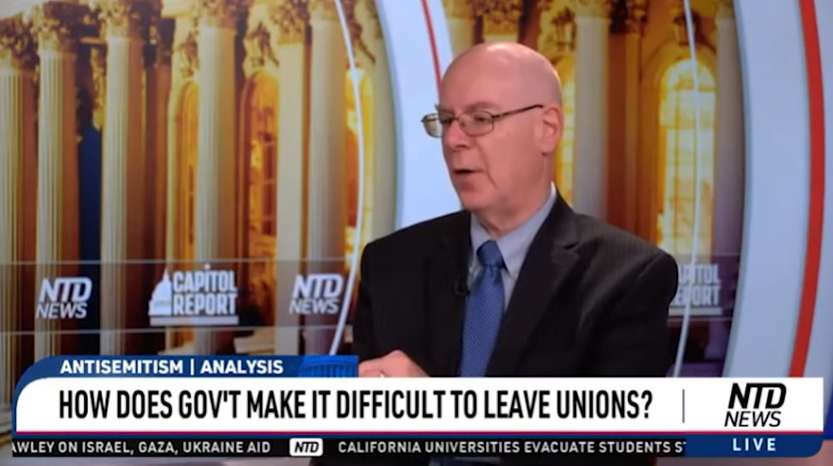
Foundation staff attorney Glenn Taubman, who aided the MIT graduate students in their legal victory, told NTD News his phone is “ringing off the hook” because university students and faculty nationwide are seeking ways to defund radical campus unions.
BOSTON, MA – “Jewish graduate students are a minority at MIT. We can’t remove the [Graduate Student Union (GSU)] or disabuse it of its antisemitism. But we also can’t support an organization that actively works toward the eradication of the Jewish homeland, where I have family living now.”
These were the words MIT Ph.D. student Will Sussman used to describe his, and other graduate students’, battle against radical union bosses at his campus, both in a Wall Street Journal op-ed and in June testimony before the U.S. House Committee on Education and the Workforce. GSU union officials gained the legal privilege to force MIT graduate students to pay dues or lose their academic work thanks to biased rulings by the National Labor Relations Board (NLRB) under both President Biden and President Obama. Since then, they’ve wasted no time in forcing even Jewish students with strong objections to the union’s anti-Israel agitating to fund their activities.
Students Battle Anti-Israel Sentiment Boosted by GSU Union Bosses
However, with free legal aid from National Right to Work Foundation staff attorneys, Sussman and his fellow Jewish graduate students Joshua Fried, Akiva Gordon, Adina Bechhofer, and Tamar Kadosh Zhitomirsky fought back against the GSU’s discriminatory dues demands. They each filed federal charges at the Equal Employment Opportunity Commission (EEOC), charging the GSU with denying them religious accommodations required by Title VII of the Civil Rights Act of 1964. Now they’ve won full accommodations that allow them to cut off all financial support for the union.
Separately, Foundation attorneys also filed federal unfair labor practice charges at the NLRB for Katerina Boukin, who objected on political grounds to the GSU’s ideological activity. Boukin sought to exercise her rights under the Foundation-won Communications Workers of America v. Beck Supreme Court decision, which lets workers who abstain from union membership opt-out of paying for the union’s political expenses.
In the wake of the October 7, 2023, attacks on Israel, Sussman and his fellow students experienced a massive wave of anti-Israel sentiment on MIT campus, including from GSU union chiefs.
“The blood had not yet dried when my colleagues at MIT declared, ‘Victory is Ours,’” related Sussman at a congressional hearing on anti- Semitism in unions. “The full-time GSU staff organizer told NBC10 Boston, ‘Those who rebel against oppression cannot be blamed for rebelling against that repression.’”
GSU Union Backed Off Unlawful Demands After Foundation Intervention
Sussman, Fried, Gordon, Bechhofer, and Zhitomirsky each requested in early 2024 that GSU union officials provide them with religious accommodations to paying union dues based on their objections to union officials’ extremist beliefs. Under federal law, such accommodations vary, but often take the form of letting the objector divert the dues from the offensive union to a 501(c)(3) charity instead. The GSU union’s brazen response was that “no principles, teachings or tenets of Judaism prohibit membership in or the payment of dues or fees to a labor union” and that no religious conflict existed because one of the founders of GSU’s parent union was himself Jewish.
The GSU union backed down after Foundation staff attorneys filed EEOC anti-discrimination charges in response to the lack of accommodation. The students have secured full religious accommodations and will pay money to charities of their choice, despite initial pushback from union bosses. The charities include American Friends of Magen David Adom and American Friends of Leket.
Katerina Boukin’s NLRB case was spurred by her disagreements with the union’s political stances on Israel. She stated that she was deeply offended by GSU’s “opposition to Israel and promotion of Leninist- Marxist global revolution” and that “[t]he GSU’s political agenda has nothing to do with my research as a graduate student at MIT, or the relationships I have with my professors and the university administration.”
“[Y]et outrageously they demand I fund their radical ideology,” Boukin said.
Foundation-Won Settlement Informs Students They Can Defund ‘Marxist’ Union
Foundation attorneys won a settlement for Boukin that not only returned illegally-seized dues to Boukin, but also required GSU bosses to inform the entire MIT graduate student body of their rights to invoke the Beck decision.
GSU bosses were forced to declare by email that they will not restrict the ability of those who resign their union memberships to cut off dues payments for political expenses and pay a reduced amount to the union. This email notice went out to approximately 3,000 MIT students.
Legal Protections Should Protect Employees’ Right to Object on Any Grounds
“The Foundation-backed MIT graduate students who fought these legal battles have earned well-deserved victories. But defending basic free association rights shouldn’t require such complicated litigation,” commented National Right to Work Foundation President Mark Mix.
“This ordeal at MIT should remind lawmakers that all Americans should have a right to protect their money from going to union bosses they don’t support, whether those objections are based on religion, politics, or any other reason.”
U.S. House Committee Spotlights Need for Employee Protections Against Forced Funding of Extremist Unions
Jewish MIT graduate student forced to pay dues to anti-Israel GSU union will testify alongside National Right to Work Foundation staff attorney
Washington, DC (July 9, 2024) – Today, Massachusetts Institute of Technology (MIT) Ph.D. student Will Sussman, who is receiving free legal aid from the National Right to Work Foundation in filing federal anti-discrimination charges against union bosses on campus, is testifying before the U.S. House Committee on Education and the Workforce.
Sussman is testifying alongside veteran Foundation staff attorney Glenn Taubman, who is providing free legal representation to Sussman and other MIT graduate students challenging forced-dues demands from the MIT Graduate Student Union (GSU-UE, an affiliate of the United Electrical Workers union).
The hearing, being held by Rep. Bob Good (R-VA) in the Subcommittee on Health, Employment, Labor, and Pensions (HELP), was called to focus on how union bosses have used their government-granted powers to force Jewish and other employees to associate with and fund unions – even as union officials are propping up increasingly radical protests and other objectionable activities on college campuses and workplaces across the country.
Jewish MIT Graduate Student: BDS-Linked Union Refused to Grant Religious Accommodation
Sussman, who is Jewish, objects to the anti-Israel advocacy of the GSU union, including the union’s endorsement of the “Boycott, Divestment and Sanctions” (BDS) movement. He and four other Jewish graduate students sent letters to GSU union officials earlier this year requesting religious accommodations to union dues payment.
Title VII of the Civil Rights Act of 1964 requires union officials to accommodate those that have religious objections to subsidizing union activities; in practice this usually entails letting the student pay an amount equivalent to dues to a charity. However, GSU union officials’ initial response was to brush aside students’ requests, claiming they didn’t understand their own faith and that their objections were actually political and not religious in nature.
“The union denied my request, telling me in a letter that ‘no principles, teachings or tenets of Judaism prohibit membership in or the payment of dues or fees to a labor union,’ that one of UE’s founders was Jewish, and that opposition to BDS isn’t a position I hold for religious reasons. In other words, UE thinks it understands my faith better than I do,” Sussman’s testimony reads.
Sussman is one of six MIT graduate students that Foundation attorneys are representing in federal proceedings against the GSU union.
Biden NLRB Policy Lets Union Officials Seize Control Over Graduate Students
As Foundation attorney Glenn Taubman’s testimony describes, partisan rulings by the National Labor Relations Board (NLRB) have bypassed Congress and given union bosses the ability to seize control over graduate students: “The current travesty of herding graduate students into anti-semitic unions finds its source with the Obama-Biden National Labor Relations Boards, which have by fiat turned graduate students into graduate employees – subject to unionization under the NLRA and, of course, the payment of forced union dues as a condition of their academic careers,” Taubman’s testimony reads.
Giving unions such monopoly bargaining power not only permits union bosses to dictate the conditions of graduate students’ academic work, but also gives them the power to force students to pay dues in states that lack Right to Work laws (like Massachusetts).
Even worse, union bosses are able to conduct disruptive strikes that stunt academic progress and frequently have outrageous political elements that have no connection to academics: For example, the recent strike United Auto Workers (UAW) union officials engineered against the University of California system was designed to defend anti-Israel rioters who were suspended and pressure university administrators into divesting from companies supporting Israel.
“Mr. Sussman’s situation should provide to American legislators a harrowing example of the kind of harm workers experience when union bosses seize monopoly bargaining power and become the mouthpiece for an entire workplace,” commented National Right to Work Foundation President Mark Mix. “The NLRB under Biden and Obama has done even more damage by expanding this coercion into academia, where campus unions have fomented unprecedented division all while threatening dissenting students with the loss of their academic work if they don’t pay up to support radical union activities.”
“National Right to Work legislation would ensure that those trapped under unwanted union influence can protect their hard-earned money from flowing into union bosses’ pockets,” Mix added. “Ultimately, though, no individual should be forced under union bosses’ so-called ‘representation’ against their will, no matter whether the source of their opposition is religious, political, or any other reason.”
Foundation Winning Protections Against Forced Unionism at Trump NLRB
The following article is from the National Right to Work Legal Defense Foundation’s bi-monthly Foundation Action Newsletter, September/October 2019 edition. To view other editions or to sign up for a free subscription, click here.
Series of victories adds protections against illegal forced dues, being trapped in union ranks
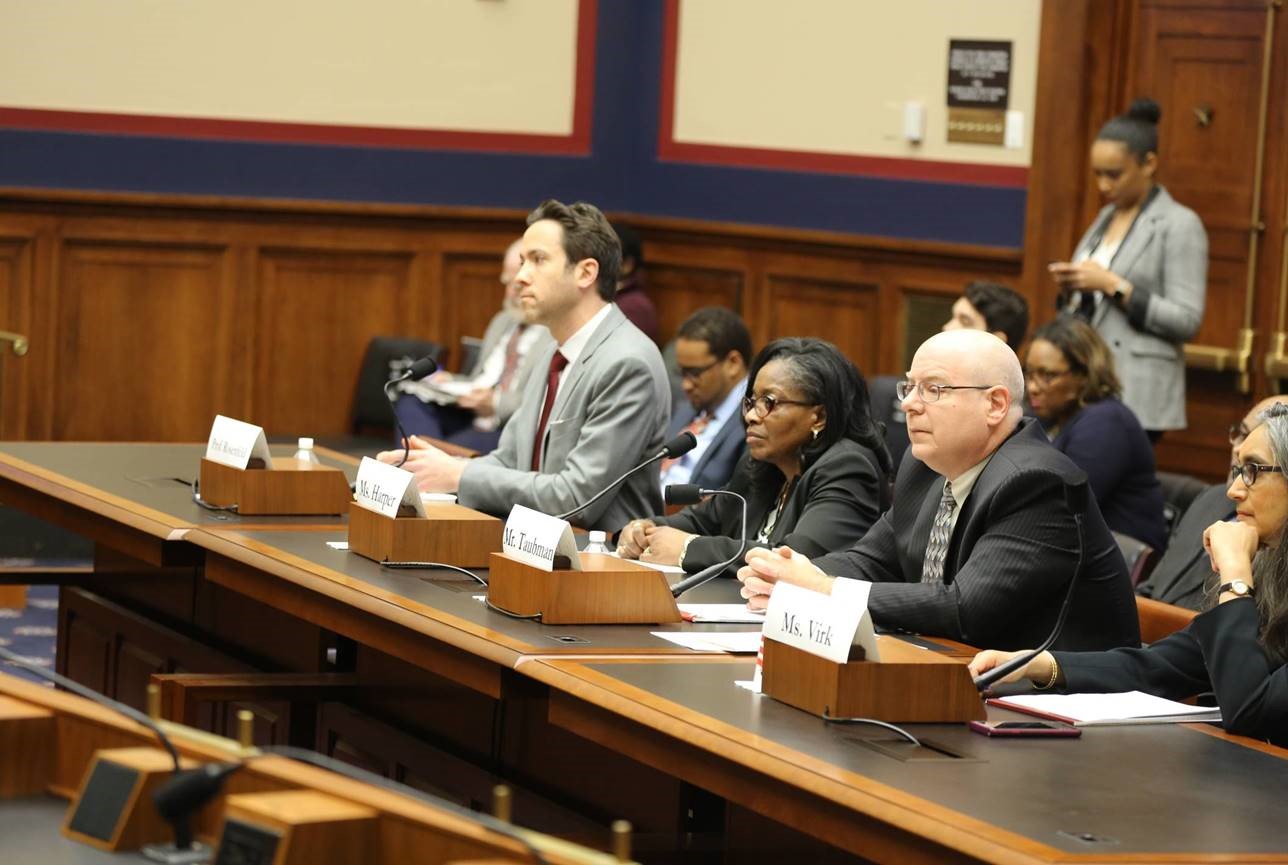
Staff attorney Glenn Taubman testified before Congress in July that existing NLRB rules wrongly favor union bosses over workers.
WASHINGTON, D.C. – In a series of recent victories, the National Labor Relations Board (NLRB) ruled in favor of workers challenging coercive union official practices, with free legal aid provided by the National Right to Work Foundation. The rulings are a stark departure from the Obama NLRB, which regularly stymied the rights of independent-minded employees opposed to associating with union bosses.
Foundation Wins Appeals in Dues Checkoff Cases
In separate cases brought by Foundation staff attorneys for Kacy Warner, a hospital worker, and Shelby Krocker, a Kroger grocery employee, the NLRB General Counsel ruled for the workers and ordered Regional Directors to prosecute union officials’ actions related to language in union dues checkoff forms.
The General Counsel’s decision to sustain Warner’s appeal concerning the checkoff authorized even more additions to the charges, saying the National Nurses Organizing Committee (NNOC) union violated the NLRA by “maintaining confusing and ambiguous dual-purpose authorization forms that unlawfully restrained employees in the exercise of their Section 7 rights.”
The General Counsel noted that the union’s forms failed to tell workers they can revoke authorizations for dues deductions after the union’s contract expires, failed to give workers adequate time to revoke authorizations, unlawfully required workers to use certified mail to send revocation requests, and failed to give “any indication to employees that payroll deduction authorization is voluntary.”
This came just a week after the General Counsel sustained another Foundation-led appeal for Krocker, who charged United Food and Commercial Workers (UFCW) union officials with illegally forcing her to sign a dues checkoff authorization. In both cases, the NLRB General Counsel authorized even more charges against union officials for misleading and confusing language regarding union dues deductions.
NLRB Regions Instructed to Prosecute Beck Violations
Also in July, the NLRB Division of Advice and General Counsel instructed regional directors to issue complaints against unions when union officials fail to inform employees of the amount of reduced union fees they can pay by objecting under the Communication Workers of America v. Beck U.S. Supreme Court decision.
The memos instruct NLRB Regional Directors to more stringently enforce workers’ Beck rights which protect workers from being forced to fund nonchargeable union activities such as union political activities. A memo issued to the Director of NLRB Region 32 read in part that “it is difficult for an employee to make an informed decision about whether to become a Beck objector without knowing the amount of savings that would result from the decision.”
“The Foundation is proud to have represented the California employee whose charge against the UFCW resulted in this Advice Memo, as well as necessitating this heightened disclosure standard by winning the Beck decision at the Supreme Court and the Penrod decision at the D.C. Circuit Court of Appeals,” National Right to Work Foundation Vice President and Legal Director Ray LaJeunesse said. Foundation staff attorneys are currently litigating several additional cases to secure and expand workers’ protections under Beck.
Ruling Aids Workers Trapped in Union Ranks They Oppose
In another Foundation victory for independent-minded workers in July, the NLRB issued a decision that limits union officials’ ability to game the NLRB system to trap workers in monopoly union ranks. The ruling allows employers to withdraw recognition from a union when a majority of its workers sign statements opposing unionization.
Foundation staff attorneys represented two workers, Brenda Lynch and Anna Marie Grant, who spearheaded the collection of signatures from a majority of workers opposed to union representation. Their employer complied with their wishes and sent the union bosses packing. After United Auto Workers (UAW) union officials sought to foist the union back onto the workers despite their clear opposition, Foundation staff attorneys persuaded the NLRB to uphold the UAW’s ouster.
“Instead of union lawyers playing legal games for months or even years to block the removal of a union that lacks majority support, the Board majority takes the common sense approach of asking union officials to prove their claim of support in a secret ballot vote of the workers,” said LaJeunesse.
Federal Board Adopts Foundation-Advocated Reform to Union Decertification Rules
The following article is from the National Right to Work Legal Defense Foundation’s bi-monthly Foundation Action Newsletter, September/October 2019 edition. To view other editions or to sign up for a free subscription, click here.
National Mediation Board simplifies process for workers under Railway Labor Act to remove a union they oppose
At the Foundation’s urging, the NMB removed unnecessary hurdles and simplified the process for rail and airline employees to remove unpopular unions from their workplaces.
WASHINGTON, D.C. – In late July the National Mediation Board (NMB) issued its final rule simplifying decertification procedures under the Railway Labor Act (RLA). The change enables workers in the airline and railway industries to more easily vote to remove a union that lacks the support of a majority of workers.
Before the decision to simplify the process, the NMB used a confusing process that required individual employees to create a fake “straw man” union to replace the incumbent union as the monopoly representative. The decertification process is particularly important because under federal law RLA unions can force workers to pay union dues or fees as a condition of employment even where state Right to Work laws protect other employees from forced union dues.
New Straightforward Rule Vindicates Foundation Campaign for Reform
“The Foundation has long advocated this type of change in the union decertification process and we are pleased the NMB has – as we called upon it to do in comments filed earlier this year – finally made this commonsense reform,” National Right to Work Foundation Vice President Patrick Semmens said at the time.
The NMB’s final decision provides a straightforward procedure for the decertification of a union, meaning workers who do not want union representation won’t have to jump through the hoops of creating and voting for a “straw man” union just to decertify the union that currently has monopoly bargaining power over their workplace.
The NMB’s final rulemaking notice reads: “The Board believes this change is necessary to fulfill the statutory mission of the Railway Labor Act by protecting employees’ right to complete independence in the decision to become represented, to remain represented, or to become unrepresented.”
“This change will ensure that each employee has a say in their representative and eliminate unnecessary hurdles for employees who no longer wish to be represented,” the NMB continued.
The National Right to Work Foundation has long called for these rules to be updated. Foundation attorneys participated in the formal comment period process and appeared at a public hearing to address the NMB and deliver the Foundation’s position. The final rule specifically references the Foundation’s comments, vindicating its efforts in the rulemaking process.
Board Eliminates Confusing ‘Straw Man’ Election Rules
“The National Right to Work Legal Foundation (Right to Work) stated that the proposed change is ‘long overdue,’ and the [Notice of Proposed Rulemaking] is ‘needed to ensure that all employees have an equal and fair choice regarding union representation. The Board has statutory authority to adopt the proposed rules, and should do so as soon as possible,’” the NMB final rule reads.
The confusing rules previously forced individual employees to concoct a “straw man” union to replace the incumbent union as the monopoly representative. Once elected by a majority of the workers, the new “straw man” representative could disclaim collective representation, but was not legally required to do so.
“At long last the National Mediation Board is providing airline and railroad workers covered by the Railway Labor Act a straightforward way to remove unwanted union ‘representation’ through a direct decertification vote,” Semmens said.
“The previous system – in which workers had to create a ‘straw man’ union just to challenge an incumbent union – only served to stymie workers’ rights and demonstrated the historic bias of the NMB in favor of compulsory unionism,” said Semmens. “It wasn’t until the Foundation-won case of Russell v. NMB in 1983 that workers even had an established legal right to throw off their union ‘representative,’ albeit only through the unnecessarily complicated “straw man” system which is finally being replaced with a simplified process to allow workers to exercise that right.”
In addition to submitting the formal comments in May, veteran Foundation staff attorney Glenn Taubman testified in favor of the rule change at the NMB hearing in late March.
Veteran Foundation Attorneys Highlight NLRB Victory for Workers Over UAW Union Bosses
Earlier this month, National Right to Work Foundation staff attorneys won a decision at the National Labor Relation Board (NLRB) for Johnson Controls Inc. employees seeking to remove the United Auto Worker (UAW) union from their workplace.
Foundation Vice President and Legal Director Raymond LaJeunesse and veteran Foundation staff attorney Glenn Taubman, who provided free legal aid to the workers, recently authored an article for the Federalist Society about the victory and how it advances the rights of workers seeking to free themselves from union monopoly ranks:
The main takeaways from this case are: 1) employers can lawfully withdraw recognition of a union when presented with objective evidence (like an employee signature petition) that the union has lost majority support, and they now face less legal jeopardy for honoring the wishes of their employees than they did under the prior regime; 2) secret ballot elections remain the favored method for determining employees’ representational desires, so if the union is “anticipatory” ousted based upon a majority employee petition but believes it actually possesses majority support, it cannot litigate its way back to power using the slow and prolonged unfair labor practice process, but must file for a secret ballot election; and 3) as noted in the dissenting opinion of Obama appointee Lauren McFerran, the Johnson Controls decision could open the door to periodic recertification elections for unions.
Many employee advocates have long urged that recertification elections are desirable. Unlike politicians who must automatically face periodic elections (a.k.a “recertifications”), current NLRB law “presumes” that unions retain majority status in perpetuity. Yet statistics show that 94% of unionized workers have never voted for the union representing their workplace. James Sherk, Union Members Never Voted for a Union, Heritage Foundation, August 30, 2016. If the NLRB adopts a recertification process, unions could not rely upon outdated doctrines granting them perpetual majority status, but would have to periodically prove their majority support. As National Right to Work Foundation attorneys have long argued, permanently encrusting a labor union on a bargaining unit, with no showing of current employee support, does not lead to workplace stability or protect employees’ right of free choice.
Read the rest here.
Learn more about the decision here.





