
Workers File Brief in Appeals Court Challenge to Biden-Era Labor Board Decision Preventing Halt of Union Dues Deductions
National Right to Work Foundation-backed employees are also challenging similar restriction on workers’ right to stop dues in ongoing NLRB cases
Washington, DC (October 13, 2026) – With free legal aid from the National Right to Work Legal Defense Foundation, two employees have filed an amicus brief at the U.S. Fifth Circuit Court of Appeals in a case (Kroger Texas L.P. v. NLRB) challenging a Biden-era National Labor Relations Board (NLRB) ruling blocking employers from ceasing union dues deductions after a contract expires.
The two workers, Brittani Butler and Cypress Meadowlark, are already challenging a separate but related NLRB precedent that restricts employees from stopping dues deductions when no union contract is in effect. Both had attempted to stop union dues deductions only to have those requests ignored by union officials, despite neither being subject to a union monopoly bargaining agreement.
Their brief urges the Court of Appeals overturn a 2022 NLRB decision in a case known as Valley Hospital II. The underlying May NLRB decision at issue in Kroger Texas L.P. v. NLRB, the Board applied Valley Hospital II to find that Kroger unlawfully stopped deducting union dues after contracts with the United Food and Commercial Workers (UFCW) Local 455 had expired.
Prior to Valley Hospital II, under a standard first decided in a 1962 Board Decision, employers could lawfully stop dues deductions after the expiration of a union contract. That decision said that dues collections, like union no-strike clauses, arbitration clauses, and compulsory unionism clauses, are exceptions to the general rule that the status quo must be continued after the expiration of a union contract.
In 2012, an Obama NLRB with two unconstitutionally appointed Board members overturned 50 years of precedent to require employers to deduct union dues even during a contract hiatus. Another lawfully appointed Obama NLRB reinstated the same rule in 2015. During the first Trump administration, the NLRB went back to the longstanding rule in Valley Hospital I, only to have the radical Biden Board reverse it again in Valley Hospital II.
Brief: The NLRB Disregards Federal Statue; Reverses Positions Regarding Dues Deductions
The brief filed by Foundation staff attorneys argues that Valley Hospital II and the subsequent Kroger decision wrongly disregarded the clear meaning of a statue that addresses payroll deduction of union dues, Section 302(c)(4) of the Labor Management Relations Act (LMRA).
First, the brief notes that under Section 302(c)(4) of the LMRA, Congress stated that union dues deduction assignments must be revocable “beyond the termination date of the applicable collective agreement.” This demonstrates that Congress thought dues deduction assignments are “rooted in contract,” and therefore do not persist beyond the expiration of a monopoly bargaining contract.
The brief further argues that Section 302(c)(4) shows Congress separated dues deductions from other employment terms by establishing an employee’s right to stop dues deductions “at will” when there is no monopoly bargaining contract in place. Finally, the brief contends that if an employer must continue dues deductions when a contract has expired, that would impermissibly make the dues assignment “irrevocable” for employers, which violates the plain language of LMRA Section 302(c)(4).
“No worker should have to wage a legal battle just to exercise their right to stop union dues from being taken out of their paycheck, especially when there isn’t even a union contract in effect,” said National Right to Work Foundation President Mark Mix. “Brittani Butler and Cypress Meadowlark know firsthand how union officials exploit Valley Hospital II and similar NLRB precedents to keep dues flowing over workers’ objections.
“The Fifth Circuit should strike down this Biden-era scheme, and the current NLRB should finish the job by scrapping every Board precedent that traps workers in dues deductions they’ve attempted to revoke,” added Mix. “Doing so would not impede the payment of voluntary union dues at all, since union bosses are always free to collect dues directly from workers who want to pay them.”
Full Foundation Action March/April Newsletter Now Online

All articles from the March/April 2025 issue of Foundation Action are now online.
In this issue:
- Following Foundation Legal Arguments, Trump Fires Biden-Appointed NLRB Bureaucrats
- Hundreds of OH Workers Exit Teamsters as Union Bosses’ Amazon ‘Strike’ Stunt Flounders
- DOJ Attorney Battles Biden Admin Union Power Grab Over Justice Department
- St. Louis-Area Worker Battles Illegal Union Threats to Get Non-Members Fired
- More Minnesota Nurses Send MNA Union Bosses Packing
- Vanderbilt Grad Students Free From Aggressive UAW Campaign
Recent articles can be found here. To sign up for a free copy of the newsletter via mail please see the form at the bottom of the page.
Tennessee AT&T Workers Force Unwanted CWA Union Bosses Out of Workplace Following Union ‘Card Check’
After union lawyers’ attempt to get the NLRB to block the vote failed, union bosses backed down and departed workplace rather than face workers’ vote
Tennessee (March 5, 2024) – Denis Hodzic, an In Home Sales Expert of AT&T Mobility Tennessee, and his coworkers have successfully pushed unwanted Communications Workers of America (CWA) union officials out of power.
The union ouster follows Hodzic’s submission of a “decertification petition” backed by his fellow employees, which asked the National Labor Relations Board (NLRB) to hold a vote to remove (or decertify) the union for AT&T Mobility In Home Sales Experts throughout Tennessee. Hodzic received free legal aid from National Right to Work Legal Defense Foundation staff attorneys.
The NLRB is the federal agency responsible for enforcing federal labor law, which includes administering votes to certify and decertify unions. Hodzic, who collected signatures from a majority of his coworkers (more than enough to trigger a decertification vote under NLRB rules), filed his decertification petition in December 2023 to challenge a so-called “card check” unionization scheme by CWA union bosses.
Last month, an NLRB Regional Director rejected union officials’ objections to the petition and ruled that a decertification election should go forward. However, before the vote could occur, CWA union officials filed paperwork disclaiming interest in continuing their control over the workers – likely to avoid an embarrassing rejection by employees at the ballot box.
Had Hodzic and his coworkers’ effort not succeeded, NLRB documents indicate that they would have been integrated into a nationwide bargaining unit comprised of thousands of employees, which would have made decertifying the union virtually impossible.
Because Tennessee is a Right to Work state, CWA union officials never had the power to force Hodzic and his colleagues to pay union dues or join the union as a condition of employment. However, even in Right to Work states, union officials can still force their one-size-fits-all contracts on all employees in a work unit, even those who oppose the union. A successful decertification election ends this monopoly bargaining power.
Biden NLRB Cracking Down on Employees’ Right to Vote in Secret on Union ‘Representation’
Under a card check, union officials can bypass the secret-ballot election process, which is the most secure and reliable way to determine if employees want to unionize. During a card check drive, union officials can engage in face-to-face interactions with employees and demand they sign union authorization cards, making the process a breeding ground for coercive and intimidating tactics. Even AFL-CIO organizing guidelines admit that employees often sign cards during a card check to “get the union off my back.”
Though union officials successfully gained control via card check, Hodzic was able to petition for a decertification vote to overturn the result thanks to the Right to Work Foundation-backed 2020 reforms to NLRB rules.
Collectively referred to as the “Election Protection Rule,” the reforms permit employees to submit decertification petitions within a 45-day window after the finalization of a card check. The Election Protection Rule also prevents union officials from manipulating charges they file alleging employer misconduct to block workers from casting ballots in a decertification election, among other things.
Unfortunately, the NLRB in Washington, DC, has begun rulemaking to undo the Election Protection Rule, which will make it much harder for employees to challenge card check drives. This is just one of several aggressive moves by the Biden NLRB to give union officials greater power to corral workers into unions, while limiting workers’ rights to get rid of unpopular unions.
Recently, the NLRB issued the Cemex decision, which gives union officials greatly expanded power to overturn elections that don’t go in their favor if an employer requests such an election to challenge a card check.
“Despite claiming to speak for workers, union bosses and their allies in the Biden NLRB seem to be intent on further constricting workers’ ability to have secure, private votes on whether union bosses deserve to have control over their working lives,” commented National Right to Work Foundation President Mark Mix. “Mr. Hodzic and his coworkers’ victory should serve as a reminder that ‘card check’ is not a reliable indicator of employee support for a union, and that giving this process priority over secret ballot elections will trap more workers under union boss control against their will.”
Foundation Freedom of Information Act Request Exposes NLRB Bias against Workers
The following article is from the National Right to Work Legal Defense Foundation’s bi-monthly Foundation Action Newsletter, July/August 2021 edition. To view other editions of Foundation Action or to sign up for a free subscription, click here.
Emails show NLRB insiders cheered Biden’s unprecedented attack on agency’s ‘independence’
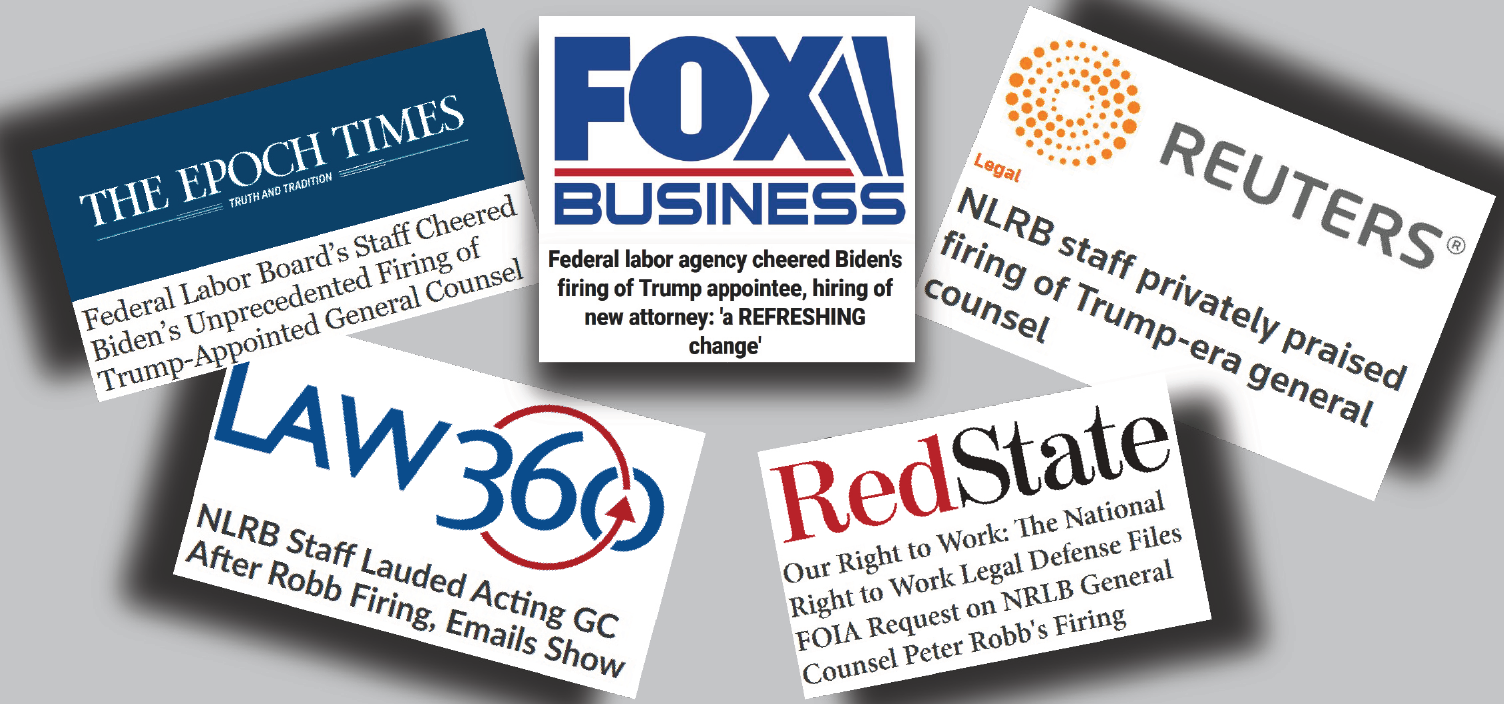
After Foundation attorneys’ FOIA request revealed pro-Biden bias pervading the “independent” NLRB, Foundation staffers secured coverage for the findings in some of the nation’s top outlets.
WASHINGTON, DC – National Right to Work Foundation attorneys have uncovered, through a Freedom of Information Act (FOIA) request, National Labor Relations Board (NLRB) staff emails that expose the partisan response to unprecedented power grabs launched by the Biden Administration at the behest of Organized Labor.
Biden Power Grab Prompts Records Request
The FOIA request was filed to provide further details surrounding Biden’s unprecedented and legally dubious removal of Trump-appointed NLRB General Counsel Peter Robb, who had sided with Foundation-represented workers in several cases in which they sought to resist union boss coercion. The emails show widespread partisan bias throughout the agency, which is charged with neutrally enforcing federal labor law.
Under long-standing federal law, the NLRB General Counsel has unreviewable authority to prosecute unfair labor practice charges, including those brought by workers against union officials. To protect that authority from blatant political interference, Congress gave the General Counsel a four-year term. Once appointed by the president and approved by the Senate, no General Counsel in the history of the NLRB had ever been fired. That changed when, just minutes after Biden took office on January 20, 2021, his administration moved to fire Robb despite 11 months remaining on his term.
NLRB Officials Celebrated Biden Attack on Labor Board’s Top Prosecutor
Following Biden’s election with the backing of Big Labor officials who wanted to shield themselves from accountability at the NLRB, Biden was encouraged by union bosses to remove General Counsel Robb and replace him with a union partisan. Five days after the removal of Robb, Biden fully obliged, selecting career NLRB bureaucrat Peter Sung Ohr as Acting General Counsel. The FOIA-requested emails show that although some NLRB officials were surprised by Biden’s actions — with one career NLRB attorney noting the move was “not expected” — some current and former NLRB officials voiced their approval of the unprecedented actions that fly in the face of the prosecutorial independence that Congress sought to protect when the General Counsel’s office was established. Los Angeles-based NLRB Region 31 Director Mori Rubin sent an email to her colleagues reacting to the news that Alice Stock, then the number-two attorney at the agency, had been fired along with Robb. Rubin derided Stock as a “clone” of Robb. She said “there is talk that Peter Ohr may be appointed acting GC, which would be wonderful!” Respondents to the thread, whose names are redacted, proclaimed: “Go Biden!!”, “That would be terrific!” and “Hope this comes true!”
Within days Ohr rescinded almost a dozen guidance memos issued by Robb, including one ensuring workers could avoid funding union political and lobbying activities, another allowing workers to intervene in legal actions that are used to block efforts to secure decertification votes, and yet another strengthening unions’ obligations to workers subject to union boss monopoly bargaining. In all these instances Ohr took the position advocated by union officials who had backed Biden’s election campaign, and against those of Foundation-backed employees.
Ohr earned praise for his aggressive implementation of the Biden agenda. Among the emails unearthed in the FOIA request was a message to Ohr from longtime NLRB attorney Emily Hunt describing her reaction on the day of Biden’s inauguration when she learned that Robb had been removed: “I exclaimed to myself, ‘This day just keeps getting better and better!’” Hunt, whose career with the NLRB spanned over 30 years, commended Ohr for rescinding Robb’s memos.
Foundation Spreads the Word About Activism within NLRB
The NLRB emails received coverage from multiple outlets including Fox Business, The Epoch Times, and Reuters. The coverage exposed the favoritism of many inside the NLRB towards union officials despite the Board’s directive to apolitically enforce federal labor law.
“By celebrating Joe Biden’s unprecedented attack on the Board’s independence so openly, the NLRB officials in these emails make it clear that those inside their agency do not want the Board to be an independent enforcer of the law as Congress intended,” said National Right to Work Foundation Vice President Patrick Semmens. “Instead, these partisans want the Board to be an activist agency with a mission of advancing union boss power at the expense of the rights of rank-and-file workers.”





