Workers Nationwide Urge Trump NLRB to End Policies Trapping Them Under Union Power
The following article is from the National Right to Work Legal Defense Foundation’s bi-monthly Foundation Action Newsletter, May/June 2025 edition. To view other editions of Foundation Action or to sign up for a free subscription, click here.
NLRB-invented policies currently allow union bosses to block worker-requested votes

Theresa Hause, an Oregon-based school bus driver, wants the Trump NLRB to end the so-called “merger doctrine” that grants union officials the power to combine workplaces into giant, inescapable mega-units.
WASHINGTON, DC – During the Biden Administration, biased, pro-Big Labor National Labor Relations Board (NLRB) bureaucrats went out of their way to undermine the idea that workers and workers alone should choose whether or not they want a union. Rolling back multiple National Right to Work Foundation-backed reforms that made it easier for workers to vote out unions they didn’t want was a prime example of this.
But the Biden NLRB’s extremism is only the latest example of how federal labor law is biased against workers opposed to union affiliation. The truth is that biased bureaucrats on the NLRB have, for decades, burdened independent-minded workers with arbitrary barriers to freeing themselves from union influence. Many of these policies — which are the inventions of NLRB decisions and appear nowhere in the National Labor Relations Act’s (NLRA) text — let union bosses block workers from exercising their statutory right to vote to remove a union.
Bus Drivers Fight Forced Dues in Huge, Inescapable Teamsters Unit
The Trump Administration taking control of the NLRB in Washington, D.C., has presented workers around the country who want to escape union influence with a new opportunity to attack these restrictions. Foundation attorneys are already helping workers lead the charge for reform to create precedents that will allow others to remove unions opposed by most workers.
Last December, Theresa Hause, a Washington State-based school bus driver, submitted to the NLRB a deauthorization petition which contained employee support well over the necessary threshold needed to trigger a vote to strip Teamsters Local 58 bosses of their forced-dues power in Hause’s workplace. Hause and her fellow drivers are employed by First Student, Inc.
She was surprised to learn during NLRB proceedings that First Student management and Teamsters union officials had covertly signed an agreement “merging” Hause’s small unit of workers into a much larger national unit, composed of thousands of Teamsters-controlled bus drivers across the country.
Because of the NLRB’s so-called “merger doctrine” policy, Hause and her colleagues are now in this “mega-unit,” and any petition to end the union’s forced-dues power (or remove the union completely) needs to contain signatures from at least 30% of the “mega-unit” — thousands of people Hause has never met — to be considered valid. The NLRB official that dismissed Hause’s petition even ruled that the fact employees were kept in the dark about this merger was irrelevant, outrageously saying “there is nothing in the merger doctrine that requires acquiescence or even notification of employees of a change in a bargaining unit.”
Hause’s Foundation-provided attorneys are challenging the merger doctrine in an appeal of Hause’s case to the NLRB in D.C., arguing among other things that the policy violates employee free choice and that it serves as a protection racket for established unions.
While Hause and her colleagues are fighting for a vote to free themselves from forced dues, attacking the merger doctrine also has significant ramifications for workers seeking to decertify a union. Foundation attorneys have represented many workers who have been shanghaied into huge, inescapable work units against their will. That includes a group of less than 10 Wisconsin First Student workers who filed a majority-backed petition to remove Teamsters officials as soon as allowed by federal law, only to be stymied by the merger doctrine because they had been secretly “merged” into a multi-company unit of around 24,000 workers in multiple states.
WV Homecare Workers Not ‘Settling’ for ‘Settlement Bar’
Meanwhile, in West Virginia, a Foundation-assisted employee of senior homecare nonprofit McDowell County Commission on Aging is attacking the NLRB’s use of another union boss-friendly policy to block his and his coworkers’ effort to kick out Service Employees International Union (SEIU) bosses: the so-called “settlement bar,” which lets unions and employers unilaterally agree in settlements to end employee-led union decertification efforts.
The employee, John Reeves, and his coworkers cast ballots in a July 2024 vote to remove SEIU union officials, but are now battling claims that a settlement SEIU bosses and Commission management signed should relegate those ballots to the trash bin. The SEIU and Commission entered into the settlement to end the decertification and resolve unfair labor practice allegations union agents had filed against the employer. That supposed employer wrongdoing was cited as the impetus for Reeves and his coworkers’ desire to remove the union — even though it was never admitted to by the employer nor proven by union lawyers.
Instead of letting Reeves show why the union’s accusations didn’t cause his employees’ disenchantment with the union, regional NLRB officials instead invoked the settlement bar and dismissed the decertification effort, based on the phony “resolution” of speculative charges by the union. Reeves is asking the NLRB in Washington, D.C., to review his case.
Reform Needed to Undo Coercive Policy
“Ms. Hause’s and Mr. Reeves’ cases provide just a sampling of the grand buffet of privileges the NLRB has granted union bosses over the years,” observed National Right to Work Foundation Vice President Patrick Semmens. “Union bosses and complicit employers should not be able to cut workers off from exercising their basic right to remove unpopular union bosses, yet that’s exactly what both the ‘merger doctrine’ and ‘settlement bar’ allow.
“If members of the Trump NLRB are dedicated to defending the rights of all American workers, they will focus not only on countering the extensive damage done to individual worker rights by the Biden Labor Board, but also on digging deeper to undo the web of non-statutory coercive union boss powers that has been created over decades,” Semmens added.
Hundreds of OH Workers Exit Teamsters as Union Bosses’ Amazon ‘Strike’ Stunt Flounders
The following article is from the National Right to Work Legal Defense Foundation’s bi-monthly Foundation Action Newsletter, March/April 2025 edition. To view other editions of Foundation Action or to sign up for a free subscription, click here.
Teamsters O’Brien tried to take away Christmas cheer, but couldn’t take away Ohio workers’ freedom

Daniel Caughhorn led a scrappy group of his coworkers in voting Teamsters bosses out of their workplace, a scrap metal processing facility in Toledo, OH. They also beat back union bosses’ attempts to overturn their vote.
WASHINGTON, DC – This past December, Teamsters President Sean O’Brien announced the “largest-ever strike against Amazon,” claiming that thousands of workers would heed his strike order, abandon their delivery vehicles and hit the picket lines. O’Brien threatened that Christmas gifts would be delayed unless his demands were met.
Those who took O’Brien’s rhetoric at face value would have thought he was a veritable Grinch stealing Christmas (even though he tried to explain it was Amazon’s fault that the strike had to occur). But even reporting from pro-Big Labor outlets soon revealed that the order was more story than substance: According to Labor Notes, only about 600 employees obeyed the strike order despite Teamsters honchos claiming to “represent” some 7,000 to 10,000 Amazon employees.
Even the small number who did cease work on O’Brien’s command are arguably not employees of Amazon, and likely aren’t under Teamsters control at all: They work primarily for independent contractors that carry out some delivery functions for Amazon. Even if O’Brien’s dubious theory claiming he had control over those delivery drivers was correct, it would have only affected 10 out of the roughly 110 Amazon centers nationwide. Still, National Right to Work Foundation staff attorneys put a special legal notice out to delivery drivers nationwide informing them of their rights if they were illegally coerced to strike.
Workers Defeat Cynical Attempt by Teamsters to Overturn Vote
The December 2024 Teamsters “strike” against Amazon may go down in history as a strained publicity stunt. But the more significant Teamsters news that month was that hundreds of Foundation-backed workers across Northern Ohio took real action by voting to free themselves from unwanted Teamsters officials’ so-called “representation.”
Dusty Hinkle, an employee for Frito-Lay’s plant in Wooster, OH, and Daniel Caughhorn, a worker at scrap metal firm Omnisource’s facility in Toledo, OH, paved the way to freedom for their coworkers by submitting petitions asking the National Labor Relations Board (NLRB) to hold votes among their coworkers to remove or “decertify” Teamsters unions at their facilities. They submitted these in October and August 2024, respectively, with free Foundation legal assistance.
Because Ohio lacks Right to Work protections for its private sector workers, Teamsters officials enforced contracts that required Hinkle, Caughhorn, and their colleagues to pay union dues or fees as a condition of keeping their jobs. In contrast, in Right to Work states, union membership and all union financial support are strictly voluntary.
The NLRB, the federal agency that enforces federal labor law, administered decertification votes at Hinkle’s and Caughhorn’s workplaces after finding that both petitions contained enough employee signatures to trigger a vote under agency rules. Even though clear majorities of workers voted against Teamsters union control in both votes, Teamsters union officials filed objections alleging misconduct by Frito-Lay and Omnisource management in an attempt to overturn the election results.
However, in both cases regional NLRB officials tossed the union objections and certified the workers’ votes. The Omnisource and Frito-Lay employees — over 430 in total — thereby cut all ties with the Teamsters unions. Now both sets of employees are free both of union bosses’ forced-dues demands and their ability to impose one-size-fits-all contracts on the workplace.
In the final months of 2024, Foundation attorneys assisted a number of other workers from across industries with efforts to remove unwanted Teamsters officials. From just October to December 2024, truck drivers from Georgia, California, Virginia, and New Jersey successfully booted out Teamsters union officials or initiated removal efforts with Foundation aid. These cases came despite increasingly hostile rulemaking from the outgoing Biden Administration’s NLRB bureaucrats in 2024, which undid key Foundation-backed reforms that made it easier for workers to request decertification elections.
Teamsters Schemes to Steal Christmas and Workers’ Rights Both Failed
“Sean O’Brien’s Christmas publicity stunt might have made him seem like an attempted stealer of gifts and holiday cheer, but these two Foundation cases from Ohio demonstrate what Teamsters bosses really are: stealers of workers’ rights and freedom,” commented National Right to Work Foundation Vice President Patrick Semmens.
“That Teamsters officials in both these cases attempted to disenfranchise workers who opposed them shows why workers are turning against their power-hungry tactics, and why American workers deserve the Right to Work choice to withhold financial support from union officials who aren’t serving their interests.”
New York Farmworkers Seek to Challenge ‘Card Check’ & Uproot UFW Union Bosses
The following article is from the National Right to Work Legal Defense Foundation’s bi-monthly Foundation Action Newsletter, January/February 2025 edition. To view other editions of Foundation Action or to sign up for a free subscription, click here.
Farmworkers fight union argument that New York labor law lets union bosses trap workers forever

Porpiglia Farms workers, who were targeted by an aggressive UFW ‘card check’ campaign against the farmworkers, are banding together to vote the union out and ensure that union officials reap what they have sown.
MARLBORO, NY – In 2020, the New York State Assembly passed a Big Labor-backed law that granted union officials sweeping new powers to impose their monopoly bargaining control over the state’s farmworkers. Since New York is one of 24 states that lacks a Right to Work law, the law authorizes union bosses to force farmworkers to pay union dues or else be fired.
But that’s not all: New York labor law went even further by mandating “card check” organizing, in which union officials deny workers a secret ballot union vote and instead claim majority support by submitting cards ostensibly showing worker support. These cards are often collected through pressure tactics, intimidation, or even threats.
But even that dramatic increase in power over the agricultural sector and agricultural workers is not enough for United Farm Workers (UFW) union officials.
UFW tyrants are advancing the cynical argument that, under New York law, workers can be forced into union ranks but can never escape forced unionism. They argue this to counter a recent National Right to Work Foundation-backed union decertification case for employees of Porpiglia Farms, an apple farm in the Hudson Valley of New York.
NY Fruit Farmworkers Seek Union Ouster After ‘Card Check’
Porpiglia employee Ricardo Bell submitted a petition last year in which he and his coworkers asked the New York Public Employment Relations Board (PERB) to hold a vote at the orchard on whether to remove the UFW. (Despite its name, PERB is responsible for enforcing labor law in both New York’s public and agricultural sectors.)
In late 2024, Foundation attorneys filed a brief for Bell countering union officials’ absurd argument that one card check drive should lock employees in a union forever. Additionally, more Foundation-backed decertification cases are sprouting up in both New York and other Big Labor-dominated states for farmworkers who are rejecting UFW officials’ card check schemes.
Brief Challenges Theory That Workers Have No Right to Remove Incumbent Union
Bell filed his decertification petition with Foundation legal aid after UFW union officials seized power at his workplace through a hasty card check unionization drive. His newest filing attacks union bosses’ contention that once a union is certified as the monopoly union “representative” of a work unit, there can be no option to remove it.
“[New York labor law] does not indicate that employees have a single chance at self-organization,” the brief says. “If that were the case, the very action of choosing a representative under [New York labor law] would deprive employees of the ability to exercise [their rights] in perpetuity….”
Foundation-Backed Workers Battle UFW ‘Card Checks’ Across Country
Since Bell’s filing, Foundation attorneys have also assisted in a union decertification effort for workers at Cherry Lawn Fruit Farms near Rochester, NY, who were targeted by a similar UFW card check campaign. These two groups of New York farmworkers join Foundation-backed employees of Wonderful Nurseries in California in challenging the UFW’s tactics.
Wonderful Nurseries workers still have multiple unfair labor practice charges pending against UFW bosses for deceptive behavior during an early 2024 card check drive. The charges detail UFW agents lying about the true purpose of cards that they collected from workers, and harassing workers who now back an effort to vote the union out.
“The aggressive and often demeaning tactics that UFW union officials use to seize control over agricultural workers show clearly why ‘card check’ is a bad idea in the agricultural sector, the public sector, and in any sector,” commented National Right to Work Foundation Vice President and Legal Director William Messenger. “UFW officials are arguing that workers should have little or no chance at all to challenge a union’s ascent to power by this process.
“The idea that workers have no ability to eject a union once it is installed in power further demonstrates that this is not about workers’ choices at all, only about union bosses’ power over workers, even when workers overwhelmingly want nothing to do with union bosses’ so-called ‘representation,’” added Messenger.
National Right to Work Foundation Highlights Michigan Workers’ Legal Options as Right to Work Repeal Looms
Legal notices: Though forced dues will again be legal in the private sector, Michigan workers can still reject union boss demands to join union and fund union political activities
Lansing, MI (February 9, 2024) – The National Right to Work Legal Defense Foundation has issued special legal notices to public and private sector workers in Michigan, which explains what rights workers still have to resist union boss demands as the repeal of the state’s Right to Work law takes effect.
In March 2023, the Michigan Legislature voted against the will of over 70% of Michiganders and repealed the state’s protections against being forced to pay union dues or fees as a condition of employment. The repeal formally takes effect on February 12, 2024.
The legal notices are available at the Foundation’s website: https://www.nrtw.org/michigan-private-sector-notice/ (for private sector workers) https://www.nrtw.org/michigan-public-sector-notice/ (for public sector workers).
MI Public Sector Workers Can Still Refrain from Union Membership and Dues Payment
By repealing Michigan’s Right to Work law, Michigan politicians granted union officials the power to compel private sector workers to pay money to a union to keep their jobs. The legal notice explains that, despite this massive expansion of government-granted power for Michigan union bosses, private sector workers still have rights under federal law to refrain from formal union membership and to refuse to pay for union political or ideological expenditures, among other rights.
“[U]nder the National Labor Relations Act (NLRA) workers subject to these forced fee arrangements cannot lawfully be compelled to be actual union members or pay full union dues to keep their jobs,” the notice reads.
As for public sector workers, the legal notice informs Michiganders that even though Michigan’s politicians have undone the state’s statutory protection against being forced to pay union bosses as a condition of employment, the repeal “does not—and cannot—strip [public sector] workers of their constitutional right” to refrain from funding union activities. The Supreme Court recognized public employees’ First Amendment right to abstain from union financial support in the 2018 Foundation-won Janus v. AFSCME ruling.
MI Union Bosses Still Can’t Force Private Sector Workers to Become Formal Members or Directly Support Union Politics
The notices inform Michigan private sector employees that, under the U.S. Supreme Court’s decision in Pattern Makers v. NLRB, independent-minded workers have a right to refrain from formal union membership. The Foundation-won CWA v. Beck Supreme Court ruling further holds that the most that union bosses can force nonmember workers to pay is a fee equal to “what the union can prove is its costs of collective bargaining, contract administration, and grievance adjustment with their employer.” This fee cannot include union expenses for political and ideological activities.
“Unions often fail to meet their legal obligation to inform workers of their right not to be a union member and to object to paying full union dues,” the notice reads. “In fact, unions oftentimes mislead workers to believe that they must join the union to keep their jobs.”
MI Private Sector Workers Have Right to Vote Out Unpopular Union Bosses
Private sector employees also have the right to petition for National Labor Relations Board-supervised “decertification elections,” which can strip union officials of their coercive powers of monopoly control over a work unit entirely.
Foundation attorneys assist hundreds of workers every year in exercising their legal right to obtain a vote to decertify unions of which they disapprove.
“Union boss allies in the Michigan Legislature foisted this repeal on workers for one reason: To enlarge the coffers of their favorite special interest,” commented National Right to Work Foundation President Mark Mix. “Instead of letting Michigan workers continue to enjoy the right to freely choose whether or not union officials have earned a cut of their hard-earned pay, Michigan legislators have granted union bosses a power that strips away basic free speech and association rights.”
“The truth is, even with this great expansion of their powers, Michigan union bosses will still try to look for ways to expand their powers beyond the law and compel more workers to associate with them,” Mix added. “That’s why it’s important for Michiganders to know their rights in this new legal landscape; they should also know that Foundation attorneys stand ready to defend the rights of any Michigan worker opposing union coercion.”
Foundation Blasts Biden NLRB’s Proposed Rule to Trap Workers in Unions
The following article is from the National Right to Work Legal Defense Foundation’s bi-monthly Foundation Action Newsletter, May/June 2023 edition. To view other editions of Foundation Action or to sign up for a free subscription, click here.
Former union lawyers target Foundation-backed reforms easing removal of unpopular unions
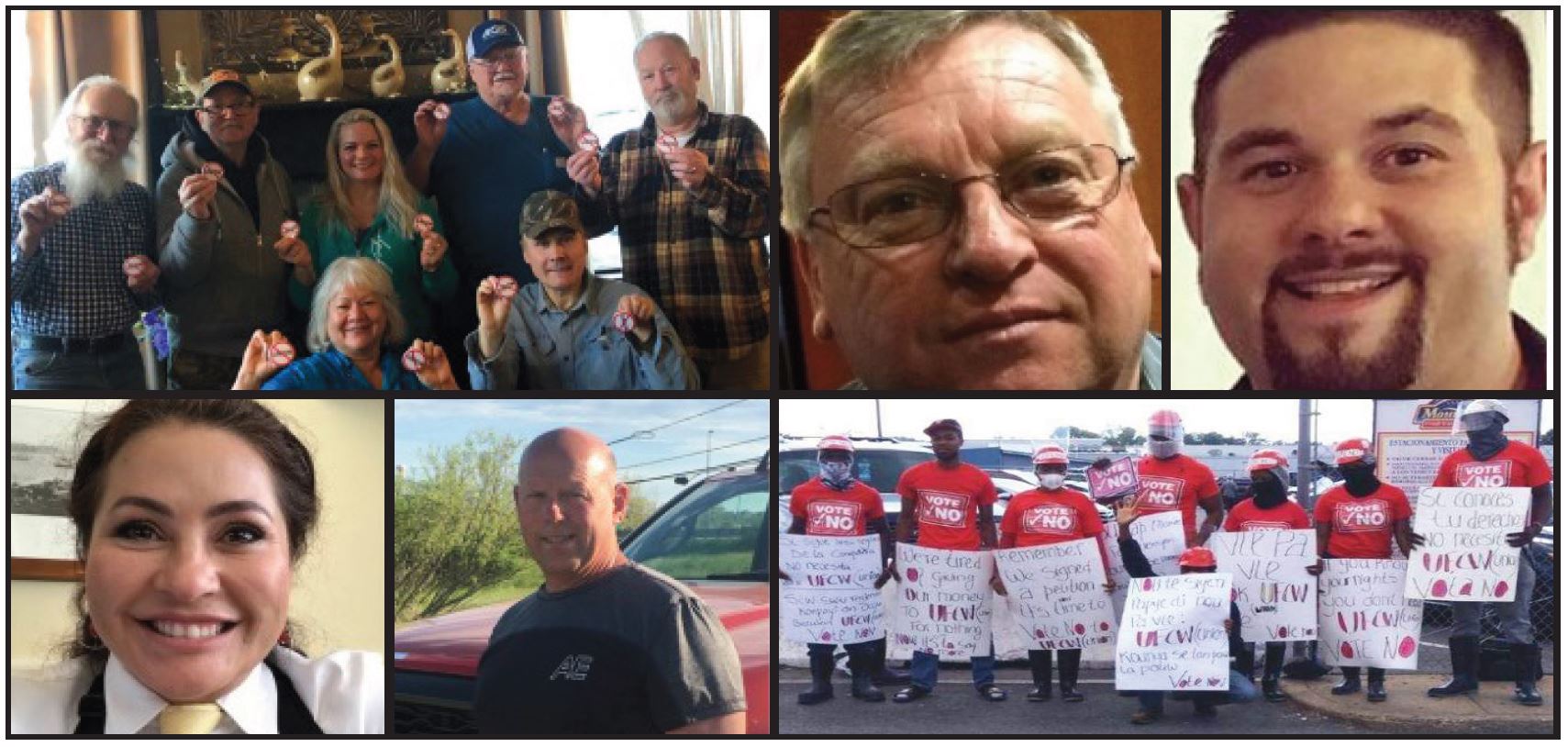
In its comments to the NLRB, the Foundation emphasized its leading role in defending workers’ right to vote out unwanted unions. Above are just a few workers whom Foundation attorneys have aided recently in decertification efforts.
WASHINGTON, DC – Bureau of Labor Statistics data show that over 90 percent of American workers have chosen not to affiliate with a union, and recent polling by Gallup shows non-union workers are overwhelmingly “not interested at all” in unionization. This isn’t a surprise considering modern day union officials’ overwhelming focus on politics, the way that monopoly “representation” often disadvantages the best employees, and union bosses’ “pay up or be fired” demands leveled at workers in non-Right to Work states, among other reasons.
The National Right to Work Foundation helped create an easier path for employees to vote out union officials they oppose by filing comments in support of the “Election Protection Rule,” which the National Labor Relations Board (NLRB) adopted in 2020. The Foundation-backed Rule eliminated several non-statutory NLRB policies that union officials manipulate to block any attempt by employees to vote them out of a workplace.
Now, former union lawyers Biden appointed to the NLRB are repaying the President’s union boss political allies by moving to eliminate the Election Protection Rule, thus restoring to union officials several coercive methods used to trap workers in unions they oppose by making it more difficult for employees to successfully petition for a decertification election.
The Foundation slammed the plan in February comments filed with the NLRB, maintaining that the rule change will trample workers’ statutory right to vote out unions they oppose while entrenching unpopular union officials. Foundation attorneys followed up with reply comments in March, which refuted several arguments union officials and Biden’s NLRB General Counsel put forth in comments supporting the Election Protection Rule’s elimination.
Biden NLRB Will Again Let Union Officials Weaponize Unproven ‘Blocking Charges’
The Foundation’s comments explain that, if the Election Protection Rule is tossed, union officials will again be able to exploit often-unproven allegations of employer unlawful behavior to delay employee-requested union decertification votes. Prior to the 2020 reforms, union officials could often stall a decertification vote for months or even years by filing these so-called “blocking charges.”
The 2020 Election Protection Rule overturned the blocking charge policy, so workers are currently allowed in most cases to cast ballots in a decertification vote before the NLRB deals with any allegations surrounding the election. This procedure eliminates the incentive outright deception. Once recognized via this card check process, under the NLRB proposal there will be a year-long non-statutory bar, during which unions are immunized from decertification attempts.
The Election Protection Rule gives employees the opportunity to challenge the union’s claim of majority support during a 45-day window period beginning upon notice of recognition. If workers collect a sufficient showing of interest for an election and file it during the 45-day window, the NLRB will hold an election in that bargaining unit. This provides a check against the most egregious card check campaigns. Barring these worker-submitted union decertification petitions “only shields what may well be a minority union from challenge” and “destroys employees’ [statutory] rights,” the Foundation’s comments say.
Worker Majority Support Doesn’t Matter for Union Elites
The comments also oppose the Biden NLRB’s plan to let union officials subject construction workers to monopoly union so-called “representation” without providing evidence of any individual worker’s support for such control, let alone a majority.
“The move to eliminate the Election Protection Rule will re-impose arbitrary policies that trample workers’ rights and allow union bosses to maintain power despite the overwhelming opposition of rank-and-file workers,” observed National Right to Work Foundation Vice President Patrick Semmens.
“The Biden NLRB, now stocked with former union lawyers, is putting on full display that its priorities lie with top D.C. union brass, not rank-and-file American workers.”
California Lifeguards Ask Supreme Court to Blow Whistle on Dues-Trap Scheme
The following article is from the National Right to Work Legal Defense Foundation’s bi-monthly Foundation Action Newsletter, November/December 2022 edition. To view other editions of Foundation Action or to sign up for a free subscription, click here.
Union bosses’ ‘maintenance of membership’ scheme drowns California lifeguards’ Janus rights for four years

These California lifeguards can ride the waves, but they certainly didn’t “waive” their Janus rights. In their Supreme Court bid, they hope to stop union bosses from locking them out of their First Amendment rights for years.
LOS ANGELES, CA – National Right to Work Foundation client Jennifer Marshall, an Orange County, CA, lifeguard, told the Los Angeles Times in May how hard California Statewide Law Enforcement Agency (CSLEA) union officials pushed union membership on her and her colleagues.
“They really pushed us to sign up for the union without a lot of information behind it,” said Marshall. “It was kind of a sign-the-papers-and-we’ll-talk-about-it-later kind of thing.” After she signed up, she hardly ever saw or heard from union officials again but full union dues were coming out of her paycheck.
What she and many of her colleagues, whom union bosses had cajoled into signing up, didn’t expect was how hard it would be to exit a union that didn’t seem to be doing anything for them. When she and her colleagues tried to resign, CSLEA officials told them that they were stuck in both full union dues payments and full union membership until 2023, pursuant to a so-called “maintenance of membership” requirement.
Marshall, along with lead plaintiff Jonathan Savas and 21 other colleagues, sued CSLEA bosses in federal court in 2020 for violating their constitutional rights. They argued the “maintenance of membership” requirement blatantly infringes on their First Amendment rights under the Foundation-won Janus v. AFSCME Supreme Court decision. In Janus, the Court declared that public sector workers cannot be forced to bankroll a union without voluntarily waiving their First Amendment right to abstain from union payments. The lifeguards also sued the state of California for its role in enforcing the unconstitutional dues deductions.
Secret Union Dues Scheme Has Been Illegal for 45 Years
Marshall, Savas, and their fellow lifeguards are now petitioning the Supreme Court of the United States to hear their case, arguing CSLEA bosses’ restrictive arrangement even violates Supreme Court precedent that predates Janus.
The lifeguards’ Foundation provided attorneys argue in the petition that “maintenance of membership” requirements not only flout Janus’ ban on all forced dues in the public sector, but even violate the Supreme Court’s now-overturned 1977 decision in Abood v. Detroit Board of Education. Abood let union officials force dissenting public sector employees to pay a portion of union dues as a condition of employment.
“Maintenance of membership” requirements – which force public employees to pay full union dues often for years after they try to resign from the union – are worse than anything permitted by Abood, Foundation staff attorneys argue.
The petition also takes to task CSLEA union bosses’ paltry defense that the lifeguards somehow voluntarily agreed to the “maintenance of membership” scheme. In Janus, the Supreme Court ruled that union officials can only take dues from a public employee’s paycheck if that employee gives a “clear and compelling” waiver of Janus rights. Foundation attorneys point out that the CSLEA union’s dues deduction forms contained only a “vague reference” to an unexplained limit on when withdrawal from membership is permitted, which is not even close to satisfying Janus’ waiver requirement.
“A vague reference to unspecified limitations in ‘the Unit 7 contract and State law’ does not establish the Lifeguards contractually consented” to union membership for four years, the petition says.
Supreme Court Must Intervene to Stop Spread of Unconstitutional Restrictions
The petition for Savas and his fellow lifeguards emphasizes how crucial it is for the Supreme Court to strike down cumbersome “maintenance of membership” restrictions, pointing out that California unions and legislators will continue to force public employees to remain formal union members and pay full dues as a condition of employment if the schemes are left unchecked.
“Other states likely will follow suit, such as Pennsylvania, whose laws also authorize maintenance of membership requirements,” the brief states.
Challenged Scheme Gives Union Bosses Control of Workers’ Janus Rights
“‘Maintenance of membership’ restrictions give union officials complete control over when public employees can exercise their rights to end union membership and cut off union dues deductions,” observed National Right to Work Foundation Vice President and Legal Director Raymond LaJeunesse.
“The Supreme Court must intervene in these lifeguards’ case to protect the First Amendment rights of all American public sector employees, and prevent union bosses and their political allies from replicating across the country these patently unconstitutional restrictions.
Foundation on Labor Day 2021
The following article is from the National Right to Work Legal Defense Foundation’s bi-monthly Foundation Action Newsletter, November/December 2021 edition. To view other editions of Foundation Action or to sign up for a free subscription, click here.
Union Boss Coercion Hurts Workers
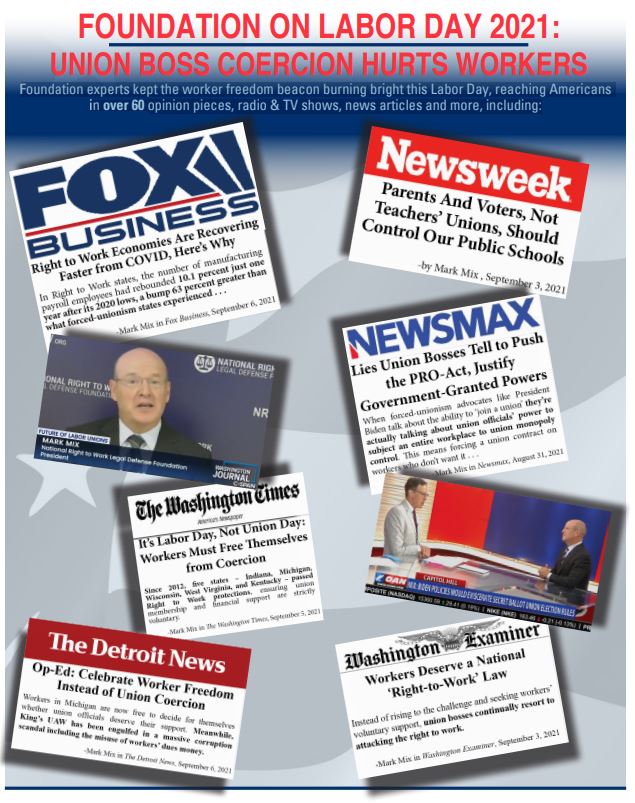
Foundation experts kept the worker freedom beacon burning bright this Labor Day, reaching Americans in over 60 opinion pieces, radio & TV shows, news articles and more, including: