
Foundation Lawsuit: Biden NLRB Structure Violates the U.S. Constitution
The following article is from the National Right to Work Legal Defense Foundation’s bi-monthly Foundation Action Newsletter, November/December 2023 edition. To view other editions of Foundation Action or to sign up for a free subscription, click here.
Groundbreaking suit filed for Starbucks employee who was denied vote to oust unwanted union bosses
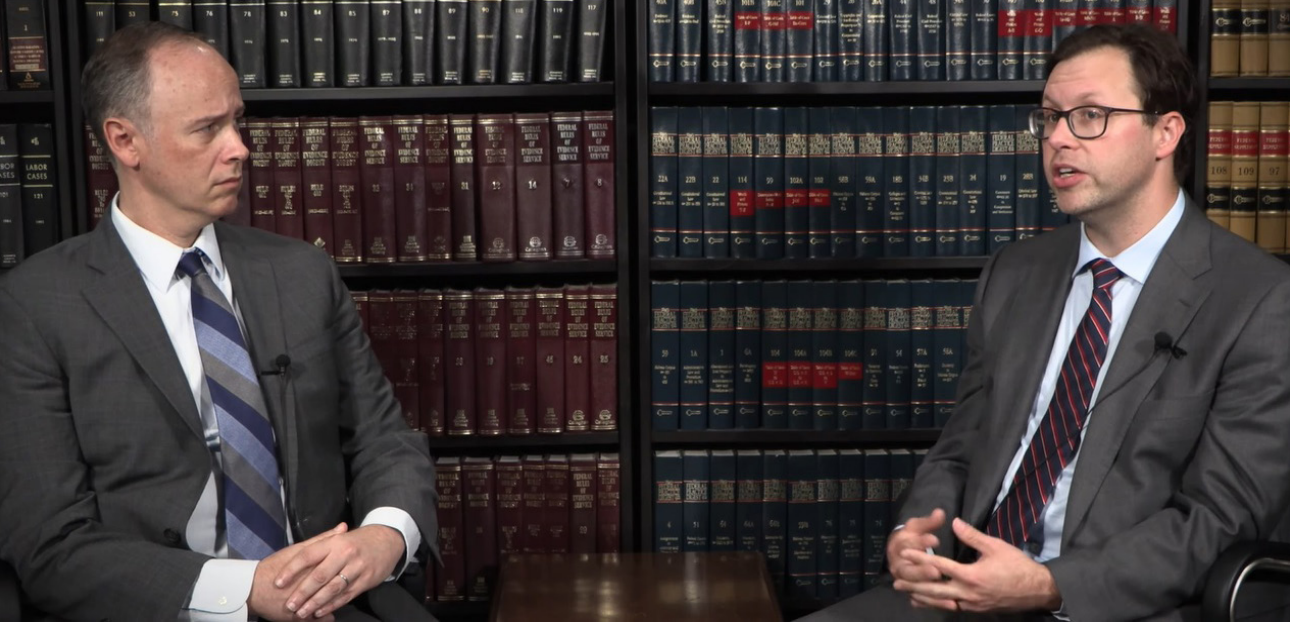
Starbucks employee Ariana Cortes’ Foundation attorney, Aaron Solem (right), is making a cutting-edge argument targeting the NLRB’s lack of accountability.
WASHINGTON, DC – The National Labor Relations Board (NLRB) is supposed to protect the right of workers to freely choose whether to associate with a union or not. The NLRB is also charged with holding unions and employers accountable when they violate worker rights. Too often, however, it has simply acted as an agency that generates policies to entrench union bosses’ power over workers while shielding union bosses from any kind of liability.
A new federal lawsuit from a National Right to Work Foundation-backed Starbucks employee, currently pending at the D.C. District Court, could upend the federal agency and result in a ruling that the current Labor Board’s structure violates the Constitution.
Employee Challenges NLRB Bureaucrats’ Protections from Presidential Removal
Ariana Cortes, a worker at the Buffalo, NY, “Del-Chip” Starbucks branch, hit the NLRB with the groundbreaking lawsuit in October, contending that the federal agency’s current structure violates the separation of powers mandated by the Constitution.
Cortes’ suit follows Foundation attorneys’ defense of her and her coworkers’ petition requesting a vote to remove Starbucks Workers United (SBWU) union officials from their workplace. Regional NLRB officials dismissed Cortes’ majority-backed petition based on SBWU allegations against Starbucks management that have no proven connection to Cortes and her coworkers’ desire for a union decertification vote.
Cortes’ lawsuit argues that because NLRB members cannot be removed at-will by the President, the NLRB’s structure violates Article II of the Constitution. Under Article II, the lawsuit contends, the President must have the power to remove officials that exercise substantial executive power.
Because the NLRB enforces federal labor law, manages union elections, and can issue legally binding rules and regulations, the lawsuit contends that the agency exercises substantial executive power. Therefore, it falls within the scope of the President’s power to remove officials at will. However, the National Labor Relations Act (NLRA), the law that established the NLRB, restricts the President’s ability to remove Board members except for neglect of duty or malfeasance.
“[T]hese restrictions are impermissible limitations on the President’s ability to remove Board members and violate the Constitution’s separation of powers. Thus, the Board, as currently constituted, is unconstitutional,” the complaint states.
Lawsuit: Unconstitutional NLRB Proceedings Must Stop
Cortes’ new federal lawsuit seeks a declaration from the District Court that the structure of the NLRB as it currently exists is unconstitutional.
“For too long the NLRB, especially the current Board, has operated as a union boss-friendly kangaroo court, complete with powerful bureaucrats who exercise unaccountable power in violation of the Constitution,” commented National Right to Work Foundation Vice President and Legal Director William Messenger. “The NLRB’s operation outside constitutional norms is easily exploited by Big Labor.”
“But as the story of Ms. Cortes shows, the NLRB’s unchecked power creates real harms for workers’ rights, especially when workers seek to free themselves from the control of union bosses they disagree with,” Messenger added.
Overwhelming Majority of Union Kitchen Workers File Petition Seeking to Remove UFCW Union
Request for end of union so-called ‘representation’ comes amid contentious boycott and picket ordered by union officials against rank-and-file workers
Washington, DC (July 14, 2023) – Employees of five Union Kitchen Grocery locations in the Washington, DC, metro area have filed a petition seeking to end United Food and Commercial Workers (UFCW) Local 400’s monopoly bargaining power over workers. The employees submitted their decertification petition to the National Labor Relations Board (NLRB) Region 5 with free legal aid from the National Right to Work Legal Defense Foundation.
Union Kitchen employee Ashley Silva submitted a union decertification petition that was supported by the vast majority of her coworkers. Under NLRB rules, this should trigger an NLRB-administered decertification vote. Under federal labor law, it is illegal for employers to engage in monopoly bargaining that impacts the employment terms of all employees, even those opposed to unionization, with a minority union that lacks the support of a bare majority of workers.
With the petition now filed, the NLRB should now promptly schedule a secret ballot election so the workers can formally vote to end union officials’ power to impose a contract, including forced dues, on the workers.
Because the District of Columbia lacks Right to Work protections for its private sector workers, UFCW union officials have the power to enter into an agreement with Union Kitchen forcing Silva and her coworkers at the four DC locations to pay union dues or fees as a condition of keeping their jobs. In contrast, in Right to Work jurisdictions like those at Union Kitchen’s Northern Virginia location, union membership and financial support are strictly voluntary.
Silva and her coworkers’ effort comes amid union boss-ordered pickets and boycotts against Union Kitchen Grocery locations, which have inflamed tensions among workers and raised questions about union officials’ motives. In some instances, reportedly union picketers have endangered workers by blocking exits, requiring the intervention of police.
“The vast majority of the workers at Union Kitchen are sick and tired of the UFCW’s picketing, harassment of employees, and constant disruptions of our day-to-day work life,” Silva said. “If the union cares at all about what we want, they will respect our wishes and immediately disclaim their interest in representing workers who have overwhelmingly rejected them.”
Union Kitchen Effort Latest in Wave of Union Decertification Efforts Nationwide
Foundation attorneys are currently assisting workers nationwide in a number of high-profile decertification efforts. Most notably, Starbucks employees at locations in Buffalo, New York City, Pittsburgh, and Bloomington, MN, are seeking to remove the Starbucks Workers United (SBWU) union only one year after the union launched a highly-publicized campaign in an attempt to unionize the coffee chain.
In Miami, Foundation attorneys also recently aided XPO Logistics freight drivers in removing an unwanted Teamsters union from their facility. Teamsters bosses, including James Hoffa, considered the Miami XPO contract a breakthrough. Now those workers have rejected the Teamsters.
The NLRB’s data shows a unionized private sector worker is now far more likely to be involved in a decertification effort as their nonunion counterpart is to be involved in a unionization campaign. NLRB statistics also show a 20% increase in decertification petitions last year versus 2021. However, union officials still have many ways to manipulate federal labor law to prevent workers from voting them out, including by filing unrelated or unverified charges against management.
“Disrupting a work environment with continuous pickets and boycotts is not what Union Kitchen Grocery employees want or need. The employees’ overwhelming support for a union decertification vote should send a strong message to UFCW union officials that they need to leave,” commented National Right to Work Foundation President Mark Mix. “Foundation attorneys will defend these employees in the exercise of their rights, and will oppose any attempts by UFCW officials to disenfranchise the Union Kitchen workers of their legal right to remove a union they so clearly want nothing to do with.”
Foundation Slams Biden Labor Board’s Biased Ruling in Federal Appeals Court
The following article is from the National Right to Work Legal Defense Foundation’s bi-monthly Foundation Action Newsletter, May/June 2023 edition. To view other editions of Foundation Action or to sign up for a free subscription, click here.
Brief contends NLRB distorted precedent to trap workers in union they oppose
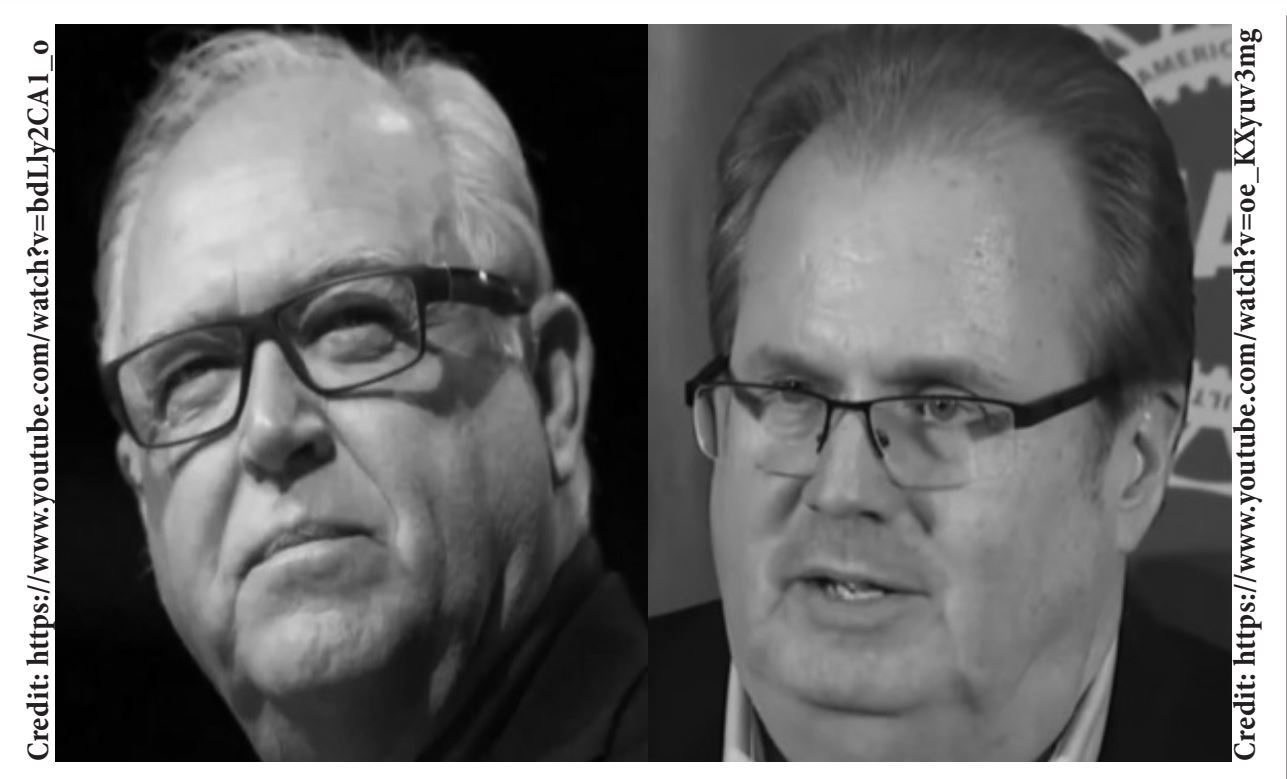
A majority of J.G. Kern employees petitioned to oust the UAW, which has seen two of its former presidents (Gary Jones, right, and Dennis Williams, left) go to jail for corruption. But a biased NLRB ruling trapped the workers in UAW ranks anyway.
WASHINGTON, DC – Foundation staff attorneys recently filed an amicus brief with the D.C. Circuit Court of Appeals in a case challenging a National Labor Relations Board (NLRB) decision reversing workers’ attempt to remove union “representation” they oppose.
In the case, J.G. Kern employees, frustrated with the United Auto Workers (UAW) Local 228 union, decided to petition to decertify, or formally remove, the union from their workplace. The workers presented this majority petition to their employer, leading to the company removing its recognition of the union.
The petition contained overwhelming support from workers in favor of removing the union. Yet, after the company withdrew recognition from the union, UAW officials ran to the Biden Labor Board in an attempt to remain in power. The Biden-appointed NLRB majority sided with the union officials by re-imposing the unpopular union over the workers’ objections.
With the case now in the federal court of appeals, the Foundation filed an amicus brief arguing the NLRB’s April 2022 ruling ignores precedent and misapplies longstanding law in siding with union officials.
Decertification Rules Already Rigged Against Workers Opposed to Union Affiliation
As the brief points out, workers looking to file a petition to remove a union they oppose already face numerous hurdles due to NLRB rules, most of which are contained nowhere in the federal statute the NLRB is charged with enforcing.
For example, a petition must be gathered outside of work hours, and outside of work-related areas. Also, unless employees use certain Board-specified language in their petition, the petition is invalid. Furthermore, employees cannot ask their employer for further information regarding the decertification process or the petition will be invalid.
The Foundation’s brief observes how workers must operate “in the dark, without help from their employer, and even if they do everything right, their efforts might come to naught through no fault of their own.” It also shows how the Biden Board has made it more difficult for individual workers to express their right to decertify unwanted, unpopular unions.
Biden NLRB Aims to Force Union on Workers Who Overwhelmingly Object
Under the Board’s “certification bar” doctrine, a union that wins a secret ballot election cannot be challenged for one year after its victory is certified by the NLRB. In this case, the UAW’s certification bar ended on October 3, 2019. In November 2019, J.G. Kern employees delivered a majority-backed petition to their employer.
The Biden Board claimed, however, that because J.G. Kern did not bargain in good faith during a three-month period at the beginning of the certification year, the employees’ majority petition was invalid. According to the Biden Board, the employer’s alleged unfair labor practices prospectively “extended” the certification year beyond its normal 12-month period.
The brief highlights the disingenuousness of the Board, pointing out that “the employees would have to divine the future to know they were collecting a petition during the ‘extended certification year.’” The Foundation urges the D.C. Circuit to command the Board to follow precedent that requires the Board to determine whether there was a “nexus” between the employer’s unfair labor practices and the decertification petition.
NLRB’s Power Grab Takes Away Workers’ Rights
The Foundation’s brief emphasizes how the Board’s decision can abolish employees’ rights guaranteed by the National Labor Relations Act. An example of that is the J.G. Kern workers’ petition, where it was only after the petition was gathered that the Board extended the union’s certification bar period.
The brief notes that usually “an employee’s decertification petition is presumptively valid unless there is a causal nexus between the unfair labor practice and the petition.” However, this is not the case under the J.G. Kern ruling.
Should the NLRB’s ruling be upheld, it “will further incentivize incumbent unions to file unfair labor practice charges to chill employees’ Section 7 ability to collect petitions,” the brief concludes.
“The NLRB’s blatant disregard for the rights of workers who don’t want anything to do with coercive unionism is on full display in this case,” commented Mark Mix, president of the National Right to Work Foundation. “The arbitrary cherry-picking of legal precedents to fit the Board’s agenda is outrageous, while expected, given the Biden Administration’s all-out effort to expand Big Labor’s coercive ranks.
Foundation to High Court: Time to End Union Boss Vandalism Exemptions
The following article is from the National Right to Work Legal Defense Foundation’s bi-monthly Foundation Action Newsletter, January/February 2023 edition. To view other editions of Foundation Action or to sign up for a free subscription, click here.
Case asks if Teamsters are immune from liability for property destruction during strike
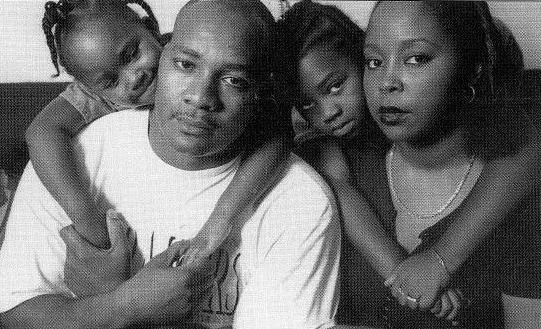
Rod Carter sought Foundation help after he was stabbed and beaten by Teamsters militants in 1997. The Foundation still fights union violence and opposes union bosses’ attempts to dodge property damage lawsuits.
WASHINGTON, DC – Unions and union officials already have an enormous number of special privileges under the law enjoyed by no other private organization or individual. Yet those special powers — including forcing workers under monopoly “representation” and union dues payments they oppose — haven’t stopped union lawyers from arguing for even more special exemptions.
In a case now before the U.S. Supreme Court, the Justices are set to decide whether the Washington State Supreme Court was correct when it granted Teamsters union officials immunity from lawsuits filed under state law. The lawsuit in this case concerned vandalism and property damage against an employer that occurred during a union boss-ordered strike.
Union Chiefs Want Blank Check to Target Workers with Property Damage
In Glacier Northwest Inc. v. International Brotherhood of Teamsters Local 174, a construction company sued the Teamsters union over property damage deliberately caused as part of a strike, only to see the Washington Supreme Court overturn the lower court and agree with union bosses’ argument that unions were exempt from such lawsuits.
With the issue now before the nation’s highest court, the National Right to Work Foundation filed a brief in the case arguing that creating such a carve-out is wrong under the law. The Foundation brief says this exemption is dangerous not only to businesses but first and foremost to independent-minded workers, and that union officials’ abundance of government-granted powers should be pared back, not extended. Oral arguments are set for January 10, 2023.
The Foundation explains in the amicus brief that “states’ interest in protecting life, limb, and private property must be respected under principles of federalism” because federal courts usually don’t offer relief for crimes like vandalism and property damage, making state courts the only place where lawsuits can be filed for such behavior. Far from being a concern only for employers who face union strike efforts, the Foundation argues, employees are often targeted by hostile or violent strike behavior and state courts often are the only forum in which they can receive justice.
“For example, in Clegg v. Powers, employees sought damages in state court for union violence and property damage during a strike,” the brief says. “Cases like Clegg demonstrate that the Court should limit” unions’ ability to dodge being sued in state court, it continues.
Foundation: Union Officials’ Special Legal Privileges Shouldn’t Be Expanded
The Foundation’s brief then points out that the Teamsters bosses’ attempt to gain this new legal privilege should be shut down given “the extraordinary privileges and exemptions already granted to unions” by Congress and courts all over the country.
These include, but are not limited to, an exemption from federal law prohibiting extortionate violence, the power to force employees in non-Right to Work states to pay union dues or fees just to stay employed, and the privilege to foist monopoly “representation” over workers against their will — powers no other private entity or individual has.
“This Court should treat unions like all other citizens or entities, clarifying that they can be liable for damages in state courts under ‘the common law rule that a man is held to intend the foreseeable consequences of his conduct,’” the brief concludes.
Unions Shouldn’t Get More Rights Than Regular Citizens
“Union officials’ theory that they should be off the hook in state court for damaging or vandalizing property is outrageous on its face. The law already has plenty of carve-outs and privileges for union hierarchies that no other private organization or citizen gets to enjoy, least of all the workers union bosses claim to ‘represent,'”” commented National Right to Work Foundation Vice President Patrick Semmens.
“Union officials regularly force millions of workers to pay union fees or be fired, and force their ‘representation’ on millions of workers who bitterly oppose it. The Supreme Court should reject this new ploy seeking another union-only exemption to regular laws, and begin to scrutinize and ultimately roll back the many existing union boss special powers.”
Las Vegas Police Officer Urges Supreme Court to Hear Case Battling Union’s Unconstitutional Dues Scheme
LVMPD officer argues union officials seized her money in violation of First Amendment through restrictive arrangement to which she never consented
Washington, DC (November 21, 2022) – Las Vegas police officer Melodie DePierro has submitted a petition asking the United States Supreme Court to hear her lawsuit defending her First Amendment right to abstain from paying dues to a union she does not support. DePierro is receiving free legal representation from National Right to Work Legal Defense Foundation staff attorneys.
DePierro, a Las Vegas Metropolitan Police Department (LVMPD) officer, contends in the lawsuit that officials of the Las Vegas Police Protective Association (PPA) union seized dues money from her paycheck in violation of her First Amendment rights pursuant to a so-called “window period” specified in the union contract. PPA officials’ “window period” scheme prohibits police officers from opting out of union financial support for over 90% of the year. DePierro never consented to – nor was ever informed of – this limitation.
DePierro seeks to enforce her First Amendment rights recognized by the Supreme Court in the landmark 2018 Janus v. AFSCME case, which was argued and won by Foundation attorneys. The Justices ruled in Janus that forcing public sector workers to subsidize an unwanted union as a condition of employment violates the First Amendment. They also held that union officials can only deduct dues from a public sector employee who has affirmatively waived his or her Janus rights.
“[I]f employee consent is not required, governments and unions can, and will…devise and enforce onerous restrictions on when employees can stop subsidizing union speech,” reads the brief.
PPA Union Officials Imposed on Officer Contract Provision She Never Knew About
According to DePierro’s original complaint, she began working for LVMPD in 2006 and voluntarily joined the PPA union at that time. However, in 2006 the union monopoly bargaining contract permitted employees to terminate dues deductions at any time.
In January 2020, she first tried to exercise her Janus rights, sending letters to both union officials and the LVMPD stating that she was resigning her membership. The letters demanded a stop to union dues being taken from her paycheck.
Her complaint reported that union and police department agents rejected that request because of the union-imposed “window period” restriction previously unknown to DePierro that purportedly limits when employees can exercise their Janus rights. As her brief notes, that “window period” restriction was added in the 2019 monopoly bargaining contract between union officials and the police department, despite the fact Janus had already been decided by then.
DePierro never agreed to such a restriction on the exercise of her First Amendment rights, but union agents nonetheless rebuffed her again when she renewed her demand to stop dues deductions in February 2020. When she filed her lawsuit, full union dues were still coming out of her paycheck.
DePierro’s Supreme Court petition argues that, because union officials kept seizing money from her wages under the guise of the “window period,” and never sought her consent to the restriction, they violated the First Amendment. As per Janus, union officials must obtain a worker’s waiver of their Janus rights before deducting dues or fees from their pay. DePierro asks the High Court to declare the “window period” scheme unconstitutional, forbid PPA and LVMPD from further enforcing it, and order PPA and LVMPD to refund with interest all dues unlawfully withheld from her pay since she tried to stop the deductions.
“This Court’s review is urgently needed because the Ninth Circuit’s decision is allowing governments and unions to unilaterally decide when and how to restrict employees’ right to refrain from subsidizing union speech—without the need to secure their affirmative consent to the restriction,” asserts the brief.
Officer Joins California Lifeguards in Asking Justices to Uphold Janus Ruling
DePierro’s petition comes as 21 Foundation-represented Southern California lifeguards are also urging the Supreme Court to hear their case challenging an anti-Janus dues scheme concocted by California Statewide Law Enforcement Agency (CSLEA) union officials. That scheme has trapped the lifeguards in union membership and full dues deductions until 2023, despite each of the lifeguards exercising his or her Janus right to abstain from union membership and union financial support.
As in DePierro’s case, the lifeguards were not explicitly informed of the so-called “maintenance of membership” restriction which now confines them in membership and full dues payment. Moreover, union officials never obtained voluntary waivers of Janus rights from any of the lifeguards before subjecting them to this scheme.
“Janus’ First Amendment protections are meant to ensure that workers are not being forced to subsidize union bosses of whom they disapprove, whether based on union officials’ ineffectiveness, political activities, divisive conduct in the workplace, or any other reason,” commented National Right to Work Foundation President Mark Mix. “Union officials’ defense of schemes that siphon money out of unwilling workers’ paychecks sends a clear message that they value dues revenue over the constitutional rights of the workers they claim to ‘represent.’”
“Two parties, here the union and police department, cannot enter into an agreement to restrict the First Amendment rights of an American citizen, yet that is exactly what has happened here to Officer DePierro,” Mix added. “The Supreme Court must defend Janus rights against such obvious violations, and ensure that these unconstitutional schemes are not allowed to stand.”
Labor Board Rejects Biden Appointee’s Attempt to Scuttle Case Against Union
The following article is from the National Right to Work Legal Defense Foundation’s bi-monthly Foundation Action Newsletter, July/August 2021 edition. To view other editions of Foundation Action or to sign up for a free subscription, click here.
Texas nurse challenges concealment of secret union-employer deal which stifles decertification

With Foundation legal aid, Texas nurse Marissa Zamora shut down NLRB “Acting” General Counsel Ohr’s attempt to block her case.
WASHINGTON, DC – The National Labor Relations Board (NLRB) recently rejected a move by NLRB Acting General Counsel Peter Ohr to prematurely end Texas nurse Marissa Zamora’s case before the Board could rule. The case challenges National Nurses Organizing Committee (NNOC) union officials’ refusal to disclose a secret agreement they signed with the parent company of her hospital that limits Zamora’s ability to remove the union from her workplace.
Ohr is a career NLRB bureaucrat, who was installed as General Counsel by President Biden this January after Biden made the unprecedented move of removing Trump-appointed NLRB General Counsel Peter Robb before his Senate-confirmed four-year term expired. Ohr filed a motion in February seeking unilaterally to send Zamora’s complaint back to the NLRB’s Fort Worth regional office to be dismissed — after Zamora’s case had already been fully briefed at the full Board in Washington.
Zamora is represented for free by National Right to Work Foundation staff attorneys, who in March opposed Ohr’s attempted maneuver. Their brief argued that snuffing
the case out now would jeopardize the NLRB’s power to decide cases involving violations of federal labor law, and also contended that Ohr lacked any authority to make his motion because of Biden’s illegal ouster of Robb. In a May decision, the NLRB agreed with Zamora’s Foundation staff attorneys that the case should continue, observing that the matter “has been fully litigated, and the controversy at issue, which remains active, is ripe for Board adjudication.” The case began when Zamora demanded a copy of the secret so-called “neutrality agreement.” Such agreements are deals between union officials and employers — usually without the knowledge of employees in a workplace — that seek to assist the union in gaining monopoly bargaining powers over rank-and-file workers.
NNOC Agents Shrouded, Lied About Deal Which Stymied Info about Decertification
“The Board correctly rejected Peter Ohr’s attempt to scuttle this case so he could let union officials off scot-free despite their secret backroom deal to undermine the rights of nurses like Marissa Zamora who are subjected to unwanted union representation,” National Right to Work Foundation President Mark Mix said about the decision to let the case move forward. These controversial top-down organizing deals frequently contain provisions that require employers to silence opposition to unionization, hand over workers’ personal information for coercive “card check” drives that bypass the protections of a secret-ballot election, provide union organizers with preferential access to the workplace and even ensure employers will help stifle workers’ efforts to decertify, i.e. remove, the union.
In Zamora’s case, she began circulating fliers and other materials in June 2018 to educate her coworkers on how they could obtain a vote to decertify the union. Legal documents she filed in her case explain that union agents “repeatedly ripp[ed] down her fliers” and that hospital officials referenced a secret agreement with the union when they denied “her access to post material on protected bulletin boards, where her material would be shielded from vandalism.”
Zamora subsequently asked both NNOC and hospital officials to show her any “neutrality agreement” that might have triggered those efforts to block her and her coworkers’ rights. All her requests were denied, and NNOC even denied that such an agreement exists. This was despite statements by hospital agents to her that indicated a “neutrality agreement” was indeed in effect.
Trump-Appointed NLRB GC Robb Backed Nurse’s Case Until Unprecedented Firing
Zamora filed federal unfair labor practice charges at the NLRB, challenging NNOC bosses’ refusal to disclose the secret agreement. Then- NLRB General Counsel Robb issued a complaint supporting the claims in Zamora’s charges.
Nevertheless, a Labor Board Administrative Law Judge (ALJ) dismissed the complaint Robb issued, even revoking subpoenas that would have compelled NNOC union bosses to reveal the covert deal.
Zamora challenged the ALJ’s dismissal, filing exceptions at the full Board in Washington. Briefs she filed supporting those exceptions pointed out that, during a two-day trial, it came out that the “neutrality agreement” existed, but it was a closely guarded secret between the hospital and union officials “to be kept strictly confidential from employees and all third parties.” Robb also submitted exceptions buttressing Zamora’s exceptions.
Robb’s pro-employee decisions preceded Ohr’s controversial installation by Biden in January, and Ohr’s subsequent attempt to remand or dismiss the case, which the NLRB has now rejected.
“The Board should now promptly rule for Ms. Zamora on the merits of the case so union bosses cannot keep secret pacts with employers to the detriment of rank-and-file employees’ protected rights,” Mix said.
Multiple Units Oust Teamsters Bosses Thanks to Foundation-Backed NLRB Rule
The following article is from the National Right to Work Legal Defense Foundation’s bi-monthly Foundation Action Newsletter, May/June 2021 edition. To view other editions of Foundation Action or to sign up for a free subscription, click here.
Unpopular Teamsters officials voted out of California, New Jersey workplaces
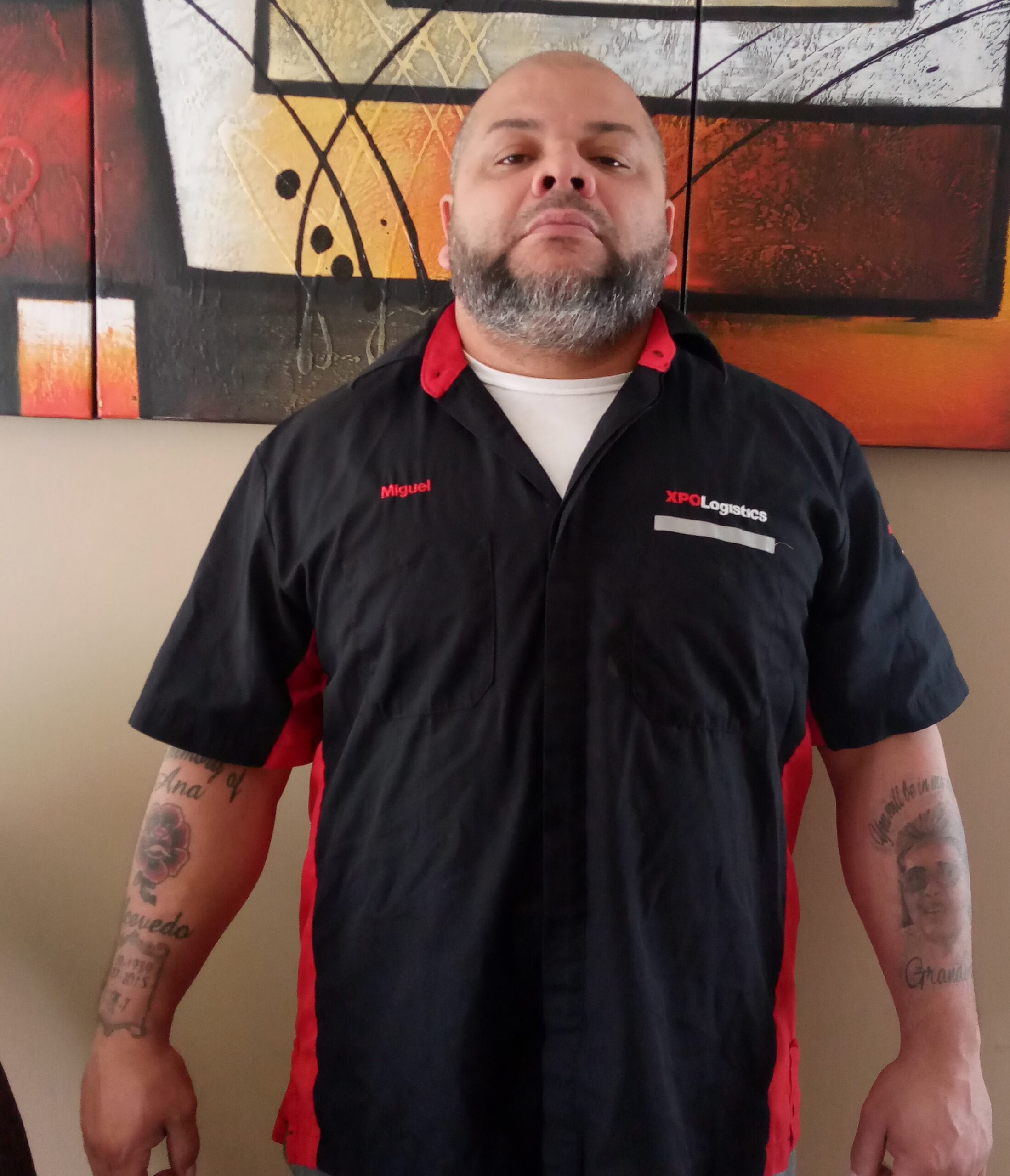
Reforms urged by Foundation staff attorneys eased Miguel Valle and his coworkers’ near-unanimous effort to vote out unpopular Teamsters officials, who tried to use “blocking charges,” ultimately to no avail.
WASHINGTON, DC – Workers in California and New Jersey who were previously subject to Teamsters bosses’ monopoly bargaining authority have freed themselves from unwanted union control.
The workers received free legal aid from Foundation staff attorneys, and benefited from rule changes at the National Labor Relations Board (NLRB) in Washington pushed for by the Foundation.
In California, Eliseo Haro, an employee at Los Angeles-based KWK Trucking, Inc., submitted a decertification petition with the NLRB because he and his coworkers were being ignored by Teamsters bosses. As Haro puts it, “The union never came in to talk to us, or negotiate a contract, or represent us. They disappeared.”
Haro’s petition was signed by nearly 80 percent of the workers in the 119-employee bargaining unit and called for an NLRB-supervised decertification election, in which KWK employees could vote out the unpopular union officials.
Rather than face an overwhelming defeat in the decertification election, Teamsters bosses chose to walk away. The union disclaimed interest in the unit, and NLRB Region 21 revoked Local 986’s certification as the workers’ monopoly bargaining agent.
New Jersey Decertification Effort Succeeds Despite Union Stall Tactics
In Cinnaminson, New Jersey, Teamsters officials did not immediately leave when a decertification petition was filed by Miguel Valle and his coworkers at a branch of XPO Logistics. Instead, Teamsters lawyers used nearly two months of unnecessary court proceedings to delay the election.
They demanded the vote be held in person at the Teamsters union hall. Foundation attorneys argued that the union lawyers’ requests were merely an effort to delay the vote. Ultimately, as expected, the NLRB’s Regional Director ruled that the election would be conducted by mail.
When Valle and his coworkers finally had their election, they voted 16-2 to remove Teamsters bosses from their workplace.
Foundation-Backed Rule Changes Reduce Needless Election Delays
For workers, just getting a decertification election is often difficult. In some cases, union bosses have created multi-year delays to stymie decertification efforts, trapping workers under union monopoly “representation” and often forced-dues payments they oppose, while they wait for a vote.
Union officials frequently attempt to delay or block decertification votes by filing “blocking charges,” unfair labor practice charges that can be used to hold up an election, even when they have nothing to do with the employees’ dissatisfaction with the union.
Union officials’ ability to use this tactic to block or delay votes has been limited by recent NLRB rulemaking, finalized in 2020. Under the NLRB’s new policy, which draws on comments filed by the National Right to Work Foundation, union charges cannot indefinitely stall employee votes, and in most instances votes occur without delay.
Additionally, as the Foundation advocated in its comments, instead of ballots being impounded for months or even years while “blocking charges” are resolved, the NLRB modified its original proposed rule so that in most cases ballots are tallied and the results are announced after employees vote.
“Union bosses can stick around for years, even when they face overwhelming opposition from rank-and-file workers, because of the legal barriers that protect union officials from decertification votes,” said National Right to Work Foundation Vice President and Legal Director Raymond LaJeunesse.
“Thanks to Foundation-backed reforms to the NLRB’s ‘blocking charge’ policy, union officials’ ability to trap workers in union ranks through legal trickery despite overwhelming opposition has been significantly curtailed.”
Foundation Asks Supreme Court to Hear Janus Case Again, Seeking Return of Forced Fees
The following article is from the National Right to Work Legal Defense Foundation’s bi-monthly Foundation Action Newsletter, May/June 2020 edition. To view other editions or to sign up for a free subscription, click here.
Case could set precedent for hundreds of millions of dollars in refunds to Big Labor’s victims
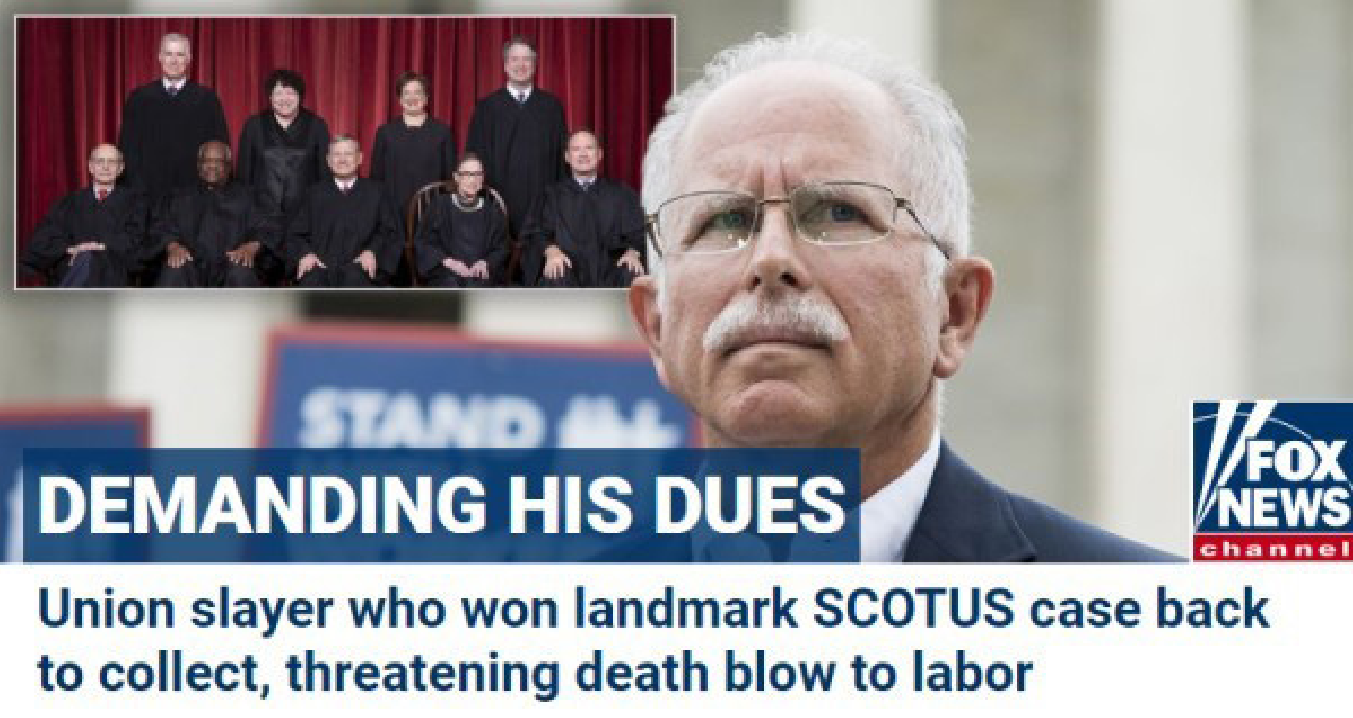
Mark Janus’ second Foundation-backed appeal to the Supreme Court landed the top spot on Fox News’ website. If Janus prevails again, hundreds of millions of dollars in unconstitutional union dues could be returned to public sector employees.
WASHINGTON, DC – Mark Janus is returning to the U.S. Supreme Court, this time asking the Justices to hear the continuation of Janus v. American Federation of State, County, and Municipal Employees (AFSCME), Council 31. Janus seeks repayment of the thousands of dollars in fees the union took from his paycheck in violation of his First Amendment rights. Another Supreme Court victory for Janus could set a precedent resulting in the return of hundreds of millions of dollars seized by union officials in violation of workers’ constitutional rights.
The original Janus v. AFSCME was argued successfully before the Supreme Court by veteran National Right to Work Foundation staff attorney William Messenger. In a landmark victory, the Court sided with Janus on June 27, 2018, and declared it illegal to force public employees to subsidize a union as a condition of employment. The Court recognized that compelling public workers to pay fees to a union violates their First Amendment rights.
Illinois Child Support Public Servant Intervenes in Lawsuit with Foundation Aid
As a result of Janus, more than five million public sector employees across the country are no longer required to pay union dues or fees to keep their jobs. However, Janus’ case continues as he seeks the return of the fees that AFSCME seized from his paycheck without his permission from June 27, 2018, to March 23, 2013, representing the two-year statute of limitations from the date his case started in March 2015 through the Supreme Court’s 2018 decision in his favor.
The Janus case began in February 2015, when then-newly elected Illinois Governor Bruce Rauner issued an executive order prohibiting state agencies from requiring employees who had abstained from formal union membership to pay union fees, based on a Right to Work Foundation U.S. Supreme Court victory in 2014 in another Illinois case. Rauner also filed a federal lawsuit seeking a declaratory judgment that forced union fees violate the First Amendment rights of public workers.
Staff attorneys from the Foundation, in partnership with the Illinois-based Liberty Justice Center, filed a motion for Mark Janus and two other plaintiffs to intervene in the case in March 2015, and have represented Janus ever since. The U.S. District Court for the Northern District of Illinois granted Janus’ motion to file a complaint in intervention, which allowed the suit to move forward even after the court ruled that Rauner lacked standing to pursue the lawsuit.
The Supreme Court permitted union bosses to impose forced union fees on public workers in the 1977 Abood v. Detroit Board of Education decision. However, before the Janus victory, Foundation staff attorneys secured several victories for workers which called the constitutionality of forced fees into question. In 2012, the court ruled in Knox v. SEIU that union officials must obtain affirmative consent from workers before using workers’ forced union fees for special assessments or risk infringing on their First Amendment rights. In 2014, the court ruled in Harris v. Quinn that requiring home healthcare providers who receive a subsidy from the government to pay union dues is a First Amendment violation.
Following Janus’ groundbreaking win at the Supreme Court in June 2018, Foundation attorneys continued his case in Illinois federal courts, arguing that the Supreme Court’s ruling is retroactive and that AFSCME should be required to return dues they seized unconstitutionally before the decision. In this and similar cases, union bosses have made a so-called “good faith” argument to defend their seizing of dues before Janus was issued. The U.S. Seventh Circuit Court of Appeals in Chicago ruled in 2019 that AFSCME could keep the unconstitutional dues, prompting Janus’ petition to the Supreme Court.
Hundreds of Millions of Dollars Potentially At Stake
“The Supreme Court agreed that the union taking money from non-members was wrong but the union still has the money it illegally garnished from my paycheck,” commented Janus. “It’s time for AFSCME to give me back the money they wrongfully took.”
Foundation staff attorneys are currently fighting for thousands of workers in about 20 cases which seek refunds of dues seized unconstitutionally before Janus was decided. While Janus is seeking the return of $3,000 of his own money, a favorable decision for him would set a precedent that could result in the return of over $120 million to public servants just in Foundation-backed cases. Other cases brought by workers could bring that total to hundreds of millions of dollars.
Workers Already Winning Refunds of Illegal Dues with Foundation Legal Aid
“The Supreme Court has already sided with the Foundation arguments for Mark Janus and ruled that forcing public employees to fund union activities violates the First Amendment,” said National Right to Work Foundation Vice President and Legal Director Raymond LaJeunesse. “The Supreme Court should take this case again to ensure that public sector union bosses are not permitted to profit from their widespread violation of workers’ First Amendment rights.”
Foundation staff attorneys in July 2018 secured the nation’s first-ever refund of dues seized unconstitutionally before Janus for Debora Nearman, an Oregon state wildlife employee. SEIU bosses were forced to settle and give back to Nearman over $3,000 in illegal fees they had seized from her over two years, during which they had sponsored an aggressive political campaign against her own husband, who ran successfully for the Oregon Legislature in 2016.





