
ATU Union Facing Prosecution After Agent Physically Assaults Bus Driver
The following article is from the National Right to Work Legal Defense Foundation’s bi-monthly Foundation Action Newsletter, September/October 2022 edition. To view other editions of Foundation Action or to sign up for a free subscription, click here.
Bus driver targeted by union militants for opposing incumbent union officials

Driven by Justice: Thomas McLamb did not let ATU union agents get away with upending his career just because he opposed their agenda. The union is now facing prosecution for its abuses.
WASHINGTON, DC – Transdev bus driver Thomas McLamb thought that Amalgamated Transit Union (ATU) union bosses at his workplace were mishandling finances and not serving the workers’ interests. In 2015, he led a campaign to vote the union out, and in October 2021 he ran for union office in the hopes of unseating officials he found ineffective.
In response, union agents kicked off a vicious retaliation campaign to punish McLamb for peacefully resisting ATU union bosses’ agenda. This included a union steward physically assaulting McLamb and another union official arranging McLamb’s illegal firing.
McLamb sought out free legal assistance from the National Right to Work Foundation and hit ATU union officials with federal charges for illegal retaliation. He also charged Transdev for the company’s role in his firing. McLamb’s opposition to the ATU union is activity protected by the National Labor Relations Act (NLRA), which guarantees workers’ right to “refrain from any or all of ” union activities. McLamb’s charges say that ATU and Transdev officials illegally violated his rights under the NLRA.
Following an investigation, the National Labor Relations Board (NLRB) issued a formal complaint against the ATU union, confirming all McLamb’s charges and scheduling a trial against ATU for its campaign of illegal retaliation. As this edition of Foundation Action went to press, a trial over the union’s misconduct had concluded. McLamb is now awaiting a decision from an NLRB Administrative Law Judge (ALJ).
Union President Encouraged Followers to Assault Dissident Workers
In a statement filed in November 2021, McLamb said that the ATU Local 689 president, Raymond Jackson, had told other union officers to “slap” employees who were opposing his agenda. Shortly after, McLamb’s statement reported, a union shop steward assaulted him. Both incidents occurred while McLamb was campaigning against the incumbent officers to serve on Local 689’s board.
The NLRB’s complaint and notice of hearing in the case echoed McLamb’s charge. It stated that “[o]n November 11, 2021 . . . [union steward] Tiyaka Boone, at the Employer’s Hubbard Road facility, in the presence of employees, physically assaulted the Charging Party.”
McLamb reported in another federal charge that, shortly after this incident, ATU official Alma Williams demanded that Transdev management fire him. The NLRB’s complaint confirms this accusation: “On November 11, 2021, Respondent, by Alma Williams, at the Employer’s Hubbard Road facility, requested that the Employer discharge the Charging Party.”
On November 16, Transdev gave McLamb a letter stating that he had been placed on “Administrative Leave without pay” pending the outcome of an investigation.
For its part, Transdev backed down and settled immediately, reinstating McLamb and paying him full back wages for the period of his suspension. The ATU union, however, remains defiant.
“The union should not be run as the personal fiefdom of union bosses who do everything they can to insulate themselves from accountability, yet that’s how ATU officials have treated it, complete with threats and violence against me for calling out union officials’ shortcomings,” McLamb told The Washington Free Beacon shortly after a trial was scheduled in his case.
Case Highlights Need for Right to Work Protections
“No American employee should have to go to work thinking that they could be fired, mugged, or slandered merely for exercising their right to oppose union officials. The NLRB’s issuance of a complaint against the ATU in Mr. McLamb’s case is a small but significant step toward justice,” commented National Right to Work Foundation Vice President Patrick Semmens. “However, due to Maryland’s lack of Right to Work protections for its private sector employees, Mr. McLamb is still required to sacrifice part of every paycheck to the same union hierarchy that is now facing prosecution for instigating violence against him.”
“Although we’re happy that the scales are finally tipping in Mr. McLamb’s favor, it’s unfortunately the reality in the 23 non-Right to Work states that workers are forced to pay fees to union hierarchies that act against their interests, sometimes even violently so.”
Workers Nationwide Press NLRB to Scrap Policy Blocking Right to Vote Out Unions
The following article is from the National Right to Work Legal Defense Foundation’s bi-monthly Foundation Action Newsletter, March/April 2021 edition. To view other editions or to sign up for a free subscription, click here.
Foundation cases contend ‘contract bar’ must be eliminated to protect employee freedom
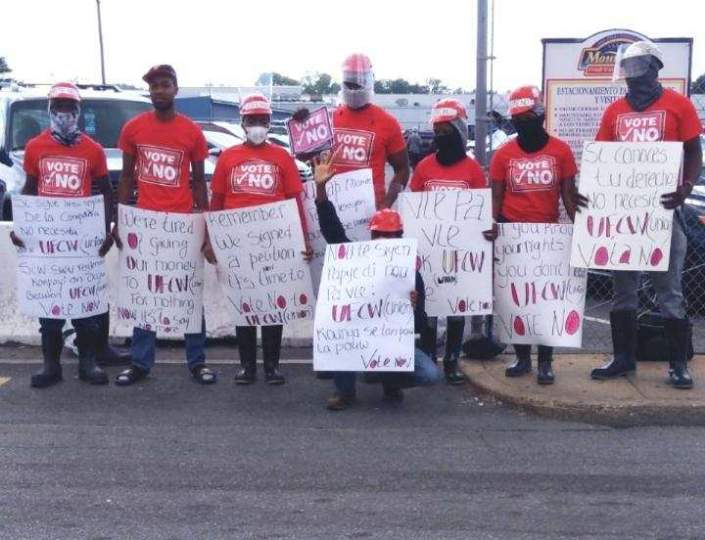
Foundation staff attorneys are assisting Delaware poultry workers in challenging UFCW bosses’ attempts to use the “contract bar” to trap them in union ranks.
WASHINGTON, DC – Foundation attorneys in January filed a Request for Review to the full National Labor Relations Board (NLRB) in Washington, D.C. The Request defends the right of Virginia Transdev workers to have a vote to remove unpopular Office and Professional Employees International Union (OPEIU) Local 2 bosses from power at their workplace.
The Transdev employees, who work at the Fairfax Connector bus service in Northern Virginia, now join Foundation-backed workers in Delaware and Puerto Rico, all of whom are urging the NLRB to eliminate the “contract bar.” That is a non-statutory NLRB policy which forbids employees from exercising their right to vote out an unpopular union in an NLRB-supervised “decertification election” for up to three years after their employer and union finalize a monopoly bargaining contract.
Foundation attorneys point out in each of these cases that the “contract bar” appears nowhere in the National Labor Relations Act (NLRA), the federal law the NLRB is charged with enforcing, and is merely the result of past union boss-friendly decisions by the Board. They also argue that the bar undermines workers’ basic right under the NLRA to remove unions that lack majority support.
“The ‘contract bar’ undermines the fundamental objective of federal labor law: Employee free choice. It makes rank-and-file employees prisoners of an unpopular union, with no way out for up to three years,” commented National Right Work Foundation President Mark Mix. “This inevitably creates an environment in which, as these employees can certainly attest, it’s impossible to hold self-serving union bosses accountable because workers are denied the right to vote them out.”
Unpopular OPEIU Bosses Went Behind Workers’ Backs to Sign Contract
The petitioner in the Transdev workers’ case, Amir Daoud, submitted a petition on November 10, 2020, signed by the necessary number of his coworkers to trigger a “decertification election” in his workplace. This was after news had gotten around that an OPEIU union agent had told some employees in October he had “negotiated a new agreement” with Transdev management and “‘intended’ to sign it without a ratification vote.” Workers had already voted down an earlier union boss-promoted monopoly bargaining contract in June.
Foundation attorneys filed a Request for Review, which notes that the union agent didn’t inform Daoud and his coworkers of when he planned to approve the new contract — until after Daoud filed the petition. The new contract was signed by union agents on October 30 and Transdev representatives on October 31.
NLRB Region 5 in Baltimore dismissed Daoud and his coworkers’ decertification petition on December 22, ruling that the “contract bar” applied because the employees’ petition was submitted just after the new contract was signed, even though the employees had no way of knowing whether or when that signing would occur.
This prompted Daoud to ask the NLRB in Washington to review the case. Because Daoud recently accepted a job with Transdev outside the OPEIU’s monopoly bargaining control, the Request for Review asks the NLRB to recognize his coworker Sheila Currie as the new petitioner to represent the interests of the workers who signed the decertification petition.
The Request exposes the arbitrariness of the “contract bar,” pointing out that the NLRB Regional Director applied it “merely because the Union ‘won the race’ and signed the contract ten days” before Daoud submitted the petition, even though the petition clearly demonstrated the employees’ interest in voting the union out.
VA and Puerto Rico Cases Follow Groundbreaking Effort by DE Poultry Workers
The Virginia Transdev employees, and a Puerto Rico armored transit guard who submitted a similar Request for Review on behalf of his coworkers with Foundation aid in January, are now battling the “contract bar” like Delaware Mountaire Farms poultry worker Oscar Cruz Sosa and his coworkers. For almost a year now, Cruz Sosa and his fellow employees have been fighting United Food and Commercial Workers (UFCW) union bosses’ attempts to use the “contract bar” to block their valid petition for a decertification vote. The Mountaire employees are now waiting for the NLRB to issue a ruling on their case.
In that case, UFCW officials claim that the “contract bar” should apply to bar any elections at Mountaire, despite an NLRB Regional Director’s decision allowing the vote because the union contract contains an invalid forced-dues clause.
When the UFCW bosses asked the full NLRB to review the Region’s order allowing the election, Cruz Sosa’s attorneys filed a brief urging that, if the Board granted review, it should use the opportunity to review the entire non-statutory “contract bar” policy. The Board is now doing just that. The UFCW union bosses are even arguing that the impounded ballots already cast by Mountaire workers should be destroyed, claiming the election should never have been held.
The Requests for Review submitted by Foundation staff attorneys for the Puerto Rico guard and Virginia Transdev employees each request that the NLRB should either grant review or least hold the case until a decision is issued in Cruz Sosa’s case.





