
Foundation Op-Ed: ‘Public Employees Never Waived Their 1st Amendment Rights’
Recently, Newsmax published an op-ed by National Right to Work Foundation President Mark Mix, highlighting a case from Alaska pending at the U.S. Supreme Court. In the case the State of Alaska seeks protect the First Amendment rights of public employees under the Foundation-won 2018 Janus v. AFSCME decision, by requiring an affirmative waiver before state agencies deduct any union dues:
If you’ve ever watched a television show featuring law enforcement, you probably know these words by heart, “You have the right to remain silent. Anything you say can and will be used against you in a court of law…”
Such a “Miranda” warning ends the following way, “Do you understand the rights I have just read to you? With these rights in mind, do you wish to speak to me?”
Police “Mirandize” suspects because, although a citizen can waive a constitutional right they have, the government cannot assume that such a right has been waived.
Miranda warnings protect citizens’ Fifth Amendment rights, but the principle applies to any constitutional right. (See Miranda v. Arizona, 384 U.S. 436 1966).
The State of Alaska has recently asked the U.S. Supreme Court to hear a case about Alaska Gov. Mike Dunleavy’s attempt to apply this principle to protect the First Amendment rights of state employees.
Five years ago, National Right to Work Legal Defense Foundation staff attorneys argued and won the landmark Janus v. AFSCME case at the U.S. Supreme Court.
That decision established that the First Amendment prohibits government unions from requiring that public employees pay union dues and fees without their explicit and informed consent.
In the wake of Janus, the State of Alaska was among the first jurisdictions to proactively enforce the decision.
Citing Janus, Gov. Dunleavy issued an executive order directing state officials not to deduct union dues from the paychecks of public employees, unless the state has clear evidence that a worker has knowingly waived their First Amendment Janus rights.
Dunleavy set up a system that required such proof be submitted annually as a condition of the state continuing to deduct union dues.
The state cannot assume state employees want to waive their rights indefinitely: Talking to a police officer voluntarily years ago is not evidence of waiving Fifth Amendment rights in perpetuity.
Despite the straightforward justification, not to mention the fact that Dunleavy’s order doesn’t prevent a single worker from having dues deducted voluntarily, government union bosses in Alaska were livid…
Find the rest of the op-ed online on the website of Newsmax here.
Case Closed: Nurse Prevails in 11-Year Legal Fight Over Forced Dues
The following article is from the National Right to Work Legal Defense Foundation’s bi-monthly Foundation Action Newsletter, January/February 2022 edition. To view other editions of Foundation Action or to sign up for a free subscription, click here.
100 Rhode Island hospital employees win refund of dues illegally seized for union lobbying

After over a decade of battling power-hungry UNAP union bosses in court, Jeanette Geary has secured not only refunds of dues seized for union politics, but a First Circuit decision clarifying non-members can never be charged for union lobbying.
WARWICK, RI – Jeanette Geary finally achieved a total victory in her 11-year legal battle against union bosses. She and 99 other current and former nurses at Kent Hospital in Rhode Island received refunds of forced dues that were illegally used to support union lobbying in state legislatures. Foundation attorneys represented Geary throughout her fight.
Geary’s journey began when she grew frustrated with United Nurses and Allied Professionals (UNAP) union bosses in her workplace. “I realized what the union was doing,” Geary explained. “The union leadership had no interest in nurses or our professional work. Their only interest was collection of dues and fees.”
Geary resigned her union membership, but union dues were still extracted from her paycheck because Rhode Island is a forced unionism state that lacks Right to Work protections. However, thanks to the Foundation-won CWA v. Beck Supreme Court decision, nonmember workers can only be forced to pay fees for union activities “germane” to union monopoly bargaining. They cannot be forced to pay the portion of dues that funds activities like union lobbying.
Nurse Harassed for Standing Up to Union Bosses
Geary demanded a breakdown of the union’s expenditures, but union bosses refused to give her a legally required independent auditor’s verification of how they calculated non-members’ reduced forced fees. Like many who speak up against union bosses, Geary became a target for union harassment. “They laughed at me. They had their workplace reps ridicule me on the job and tell me I could file grievances that would be thrown away and said so with a big smile,” Geary recalled.
In 2009, Geary filed federal charges against union officials. The trial revealed UNAP officials were charging non-member nurses for lobbying in state legislatures. Despite the Supreme Court’s clear mandate in Beck that non-members’ money could not be used to fund political causes, union lawyers argued the lobbying was “germane” to the union’s monopoly bargaining.
Thanks to delays caused by President Obama’s illegal recess appointments to the National Labor Relations Board (NLRB), Geary had to file two petitions with the U.S.
Court of Appeals in Washington, D.C., and didn’t get a final NLRB ruling for nearly a decade. Finally, in March 2019, the NLRB ruled 3-1 that union officials cannot charge non-members for lobbying of any kind. It also ruled that union officials must provide independent verification that the union expenses they force non-members to pay have been audited.
Union Bosses Ridiculously Claimed Some Union Lobbying Wasn’t Political
Union officials still wouldn’t abandon their argument that nonmembers could be forced to pay for some union lobbying as a condition of employment. Union lawyers appealed the NLRB’s decision to the U.S. Court of Appeals for the First Circuit. A three-judge panel that included retired Supreme Court Justice David Souter ruled unanimously in Geary’s favor, saying “we see no convincing argument that legislative lobbying is not a ‘political’ activity.”
Union officials made a last-ditch attempt to overturn the decision, requesting an en banc hearing by the entire Court of Appeals, but that request was denied. In September 2021, union bosses finally paid back, with interest, thousands of dollars taken from Geary and 99 other current and former Kent Hospital nurses who were not union members but were charged for the union’s lobbying, bringing the decade-long case to a close.
“Jeanette Geary faced workplace ridicule for her decision to stand up to union bosses, yet she persevered for eleven years,” said National Right to Work Foundation Vice President and Legal Director Raymond LaJeunesse. “In the process, she won important legal precedents that will protect thousands of other workers from having their money illegally used to fund union politics.”
Foundation Urges Federal and State Governments to Protect First Amendment Rights
The following article is from the National Right to Work Legal Defense Foundation’s bi-monthly Foundation Action Newsletter, November/December 2019 edition. To view other editions or to sign up for a free subscription, click here.
Alaska first state to require First Amendment Janus rights waiver before deducting union dues
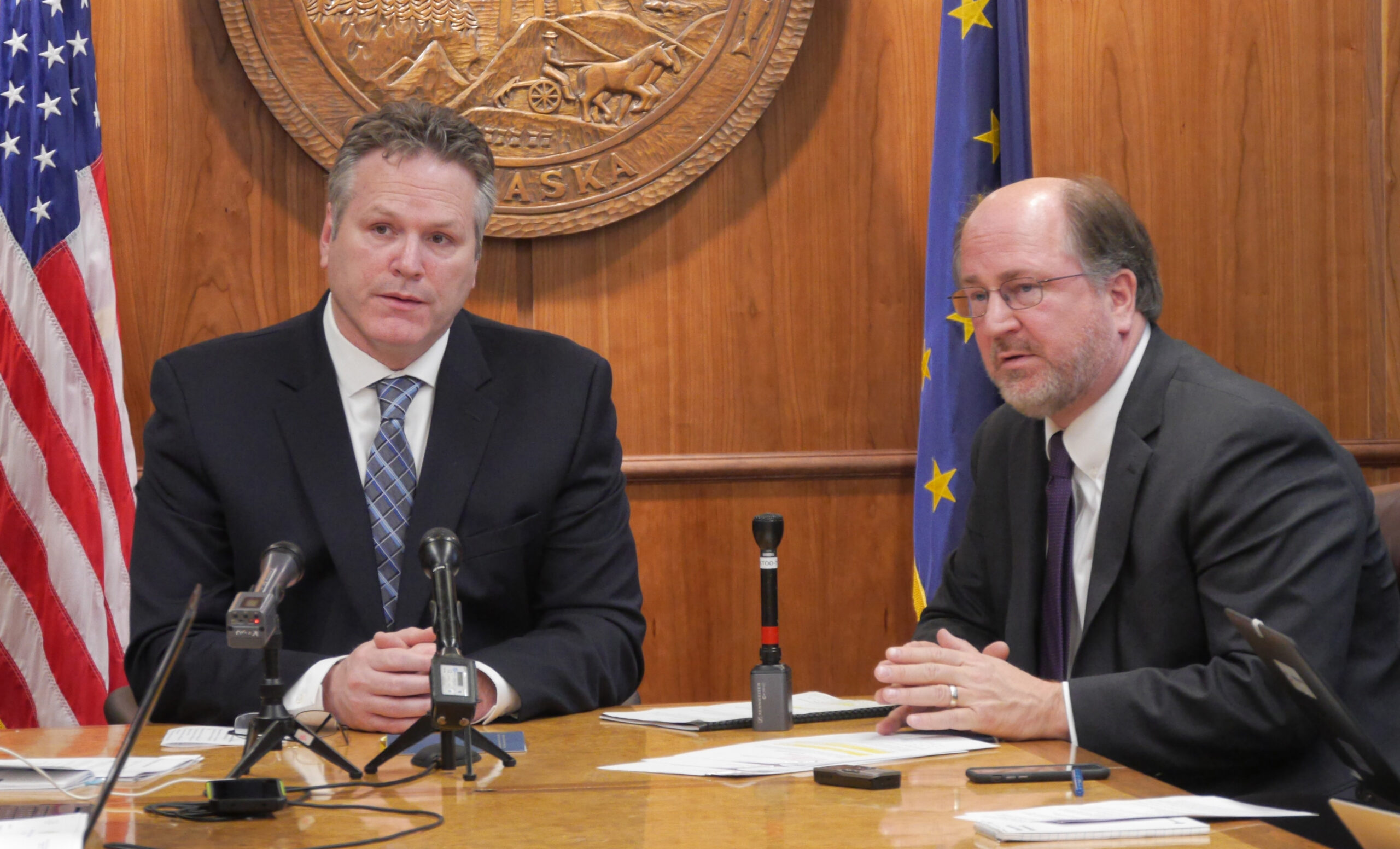 Alaska Gov. Mike Dunleavy (left), following an opinion from Attorney General Kevin Clarkson, ordered all Alaska state agencies to protect state employees’ First Amendment rights under Janus.
ANCHORAGE, AK – In late September, Alaska Governor Mike Dunleavy signed an executive order to protect the First Amendment rights of state employees established in last year’s Janus v. AFSCME Supreme Court decision. The order calls for the State of Alaska to stop deducting union dues from the paycheck of any worker who hasn’t filed a form with the state affirmatively waiving his or her First Amendment right under Janus not to fund any union activities.
The move follows a letter last year sent by National Right to Work Foundation Legal Director Raymond LaJeunesse to state comptrollers in Alaska and other states, urging them to modify dues deduction policies to comply with the Janus decision.
Foundation Comments Detail Need to End Dues Deductions Uncompliant with Janus
The Foundation also recently filed comments with the Federal Labor Relations Authority (FLRA) regarding the need for the federal government to take steps to protect the First Amendment rights of employees recognized in the Foundation-won Janus decision. The Foundation’s comments were submitted after the U.S. Office of Personnel Management (OPM) asked the FLRA to solicit public comments on how to proceed with union dues deductions in light of the Supreme Court’s Janus decision last year.
In that case, the High Court held that requiring public employees to pay union dues or fees without their consent violates the employees’ First Amendment rights “by compelling them to subsidize private speech on matters of substantial public concern.” Justice Samuel Alito’s opinion for the court further ruled that no union dues or fees could be taken from a public employee “unless the employee affirmatively consents to pay” using a “freely given” waiver of his or her First Amendment rights.
Consistent with that standard, the Foundation’s comments urge the FLRA to issue guidance to agencies that they “must cease deducting union dues from the wages of employees who signed a dues deduction form that does not satisfy the [Janus] standard.” According to Department of Labor statistics, nearly one million federal employees — 26.4% of all federal workers — are union members, many of them likely having dues deducted from their paychecks despite never having knowingly waived their First Amendment right not to subsidize union activities.
The Foundation comments make clear that these dues deductions should cease in the wake of Janus. To comply with Janus, workers wanting to voluntarily pay union dues can either provide the government with a valid waiver of their rights or pay dues on their own without using taxpayer-funded payroll systems to forward the money to union officials.
The Foundation’s comments to the FLRA further argue that, even where workers provide a valid authorization for dues deductions that meets the Janus standard, the government shouldn’t block them from revoking that authorization if the request is submitted at any time at least a year after the Janus-compliant authorization was obtained.
Foundation Comments Push to End Union-Created “Window Period” Scheme
Unfortunately, agencies and union officials often prohibit federal employees from stopping the seizure of union dues from their wages except during short annual escape periods. The comments filed by the National Right to Work Foundation say that this practice does not comply with Janus either.
“The Janus precedent is very clear about this: Without affirmative and knowing waivers from public workers, government entities cannot collect union dues without violating a worker’s First Amendment rights,” commented National Right to Work Foundation President Mark Mix.
“Currently, the government seizes union dues from almost one million federal employees in violation of the Janus decision’s First Amendment standard. Federal agencies are obligated to protect workers’ constitutional rights in this rulemaking process.”
Since the Janus decision last year, Foundation staff attorneys have been fighting to ensure public workers’ First Amendment rights are protected, litigating more than 30 cases in federal courts across the country to enforce the landmark ruling.





