
Labor Day 2024: National Right to Work Emphasizes High Stakes for Worker Freedom
Mark Mix, president of the National Right to Work Legal Defense Foundation and the National Right to Work Committee, issued the following statement on the occasion of Labor Day 2024:
On Labor Day, we celebrate the dedication and ingenuity of America’s working people. Their hard work is truly what keeps this nation prosperous and thriving, but union officials invariably attempt to hijack Labor Day to promote an agenda that undermines the rights and freedoms of our nation’s working men and women.
That’s especially true during this election year, when union officials are claiming that America’s workers are headed for disaster unless their handpicked candidates ascend to power and enact their radical policy agenda. But it’s plain to see that union bosses’ agenda prioritizes divisive politics and coercing workers far above what workers actually want – more freedom.
Big Labor is still pushing as its number-one legislative priority the radical “PRO-Act,” which will eliminate all state Right to Work protections and force millions more workers to pay union dues just to keep their jobs. Among the PRO-Act’s backers is Kamala Harris, who wants nationwide forced-dues despite admitting in a brief to the Supreme Court that union bosses use their power to undermine the economic interests of many workers.
This may be a winning strategy for collecting union boss-directed PAC contributions and endorsements, but stripping workers of the right to choose freely whether union membership and financial support is right for them is without a doubt anti-worker. This is especially true considering the vast majority of workers are not unionized and polls show most have “no interest at all” in becoming a union member.
Elected officials of all political stripes are right to want the votes of hardworking Americans, but the way to win those votes is not granting special interest union bosses the legal power to threaten workers to pay up or be fired. The real pro-worker position is Right to Work, which trusts workers with the choice, so each can join and pay dues to a union if they want but none can be required to join or pay against their will.
This Labor Day, let’s celebrate American employees by empowering each and every one with the freedom that Right to Work provides.
Mark’s statement comes as a newly released nationwide poll of registered voters finds overwhelming support for Right to Work (82%), including among voters of all party affiliations. The Rasmussen Media Group poll also found that 79 percent of union members back Right to Work and oppose forced union membership and dues. Click here to see the results.
Foundation Op-Ed: ‘Biden’s Labor Board Wants to Trap Workers in Unions they Oppose’
In an op-ed for The Hill published on Labor Day (September 5, 2023) entitled “Biden’s labor board wants to trap workers in unions they oppose,” National Right to Work Foundation President Mark Mix highlighted the coercive pro-union boss policies being pushed by Biden-majority National Labor Relations Board to the detriment of the rights of independent-minded workers:
Big Labor bosses have a problem: Despite their vitriolic rhetoric and a small number of loud online activists, most workers want nothing to do with unions.
A Gallup poll released last Labor Day spotlighted the issue: A strong majority of nonunion workers in the U.S. (58 percent) say they are “not interested at all” in joining a union, whereas just 11 percent say they are “extremely interested.”
Since it takes a majority of workers in a given workplace to support a union before monopoly union representation can be imposed, union organizers face a basic math problem — one that explains why only 6 percent of private-sector workers are unionized today.
Yet rather than consider ways of making unionization more attractive to rank-and-file workers, politically-connected union bosses have a different plan: Rig the rules to force more workers into their ranks, willing or not.
President Biden, who campaigned on being “the most pro-union president in American history” and is counting on Big Labor’s multi-billion-dollar political machine again in 2024, is unleashing his administration to the benefit of his favorite special interest.
The National Labor Relations Board (NLRB), stocked with Biden appointees and former union lawyers, has been busy doing just that. If workers won’t voluntarily vote unions in, Biden’s NLRB, whose rules cover most private sector workers, wants to take their vote away.
That’s why the NLRB, at the end of August, effectively mandated the “card check” unionization process by bureaucratic fiat. Never mind that numerous union-backed measures in Congress to require this abuse-prone unionization process have failed to pass into law.
Card-check drives occur when employers, usually in the face of union-applied political and economic pressure, waive workers’ right to a secret ballot election. During these drives, union officials are allowed to demand union authorization cards directly from workers using coercive tactics that would be unlawful during a secret ballot vote.
Union organizers can show up at workers’ homes over and over again demanding signatures, in some instances requiring workers to call the police to get organizers to leave. Workers report being misled about the true implications of signing the cards, and some have been told they would be fired if they didn’t sign just before the union successfully took over.
Some workers even face threats of violence. In one SEIU organizing drive, a worker reported being told that the union would “come and get her children” and “slash her tires” if she didn’t sign a union card…
Read the rest of Mark’s piece on the website of The Hill here.
Foundation on Labor Day 2021
The following article is from the National Right to Work Legal Defense Foundation’s bi-monthly Foundation Action Newsletter, November/December 2021 edition. To view other editions of Foundation Action or to sign up for a free subscription, click here.
Union Boss Coercion Hurts Workers
Foundation experts kept the worker freedom beacon burning bright this Labor Day, reaching Americans in over 60 opinion pieces, radio & TV shows, news articles and more, including:
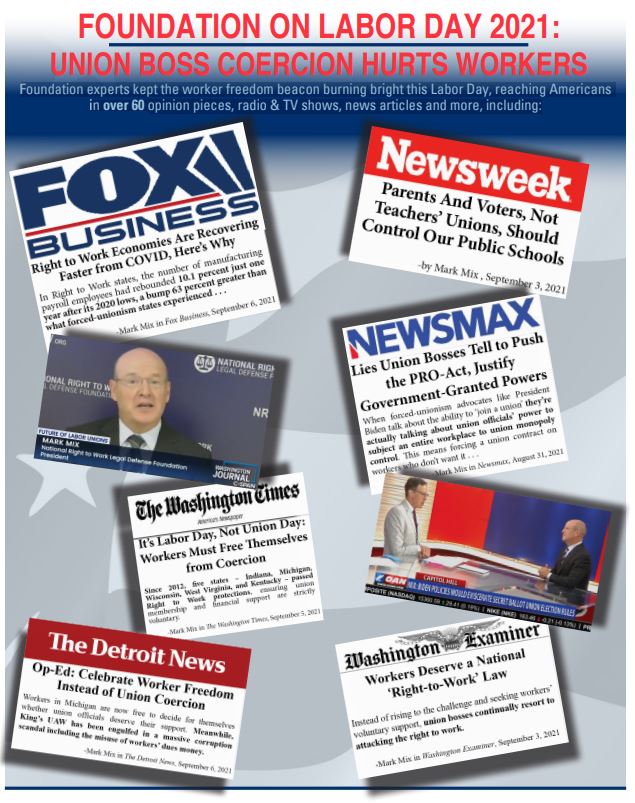
Labor Day Media Round Up: National Right to Work Commentaries Highlight Injustices of Forced Unionism
On Labor Day, the National Right to Work Foundation generated significant coverage in both national and local media outlets, especially on newspaper opinion pages. Foundation President Mark Mix wrote a number of pieces for outlets around the country highlighting the injustices of compulsory unionism and what can be done to protect workers freedom.
Mix wrote for USA Today that no American should be forced to pay union dues just to get or keep a job and highlighted the prevalence of compulsory unionism despite Right to Work laws gaining ground:
Twenty-seven states have now enacted and implemented right-to-work laws, with five joining in the last eight years.
And on June 27 of last year, the U.S Supreme Court handed down one of the most significant employee rights legal victories in the history of the right-to-work movement with the Janus decision, which ended the forced payment of union dues or fees for millions of government workers nationwide.
Unfortunately, there are more private sector American workers in the 23 non-right-to-work states and others in the railway and airline industries who still work under compulsory unionism.
Mix also wrote a column for the Detroit News arguing that no worker should ever have to fear union violence just because they disagree with union tactics or thuggish strong-arming:
Violence, the threat of violence and the wrongful non-violent use of fear and intimidation by union thugs should be illegal. No exceptions.
The spreading UAW corruption scandal shows that union bosses often act as though they are above the law.
For the Lexington Herald-Leader, Mix wrote about how Kentucky’s Right to Work law benefits the state, and why they need to protect it from the attacks of Democrat and gubernatorial candidate Attorney General Andy Beshear, who wants to give power back to union bosses should he be elected to replace Governor Matt Bevin a friend of Right to Work:
Beshear wants to return the Commonwealth of Kentucky to the days of workers being forced to hand over a portion of their hard-earned paychecks to the union boss elites to get or keep a job. Meanwhile, the Bevin Administration has spearheaded record economic growth after passing Right to Work here in Kentucky.
Even putting that enormous economic growth aside, the fact is that one candidate favors allowing Big Labor to extract money from workers’ paychecks, and the other candidate has worked tirelessly to protect Kentucky workers’ right to hold onto their paychecks without union boss interference.
And for the Las Vegas Review-Journal, Mark wrote how Right to Work laws have benefitted Nevada’s workers and families for more than half a century, causing noticeable effects for the state’s economy:
There is a reason Tesla’s Gigafactory is located in Nevada and not California. A nationwide 2017 survey of business leaders conducted by Chief Executive magazine found that, by a 2-to-1 margin, CEOs prefer adding jobs in right-to-work states over other states.
Business owners correctly view states that have passed right-to-work laws as being more welcoming and business-friendly than high-tax, forced-dues states such as California. That is why federal Bureau of Labor Statistics data show that from 2013-18, factory employment growth in Nevada was more than three times greater than in Western forced-union states such as Colorado, Oregon and Montana.
Just a few days after Labor Day, the Daily Caller published a timely op-ed from Mix regarding the Trump Administration’s rules to make it harder for union officials, like those implicated in the unfolding UAW scandal, to spend worker’s money on themselves or fuel their corruption:
At the end of May, the Trump Labor Department unveiled a rule that, as a contemporaneous news account filed by the Law360 legal news service explained, imposes “financial disclosure requirements for certain trusts that unions set up, scrutiny the agency says will ‘deter fraud and corruption.”
The proposed rule would reestablish the Form T-1, which until it was scuttled by union-label Obama administration bureaucrats in 2010 blocked officers of unions with $250,000 or more in annual revenue from using trusts supposedly created to benefit rank-and-file members to circumvent the federal reporting requirements for such unions that Congress instituted in the Labor-Management Reporting and Disclosure Act.
In addition, Mix wrote two op-eds, one for Right to Work states and the other for non-Right to Work states, which were sent out across the country and printed in local newspapers. They highlight the benefits of Right to Work laws and the problems that forced unionism causes.





