
Teamsters Officials ‘Beck’ Down: Must Return Thousands in Dues Seized for Politics
Foundation-won settlement also forces union officials to stop threatening non-members
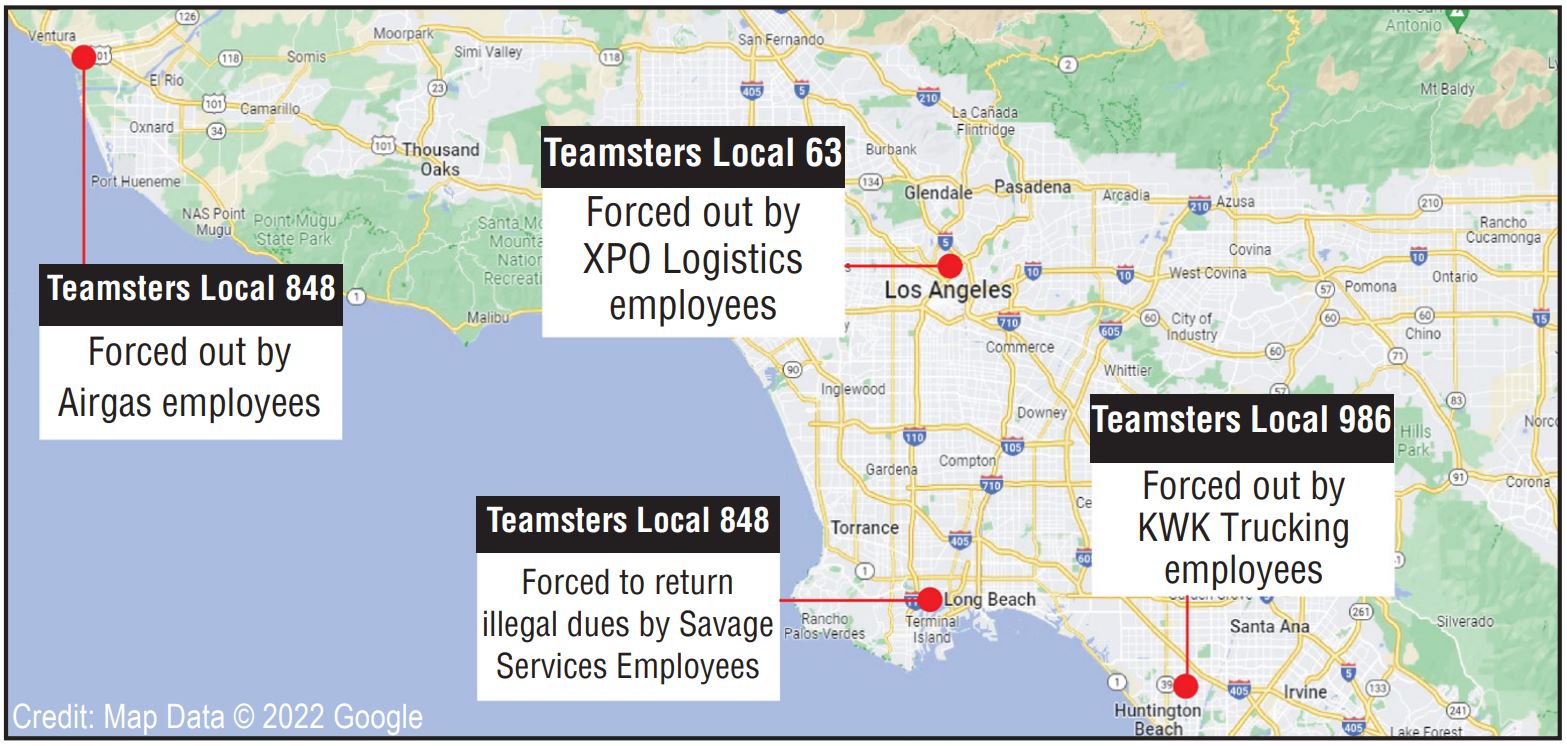
SoCal Shenanigans: Teamsters officials’ disrespect for rank-and-file workers and their rights led to multiple Foundation-backed employee actions against them in just the past year.
LOS ANGELES, CA – When Nelson Medina and about 60 of his coworkers at Savage Services in Long Beach tried to exercise their right as union non-members to opt out of funding Teamsters Local 848 officials’ political expenditures, Teamsters bosses responded with harassment, misinformation, and threats of termination.
Now, with free legal aid from the National Right to Work Foundation, they have won a settlement that required Teamsters honchos to pay back thousands of dollars in dues union officials seized in violation of workers’ rights under the Foundation-won CWA v. Beck Supreme Court decision.
Because California lacks Right to Work protections, even Golden State private sector workers who oppose a union’s presence in their workplace can be required to pay union dues or fees to keep their jobs. However, under the Beck decision, union officials can never require non-members to subsidize union political activity. Beck also entitles employees who have abstained from union membership to receive union financial disclosures.
Teamsters Bosses to Workers: Fund Union Politics or Be Fired
Medina originally filed charges against Teamsters officials for illegal dues practices in September 2021. The charges stated that he had sent Teamsters officials a letter on August 15 exercising his right to reject formal union membership and invoking his right under Beck to cut off dues deductions for union politics.
About a month after the letter, the charge noted, union officials informed Savage Services management by mail that if Medina and 12 fellow employees who also objected to full union membership did not complete membership applications and pay full dues for the month of September, the employer should terminate the employees before September’s final week.
The settlement, in addition to requiring Teamsters bosses to return nearly $6,000 in illegally taken dues to Savage Services employees, also mandated that union officials declare in a public notice that they “will not fail to provide non-member employees with a breakdown of dues and fees required for Beck objectors upon request.”
They also had to declare they “will not threaten employees who have raised Beck objections with termination for failing to complete a union application as a condition of employment.”
“That Teamsters Local 848 officials illegally siphoned money for politics from almost 60 Savage Services employees and threatened termination of those who dared to stand up for their rights demonstrates clearly that Teamsters officials prioritize power far above the employees they claim to ‘represent,’” commented National Right to Work Foundation Vice President and Legal Director Raymond LaJeunesse. “Based on the sheer number of employees in Medina’s workplace who received refunds as the result of this settlement, Teamsters officials apparently played fast and loose with the rights of all workers who objected to the union agenda.”
Foundation Attorneys Counter Teamsters Coercion Across Southern California
Last September, Foundation staff attorneys also aided Ventura, CA, Airgas employees in removing Teamsters Local 848 from their facility. After litigation that had lasted almost a year, as well as two submissions of petitions demonstrating a majority of workers at the plant wanted the Teamsters gone, union officials finally departed the plant. They did so just before the NLRB was slated to conduct a secret-ballot vote whether to remove the union at the plant, likely leaving to avoid an embarrassing rejection by the workers.
The string of Foundation-assisted worker victories over unwanted Teamsters officials in Southern California continued last year when Ozvaldo Gutierrez and his XPO Logistics coworkers forced Teamsters Local 63 union bosses out of their Los Angeles facility in October.
Multiple Units Oust Teamsters Bosses Thanks to Foundation-Backed NLRB Rule
The following article is from the National Right to Work Legal Defense Foundation’s bi-monthly Foundation Action Newsletter, May/June 2021 edition. To view other editions of Foundation Action or to sign up for a free subscription, click here.
Unpopular Teamsters officials voted out of California, New Jersey workplaces
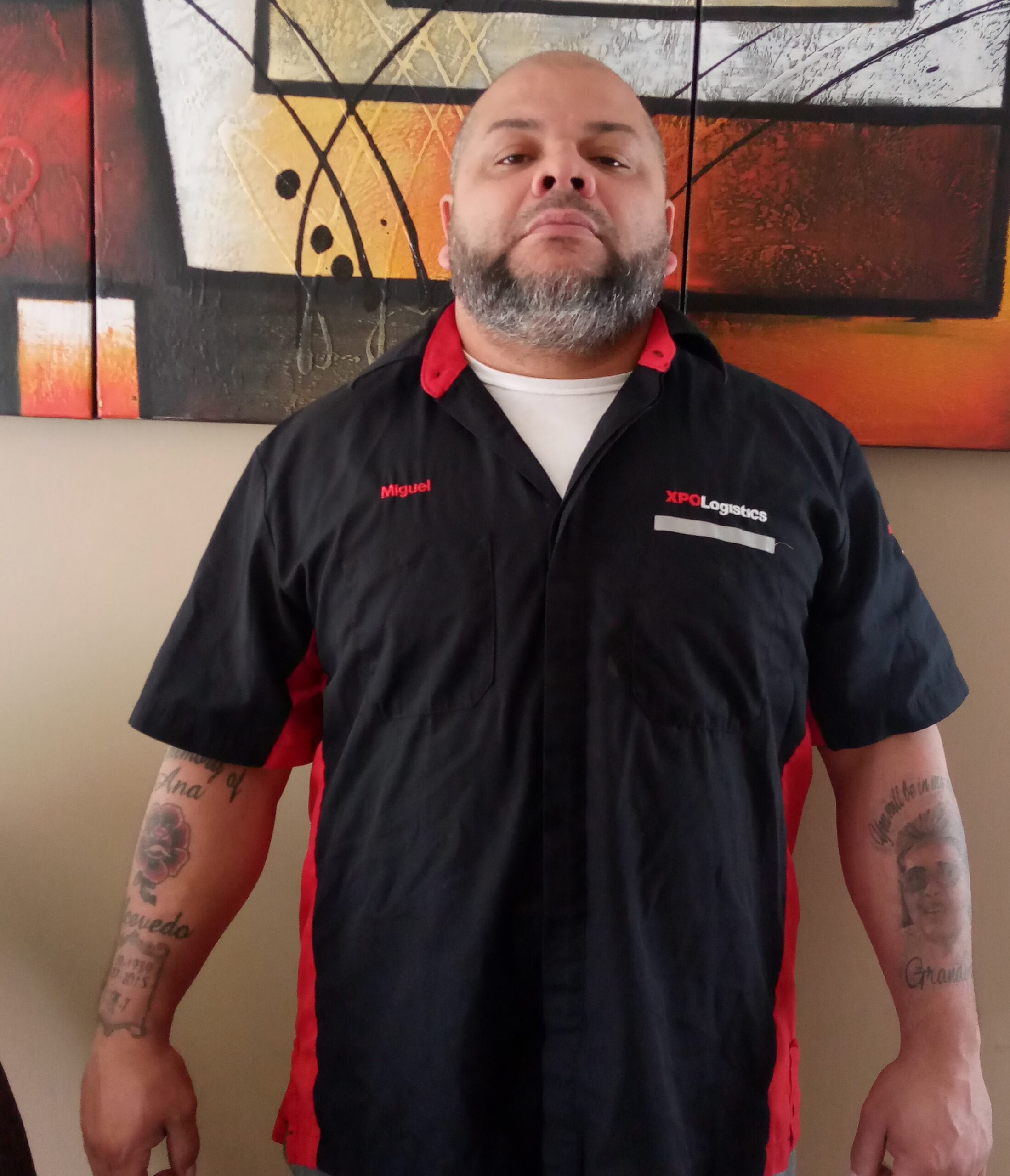
Reforms urged by Foundation staff attorneys eased Miguel Valle and his coworkers’ near-unanimous effort to vote out unpopular Teamsters officials, who tried to use “blocking charges,” ultimately to no avail.
WASHINGTON, DC – Workers in California and New Jersey who were previously subject to Teamsters bosses’ monopoly bargaining authority have freed themselves from unwanted union control.
The workers received free legal aid from Foundation staff attorneys, and benefited from rule changes at the National Labor Relations Board (NLRB) in Washington pushed for by the Foundation.
In California, Eliseo Haro, an employee at Los Angeles-based KWK Trucking, Inc., submitted a decertification petition with the NLRB because he and his coworkers were being ignored by Teamsters bosses. As Haro puts it, “The union never came in to talk to us, or negotiate a contract, or represent us. They disappeared.”
Haro’s petition was signed by nearly 80 percent of the workers in the 119-employee bargaining unit and called for an NLRB-supervised decertification election, in which KWK employees could vote out the unpopular union officials.
Rather than face an overwhelming defeat in the decertification election, Teamsters bosses chose to walk away. The union disclaimed interest in the unit, and NLRB Region 21 revoked Local 986’s certification as the workers’ monopoly bargaining agent.
New Jersey Decertification Effort Succeeds Despite Union Stall Tactics
In Cinnaminson, New Jersey, Teamsters officials did not immediately leave when a decertification petition was filed by Miguel Valle and his coworkers at a branch of XPO Logistics. Instead, Teamsters lawyers used nearly two months of unnecessary court proceedings to delay the election.
They demanded the vote be held in person at the Teamsters union hall. Foundation attorneys argued that the union lawyers’ requests were merely an effort to delay the vote. Ultimately, as expected, the NLRB’s Regional Director ruled that the election would be conducted by mail.
When Valle and his coworkers finally had their election, they voted 16-2 to remove Teamsters bosses from their workplace.
Foundation-Backed Rule Changes Reduce Needless Election Delays
For workers, just getting a decertification election is often difficult. In some cases, union bosses have created multi-year delays to stymie decertification efforts, trapping workers under union monopoly “representation” and often forced-dues payments they oppose, while they wait for a vote.
Union officials frequently attempt to delay or block decertification votes by filing “blocking charges,” unfair labor practice charges that can be used to hold up an election, even when they have nothing to do with the employees’ dissatisfaction with the union.
Union officials’ ability to use this tactic to block or delay votes has been limited by recent NLRB rulemaking, finalized in 2020. Under the NLRB’s new policy, which draws on comments filed by the National Right to Work Foundation, union charges cannot indefinitely stall employee votes, and in most instances votes occur without delay.
Additionally, as the Foundation advocated in its comments, instead of ballots being impounded for months or even years while “blocking charges” are resolved, the NLRB modified its original proposed rule so that in most cases ballots are tallied and the results are announced after employees vote.
“Union bosses can stick around for years, even when they face overwhelming opposition from rank-and-file workers, because of the legal barriers that protect union officials from decertification votes,” said National Right to Work Foundation Vice President and Legal Director Raymond LaJeunesse.
“Thanks to Foundation-backed reforms to the NLRB’s ‘blocking charge’ policy, union officials’ ability to trap workers in union ranks through legal trickery despite overwhelming opposition has been significantly curtailed.”





