
Jewish CUNY Professors’ Groundbreaking Bid at Supreme Court Challenging Forced Union Association Fully Briefed
Profs challenge NY law forcing them under ‘representation’ of anti-Semitic union officials; seek First Amendment ruling against union coercion of public employees
Washington, DC (December 23, 2024) – The final brief has been submitted urging the U.S. Supreme Court to hear six City University of New York (CUNY) professors’ First Amendment case challenging the monopoly representation powers of Professional Staff Congress (PSC) union officials. The professors, five of whom are Jewish, want to dissociate completely from PSC based on public statements and other actions the professors find highly anti-Semitic and anti-Israel, but New York state law forces the professors to accept the union’s so-called “representation.”
The professors, Avraham Goldstein, Michael Goldstein, Frimette Kass-Shraibman, Mitchell Langbert, Jeffrey Lax, and Maria Pagano, are receiving free legal aid from the National Right to Work Legal Defense Foundation and The Fairness Center. The lawsuit challenges aspects of New York State’s “Taylor Law”, which grants union bosses monopoly bargaining power in the public sector. This gives union bosses the power to speak and contract for public workers, including those that want nothing to do with the union. In addition to opposing the union’s extreme ideology, the professors oppose being forced into a “bargaining unit” of instructional staff who share the union’s objectionable beliefs or have employment interests diverging from their own.
The professors’ original petition for writ of certiorari, filed in July, points out that the High Court has, for decades, recognized how public sector monopoly bargaining burdens workers’ First Amendment freedom of association rights. In 1944, the Supreme Court’s decision in Steele v. Louisville & Nashville Railway Co. recognized how rail union bosses were manipulating their powers over the workplace to discriminate against African-American railway workers. The Supreme Court restated its concerns most recently in the 2018 Foundation-won Janus v. AFSCME decision, calling monopoly bargaining “a significant impingement on associational freedoms.”
In the latest filing, Foundation attorneys continue attacking PSC lawyers’ theory that the Supreme Court’s 1984 decision in Minnesota State Board for Community Colleges v. Knight – a case that dealt with the unrelated topic of whether public employees who had abstained from union membership had a right to attend union meetings – should dictate an unfavorable outcome for the professors in this case.
“This case squarely presents the question whether it violates the First Amendment for a state to prohibit individuals from dissociating from a union’s representation to protest that union’s expressive activities.… As the Professors stated in their complaint and briefs, by compelling them to remain under the yoke of PSC’s representation, PSC and CUNY quash the Professors’ ability to express their revulsion with PSC’s advocacy. They should be free to completely dissociate themselves from that advocacy group.”
Law Forces Jewish CUNY Professors to Associate with Anti-Israel PSC Union
The professors’ original complaint recounted that several of the professors chose to dissociate from PSC based on a host of discriminatory actions perpetrated by union agents and adherents, including a June 2021 union resolution that the professors viewed as “anti-Semitic, anti-Jewish, and anti-Israel.”
The complaint said Prof. Michael Goldstein “experienced anti-Semitic and anti-Zionist attacks from members of PSC, including what he sees as bullying, harassment, destruction of property, calls for him to be fired, organization of student attacks against him, and threats against him and his family.” Goldstein has needed a guard to accompany him on campus, the complaint noted.
Prof. Lax, the complaint explained, already received in a separate case a letter of determination from the Equal Employment Opportunity Commission (EEOC) “that CUNY and PSC leaders discriminated against him, retaliated against him, and subjected him to a hostile work environment on the basis of religion.” Prof. Lax “has felt marginalized and ostracized by PSC because the union has made it clear that Jews who support the Jewish homeland, the State of Israel, are not welcome,” said the complaint. As their petition of certiorari notes, these conflicts have significantly increased since October 7, 2023.
SCOTUS Asked to Overturn Laws Imposing Union Power on Public Workers
The petition asks the Supreme Court to take up the case and stop CUNY and the State of New York from letting PSC union bosses impose their “representation” on the professors. It also demands that the Court declare unconstitutional Section 204 of New York’s Taylor Law to the extent that it compels the professors under union power.
University faculty and students across the country are increasingly seeking out Foundation legal aid to counter union coercion within the academic sphere – especially coercion relating to anti-Semitic or anti-Israel agendas that union bosses are pushing. In August, five Jewish Massachusetts Institute of Technology (MIT) graduate students won favorable settlements after pro-BDS Graduate Student Union (GSU-UE) officials tried to force them to pay for the union’s activities despite their requests for religious accommodations under the Civil Rights Act of 1964. A mathematics Ph. D. student at Dartmouth is pursuing a similar religious discrimination case with Foundation aid.
“No public worker should be forced to associate with union officials who denigrate their culture and identity. But unfortunately this is exactly what New York State’s Taylor Law and many similar laws around the country allow,” commented National Right to Work Foundation President Mark Mix. “The Supreme Court has expressed concerns with monopoly bargaining for decades, and it’s high time that the justices finally acknowledge the First Amendment protects government employees from being forced to accept ‘representation’ they adamantly oppose.”
Jewish MIT Graduate Students Force Anti-Israel Union to Abandon Discriminatory Demands for Dues Payment
Settlement includes requirement that GSU union inform 3,000+ students of their right to refrain from paying for radical union political activities
Boston, MA (August 21, 2024) – Several Jewish graduate students at the Massachusetts Institute of Technology (MIT) have prevailed in their legal cases to cut off financial support to the MIT Graduate Student Union (GSU), an affiliate of the United Electrical (UE) union. The students, all of whom received free legal assistance from National Right to Work Foundation staff attorneys, objected to GSU union officials’ anti-Israel activities, particularly their support for the Boycott, Divestment, Sanctions (BDS) movement.
Because Massachusetts lacks Right to Work protections that make union membership and financial support voluntary, union officials at unionized private colleges like MIT can force graduate students to financially support a union under threat of losing their academic positions and work. However, this power is subject to limitations under federal anti-discrimination law and some Supreme Court decisions.
Foundation staff attorneys litigated federal charges at the Equal Employment Opportunity Commission (EEOC) in March for William Sussman, Joshua Fried, Akiva Gordon, Adina Bechhofer, and Tamar Kadosh Zhitomirsky, each of which stated that the union had demanded full dues payments even after they had each stated their religious objection to funding the union and asked for an accommodation as per Title VII of the Civil Rights Act of 1964. Such accommodations vary, but often take the form of letting the objector divert the dues from the offensive union to a 501(c)(3) charity instead.
Shortly after those filings, Foundation staff attorneys also filed federal unfair labor practice charges at the National Labor Relations Board (NLRB) for Katerina Boukin, who objected on political grounds to the GSU’s ideological activity and sought to exercise her rights under the Foundation-won Communications Workers of America v. Beck Supreme Court decision. In Beck, the Court ruled that union officials cannot force those who opt out of formal union membership (like Boukin) to pay dues or fees for union expenses not directly related to collective bargaining, even in a non-Right to Work state. GSU bosses denied Boukin’s Beck request on the specious grounds that she had missed a short union-concocted “window period” in which such an objection would be accepted.
Settlement Blocks Union Bosses from Using Student Money to Support Extremism
The students have now won a favorable NLRB settlement, and a favorable outcome of the EEOC charges, that fully vindicate their rights. The students who voiced religious objections (Sussman, Fried, Gordon, Bechhofer, and Zhitomirsky) have obtained accommodations under which they will pay no money to the union and will instead pay money to charities of their choice, despite initial pushback from union bosses. The charities include American Friends of Magen David Adom and American Friends of Leket.
Foundation attorneys scored for Katerina Boukin a settlement that will require GSU bosses to inform the entire MIT graduate student body of their rights to invoke the Beck decision. GSU bosses must declare by email that they will not restrict the ability of those who resign their union memberships to cut off dues payments for political expenses and pay a reduced amount to the union. This email notice will go out to approximately 3,000 MIT students.
The Jewish students’ efforts to assert their rights put on display the radicalism of GSU union officials. The students who asserted religious objections to supporting the union initially received form letters as responses to their requests, which callously claimed that “no principles, teachings or tenets of Judaism prohibit membership in or the payment of dues or fees to a labor union” and that no religious conflict existed because the founder of GSU’s parent union was himself Jewish. Through the Foundation-backed litigation, the students’ religious objections to supporting GSU were accommodated.
MIT Students Expose GSU Misdeeds to Congress & Nation
Both Will Sussman and Katerina Boukin publicly commented on how the GSU union’s public image was synonymous with political extremism and had little to do with academics. Boukin stated that she was deeply offended by the union’s “opposition to Israel and promotion of Leninist-Marxist global revolution” and that “[t]he GSU’s political agenda has nothing to do with my research as a graduate student at MIT, or the relationships I have with my professors and the university administration, yet outrageously they demand I fund their radical ideology.”
In July, Will Sussman appeared before the U.S. House Committee on Education and the Workforce to reveal even more details about his and his colleagues’ distressing experience with the GSU union. As Sussman testified, after the October 7 attacks on Israel, GSU union representatives voiced support for Hamas’ bloody “rebellion” and the GSU Vice President was even arrested for her behavior at an anti-Israel protest. “She was banned from campus but remains on [dues-funded] paid ‘union leave,’” Sussman stated.
“The Foundation-backed MIT graduate students who fought these legal battles have earned well-deserved victories. But defending basic free association rights shouldn’t require such lengthy litigation, and meaningful reforms are necessary to ensure union support is truly voluntary,” commented National Right to Work Foundation President Mark Mix. “Forcing GSU union officials to abandon their blatantly discriminatory dues practices is only the tip of the iceberg: Because Massachusetts lacks Right to Work protections, GSU still has the power to force the vast majority of MIT graduate students to subsidize some portion of their activities.
“Foundation attorneys are continuing to provide legal aid for all those who challenge the imposition of radical union agendas at places such as the University of Chicago, Dartmouth, and Johns Hopkins, and they are doing so for adherents of both Judaism and Christianity. But this ordeal at MIT should remind lawmakers that all Americans should have a right to protect their money from going to union bosses they don’t support, whether those objections are based on religion, politics, or any other reason,” Mix added.
CUNY Professors Ask U.S. Supreme Court to Hear Case Challenging Forced Association with Antisemitism-Linked Union
NY law forces professors to be represented by hostile union bosses, but SCOTUS ruling could free public workers nationwide from unwanted union power
Washington, DC (July 22, 2024) – Six City University of New York (CUNY) professors are asking the U.S. Supreme Court to hear their federal civil rights lawsuit charging Professional Staff Congress (PSC) union officials with forcing them to accept the union’s so-called “representation” in violation of their First Amendment rights. The professors, five of whom are Jewish, oppose the PSC union’s public statements and other actions as being strongly anti-Semitic and anti-Israel.
The professors, Avraham Goldstein, Michael Goldstein, Frimette Kass-Shraibman, Mitchell Langbert, Jeffrey Lax, and Maria Pagano, are receiving free legal aid from the National Right to Work Legal Defense Foundation and The Fairness Center. The lawsuit challenges aspects of New York State’s “Taylor Law”, which grants union bosses monopoly bargaining power in the public sector. This permits union bosses to speak and contract for public workers, including those that want nothing to do with the union. In addition to opposing the union’s extreme ideology, the professors oppose being forced into a “bargaining unit” of instructional staff who share the union’s objectionable beliefs or have employment interests diverging from their own.
The professors’ petition of certiorari points out that the High Court has recognized for decades how public sector monopoly bargaining burdens workers’ First Amendment freedom of association rights. In 1944, the Supreme Court’s decision in Steele v. Louisville & Nashville Railway Co. recognized how rail union bosses were manipulating their powers over the workplace to discriminate against African-American railway workers. The Supreme Court restated its concerns most recently in the 2018 Foundation-won Janus v. AFSCME decision, with the majority calling monopoly bargaining “a significant impingement on associational freedoms.”
The petition also counters lower courts’ mistaken assertions that the Supreme Court’s 1984 Minnesota State Board for Community Colleges v. Knight decision disposes of the CUNY professors’ case. As the petition points out, Knight only dealt with public employees’ ability to participate in union meetings and not with the professors’ legal argument that being forced to accept the bargaining power and “representation” of union officials is a violation of First Amendment free association rights. With lower courts so frequently misinterpreting Knight, the petition argues the Supreme Court is needed to clarify the issue, and apply the proper First Amendment analysis to the New York laws’ forced-representation scheme.
“The core issue in this case is straightforward: can the government force Jewish professors to accept the representation of an advocacy group they rightly consider to be anti-Semitic? The answer plainly should be ‘no,’” the petition begins. “The First Amendment protects the rights of individuals, and especially religious dissenters, to disaffliate themselves from associations and speech they abhor.”
“Knight did not sanction a state forcing Jewish faculty members who are ardent Zionists to accept the representation of a union that supports policies they consider anti-Israel,” the petition continues. “The Court should grant this petition to clarify Knight and make clear that the First Amendment protects individuals’ right to dissociate themselves from advocacy groups that support policies contrary to their deeply held beliefs.”
Law Forces Jewish CUNY Professors to Associate with Anti-Israel PSC Union
The professors’ original complaint recounted that several of the professors chose to dissociate from PSC based on a host of discriminatory actions perpetrated by union agents and adherents, including a June 2021 union resolution that the professors viewed as “anti-Semitic, anti-Jewish, and anti-Israel.”
The complaint said Prof. Michael Goldstein “experienced anti-Semitic and anti-Zionist attacks from members of PSC, including what he sees as bullying, harassment, destruction of property, calls for him to be fired, organization of student attacks against him, and threats against him and his family.” Goldstein has needed a guard to accompany him on campus, the complaint noted.
Prof. Lax, the complaint explained, already received in a separate case a letter of determination from the Equal Employment Opportunity Commission (EEOC) “that CUNY and PSC leaders discriminated against him, retaliated against him, and subjected him to a hostile work environment on the basis of religion.” Prof. Lax “has felt marginalized and ostracized by PSC because the union has made it clear that Jews who support the Jewish homeland, the State of Israel, are not welcome,” said the complaint. As their petition of certiorari notes, these conflicts have significantly increased since October 7.
SCOTUS Asked to Overturn Laws Imposing Union Power on Public Workers
The petition asks the Supreme Court to take up the case and stop CUNY and the State of New York from letting PSC union bosses impose their “representation” on the professors. It also demands that the court declare unconstitutional Section 204 of New York’s Taylor Law to the extent that it compels the professors under union power.
Issues with union monopoly bargaining power in the academic sphere came into the national spotlight just this month, when the U.S. House Committee on Education and the Workforce held a hearing on fighting antisemitism in unions. There, Will Sussman, a Ph.D. student at the Massachusetts Institute of Technology, testified about how the law forces him and other graduate students across the nation to associate with union bosses that perpetrate divisive protests and denigrate Israel. Sussman, who is Jewish, filed federal discrimination charges against the MIT Graduate Student Union (GSU-UE).
“New York’s legal scheme forces these CUNY professors to associate with union officials who insult their identity and create a work environment rife with bullying and harassment. It’s hard to think of a more obvious violation of the First Amendment,” commented National Right to Work Foundation President Mark Mix. “The Supreme Court has expressed concerns with monopoly bargaining for decades, and it’s high time that the justices finally acknowledge the First Amendment protects government employees from being forced to associate with political so-called ‘representation’ they adamantly oppose.”
NYC University Professors Take Aim at Forced Union ‘Representation’
The following article is from the National Right to Work Legal Defense Foundation’s bi-monthly Foundation Action Newsletter, March/April 2022 edition. To view other editions of Foundation Action or to sign up for a free subscription, click here.
CUNY professors’ lawsuit argues NY law forces them under power of anti-Semitic union
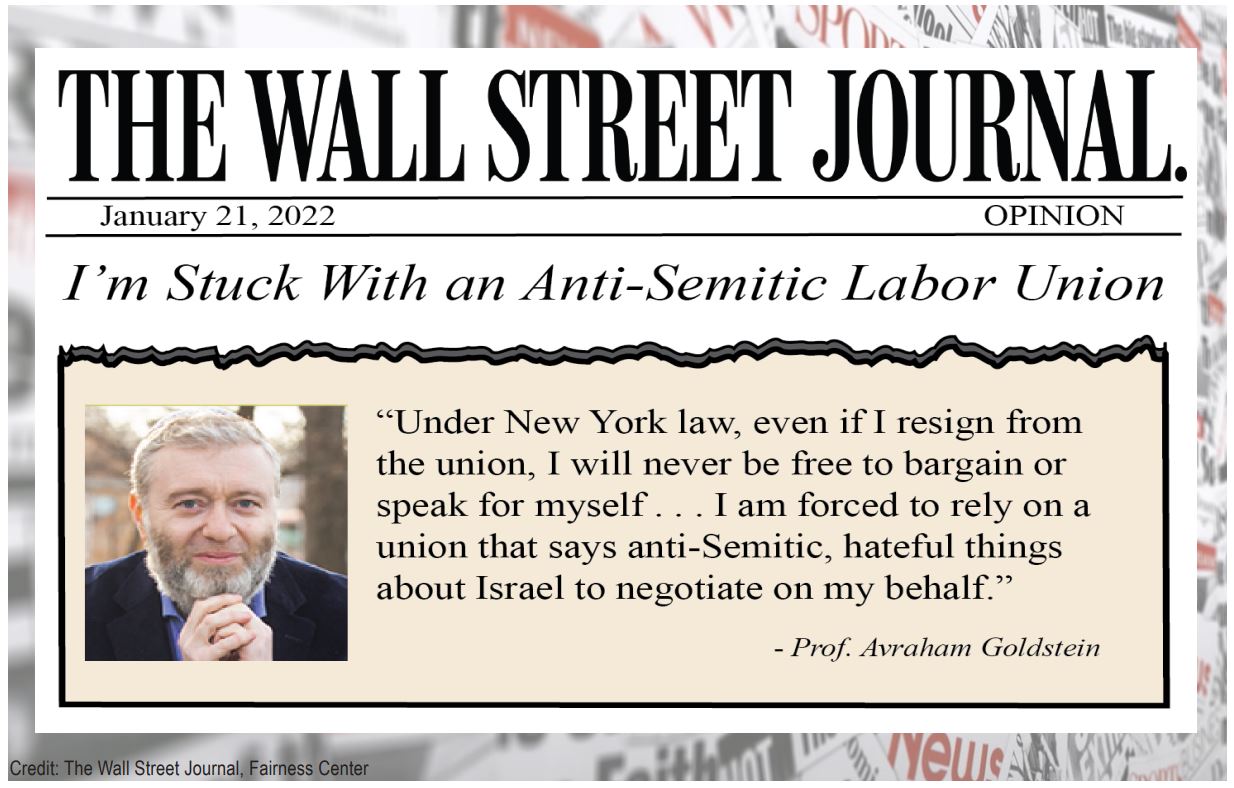
Prof. Avraham Goldstein recalled in a Wall Street Journal piece the anti-Semitism his family faced in the Soviet Union. He and other plaintiffs argue they shouldn’t be forced to associate with a union that subjects them to similar hostility.
NEW YORK, NY – For decades, government sector union bosses have relied on two pillars of coercion — forced dues and forced representation — to maintain their grip on power over America’s public servants and the public services citizens rely on.
While the Supreme Court in the 2018 National Right to Work Foundation-won Janus v. AFSCME Supreme Court case recognized that forcing government employees to pay dues to stay employed violates the First Amendment, a new Foundation-assisted civil rights lawsuit from six City University of New York (CUNY) system professors may finally defeat union bosses’ privilege to impose union representation over the objections of public workers.
CUNY professors Jeffrey Lax, Michael Goldstein, Avraham Goldstein, Frimette Kass-Shraibman, Mitchell Langbert, and Maria Pagano sued the AFL-CIO-affiliated Professional Staff Congress (PSC) union, CUNY executives, and New York State officials in January, challenging New York State’s “Taylor Law” that gives unions monopoly bargaining privileges in public sector workplaces like CUNY.
The plaintiffs, most of whom are Jewish, oppose the union’s “representation” on the grounds that union officials and adherents have relentlessly denigrated their religious and cultural identity. Several of the plaintiffs exercised their Janus right to cut off dues after PSC officials rammed through a resolution in June 2021 that they found “anti-Semitic, anti-Jewish, and anti-Israel,” according to the lawsuit.
Discrimination Cited in Groundbreaking First Amendment Case
The lawsuit, which was filed with legal aid from both the National Right to Work Foundation and Pennsylvania-based Fairness Center, says: “Despite Plaintiffs’ resignations from membership in PSC, Defendants . . . acting in concert and under color of state law, force all Plaintiffs to continue to utilize PSC as their exclusive bargaining representative.”
The resolution is not nearly the worst example of PSC officials’ anti-Semitism, according to the lawsuit. Prof. Michael Goldstein asserts that adherents of PSC are waging a campaign to get him fired and have targeted him with harassment and threats such that he must have an armed guard accompany him on campus. Prof. Lax cites in the lawsuit a determination he has already received from the Equal Employment Opportunity Commission (EEOC) that “PSC leaders discriminated against him, retaliated against him, and subjected him to a hostile work environment on the basis of religion.”
While all of the professors take issue with PSC bosses’ radicalism, they also want to break free from internal conflicts within the large and disparate unit, which consists of full-time, part-time, and adjunct teaching employees and others. Prof. Kass-Shraibman states in the lawsuit that “instead of prioritizing the pay of full-time faculty, PSC expended resources advocating on behalf of teachers in Peru, graduate students at various other universities and the so-called ‘Occupy Wall Street’ movement.”
On top of all that, Profs. Avraham Goldstein, Kass-Shraibman, and Langbert contend that PSC officials aren’t even respecting their First Amendment Janus rights. Although all three professors clearly indicated they wanted to cut off financial support to the union, the lawsuit explains that “Defendants PSC and the City . . . have taken and continue to take and/or have accepted and continue to accept union dues from [their] wages as a condition of employment . . .” in violation of Janus.
“I had paid thousands of dollars in union dues for workplace representation, not for political statements or attacks on my beliefs and identity,” Prof. Avraham Goldstein wrote in a piece for The Wall Street Journal. “I decided to resign my union membership and naively thought I could leave the union and its politics behind for good.”
“I was wrong,” recounted Prof. Goldstein. “Union officials refused my resignation and continued taking union dues out of my paycheck.”
Suit Seeks Damages and to Overturn NY Law Authorizing Union Control
The lawsuit seeks a declaration from the U.S. District Court for the Southern District of New York that the Taylor Law’s imposition of monopoly union control is unconstitutional, and that the defendants cease “certifying or recognizing PSC, or any other union, as Plaintiffs’ exclusive representative without their consent.” The lawsuit also demands the union and university return dues seized in violation of Janus to Profs. Avraham Goldstein, Kass-Shraibman, and Langbert.
“By forcing these professors into a monopoly union collective against their will, the state of New York mandates that they associate with union officials and other union members who take positions that are deeply offensive to these professors’ most fundamental beliefs,” observed National Right to Work Foundation President Mark Mix. “New York State’s Taylor Law authorizes such unconscionable compulsion. It is time federal courts fully protect the rights of government employees to exercise their freedom to disassociate from an unwanted union, whether their objections are religious, cultural, financial, or otherwise.”





