
IUOE Union Bosses Hit With Federal Charge for Illegal Termination
The following article is from the National Right to Work Legal Defense Foundation’s bi-monthly Foundation Action Newsletter, January/February 2024 edition. To view other editions of Foundation Action or to sign up for a free subscription, click here.
Longstanding law protects against mandatory dues deductions, formal union membership

Firestop inspector Alexandra Le isn’t going to let IUOE union bosses snuff out her livelihood over her refusal to join or support the union. She’s filed federal charges with Foundation aid.
PLEASANTON, CA – Sometimes, even the extraordinary power to demand payments from workers under threat of termination isn’t enough for union bosses, who frequently go beyond what is legal to coerce workers into membership and dues payment.
Alexandra Le, an employee of Construction Testing Services (CTS), found herself on the receiving end of such illegal demands from International Union of Operating Engineers (IUOE) officials in October. But Le is now fighting back, hitting IUOE bosses and her employer with federal charges at National Labor Relations Board (NLRB) Region 32 with free legal aid from the National Right to Work Foundation.
Union Misinformed Worker About Rights
Le’s charges state that IUOE bosses got her fired after she rebuffed their demands to formally join the union. Additionally, Le’s charges maintain that union officials unlawfully deducted union dues from her paycheck without her permission and failed to inform her of her right to pay reduced union dues as a non-member — a right secured by the Foundation-won CWA v. Beck Supreme Court victory.
Because California lacks Right to Work protections for its private sector workers, Le and her coworkers can be forced to pay some fees to the union to keep their jobs, even if they’ve abstained from formal union membership. However, as per Beck, in non-Right to Work states, union officials can’t force nonmember employees to pay for union expenses (such as union politics) that go beyond what the union claims goes to bargaining.
Other Supreme Court precedents require union bosses to seek workers’ express consent before deducting dues directly from their paychecks.
In Right to Work states, all union financial support is voluntary and the choice of each individual worker.
Employee Demands Federal Injunction to Reverse Illegal Union-Ordered Firing
“It’s outrageous that IUOE union officials believe they can get me fired simply because I don’t agree with their organization and don’t want to support or affiliate with them,” Le said. “IUOE union officials have been far more concerned with consolidating power in the workplace and collecting dues than caring about me and my coworkers, and I hope the NLRB will hold them responsible for their illegal actions.”
Le’s charge against the IUOE union states that, after she refused to affiliate with the union, IUOE bosses “caused Charging Party to be removed from the work schedule by her Employer as of October 2nd.” The NLRB v. General Motors Corp. U.S. Supreme Court decision protects the right of workers to refuse formal union membership, even in a non-Right to Work state.
As a remedy, the charge asks the NLRB Regional Director in Oakland to “invoke its authority under Section 10(j)” of the National Labor Relations Act (NLRA), which empowers the Board to seek an injunction from a federal court to stop IUOE and CTS management from committing the unfair labor practices.
Workers Need More Protections Against Union Boss Coercion
“Ms. Le’s case shows why Right to Work protections are important,” commented National Right to Work Foundation Vice President and Legal Director William Messenger.
“Even if IUOE union officials had followed federal labor law in this case, Ms. Le would still be forced to contribute to the activities of an organization she clearly doesn’t want to be part of.
“As Ms. Le’s case demonstrates, union bosses often value workers merely as sources of dues revenue and will go to extraordinary lengths to keep the money flowing,” Messenger added. “Workers deserve more protections against union boss coercion, not fewer.”
East Bay-Area Fire Safety Inspector Prevails in Case Against IUOE Union for Illegal Firing
Employee wins reinstatement and back pay after being unlawfully fired for exercising right to reject formal union membership
Pleasanton, CA (January 4, 2024) – After being fired over her refusal to formally become a formal union member, Construction Testing Services employee Alexandra Le won a settlement against the International Union of Operating Engineers (IUOE) and her employer. The settlement, won with free legal representation from National Right to Work Foundation staff attorneys, requires CTS to reinstate Le and requires CTS and the IUOE union to jointly pay back to her over $9,000 in back wages and benefits. Le will also receive back hundreds in union fees that were deducted from her paycheck without her authorization.
In October, Le filed federal charges at National Labor Relations Board (NLRB) Region 32 in Oakland, CA, stating that IUOE union officials illegally demanded she join the union as a condition of keeping her job and instigated her firing by CTS when she refused to join. Le, who works in fire and life safety as a firestop inspector, also noted in her charges that IUOE officials failed to inform her of her right to abstain from formal union membership, and never notified her of her right to pay a reduced amount of union dues as a nonmember.
According to her charges, company and union officials began deducting full union dues directly from her paycheck without her permission, and deducted a dues amount that included union political expenses and other costs not legally chargeable to workers who aren’t formal union members.
IUOE Union Officials Ignored Supreme Court Precedents in Effort to Force Worker into Union Membership
Because California lacks Right to Work protections for its private sector workers, Le and her coworkers can be forced to pay some fees to the union as a condition of keeping their jobs, even if they’ve abstained from formal union membership. However, as per the National Right to Work Foundation-won CWA v. Beck Supreme Court decision, even in non-Right to Work states union officials can’t force nonmember employees to pay for union politics and other activities outside the union’s bargaining functions. Other Supreme Court precedents and federal labor laws protect workers’ right to refrain from formal union membership and require union bosses to seek workers’ express consent before deducting dues directly from their paychecks.
In contrast, in Right to Work states, union membership and all union financial support are fully voluntary. As Le’s case was ongoing, she submitted written testimony to the U.S. House of Representatives’ Committee on Education and the Workforce for a hearing on a federal law to expand Right to Work protections for employees nationwide.
In her testimony, she described the impact the illegal union-instigated firing had on her life: “My absence significantly set me back from a financial standpoint and has led to the stressful process of having to fight for my rights via the legal process…And while the union fees cause a notable decrease in my hard-earned take-home pay, the time lost and stress incurred by asserting rights that I had to discover independently has been equally detrimental.”
“Simply put, nobody should be forced to join or pay any dues or fees to a union that they do not want to join,” Le concluded. Two other workers who had received free legal aid from the National Right to Work Foundation also testified in the hearing about their experiences with illegal union forced-dues demands as a result of lacking the protection of Right to Work laws.
Worker Will Receive Back Pay and Repayments of Union Dues and Fees as Part of Settlement
Le’s Foundation-won settlement completely vindicates her rights. In addition to reinstatement and repayments of back wages and illegally-seized union fees, the settlement dictates that the company will only deduct the reduced Beck amount of union dues from Le’s paycheck going forward. The union will also waive fees totaling roughly $1,700 that its officials tried to force Le to pay from the time her case began back to the date of her hiring.
“Ms. Le’s battle to protect her freedom of association from IUOE union officials is courageous, but no worker should ever have to fight this hard to protect their livelihood from dues-hungry union officials,” commented National Right to Work Foundation President Mark Mix.
“While we’re proud to help Ms. Le prevail in her case, the fact is that the very IUOE bosses who so callously instigated her illegal firing are still authorized to collect mandatory union fees from her because California workers lack the protection of a Right to Work law,” Mix added. “Workers themselves – not union bosses – should be in charge of determining whether a union is worthy of receiving their hard-earned cash, which is why all Americans deserve the protection of Right to Work.”
National Right to Work Foundation Slams Decision Trapping Michigan Construction Workers in Unpopular Union
NLRB rules that ballots employees already cast in vote to oust union cannot be counted, highlighting Labor Board’s pro-union boss bias
Washington, DC (June 21, 2022) – The National Labor Relations Board (NLRB) in Washington, DC, has permitted the destruction of hundreds of ballots already cast by Michigan Rieth-Riley Construction Company workers in an election whether to oust International Union of Operating Engineers (IUOE) union officials. The decision shuts down a years-long effort by Rieth-Riley employees to remove IUOE Local 324 officials, allowing the union to stifle the workers’ vote with questionable “blocking charges” against Rieth-Riley management.
Rieth-Riley employee Rayalan Kent led the effort to vote out IUOE union officials. With the assistance of National Right to Work Foundation staff attorneys, he submitted two petitions in 2020 with enough worker support to trigger the NLRB’s administration of a “decertification vote.” A vote finally occurred in October 2020, but Regional NLRB officials in Detroit ruled, just hours before the ballots were to be counted, that union boss-concocted “blocking charges” invalidated the employees’ petition. The NLRB in Washington has now affirmed that decision.
Both rulings fly in the face of Foundation-backed reforms the NLRB adopted in 2020 regarding “blocking charges,” which provided that ballots in union decertification elections should be counted first before any unfair labor practice charges surrounding the election are dealt with. Moreover, even prior NLRB precedent required that an evidentiary hearing be held to determine whether there is any “causal nexus” between union allegations of employer misconduct and employee dissatisfaction engendering a union decertification effort. But the NLRB never held any such hearing in this case.
Settlements Foundation attorneys won in 2021 for Rieth-Riley employees Rob Nevins and Jesse London indicate that malfeasance by IUOE officials, not Rieth-Riley misdeeds, likely caused the company’s workers to push for the union’s ouster. London and Nevins decided to end their union memberships and keep working to support their families despite a union boss-ordered strike in 2019.
Nevins charged union officials with threatening to “blackball” him if he didn’t strike, and London reported that IUOE officials refused to hand over health insurance premium money they owed him for time he participated in the strike. The settlements mandated that IUOE union bosses not discriminate against London and Nevins for exercising their right to refrain from union membership, and also ordered them to pay London the health insurance premium money he was owed.
“The current decision demonstrates how the NLRB and its bureaucrats have twisted a law that is allegedly designed to protect the free choice rights of rank-and-file workers. Instead of supporting workers’ rights, this Board and past Boards have weaponized the National Labor Relations Act against workers solely to entrench union boss power,” commented National Right to Work Foundation President Mark Mix. “Rather than apply the letter and spirit of the 2020 Election Protection rule, Joe Biden’s NLRB has undermined and rendered useless even those modest reforms. Given this awful ruling, it is now likely that Rieth-Riley workers’ votes to remove the union will simply be dropped in a trash can.”
Mix added: “Workers have a statutory right to vote out a union they oppose and NLRB bureaucrats should not be able to nullify that right on the basis of unproven and often unrelated allegations of employer misconduct.”
Red Rock Casino Slot Technicians Blast Regional Labor Board Ruling Trapping Them Under Unpopular Union, Appeal Decision
Employee vote to decertify union blocked based on allegations that have nothing to do with slot techs’ bargaining unit
Las Vegas, NV (May 9, 2022) – Red Rock Casino slot machine technician Jereme Barrios has asked the National Labor Relations Board (NLRB) in Washington, DC, to reverse an NLRB Region’s decision which blocks his and his coworkers’ right to vote out a union that a majority of them have already expressed interest in removing. Barrios is receiving free legal representation from National Right to Work Foundation staff attorneys.
Barrios submitted a petition to the NLRB Region 28 in March asking the agency to conduct a union “decertification vote” amongst his fellow slot technicians whether to kick out International Union of Operating Engineers (IUOE) Local 501 officials. The petition contained signatures of a large majority of his colleagues.
However, the Region did not schedule the vote as Barrios and his coworkers had asked. NLRB Region 28 Director Cornele Overstreet instead ruled in April that largely unverified and unrelated allegations (also called “blocking charges”) union officials had made against management of Station Casinos, Red Rock’s parent company, blocked the technicians from exercising their right to vote whether to remove the union.
Barrios’ Request for Review argues that the Region’s decision is unfounded, and requests that the NLRB in Washington, DC, reverse it and allow them to have an immediate decertification vote.
Slot Tech’s Request for Review Criticizes Regional Labor Board Decision as “a Scattershot Mess”
Barrios’ Request for Review begins by explaining that, even if any of the union’s “blocking charges” have merit, the NLRB Regional Director was not adhering to Foundation-backed reforms in the rules regarding “blocking charges” that the NLRB formally adopted in 2020. Under the reforms, “blocking charges” generally do not stop employees from exercising their right to vote in a decertification election. Instead, the NLRB takes up any “blocking charges” surrounding an election after a vote tally has been released.
“The Regional Director ignored the current Election Rules and even refused to cite them,” Barrios’ Request for Review says.
Moreover, Barrios’ Foundation attorneys go even deeper and demonstrate that, even under the old election rules which would have allowed “blocking charges” to stall a decertification election, the union’s allegations against the employer are completely insufficient to block an employee vote.
Barrios’ attorneys show that the majority of the union’s accusations describe alleged employer malfeasance concerning bargaining units other than Barrios’. The Request for Review points out that, by the Region’s logic, “any employer’s unfair labor practice could block any decertification in any of its other units, no matter how remote.”
The remaining “blocking charges,” including an allegation that Red Rock management did not bargain with the union over COVID-19 protections, Barrios’ Request for Review explains, either do not reveal actual violations of federal labor law by Red Rock management or have no causal connection to Barrios and his colleagues’ desire to remove the union. Barrios’ brief notes that Red Rock officials already complied with a consent order regarding the dispute over COVID-19 protections and “likely remedied any violation that could conceivably block an election.”
Foundation Attorneys Aid Other Station Casinos Employees
The slot techs’ effort comes as Red Rock hospitality and foodservice staff, led by Foundation-backed employee Raynell Teske, are battling an order from a federal district court judge that forces them under the “representation” of Culinary Union bosses. The order was issued despite the fact that a majority of the hospitality and foodservice employees voted in a secret ballot election to reject union officials’ effort to install themselves at the casino.
Foundation attorneys also represent Palms Casino engineering worker Thomas Stallings and his coworkers in their decertification effort against IUOE and International Union of Painters and Allied Trades (IUPAT) officials. As in Barrios’ case, Stallings’ attorneys argue that regional NLRB officials have left Stallings and his coworkers trapped under the monopoly control of an unpopular union despite the current NLRB rules regarding “blocking charges,” and despite the fact the accusations by union officials against their employer have little if anything to do with Stallings’ work unit.
“Las Vegas is now home to at least three instances where regional NLRB officials have reflexively indulged union boss requests to remain in power at workplaces where a clear majority of workers want the union gone,” commented National Right to Work Foundation President Mark Mix. “Las Vegas is indeed ‘Sin City,’ if the sin is disrespecting workers’ fundamental right to choose freely whether or not union bosses should speak for them.”
“Foundation attorneys are proud to stand by these courageous workers, who are fighting not only union coercion but an NLRB Regional Director seemingly determined to undermine the rights of workers opposed to union affiliation,” Mix added.
Ohio Municipal Employee Challenges Deceitful Unconstitutional Dues Deductions
The following article is from the National Right to Work Legal Defense Foundation’s bi-monthly Foundation Action Newsletter, March/April 2021 edition. To view other editions or to sign up for a free subscription, click here.
IUOE bosses’ scheme renames forced-fee payments clearly outlawed in Janus decision
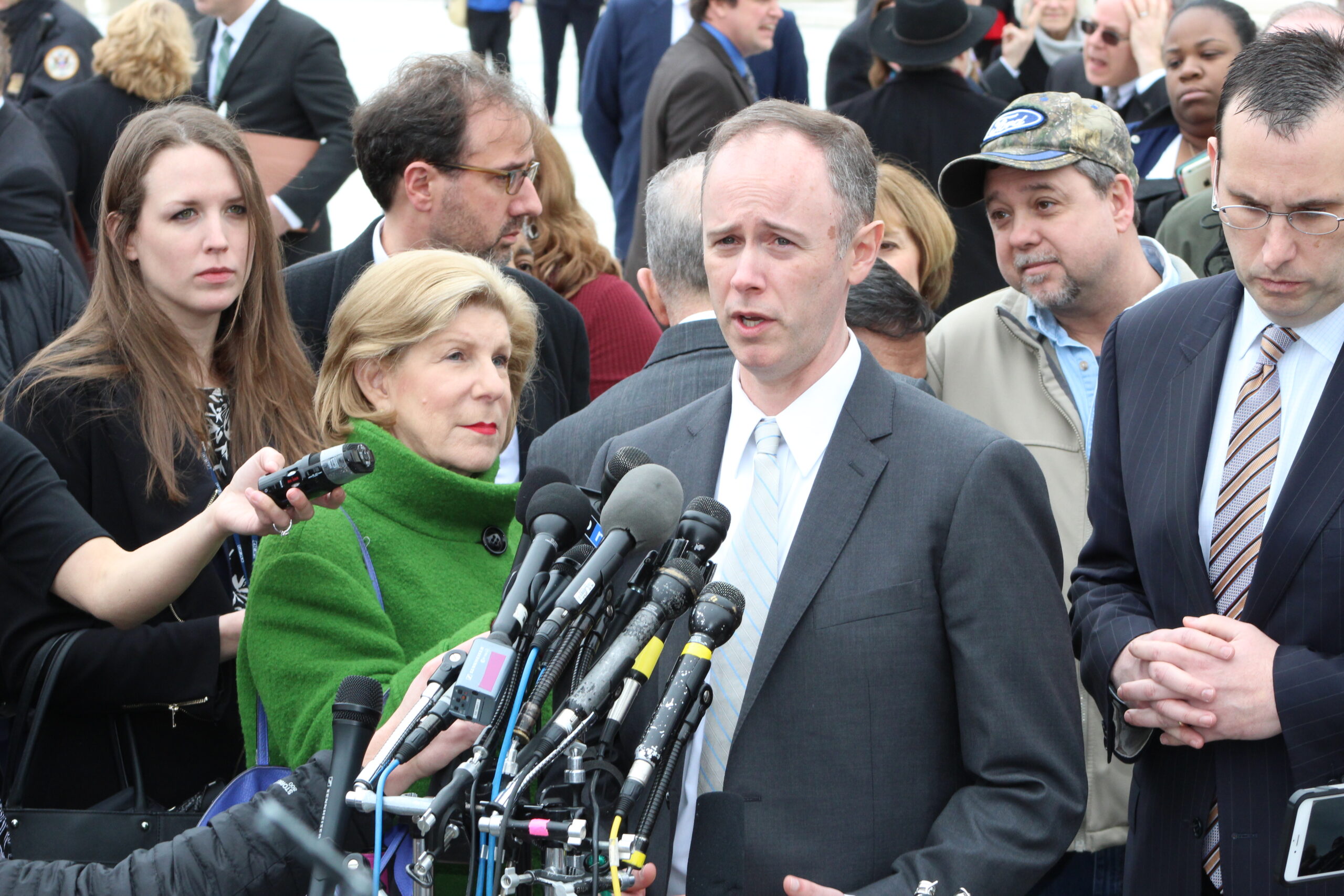
Veteran Foundation staff attorney William Messenger successfully argued Janus over two years ago, but union bosses are still concocting schemes to circumvent it. Timothy Crane is now fighting a particularly flagrant example.
CINCINNATI, OH – With free legal aid from National Right to Work Foundation staff attorneys, City of Hamilton employee Timothy Crane is suing International Union of Operating Engineers (IUOE) Local 20 union officials and the City of Hamilton for seizing a compulsory fee from his paycheck in violation of his First Amendment rights.
His complaint, filed in the U.S. District Court for the Southern District of Ohio, contends that union bosses are infringing on his rights under the Janus v. AFSCME decision by forcing him to pay a so-called “agreement administration fee” equal to more than 90 percent of full union dues as a condition of his employment.
In the 2018 Foundation-won Janus decision, the High Court ruled that no public worker can be forced to pay union dues or fees as a condition of getting or keeping a job. The Court also held that union dues or fees can only be deducted from a public employee’s paycheck if that employee clearly and affirmatively waives his or her right not to pay. Justice Samuel Alito wrote for the Court majority that “such a waiver cannot be presumed” by union or state officials.
Even After City Employee Exercised His Janus Rights, Union Honchos Seized Fees
Crane sent letters to IUOE union officials in both August and September of 2020, attempting to exercise his First Amendment Janus right to end dues deductions from his paycheck. After sending these two letters, however, he discovered that an “agreement administration fee” was now being taken from his pay by the City at the behest of IUOE union bosses.
Crane’s complaint contends that this is just a so-called “agency fee” — compulsory union payments charged to employees who refrain from formal union membership that were definitively outlawed by the Janus v. AFSCME decision — masquerading under a different name. The suit urges the District Court to declare it unconstitutional for IUOE Local 20 and the City of Hamilton to force him to pay this compulsory union fee. Crane’s lawsuit also seeks a refund of all money that the union has illegally taken from his paycheck under the unconstitutional arrangement.
Chain of Foundation-backed Janus Victories for Ohio Workers Likely to Continue
Since Janus was handed down by the Supreme Court, Foundation staff attorneys have already won favorable settlements in four cases for Buckeye State public workers who have challenged illegal union-created restrictions on the exercise of Janus First Amendment rights. In a July 2020 settlement in a class-action lawsuit filed by four state workers, nearly 30,000 Ohio public employees were freed from an “escape-period” scheme imposed by Ohio Civil Service Employees Association (OCSEA) union chiefs, which limited to just a handful of days every few years the time in which a public employee could exercise his or her Janus rights.
“IUOE bosses, who may have thought they were going to trick employees into funding their agenda against their will with this blatantly unconstitutional scheme, have now been caught red-handed,” commented National Right to Work Foundation Vice President and Legal Director Raymond LaJeunesse. “Rank-and-file workers like Mr. Crane now see that IUOE officials are far more interested in keeping hard-earned employee cash flowing into their coffers than in respecting the First Amendment rights of the workers they claim to represent.”
LaJeunesse continued: “The string of Foundation victories for independent-minded Buckeye State employees who just want to exercise their First Amendment rights is not going to end here.”





