
Professors Launch Landmark SCOTUS Bid to End Forced Union Association
The following article is from the National Right to Work Legal Defense Foundation’s bi-monthly Foundation Action Newsletter, September/October 2024 edition. To view other editions of Foundation Action or to sign up for a free subscription, click here.
NY law unconstitutionally forces professors under “representation” of anti-Semitic union
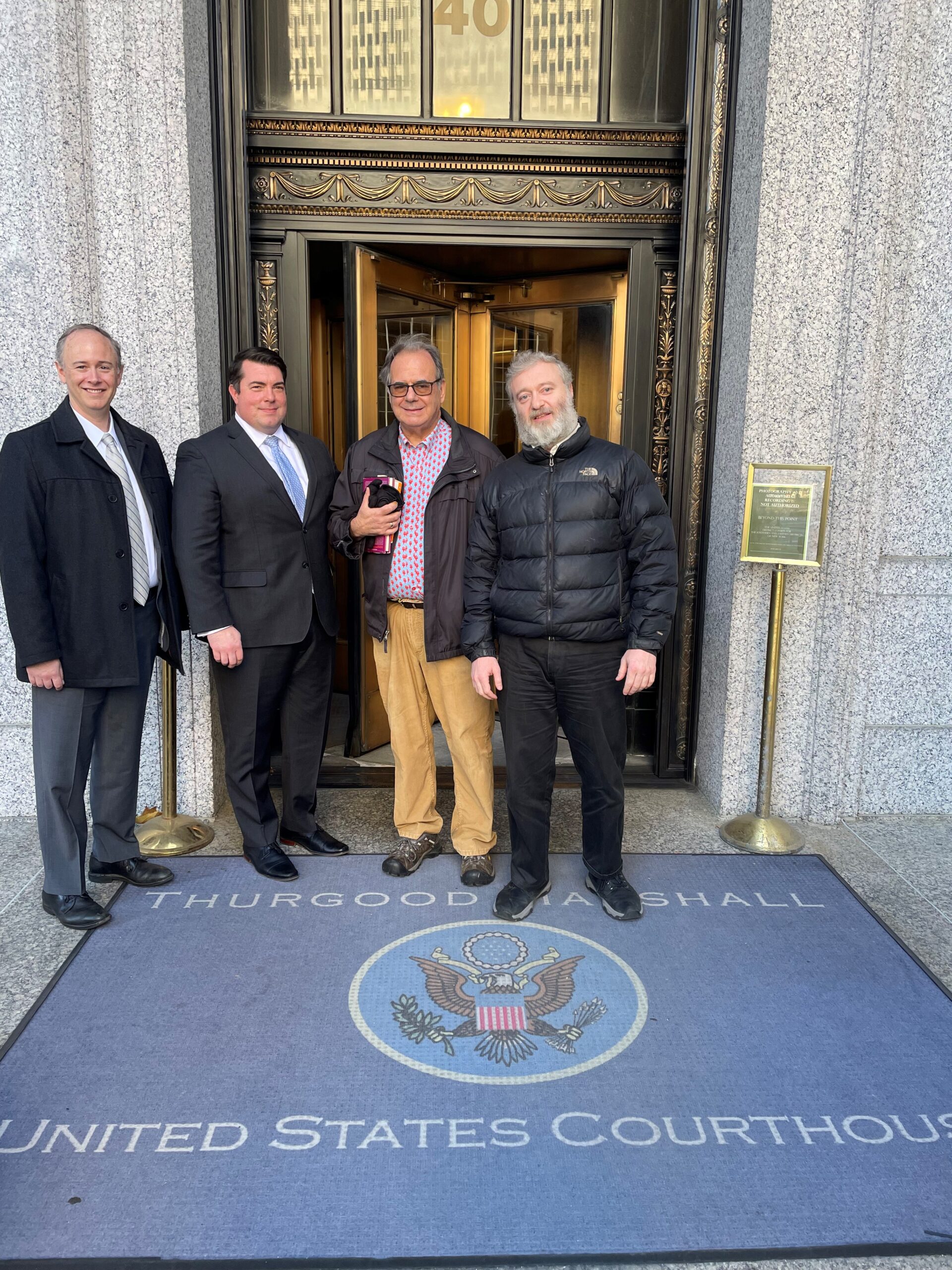
Together, (from left) Foundation Legal Director William Messenger, Fairness Center General Counsel Nathan McGrath, and CUNY Professors Mitchell Langbert and Avraham Goldstein seek to establish new protections against forced union association.
WASHINGTON, DC – Avraham Goldstein, a mathematics professor at the City University of New York (CUNY), wrote in a 2022 Wall Street Journal op-ed about the predicament that he and many of his Jewish colleagues face because New York law forces them under the “representation” of an anti-Israel union: “I had paid thousands of dollars in union dues for workplace representation, not for political statements or attacks on my beliefs and identity. I decided to resign my union membership and naively thought I could leave the union and its politics behind for good . . . I was wrong.”
It was this situation that led Avraham Goldstein, along with fellow professors Michael Goldstein, Frimette Kass-Shraibman, Mitchell Langbert, Jeffrey Lax, and Maria Pagano, to file a federal lawsuit against the Professional Staff Congress (PSC) union, CUNY, and State of New York officials in 2022. That lawsuit challenged New York State’s “Taylor Law,” which grants union bosses monopoly bargaining power in the public sector. Such power permits union bosses to speak and contract for public workers — including those that want nothing to do with the union.
Professors’ Petition: First Amendment Protects Union Dissenters
Staff attorneys from the National Right to Work Foundation and The Fairness Center have litigated the professors’ case up through the federal court system. Now they’re asking the U.S. Supreme Court to take their case and clarify that the First Amendment forbids union officials from foisting their voice and values on public sector workers who oppose the union.
“The core issue in this case is straightforward: can the government force Jewish professors to accept the representation of an advocacy group they rightly consider to be anti-Semitic? The answer plainly should be ‘no,’” the petition begins.
The High Court has recognized for decades how public sector monopoly bargaining burdens workers’ First Amendment freedom of association rights. In 1944, the Supreme Court’s decision in Steele v. Louisville & Nashville Railway Co. recognized how rail union bosses were manipulating their powers over the workplace to discriminate against African-American railway workers. The Supreme Court restated its concerns most recently in the 2018 Foundation-won Janus v. AFSCME decision, with the majority calling monopoly bargaining “a significant impingement on associational freedoms.”
Original Complaint Detailed Union Bosses’ Discrimination
The professors’ original complaint, filed in the U.S. District Court for the Southern District of New York, recounted that several of the professors chose to dissociate from PSC based on a host of discriminatory actions perpetrated by union agents and adherents — including a June 2021 union resolution that the professors viewed as “anti-Semitic, anti-Jewish, and anti-Israel.”
The complaint said Prof. Michael Goldstein “experienced anti-Semitic and anti-Zionist attacks from members of PSC, including what he sees as bullying, harassment, destruction of property, calls for him to be fired, organization of student attacks against him, and threats against him and his family.” Goldstein has needed a guard to accompany him on campus, the complaint noted.
Prof. Lax, the complaint explained, already received in a separate case a letter of determination from the Equal Employment Opportunity Commission (EEOC) “that CUNY and PSC leaders discriminated against him, retaliated against him, and subjected him to a hostile work environment on the basis of religion.” As their petition at the Supreme Court notes, these conflicts have significantly increased since the events of October 7.
Professors Could Create Groundbreaking Precedent
The petition asks the Supreme Court to take up the case and stop CUNY and the State of New York from letting PSC union bosses impose their “representation” on the professors.
“New York’s legal scheme forces these CUNY professors to associate with union officials who insult their identity and create a work environment rife with bullying and harassment. It’s hard to think of a more obvious violation of the First Amendment,” commented National Right to Work Foundation President Mark Mix. “It’s high time that the Justices finally acknowledge the First Amendment protects government employees from being forced to accept political ‘representation’ they adamantly oppose.”
CUNY Professors Ask U.S. Supreme Court to Hear Case Challenging Forced Association with Antisemitism-Linked Union
NY law forces professors to be represented by hostile union bosses, but SCOTUS ruling could free public workers nationwide from unwanted union power
Washington, DC (July 22, 2024) – Six City University of New York (CUNY) professors are asking the U.S. Supreme Court to hear their federal civil rights lawsuit charging Professional Staff Congress (PSC) union officials with forcing them to accept the union’s so-called “representation” in violation of their First Amendment rights. The professors, five of whom are Jewish, oppose the PSC union’s public statements and other actions as being strongly anti-Semitic and anti-Israel.
The professors, Avraham Goldstein, Michael Goldstein, Frimette Kass-Shraibman, Mitchell Langbert, Jeffrey Lax, and Maria Pagano, are receiving free legal aid from the National Right to Work Legal Defense Foundation and The Fairness Center. The lawsuit challenges aspects of New York State’s “Taylor Law”, which grants union bosses monopoly bargaining power in the public sector. This permits union bosses to speak and contract for public workers, including those that want nothing to do with the union. In addition to opposing the union’s extreme ideology, the professors oppose being forced into a “bargaining unit” of instructional staff who share the union’s objectionable beliefs or have employment interests diverging from their own.
The professors’ petition of certiorari points out that the High Court has recognized for decades how public sector monopoly bargaining burdens workers’ First Amendment freedom of association rights. In 1944, the Supreme Court’s decision in Steele v. Louisville & Nashville Railway Co. recognized how rail union bosses were manipulating their powers over the workplace to discriminate against African-American railway workers. The Supreme Court restated its concerns most recently in the 2018 Foundation-won Janus v. AFSCME decision, with the majority calling monopoly bargaining “a significant impingement on associational freedoms.”
The petition also counters lower courts’ mistaken assertions that the Supreme Court’s 1984 Minnesota State Board for Community Colleges v. Knight decision disposes of the CUNY professors’ case. As the petition points out, Knight only dealt with public employees’ ability to participate in union meetings and not with the professors’ legal argument that being forced to accept the bargaining power and “representation” of union officials is a violation of First Amendment free association rights. With lower courts so frequently misinterpreting Knight, the petition argues the Supreme Court is needed to clarify the issue, and apply the proper First Amendment analysis to the New York laws’ forced-representation scheme.
“The core issue in this case is straightforward: can the government force Jewish professors to accept the representation of an advocacy group they rightly consider to be anti-Semitic? The answer plainly should be ‘no,’” the petition begins. “The First Amendment protects the rights of individuals, and especially religious dissenters, to disaffliate themselves from associations and speech they abhor.”
“Knight did not sanction a state forcing Jewish faculty members who are ardent Zionists to accept the representation of a union that supports policies they consider anti-Israel,” the petition continues. “The Court should grant this petition to clarify Knight and make clear that the First Amendment protects individuals’ right to dissociate themselves from advocacy groups that support policies contrary to their deeply held beliefs.”
Law Forces Jewish CUNY Professors to Associate with Anti-Israel PSC Union
The professors’ original complaint recounted that several of the professors chose to dissociate from PSC based on a host of discriminatory actions perpetrated by union agents and adherents, including a June 2021 union resolution that the professors viewed as “anti-Semitic, anti-Jewish, and anti-Israel.”
The complaint said Prof. Michael Goldstein “experienced anti-Semitic and anti-Zionist attacks from members of PSC, including what he sees as bullying, harassment, destruction of property, calls for him to be fired, organization of student attacks against him, and threats against him and his family.” Goldstein has needed a guard to accompany him on campus, the complaint noted.
Prof. Lax, the complaint explained, already received in a separate case a letter of determination from the Equal Employment Opportunity Commission (EEOC) “that CUNY and PSC leaders discriminated against him, retaliated against him, and subjected him to a hostile work environment on the basis of religion.” Prof. Lax “has felt marginalized and ostracized by PSC because the union has made it clear that Jews who support the Jewish homeland, the State of Israel, are not welcome,” said the complaint. As their petition of certiorari notes, these conflicts have significantly increased since October 7.
SCOTUS Asked to Overturn Laws Imposing Union Power on Public Workers
The petition asks the Supreme Court to take up the case and stop CUNY and the State of New York from letting PSC union bosses impose their “representation” on the professors. It also demands that the court declare unconstitutional Section 204 of New York’s Taylor Law to the extent that it compels the professors under union power.
Issues with union monopoly bargaining power in the academic sphere came into the national spotlight just this month, when the U.S. House Committee on Education and the Workforce held a hearing on fighting antisemitism in unions. There, Will Sussman, a Ph.D. student at the Massachusetts Institute of Technology, testified about how the law forces him and other graduate students across the nation to associate with union bosses that perpetrate divisive protests and denigrate Israel. Sussman, who is Jewish, filed federal discrimination charges against the MIT Graduate Student Union (GSU-UE).
“New York’s legal scheme forces these CUNY professors to associate with union officials who insult their identity and create a work environment rife with bullying and harassment. It’s hard to think of a more obvious violation of the First Amendment,” commented National Right to Work Foundation President Mark Mix. “The Supreme Court has expressed concerns with monopoly bargaining for decades, and it’s high time that the justices finally acknowledge the First Amendment protects government employees from being forced to associate with political so-called ‘representation’ they adamantly oppose.”
After Janus, Foundation Continues Fight to Expand Freedom for Public Employees
The following article is from the National Right to Work Legal Defense Foundation’s bi-monthly Foundation Action Newsletter, September/October 2023 edition. To view other editions of Foundation Action or to sign up for a free subscription, click here.
Building off Janus, CUNY professors’ lawsuit could end forced ‘representation’ powers
The Foundation’s historic Janus victory was a serious blow to public sector union bosses’ coercive power in its own right. But it also opened the door for efforts to free public workers completely from forced dues and forced representation.
NEW YORK, NY – Up until 2018, union bosses had the power to force millions of government workers to pay union dues or fees just to keep their jobs. While such an enormous privilege was not only a gross violation of workers’ free association rights, it also provided a steady stream of forced dues to union bosses, which contributed to their outsized influence over the government and our political system.
Union officials’ forced-dues power over public sector workers crumbled on June 27, 2018, when National Right to Work Foundation staff attorneys won the landmark Janus v. AFSCME decision at the U.S. Supreme Court. A majority of the Justices agreed with Foundation attorneys that every American public sector worker has a First Amendment right to abstain from paying dues to an unwanted union.
On the fifth anniversary of Janus, its impact can’t be overstated. Between the Janus decision itself and over 50 follow-up cases, Foundation staff attorneys have enforced the rights of over 500,000 employees nationwide. Meanwhile, studies find that independent-minded workers are withholding over $700 million in formerly mandatory dues and fees from public sector union bosses every year as a result of the decision.
Of course, Foundation staff attorneys continue to fight to defend, enforce, and expand on the landmark decision.
New Challenge to Forced ‘Representation’ Reaches Court of Appeals
In an ongoing Foundation-assisted case, Goldstein v. Professional Staff Congress (PSC), six City University of New York (CUNY) professors seek to knock down the final pillar of coercive union power in the public sector — union bosses’ power to force their one-size-fits=all “representation” on workers who don’t want it.
A brief recently filed at the Second Circuit Court of Appeals for the professors argues that PSC union officials are violating the professors’ First Amendment rights by forcing them to accept the union’s monopoly control and “representation.”
Professors’ Lawsuit: Janus Already Noted Dangers of Monopoly Bargaining
The professors have found the actions of PSC union bosses and adherents to be “anti-Semitic, anti-Jewish, and anti-Israel,” and have even reported union-instigated bullying and threats targeted against them.
The professors’ opening brief at the Second Circuit maintains that the Supreme Court already acknowledged in the Janus decision that public sector monopoly bargaining is “a significant impingement on associational freedoms,” and argues that New York State’s Taylor Law authorizes such bargaining in violation of workers’ rights.
“If the First Amendment prohibits anything, it prohibits the government from dictating who speaks for citizens in their relations with the government,” reads the brief.
The case, which will likely head to the U.S. Supreme Court no matter how the Circuit Court rules, could set a nationwide precedent forbidding public sector monopoly bargaining, just as Janus prohibits forced dues in all public sector workplaces. The combination of both Foundation-won precedents would guard public workers nationwide from both forced dues and forced representation.
Foundation Brief Defends State Law to Fortify Janus
The Janus victory also motivated freedom-loving state legislators to take extra measures to ensure workers’ First Amendment rights under Janus are being enforced.
In Indiana, a reform now forbids public employers from using taxpayer-funded government payroll systems to deduct union dues without a worker’s explicit consent. Public employers must obtain yearly consent from workers who wish to have union dues taken from their paychecks, and must also ensure that workers have notice of their constitutional right not to fund union activities. Unsurprisingly, dues-hungry Anderson Federation of Teachers (AFT) union officials sued the state to block these commonsense protections.
Foundation attorneys joined the fight recently to defend Indiana’s laws. A Foundation brief in the Seventh Circuit Court of Appeals urges the court to overturn a lower court’s injunction of these reforms, citing Seventh Circuit precedent.
Foundation attorneys helped successfully defend a similar law in West Virginia in 2021, which the West Virginia Supreme Court upheld on the basis that union bosses “have no constitutional entitlement to employees’ money or to the employer’s administration of union dues deduction schemes.”
Federal Courts Must End Union Monopolies
“Janus was a great triumph for American public workers’ freedom, but it was only a step toward the ultimate goal of freeing public workers from all unwanted union coercion,” commented National Right to Work Foundation Vice President Patrick Semmens. “No American worker should be forced to associate with union officials and union members that openly oppose their interests, including through attacks on their culture and religion as the plaintiffs in Goldstein have harrowingly experienced.”
“It’s encouraging to see that states like Indiana have stepped up to protect workers’ Janus rights,” Semmens added. “But ultimately, after recognizing in Janus and older precedents that union monopoly bargaining abridges workers’ free association rights, it’s high time for federal courts to end this enormous government-granted power for union bosses once and for all.”
CUNY Professors’ Lawsuit Challenging Forced Association with Antisemitism-Linked Union Continues at Second Circuit
City University professors challenge NY law that forces them to be represented by hostile union hierarchy
New York, NY (June 5, 2023) – Six City University of New York (CUNY) professors have taken their federal civil rights lawsuit against Professional Staff Congress (PSC) union officials to the Second Circuit Court of Appeals. The professors, Avraham Goldstein, Michael Goldstein, Frimette Kass-Shraibman, Mitchell Langbert, Jeffrey Lax, and Maria Pagano, charge PSC union bosses with violating the First Amendment by forcing them to accept the union’s monopoly control and “representation” – “representation” the professors not only oppose, but find extremely offensive and in contradiction to their personal beliefs.
The professors, five of whom are Jewish, are receiving free legal aid from the National Right to Work Foundation and The Fairness Center. They seek to overturn New York State’s “Taylor Law,” which grants public sector union bosses the power to speak and contract for workers, including those that want nothing to do with the union. In addition to opposing the union’s extreme ideology, the professors oppose being forced into a “bargaining unit” of instructional staff who share the union’s beliefs or have employment interests diverging from their own.
The professors’ opening brief at the Second Circuit argues that a lower court’s reliance on the U.S. Supreme Court’s 1984 decision in Minnesota State Board for Community Colleges v. Knight was misguided. Knight, the brief states, dealt primarily with public employees’ ability to participate in union meetings and not with the professors’ legal argument that being forced to accept the bargaining power and “representation” of union officials is a violation of First Amendment free association rights.
The brief also maintains that the Supreme Court in the 2018 Foundation-won Janus v. AFSCME Supreme Court decision acknowledged that public sector monopoly bargaining is “a significant impingement on associational freedoms.” Other Supreme Court decisions as early as 1944 also recognized problems with monopoly bargaining, the brief notes, including the Steele v. Louisville & Nashville Railway Co. decision, in which African-American railway workers challenged a rail union’s racially discriminatory hiring and promotion policies.
“If the First Amendment prohibits anything, it prohibits the government from dictating who speaks for citizens in their relations with the government,” reads the brief. “The State Appellees and CUNY thus necessarily infringe on the Professors’ speech and associational rights by forcing them to accept a hostile political group, which they view as anti-Semitic, as their exclusive agent for speaking and contracting with their government employer.”
Lawsuit: Professors Compelled to Associate with Union Even After Bullying and Threats
The professors’ original complaint recounted that several of the professors chose to dissociate from PSC based on a June 2021 union resolution that they viewed as “anti-Semitic, anti-Jewish, and anti-Israel,” and a host of other discriminatory actions perpetrated by union agents and adherents.
The complaint said Prof. Michael Goldstein “experienced anti-Semitic and anti-Zionist attacks from members of PSC, including what he sees as bullying, harassment, destruction of property, calls for him to be fired, organization of student attacks against him, and threats against him and his family.” Goldstein has needed a guard to accompany him on campus, the complaint noted.
Prof. Lax, the complaint explained, already received in a separate case a letter of determination from the Equal Employment Opportunity Commission (EEOC) “that CUNY and PSC leaders discriminated against him, retaliated against him, and subjected him to a hostile work environment on the basis of religion.” Prof. Lax “has felt marginalized and ostracized by PSC because the union has made it clear that Jews who support the Jewish homeland, the State of Israel, are not welcome,” said the complaint.
Suit Seeks Overturn of New York State Law Forcing Union Power on Professors & Damages
The lawsuit seeks to stop the defendants from “certifying or recognizing PSC, or any other union, as Plaintiffs’ exclusive representative without their consent” and “enforcing any provisions…that require Plaintiffs to provide financial support to PSC.” It also demands that the court declare “Section 204 of the Taylor Law…unconstitutional under the First Amendment to the United States Constitution to the extent that it requires or authorizes PSC to be Plaintiffs’ exclusive representative…”
“No American worker should be forced to associate with union officials and union members that openly denigrate their identities and deeply-held beliefs,” commented National Right to Work Foundation President Mark Mix. “Yet, New York State’s Taylor Law grants union officials the power to force dissenting workers under the ‘exclusive representation’ of a union hierarchy. As these CUNY professors have experienced, granting union officials the power to nullify public employees’ free association rights in this way breeds serious harm and discord among employees.”
“Not just in Janus v. AFSCME, but in decisions going back decades, the Supreme Court has questioned the constitutionality of union monopoly bargaining,” Mix added. “Federal courts must take action to ensure that government employees can freely exercise their right to dissociate from an unwanted union for religious, cultural, financial, or any other reasons.”
“Our clients want to vindicate their First Amendment rights and win their independence from a union they believe hates them,” commented Fairness Center President and General Counsel Nathan McGrath. “If successful, their lawsuit could transform the relationship between public-sector unions and employees in New York and, potentially, beyond.”
NYC University Professors Take Aim at Forced Union ‘Representation’
The following article is from the National Right to Work Legal Defense Foundation’s bi-monthly Foundation Action Newsletter, March/April 2022 edition. To view other editions of Foundation Action or to sign up for a free subscription, click here.
CUNY professors’ lawsuit argues NY law forces them under power of anti-Semitic union
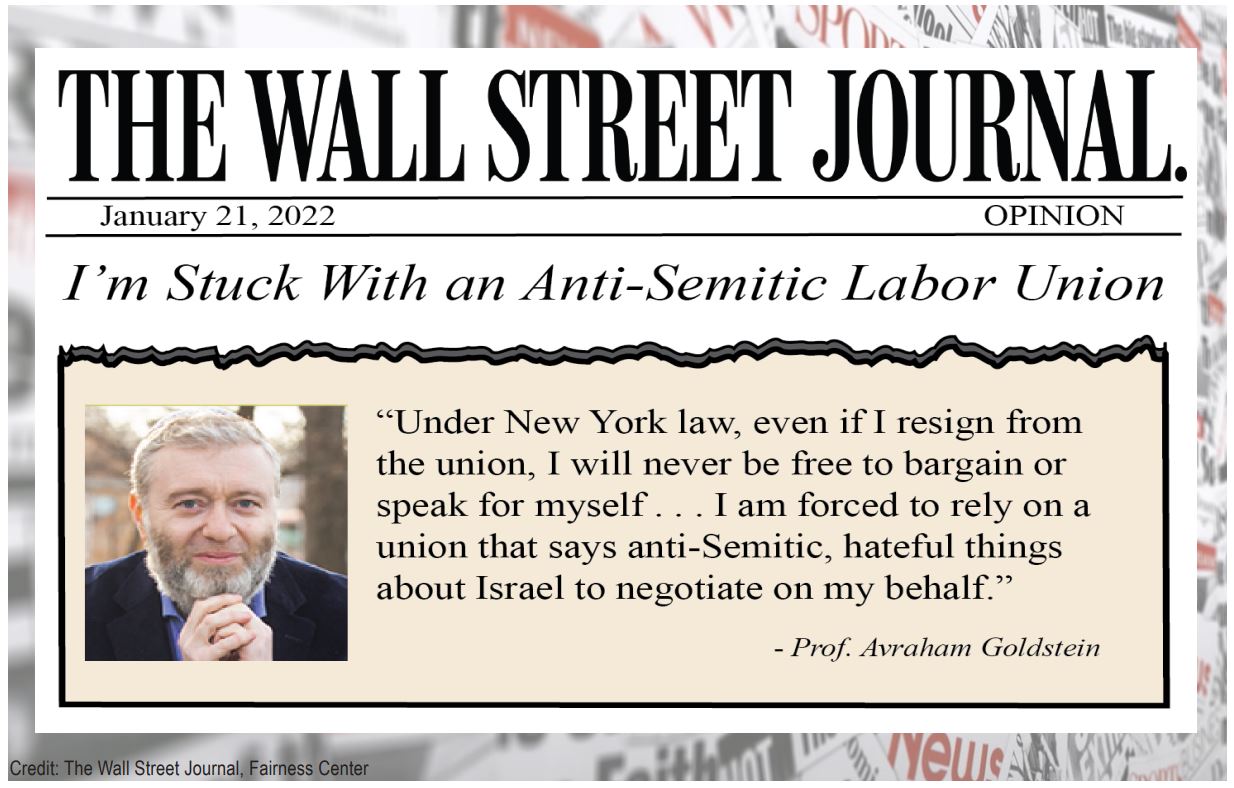
Prof. Avraham Goldstein recalled in a Wall Street Journal piece the anti-Semitism his family faced in the Soviet Union. He and other plaintiffs argue they shouldn’t be forced to associate with a union that subjects them to similar hostility.
NEW YORK, NY – For decades, government sector union bosses have relied on two pillars of coercion — forced dues and forced representation — to maintain their grip on power over America’s public servants and the public services citizens rely on.
While the Supreme Court in the 2018 National Right to Work Foundation-won Janus v. AFSCME Supreme Court case recognized that forcing government employees to pay dues to stay employed violates the First Amendment, a new Foundation-assisted civil rights lawsuit from six City University of New York (CUNY) system professors may finally defeat union bosses’ privilege to impose union representation over the objections of public workers.
CUNY professors Jeffrey Lax, Michael Goldstein, Avraham Goldstein, Frimette Kass-Shraibman, Mitchell Langbert, and Maria Pagano sued the AFL-CIO-affiliated Professional Staff Congress (PSC) union, CUNY executives, and New York State officials in January, challenging New York State’s “Taylor Law” that gives unions monopoly bargaining privileges in public sector workplaces like CUNY.
The plaintiffs, most of whom are Jewish, oppose the union’s “representation” on the grounds that union officials and adherents have relentlessly denigrated their religious and cultural identity. Several of the plaintiffs exercised their Janus right to cut off dues after PSC officials rammed through a resolution in June 2021 that they found “anti-Semitic, anti-Jewish, and anti-Israel,” according to the lawsuit.
Discrimination Cited in Groundbreaking First Amendment Case
The lawsuit, which was filed with legal aid from both the National Right to Work Foundation and Pennsylvania-based Fairness Center, says: “Despite Plaintiffs’ resignations from membership in PSC, Defendants . . . acting in concert and under color of state law, force all Plaintiffs to continue to utilize PSC as their exclusive bargaining representative.”
The resolution is not nearly the worst example of PSC officials’ anti-Semitism, according to the lawsuit. Prof. Michael Goldstein asserts that adherents of PSC are waging a campaign to get him fired and have targeted him with harassment and threats such that he must have an armed guard accompany him on campus. Prof. Lax cites in the lawsuit a determination he has already received from the Equal Employment Opportunity Commission (EEOC) that “PSC leaders discriminated against him, retaliated against him, and subjected him to a hostile work environment on the basis of religion.”
While all of the professors take issue with PSC bosses’ radicalism, they also want to break free from internal conflicts within the large and disparate unit, which consists of full-time, part-time, and adjunct teaching employees and others. Prof. Kass-Shraibman states in the lawsuit that “instead of prioritizing the pay of full-time faculty, PSC expended resources advocating on behalf of teachers in Peru, graduate students at various other universities and the so-called ‘Occupy Wall Street’ movement.”
On top of all that, Profs. Avraham Goldstein, Kass-Shraibman, and Langbert contend that PSC officials aren’t even respecting their First Amendment Janus rights. Although all three professors clearly indicated they wanted to cut off financial support to the union, the lawsuit explains that “Defendants PSC and the City . . . have taken and continue to take and/or have accepted and continue to accept union dues from [their] wages as a condition of employment . . .” in violation of Janus.
“I had paid thousands of dollars in union dues for workplace representation, not for political statements or attacks on my beliefs and identity,” Prof. Avraham Goldstein wrote in a piece for The Wall Street Journal. “I decided to resign my union membership and naively thought I could leave the union and its politics behind for good.”
“I was wrong,” recounted Prof. Goldstein. “Union officials refused my resignation and continued taking union dues out of my paycheck.”
Suit Seeks Damages and to Overturn NY Law Authorizing Union Control
The lawsuit seeks a declaration from the U.S. District Court for the Southern District of New York that the Taylor Law’s imposition of monopoly union control is unconstitutional, and that the defendants cease “certifying or recognizing PSC, or any other union, as Plaintiffs’ exclusive representative without their consent.” The lawsuit also demands the union and university return dues seized in violation of Janus to Profs. Avraham Goldstein, Kass-Shraibman, and Langbert.
“By forcing these professors into a monopoly union collective against their will, the state of New York mandates that they associate with union officials and other union members who take positions that are deeply offensive to these professors’ most fundamental beliefs,” observed National Right to Work Foundation President Mark Mix. “New York State’s Taylor Law authorizes such unconscionable compulsion. It is time federal courts fully protect the rights of government employees to exercise their freedom to disassociate from an unwanted union, whether their objections are religious, cultural, financial, or otherwise.”





