
Public Servants Across Country Stand Strong in Defending Janus Rights
The following article is from the National Right to Work Legal Defense Foundation’s bi-monthly Foundation Action Newsletter, January/February 2026 edition. To view other editions of Foundation Action or to sign up for a free subscription, click here.
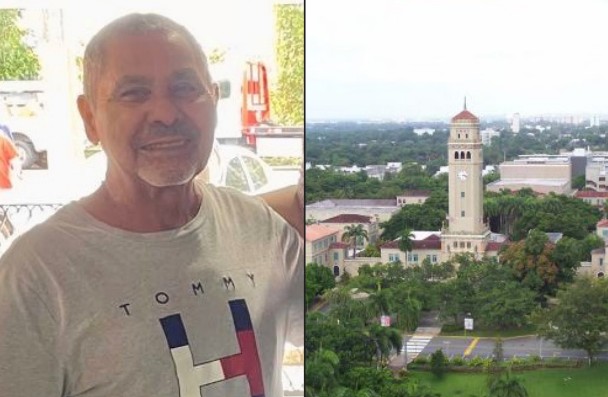
Jose Ramos, a University of Puerto Rico maintenance employee, isn’t going to let union bosses maintain their flimsy defense that they are entitled to keep his hard-earned money in violation of the First Amendment.
As 2025 waned, National Right to Work Foundation staff attorneys brought their expertise to bear as government employees in Washington State and Puerto Rico continued legal battles to get back money that union bosses never should have seized from their paychecks.
These workers are invoking their rights under the Foundation-won Janus v. AFSCME decision, which the Supreme Court handed down in 2018. In Janus, the Justices ruled that all American public sector workers have a First Amendment right to abstain from paying dues to union officials they don’t support.
Despite Janus’ commonsense protections, many union bosses, intent on keeping their coffers stocked with dues money seized from unwilling public employees, are still trying to skirt the Court’s ruling.
AFSCME Bosses Refuse to Return Illegally-Seized Money to Worker
That includes AFSCME union officials in Washington State, whom City of Everett employee Xenia Davidsen is fighting at the Washington State Public Employment Relations Commission (PERC). Davidsen charged AFSCME chiefs with accepting money that City officials had illicitly funneled from her paycheck to the union.
Davidsen had requested dues deductions to stop in 2024 in accordance with Janus, but City officials failed to monitor the email address through which AFSCME directed the City to stop the deductions. This incompetence led to the City seizing dues money from Davidsen at least 12 times without her authorization — and AFSCME union officials have stubbornly refused to admit they must post a notice stating they were wrong to accept the deductions.
“On none of those… instances did the Union stop to question why it was accepting dues that it knew were unauthorized to it,” argue Foundation attorneys in Davidsen’s latest brief before the PERC.
Meanwhile, Foundation attorneys also defended the Janus rights of two groups of Puerto Rico public employees in oral arguments before the First Circuit Court of Appeals last October.
Foundation Challenges Puerto Rico Court’s Refusal to Nix Anti-Janus Statute
In one case, Cruz v. UIA, Puerto Rico Aqueduct and Sewer Authority (PRASA) employee Reynaldo Cruz is trying to reclaim union dues money that officials of the Authentic Independent Union of Water and Sewer Authority Employees (UIA) took in violation of his First Amendment rights.
Cruz’s lawsuit challenges both union bosses’ demands that he pay union dues or lose his job, as well as the Puerto Rico territorial laws that allow such unconstitutional demands. Though UIA union bosses claim they have already deposited the illegally-seized money with a lower federal court, that court confusingly declined to issue a ruling that legally entitles Cruz to collect the funds.
During oral arguments, Cruz’s legal team argued that this legal sleight-of-hand created “a roadmap for civil rights defendants to violate civil rights plaintiffs’ rights.”
Foundation Won’t Let Union Bosses & Bureaucrats Ignore Janus
Also argued before the First Circuit at the end of 2025 was Ramos v. Delgado, in which Foundation attorneys represent Jose Ramos and other University of Puerto Rico maintenance employees who had dues illegally deducted from their paychecks for years.
Ramos and his colleagues are seeking refunds of all dues taken unlawfully since the Janus decision. Puerto Rico continues to be a hotbed for union violations of the Janus decision, but luckily, workers continue to stand up with Foundation legal aid.
Most recently, public employee Luis Rigau filed a federal lawsuit to challenge the Puerto Rico Industrial Commission (PRIC) union’s blatantly illegal reinstatement of automatic forced-dues deductions against nonmembers.
“Despite Janus’ clear constitutional command, union bosses, legislators, and public officials are still trying to do legal gymnastics to end-run the decision,” commented National Right to Work Foundation Vice President and Legal Director William Messenger.
“All public sector workers deserve the free choice that Janus secures, and Foundation attorneys will continue to back them in their court battles for freedom.”
Puerto Rico Public Workers Defend First Amendment Right to Stop Union Dues Payments in Federal Court Arguments
Two arguments held this week at First Circuit Court of Appeals involve rights under landmark Janus v. AFSCME U.S. Supreme Court decision
San Juan, PR (October 30, 2025) – Oral arguments for two lawsuits in which Puerto Rico public employees are defending their First Amendment rights under the Janus v. AFSCME U.S. Supreme Court decision are taking place before the U.S. Court of Appeals for the First Circuit in San Juan this week. Both sets of workers are receiving free legal representation from National Right to Work Foundation staff attorneys.
The Supreme Court recognized in the landmark Janus decision that all public sector workers have a First Amendment right to cut off dues payments to union officials. The Janus ruling further clarified that union officials cannot deduct union dues from any public sector worker’s paycheck unless he has affirmatively waived his First Amendment right not to pay. Foundation staff attorneys argued and won Janus in 2018.
Despite Janus’ clear standards, union officials have attempted to circumvent the decision in a number of ways, necessitating further Foundation legal action.
PRASA Employee Fights Blatantly Illegal Forced-Dues Statute
The first Foundation case, Cruz v. UIA, which the First Circuit heard Wednesday, involves Puerto Rico Aqueduct and Sewer Authority (PRASA) employee Reynaldo Cruz’s attempt to reclaim union dues money that officials of the Authentic Independent Union of Water and Sewer Authority Employees (UIA) took in violation of the First Amendment. Cruz’s lawsuit challenged both union bosses’ demands that he pay union dues or lose his job, as well as the Puerto Rico territorial laws that greenlight such unconstitutional demands.
As opposed to resolving the legal claims in his case, the Puerto Rico District Court confusingly ruled Cruz’s case “moot” after UIA union officials remitted his illegally-seized dues money to the Clerk of the District Court. Cruz has still not received his money, and argues that his Janus rights will not be vindicated until a judgment is entered in his favor.
UPR Workers Seek to Vindicate Years of Illegal Dues Deductions
The second Foundation case, which the First Circuit is slated to hear Friday (Ramos v. Delgado), is a challenge from University of Puerto Rico (UPR) maintenance employees Jose Ramos, Antonio Mendez, Jose Cotto, and Igneris Perez. They argue that union officials seized union dues from their paychecks for years both in violation of Janus and other legal protections that predate Janus.
Ramos and the other plaintiffs contend that union officials never sought their consent properly for dues deductions both before and after the Janus decision, and that they should receive refunds of all dues taken unlawfully within the 15-year statute of limitations.
“Janus laid out the very simple principle that public sector workers – not union bosses – should be in charge of deciding whether a union has earned their financial support,” commented National Right to Work Foundation President Mark Mix. “Despite Janus’ clear constitutional command, union bosses and legislators still try to skirt it, and courts still allow obvious violations to go unpunished. In Mr. Cruz’s case, the District Court refused to even examine a Puerto Rico statute that authorizes illegal forced-dues language in public sector union contracts.
“All public sector workers deserve the free choice that Janus secures, and Foundation attorneys will continue to back them in their court battles for freedom,” Mix added.
20 Wonderful Nurseries Farmworkers Seek to Join Federal Challenge to Biased Pro-Union Boss California Agricultural Labor Law
Filing: UFW union-backed law sweeps workers into union via coercive ‘card check’ scheme and imposes forced dues in violation of First Amendment
Bakersfield, CA (February 5, 2025) – A group of 20 employees of food and drink company Wonderful Nurseries’ Wasco, CA, facility have filed a motion to intervene in a federal lawsuit challenging a California law that will force them under the control of United Farm Workers (UFW) union officials, to whom they have strenuously objected. The employees, who last year were subject to an aggressive “card check” unionization campaign from the UFW, are receiving free legal aid in their effort to defend their rights from National Right to Work Legal Defense Foundation staff attorneys.
The federal lawsuit the workers seek to join was filed by Wonderful Nurseries against the California Agricultural Labor Relations Board (ALRB), and challenges the ALRB’s “mandatory mediation and conciliation” (MMC) process, which follows the ALRB’s highly-suspect certification of the UFW as the monopoly bargaining representative of the workers. The workers were denied intervention in Wonderful Nurseries’ state court lawsuit challenging the card check certification last July, one week before the court enjoined further proceedings based upon the certification. That lawsuit contends that UFW union agents claimed majority support by submitting to the ALRB union authorization cards that they had fraudulently obtained from workers.
As part of their motion to intervene in this new federal suit, the workers have also filed a proposed intervenors’ complaint detailing even more rights violations by the ALRB. The employees’ filing points out that the Wonderful Nurseries workers must be allowed to vindicate their own rights, which are inherently impacted by the lawsuit.
California labor law mandates that the ALRB should immediately certify a union as monopoly bargaining agent if it submits union cards from a majority of workers, even if there are objections as to how the cards were collected. “Card check” denies workers their right to vote in secret on whether they want a union, and instead allows union officials to demand union authorization cards directly from workers. Past Foundation-backed legal action by Wonderful Nurseries employees at the ALRB detailed the threats and discriminatory behavior that union agents used to obtain the cards.
The Wonderful Nurseries employees’ complaint and motion to intervene, filed by Foundation staff attorneys, joins Wonderful Nurseries’ challenge to the “mandatory mediation and conciliation” provisions of California labor law. Those provisions would force UFW officials and Wonderful Nurseries management to finalize a union contract that will almost certainly subject the workers to UFW union boss control for three years and payment of forced union dues as a condition of keeping their jobs.
“[T]he Employees seek this Court’s immediate intervention to protect their fundamental liberty interests, especially their freedom of association between and amongst themselves, and with their employer, and their rights to be free from State-compelled monopoly representation by a labor organization not legitimately chosen by a majority of employees, and from State-mandated payment of union dues or fees,” the complaint reads.
Radical CA Labor Law Violates First Amendment Janus Decision by Imposing Government-Mandated Forced-Dues Contracts on Workers
The complaint points out that state imposition of such a contract on the Wonderful Nurseries farmworkers would harm their First Amendment rights, as spelled out in the landmark Foundation-won Supreme Court case Janus v. AFSCME. “[Janus] barred state-mandated and –enforced forced-unionism schemes,” reads the complaint.
In the 2018 Janus decision, the U.S. Supreme Court ruled that government-enforced union contracts that required state employees to pay union dues or fees as a condition of keeping their jobs are a violation of First Amendment free association principles. In this case, Foundation attorneys argue, the State of California would be compelling Wonderful Nurseries and the UFW union to impose a similar contract over farmworkers – one which would require them to subsidize the union or be fired. For that reason, the state government would be violating the First Amendment in the same way as happened in Janus, Foundation attorneys contend.
Employees: UFW Union Created Atmosphere of Intimidation, Discrimination During Union Campaign
Wonderful Nurseries employees Claudia Chavez and Maria Gutierrez, who are part of the current effort, sought to intervene in this case before the ALRB, following the agency’s certification of the UFW’s dubious claims of majority support. In unfair labor practice charges before the ALRB, Chavez and Gutierrez described multiple fabrications – and even discriminatory behavior – that UFW union bosses used to get employees to sign authorization cards, including “representing that certain COVID-19-related public benefits available to farmworkers required signatures on union membership cards…that union membership cards were not, in fact, union membership cards to be used in any UFW organizing efforts…presenting to strictly Spanish-speaking discriminatees union membership cards only in English…[and] presenting to illiterate discriminatees union membership cards and misrepresenting their content and/or significance.”
“UFW union officials deceived us just so they could gain power in our workplace,” Chavez and Gutierrez commented after filing charges. “Instead of just letting us vote in secret on whether we want a union, they went around lying and threatening to get cards and now are cracking down on anyone who speaks out against the union.”
“Wonderful Nurseries workers, who are desperately trying to defend their freedom from an unwanted UFW union, are finding themselves fighting not only UFW lawyers, but also the full weight of California’s top-down, draconian labor policy,” commented National Right to Work Foundation President Mark Mix. “By granting union bosses the authority to sweep workers under their control with suspect ‘card check’ campaigns, then having the government impose a forced-dues contract over the objection of both workers and businesses, California legislators have created an environment where workers’ individual rights are being crushed to promote raw, unchecked union boss power.”
Puerto Rico Police Bureau Employees Foil Anti-Janus Scheme
The following article is from the National Right to Work Legal Defense Foundation’s bi-monthly Foundation Action Newsletter, November/December 2024 edition. To view other editions of Foundation Action or to sign up for a free subscription, click here.
Federal court strikes down discrimination against workers at the Puerto Rico Police Bureau who exercised First Amendment rights
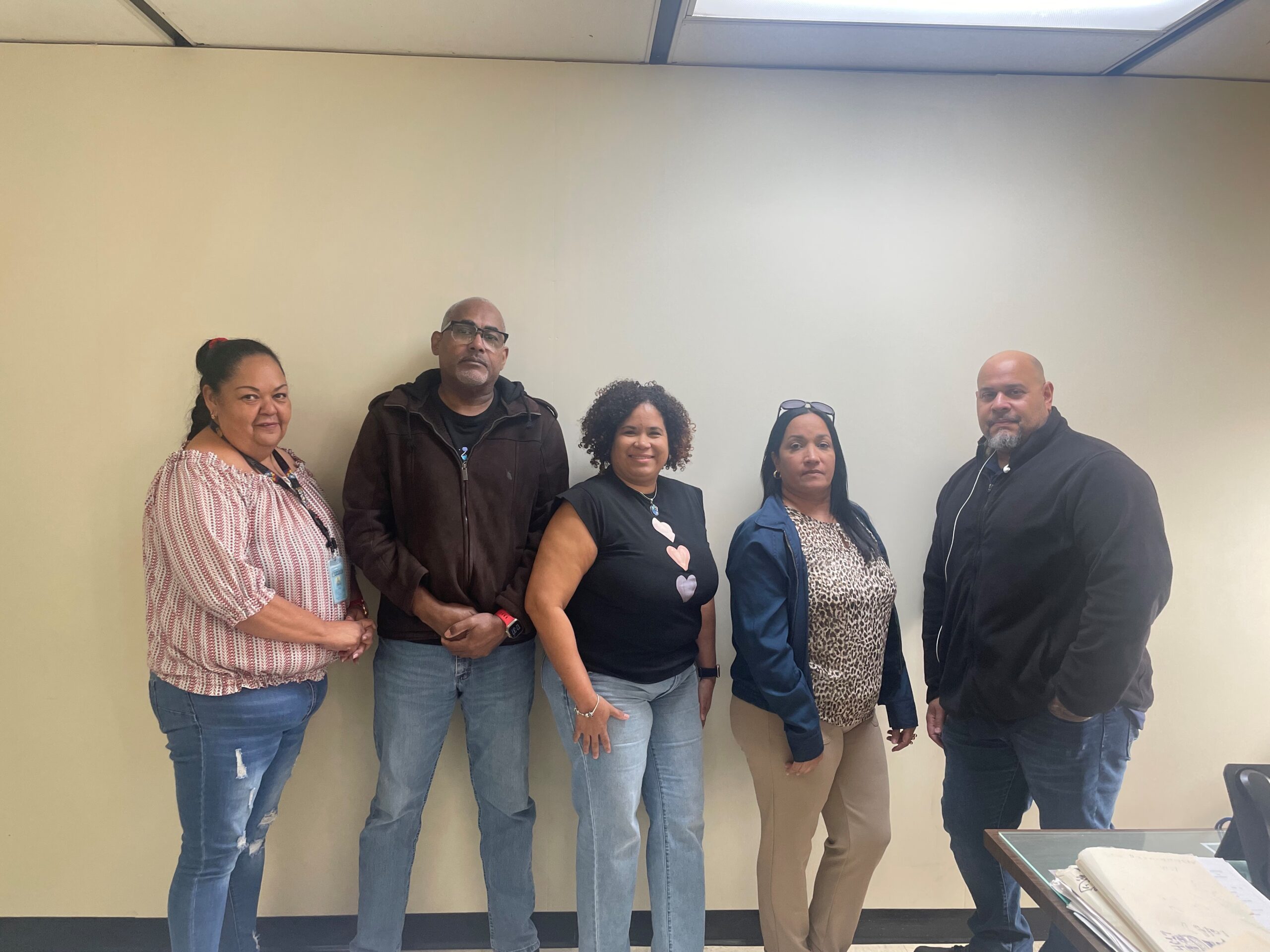
Vanessa Carbonell (center) and other employees of the Puerto Rico Police Bureau won big at the Puerto Rico District Court in September 2024. Their Foundation-won decision forces their employer and the union to stop violating their Janus rights.
SAN JUAN, PR – The National Right to Work Foundation’s 2018 victory at the U.S. Supreme Court in Janus v. AFSCME opened new horizons for employee freedom across the country. For the first time, the Justices recognized that the First Amendment prohibits union bosses from forcing public sector employees to join a union or pay dues as a condition of employment, and that union bosses can only take dues from a worker’s paycheck with their affirmative consent.
Foundation attorneys’ efforts to enforce the landmark decision yielded a big victory this September for a wide swath of civilian employees at the Puerto Rico Police Bureau (PRPB). In a class action federal lawsuit, more than a dozen PRPB employees charged officials of the Union of Organized Civilian Employees with violating their Janus rights by stripping them of an employer-provided health benefit because they refused to join the union.
A recent decision from the District Court of Puerto Rico found in favor of the employees’ arguments, stating that their employer had indeed taken away the health benefit because the employees exercised their right to not join or pay dues to the union.
Scheme Forced Workers to Join Union or Lose Access to Better Healthcare
“This is either retaliation for exercise of non-union members’ post-Janus non-associational rights under the First Amendment under the Constitution or simply discrimination,” said the Court.
According to lead plaintiff Vanessa Carbonell and her colleagues’ original lawsuit, they all exercised their Janus right to opt out of the union at various points after the 2018 Janus decision. They each began noticing that as dues ceased coming out of their paychecks, they also stopped receiving a $25-a-month employer-paid benefit intended to help employees pay for better health insurance.
The lawsuit demonstrated that PRPB officials cut the benefit off to employees who refused union membership — a clear case of discrimination against employees who exercise their First Amendment right to abstain from union affiliation.
Union and Employer Must Stop Discrimination
The District Court’s decision, in addition to declaring that the ploy by PRPB and the Union of Organized Civilian Employees is unconstitutional, orders an injunction to stop PRPB officials from continuing to withhold the benefit from Carbonell and other employees.
“Janus enshrined a very simple First Amendment principle: That union officials need to convince public employees to support their organization and activities voluntarily,” commented National Right to Work Foundation Vice President Patrick Semmens.
Professors Launch Landmark SCOTUS Bid to End Forced Union Association
The following article is from the National Right to Work Legal Defense Foundation’s bi-monthly Foundation Action Newsletter, September/October 2024 edition. To view other editions of Foundation Action or to sign up for a free subscription, click here.
NY law unconstitutionally forces professors under “representation” of anti-Semitic union
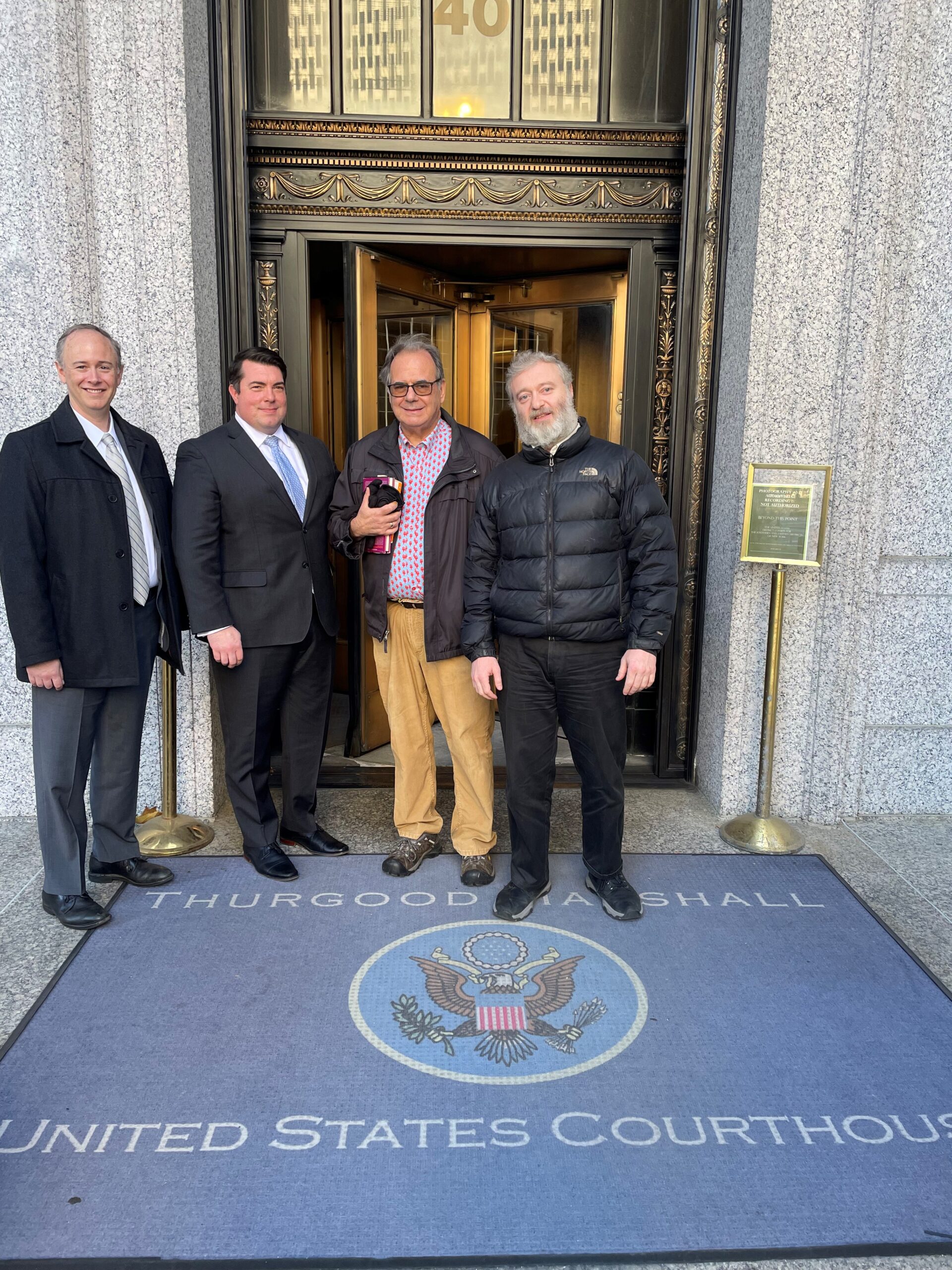
Together, (from left) Foundation Legal Director William Messenger, Fairness Center General Counsel Nathan McGrath, and CUNY Professors Mitchell Langbert and Avraham Goldstein seek to establish new protections against forced union association.
WASHINGTON, DC – Avraham Goldstein, a mathematics professor at the City University of New York (CUNY), wrote in a 2022 Wall Street Journal op-ed about the predicament that he and many of his Jewish colleagues face because New York law forces them under the “representation” of an anti-Israel union: “I had paid thousands of dollars in union dues for workplace representation, not for political statements or attacks on my beliefs and identity. I decided to resign my union membership and naively thought I could leave the union and its politics behind for good . . . I was wrong.”
It was this situation that led Avraham Goldstein, along with fellow professors Michael Goldstein, Frimette Kass-Shraibman, Mitchell Langbert, Jeffrey Lax, and Maria Pagano, to file a federal lawsuit against the Professional Staff Congress (PSC) union, CUNY, and State of New York officials in 2022. That lawsuit challenged New York State’s “Taylor Law,” which grants union bosses monopoly bargaining power in the public sector. Such power permits union bosses to speak and contract for public workers — including those that want nothing to do with the union.
Professors’ Petition: First Amendment Protects Union Dissenters
Staff attorneys from the National Right to Work Foundation and The Fairness Center have litigated the professors’ case up through the federal court system. Now they’re asking the U.S. Supreme Court to take their case and clarify that the First Amendment forbids union officials from foisting their voice and values on public sector workers who oppose the union.
“The core issue in this case is straightforward: can the government force Jewish professors to accept the representation of an advocacy group they rightly consider to be anti-Semitic? The answer plainly should be ‘no,’” the petition begins.
The High Court has recognized for decades how public sector monopoly bargaining burdens workers’ First Amendment freedom of association rights. In 1944, the Supreme Court’s decision in Steele v. Louisville & Nashville Railway Co. recognized how rail union bosses were manipulating their powers over the workplace to discriminate against African-American railway workers. The Supreme Court restated its concerns most recently in the 2018 Foundation-won Janus v. AFSCME decision, with the majority calling monopoly bargaining “a significant impingement on associational freedoms.”
Original Complaint Detailed Union Bosses’ Discrimination
The professors’ original complaint, filed in the U.S. District Court for the Southern District of New York, recounted that several of the professors chose to dissociate from PSC based on a host of discriminatory actions perpetrated by union agents and adherents — including a June 2021 union resolution that the professors viewed as “anti-Semitic, anti-Jewish, and anti-Israel.”
The complaint said Prof. Michael Goldstein “experienced anti-Semitic and anti-Zionist attacks from members of PSC, including what he sees as bullying, harassment, destruction of property, calls for him to be fired, organization of student attacks against him, and threats against him and his family.” Goldstein has needed a guard to accompany him on campus, the complaint noted.
Prof. Lax, the complaint explained, already received in a separate case a letter of determination from the Equal Employment Opportunity Commission (EEOC) “that CUNY and PSC leaders discriminated against him, retaliated against him, and subjected him to a hostile work environment on the basis of religion.” As their petition at the Supreme Court notes, these conflicts have significantly increased since the events of October 7.
Professors Could Create Groundbreaking Precedent
The petition asks the Supreme Court to take up the case and stop CUNY and the State of New York from letting PSC union bosses impose their “representation” on the professors.
“New York’s legal scheme forces these CUNY professors to associate with union officials who insult their identity and create a work environment rife with bullying and harassment. It’s hard to think of a more obvious violation of the First Amendment,” commented National Right to Work Foundation President Mark Mix. “It’s high time that the Justices finally acknowledge the First Amendment protects government employees from being forced to accept political ‘representation’ they adamantly oppose.”
CUNY Professors Ask U.S. Supreme Court to Hear Case Challenging Forced Association with Antisemitism-Linked Union
NY law forces professors to be represented by hostile union bosses, but SCOTUS ruling could free public workers nationwide from unwanted union power
Washington, DC (July 22, 2024) – Six City University of New York (CUNY) professors are asking the U.S. Supreme Court to hear their federal civil rights lawsuit charging Professional Staff Congress (PSC) union officials with forcing them to accept the union’s so-called “representation” in violation of their First Amendment rights. The professors, five of whom are Jewish, oppose the PSC union’s public statements and other actions as being strongly anti-Semitic and anti-Israel.
The professors, Avraham Goldstein, Michael Goldstein, Frimette Kass-Shraibman, Mitchell Langbert, Jeffrey Lax, and Maria Pagano, are receiving free legal aid from the National Right to Work Legal Defense Foundation and The Fairness Center. The lawsuit challenges aspects of New York State’s “Taylor Law”, which grants union bosses monopoly bargaining power in the public sector. This permits union bosses to speak and contract for public workers, including those that want nothing to do with the union. In addition to opposing the union’s extreme ideology, the professors oppose being forced into a “bargaining unit” of instructional staff who share the union’s objectionable beliefs or have employment interests diverging from their own.
The professors’ petition of certiorari points out that the High Court has recognized for decades how public sector monopoly bargaining burdens workers’ First Amendment freedom of association rights. In 1944, the Supreme Court’s decision in Steele v. Louisville & Nashville Railway Co. recognized how rail union bosses were manipulating their powers over the workplace to discriminate against African-American railway workers. The Supreme Court restated its concerns most recently in the 2018 Foundation-won Janus v. AFSCME decision, with the majority calling monopoly bargaining “a significant impingement on associational freedoms.”
The petition also counters lower courts’ mistaken assertions that the Supreme Court’s 1984 Minnesota State Board for Community Colleges v. Knight decision disposes of the CUNY professors’ case. As the petition points out, Knight only dealt with public employees’ ability to participate in union meetings and not with the professors’ legal argument that being forced to accept the bargaining power and “representation” of union officials is a violation of First Amendment free association rights. With lower courts so frequently misinterpreting Knight, the petition argues the Supreme Court is needed to clarify the issue, and apply the proper First Amendment analysis to the New York laws’ forced-representation scheme.
“The core issue in this case is straightforward: can the government force Jewish professors to accept the representation of an advocacy group they rightly consider to be anti-Semitic? The answer plainly should be ‘no,’” the petition begins. “The First Amendment protects the rights of individuals, and especially religious dissenters, to disaffliate themselves from associations and speech they abhor.”
“Knight did not sanction a state forcing Jewish faculty members who are ardent Zionists to accept the representation of a union that supports policies they consider anti-Israel,” the petition continues. “The Court should grant this petition to clarify Knight and make clear that the First Amendment protects individuals’ right to dissociate themselves from advocacy groups that support policies contrary to their deeply held beliefs.”
Law Forces Jewish CUNY Professors to Associate with Anti-Israel PSC Union
The professors’ original complaint recounted that several of the professors chose to dissociate from PSC based on a host of discriminatory actions perpetrated by union agents and adherents, including a June 2021 union resolution that the professors viewed as “anti-Semitic, anti-Jewish, and anti-Israel.”
The complaint said Prof. Michael Goldstein “experienced anti-Semitic and anti-Zionist attacks from members of PSC, including what he sees as bullying, harassment, destruction of property, calls for him to be fired, organization of student attacks against him, and threats against him and his family.” Goldstein has needed a guard to accompany him on campus, the complaint noted.
Prof. Lax, the complaint explained, already received in a separate case a letter of determination from the Equal Employment Opportunity Commission (EEOC) “that CUNY and PSC leaders discriminated against him, retaliated against him, and subjected him to a hostile work environment on the basis of religion.” Prof. Lax “has felt marginalized and ostracized by PSC because the union has made it clear that Jews who support the Jewish homeland, the State of Israel, are not welcome,” said the complaint. As their petition of certiorari notes, these conflicts have significantly increased since October 7.
SCOTUS Asked to Overturn Laws Imposing Union Power on Public Workers
The petition asks the Supreme Court to take up the case and stop CUNY and the State of New York from letting PSC union bosses impose their “representation” on the professors. It also demands that the court declare unconstitutional Section 204 of New York’s Taylor Law to the extent that it compels the professors under union power.
Issues with union monopoly bargaining power in the academic sphere came into the national spotlight just this month, when the U.S. House Committee on Education and the Workforce held a hearing on fighting antisemitism in unions. There, Will Sussman, a Ph.D. student at the Massachusetts Institute of Technology, testified about how the law forces him and other graduate students across the nation to associate with union bosses that perpetrate divisive protests and denigrate Israel. Sussman, who is Jewish, filed federal discrimination charges against the MIT Graduate Student Union (GSU-UE).
“New York’s legal scheme forces these CUNY professors to associate with union officials who insult their identity and create a work environment rife with bullying and harassment. It’s hard to think of a more obvious violation of the First Amendment,” commented National Right to Work Foundation President Mark Mix. “The Supreme Court has expressed concerns with monopoly bargaining for decades, and it’s high time that the justices finally acknowledge the First Amendment protects government employees from being forced to associate with political so-called ‘representation’ they adamantly oppose.”
Foundation: Under Janus, Union Boss “Release Time” Violates AZ Constitution
The following article is from the National Right to Work Legal Defense Foundation’s bi-monthly Foundation Action Newsletter, March/April 2024 edition. To view other editions of Foundation Action or to sign up for a free subscription, click here.
So-called “official time” scheme puts tax dollars toward union politics, says Foundation brief
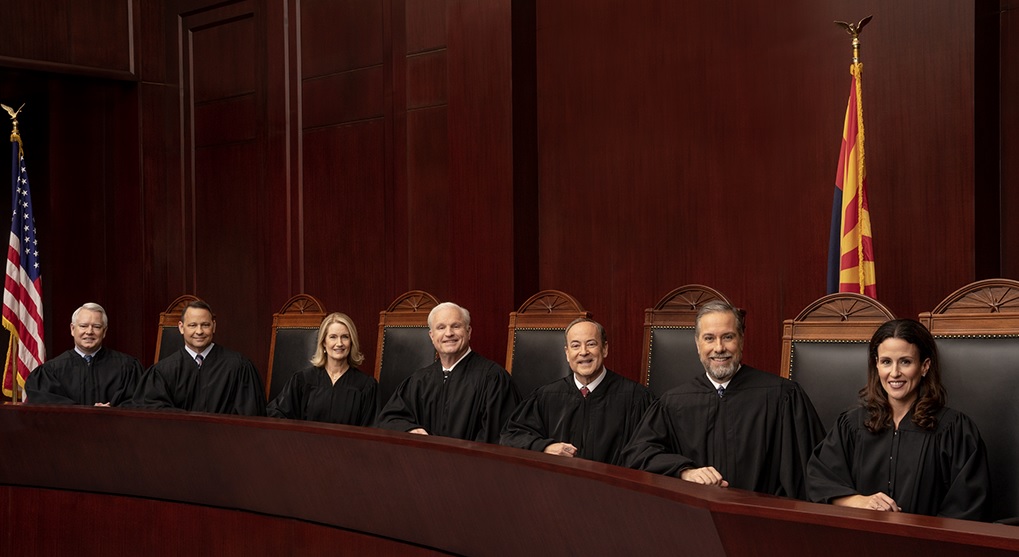
Foundation attorneys argue before the Arizona Supreme Court (above) and Texas Supreme Court that Janus’ ban on forcing public workers to fund union activities shows why state constitutions forbid the same coercion applied to taxpayers.
PHOENIX, AZ – The National Right to Work Foundation-won Janus v. AFSCME Supreme Court decision provided massive new protections for American public employees’ free association rights. In 2018, the Court recognized for the first time that forcing a public employee to pay union dues just to keep his or her job is a First Amendment violation.
The Janus decision, buoyed by National Right to Work Foundation follow-up enforcement actions, means today well over half a million public employees are free of mandatory union payments. Yet, the implications of Janus go even beyond the billions of dollars in previously mandatory dues payments that union bosses can no longer force workers to pay.
Underpinning the Janus ruling was Foundation attorneys’ core argument that all public sector union activities involve influencing the government, and are therefore inherently political speech. Because of this, Foundation staff attorneys now argue that applying Janus to the practice known as union “official time” or “release time” — where government union officials are paid tax money to conduct union business instead of government work — shows how the scheme violates multiple state constitutions.
Foundation Attorneys Bring Janus Expertise to Public Employee Lawsuit
In Arizona for example, Phoenix city employees Mark Gilmore and Mark Harder sued Phoenix mayor Kate Gallego in 2023 for engaging in a scheme that redirects taxpayer funds intended for public employees’ compensation toward political advocacy conducted by American Federation of State, County and Municipal Employees (AFSCME) Field II agents.
That case, Gilmore v. Gallego, is now before the Arizona Supreme Court, where Foundation attorneys filed a legal brief arguing that this so-called “release time” scheme violates Arizona’s Gift Clause, which forbids the government from paying out benefits to private parties that serve no public purpose.
The brief points out that, in Janus, the Supreme Court found that all government union bargaining is a form of lobbying designed to influence public policy for the benefit of the union. That means taxpayer subsidies of such union activities inherently violate the Arizona Constitution’s Gift Clause.
Phoenix’s Arrangement Pays Union Bosses to Lobby City
Phoenix’s “release time” scheme funnels taxpayer money into four full-time positions for union officials for the purpose of conducting union business, creates a bank of over 3,000 paid hours to be used by other union official employees for union purposes, and provides multiple other perks for union agents.
The policies unions lobby for “often are matters of substantial public concern, such as how much money the government expends on wages and benefits,” the Foundation’s brief reads. With its release time policy, the City is effectively paying individuals to lobby the City for a private advocacy organization and its members. The notion that this political advocacy serves a public purpose is untenable.”
Foundation attorneys are backing a similar lawsuit at the Texas Supreme Court. In Roger Borgelt v. City of Austin, Texas taxpayers are fighting a scheme that City of Austin officials are using to direct taxpayer dollars to Austin Firefighters Association union officials to conduct union business.
“Union bosses, who will often screech about ‘corporate welfare,’ are more than happy to arrange so-called ‘release time’ schemes in which taxpayer dollars are funneled toward supporting their massive lobbying efforts,” stated National Right to Work Foundation Vice President and Legal Director William Messenger. “Janus made it plain and simple that compelling public sector employees to fund union activities constitutes forced political speech, and courts everywhere have an obligation to declare such compulsion illegal when foisted on taxpayers.”
Puerto Rico Union Bosses Try to Dodge Consequences of Janus Lawsuit
The following article is from the National Right to Work Legal Defense Foundation’s bi-monthly Foundation Action Newsletter, January/February 2024 edition. To view other editions of Foundation Action or to sign up for a free subscription, click here.
Worker still battling scofflaw union officials who tried to saddle him with restraining order

PRASA employee Reynaldo Cruz didn’t back down after UIA union officials tried to foist a specious restraining order on him. He isn’t backing down in the face of UIA union officials’ Janus violations either.
SAN JUAN, PR – When Reynaldo Cruz, an employee of the Puerto Rican Aqueduct and Sewer Authority (PRASA), made a Facebook post referring to a chapter president of the Authentic Independent Union of Water and Sewer Authority Employees (UIA) as “lazy,” the chapter president tried to hit him with a restraining order.
“A UIA union official targeted me with a restraining order for daring to speak out against the union, which is my free speech right,” commented Cruz. “That’s ridiculous coming
from union officials who claim to ‘represent’ me and my coworkers.”
National Right to Work Foundation staff attorneys in October 2023 defeated the UIA official’s specious argument that the court should issue a restraining order against Cruz because he
would have had to “stalk” him to know of his laziness. But Cruz’s battle against the UIA union is far from over.
District Court Refuses to Crack Down on Obvious Janus Violations
Cruz is currently challenging a decision by the District Court of Puerto Rico in his years-long case to reclaim dues money that UIA union officials took unconstitutionally from his paycheck.
The District Court made the puzzling move of dismissing Cruz’s suit as “moot” after UIA officials deposited money due to Cruz with the Clerk of the District Court of Puerto Rico. In his motion to alter and amend the judgment, Cruz argues that because the court has not decided any of his underlying claims or entered a judgment in his favor, he has no entitlement to and cannot seek or obtain that money. Cruz is also appealing the District Court’s dismissal of his suit to the First Circuit Court of Appeals in Boston, MA.
“Until the Court enters a declaratory judgment for Cruz, Cruz’s injury-in-fact will persist because Cruz has not received monetary relief and the Court has not entered judgment for Cruz entitling him to the UIA deposit,” Cruz’s motion reads.
Cruz argues in his suit that various provisions of the Puerto Rico Labor Relations Act, which UIA union bosses relied upon to take money from his paycheck, violate the First Amendment. In 2018, the Supreme Court ruled in the landmark Foundation-won Janus v. AFSCME case that public employees have a First Amendment right to opt-out of dues payments to
an unwanted union, and that public employees must waive this right before any dues are deducted from their paychecks.
Cruz’s Janus lawsuit began in 2017, after UIA officials responded to his request to end his union membership and stop dues payments by telling him that he could only cut ties with the union if he left his current job. In addition to naming the UIA, Cruz’s lawsuit also names the Governor of Puerto Rico in his official capacity as Cruz is also challenging the constitutionality of Puerto Rico’s laws authorizing mandatory dues and so-called “maintenance of membership” agreements.
The Janus case was decided as Cruz’s case was ongoing. The Justices definitively ruled that requiring public sector employees to pay union dues as a condition of employment violates their First Amendment free association rights.
The Puerto Rico District Court issued its ruling on October 17, 2023. In addition to not entering a judgment for Cruz deciding his entitlement to the unconstitutionally seized money, the Court also didn’t reach a conclusion on the constitutionality of the Puerto Rico law authorizing mandatory dues payment and membership, nor did it require the UIA union to abandon anti-Janus contract provisions.
Union Bosses Must Be Made to Comply with Janus
“The ruling in Mr. Cruz’s case poses serious issues for public employees across Puerto Rico and across the country,” commented National Right to Work Foundation Vice President Patrick Semmens. “If allowed to stand, it creates a precedent in which workers get no relief when union bosses seize money unconstitutionally from their hard-earned pay, and in which laws that authorize such illegal dues deductions are allowed to stand despite Janus unambiguously prohibiting them.
“Foundation staff attorneys will continue to fight for Mr. Cruz until his rights are vindicated and he gets a judgment awarding him the money he is constitutionally entitled to,” Semmens added.
Right to Work Foundation Brief: 2018 Janus Decision Means Union “Release Time” Violates AZ Constitution’s Gift Clause
Brief supports challenge pending at Arizona Supreme Court against Phoenix’s scheme to subsidize inherently political union activities with tax dollars
Phoenix, AZ (December 14, 2023) – The National Right to Work Foundation has just filed an amicus brief in Mark Gilmore v. Kate Gallego, a case currently pending before the Arizona Supreme Court. In the case, Phoenix city employees Mark Gilmore and Mark Harder are suing Phoenix Mayor Kate Gallego for engaging in a scheme that redirects taxpayer funds intended for public employees’ compensation toward political advocacy conducted by American Federation of State, County and Municipal Employees (AFSCME) Field II agents on so-called “release time.”
Specifically, the plaintiffs’ lawsuit argues the Arizona Constitution prohibits the use of taxpayer dollars to fund four full-time positions for union officials for the purpose of conducting union business, in addition to a bank of over 3,000 paid hours to be used by other union officials for union purposes, and multiple other perks for union agents.
The Foundation’s brief argues that the release time scheme violates Arizona’s Gift Clause, which forbids government transactions that bestow benefits on private entities while serving no public purpose. The brief points out that the U.S. Supreme Court’s ruling in the Foundation-won Janus v. AFSCME case demonstrates that, under the First Amendment, all government union activities are a form of lobbying designed to influence public policy for the benefit of the union. That means taxpayer subsidies of such activities inherently violate the Arizona Constitution’s Gift Clause.
Brief: “Release Time” Funnels Tax Dollars Unconstitutionally to Union Bosses
The policies unions lobby for “often are matters of substantial public concern, such as how much money the government expends on wages and benefits,” the brief reads. “With its release time policy, the City is effectively paying individuals to lobby the City for a private advocacy organization and its members. The notion that this political advocacy serves a public purpose is untenable.”
In the Janus decision, the U.S. Supreme Court ruled that forcing public sector workers to fund any union activities as a condition of employment constitutes forced political speech barred by the First Amendment.
The Foundation’s brief also deconstructs a proposition that the City of Phoenix’s ability to impose one-size-fits-all union contracts on entire swaths of employees somehow counts as a “public benefit” that the City receives in exchange for enforcing the release time scheme. Foundation attorneys instead argue that the municipal labor code already imposes this obligation on both the union and the City, and thus isn’t a benefit that union bosses are giving the City.
“Given the code already requires the City and AFSCME to impose uniform terms of employment on unit employees, union member and nonmember alike, it necessarily follows that the City did not need to provide AFSCME agents with release time to comply with its pre-existing legal obligations,” the brief contends.
“Union bosses, who will often screech about ‘corporate welfare,’ are more than happy to arrange so-called ‘release time’ schemes in which taxpayer dollars are funneled toward supporting their massive lobbying efforts,” stated National Right to Work Foundation President Mark Mix. “Janus made it plain and simple that compelling public sector employees to fund union activities constitutes forced political speech, and the Arizona Supreme Court has an obligation to declare unlawful compulsion foisted on taxpayers.”
Foundation Asks Supreme Court to Take on Widespread Janus Violations
The following article is from the National Right to Work Legal Defense Foundation’s bi-monthly Foundation Action Newsletter, November/December 2023 edition. To view other editions of Foundation Action or to sign up for a free subscription, click here.
Brief: Pending case should be used to underscore need to obtain workers’ consent to dues
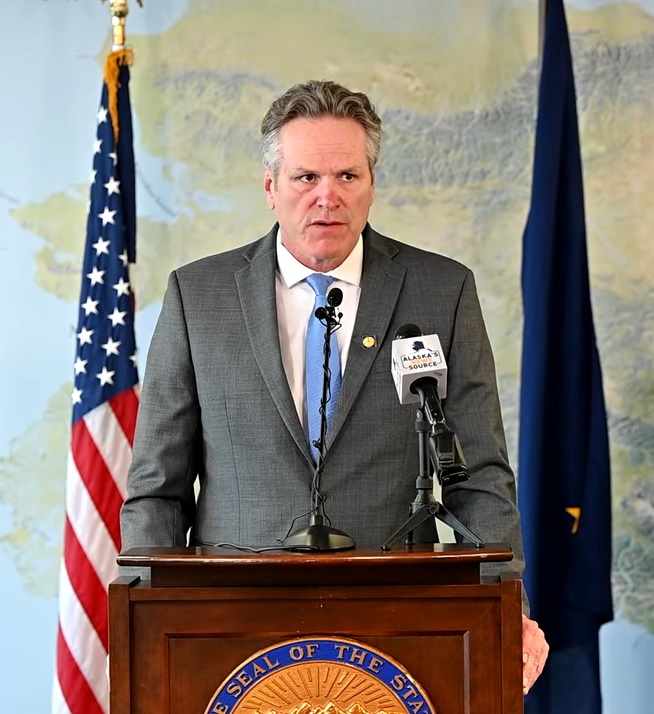
In 2019, Alaska Gov. Mike Dunleavy took proactive steps to protect Janus, but dues-hungry ASEA union bosses fought his actions all the way up to the Supreme Court.
WASHINGTON, DC – The National Right to Work Foundation’s victory in the 2018 Janus v. AFSCME Supreme Court case set a monumental First Amendment precedent. In Janus, the Justices recognized that no public sector worker can be forced to pay union dues as a condition of employment, and that unions cannot deduct union dues from a public sector worker’s wages unless that worker waives his or her Janus rights.
Now the Foundation is asking the U.S. Supreme Court to, five years after Janus was issued, take another case to clarify and fortify the Janus precedent against numerous misinterpretations by greedy union officials, union-backed state politicians, and, most worryingly, some lower court judges.
Alaska Takes Lead on Janus Rights Only to Face Union Boss Resistance
The Foundation’s brief asks the Supreme Court to weigh in on an Alaska lawsuit that started when union officials sought to nullify Alaska state officials’ attempt to fully protect the First Amendment rights of public employees. Union officials challenged the state’s arrangement which ensured that the state didn’t deduct dues from any public employee who had not knowingly waived their rights under Janus.
After the Janus decision, Alaska Gov. Mike Dunleavy issued an executive order requiring the state to obtain proof of consent from workers each year to deduct union dues from their paychecks. The requirement was designed to prevent union bosses from deducting dues money from the wages of a worker who didn’t fully understand their legal rights under Janus. Many workers, for example, may have authorized dues deductions years before the Supreme Court recognized that mandatory payments to unions as a condition of government employment violate the Constitution.
Unwilling to comply with even this modest check on their power to deduct union dues directly from government employees’ paychecks, Alaska State Employees Association (ASEA) officials battled the State of Alaska in state court. Eventually, ASEA union lawyers were able to get the state’s highest court to block the arrangement. But the Supreme Court has the ability to fix the Alaska State Supreme Court’s misinterpretation of Janus.
Following the State of Alaska’s petition asking the U.S. Supreme Court to hear arguments in the case, Foundation attorneys filed a legal brief of their own, urging the Justices to uphold Alaska’s safeguards on Janus and correct the misinterpretations of Janus made by an increasing number of courts and state governments around the country.
Brief: States and Courts Are Ignoring Janus, Need to Be Reined In
The Foundation’s argument notes that, after the Janus decision, at least seventeen states either changed their laws to require government employers to enforce union boss-invented restrictions on when employees can stop union dues deductions, or enforced dues deduction restrictions already on the books. Both lead to unacceptable restraints on public sector workers’ Janus rights, the amicus brief argues.
The amicus brief further contends that lower courts, especially the Ninth Circuit Court of Appeals with jurisdiction over Alaska, have misinterpreted Janus by not mandating government employers notify public workers of their Janus rights before taking union dues from their paychecks. For a waiver of one’s rights to be effective, a person must know what those rights are — just as police officers “Mirandize” suspects they arrest by informing them of their “right to remain silent.”
Union Bosses Value Dues-Funded Politicking Over Public Servants’ Rights
The amicus brief also points out that the Ninth Circuit has issued decisions that free public employers from any obligation to prove that union bosses obtained authentic consent from workers before dues are taken from their wages — opening the door for forged or fake dues deduction cards.
“Unless the Court grants review and breathes new life into Janus’ waiver requirement, unions and their government allies will continue to severely restrict the right of millions of employees to stop subsidizing union speech,” the amicus brief concludes.
“Public sector union bosses, who prize their own dues-funded political influence far above the individual rights of the employees they claim to ‘represent,’ have tried everything in their power to dodge the Janus ruling and keep siphoning money from workers,” commented National Right to Work Foundation Vice President Patrick Semmens. “The Supreme Court
has an opportunity in the State of Alaska’s case to set the record straight and ensure that workers’ free association rights can’t simply be molded according to their own schemes.”





