
Employee Advocate Supports Repeal of Biden-Backed Union Power Scheme Over Temporary Agricultural Workers
National Right to Work Foundation comments: Biden DOL lacked authority to impose pro-union boss regulation over temporary agricultural workers
Washington, DC (September 4, 2025) – The National Right to Work Legal Defense Foundation has submitted comments supporting the Department of Labor’s (DOL) proposal to scrap a Biden-era rule that lays the groundwork for giving union bosses monopoly bargaining powers over temporary agricultural employees. The Biden DOL rule, misleadingly titled “Improving Protections for Workers in Temporary Agricultural Employment in the United States,” also contained provisions that would have given union officials nearly unrestricted power to enter farmers’ private property.
The Foundation’s comments argue that the repeal is justified because the National Labor Relations Act (NLRA), the federal law that lets union bosses gain monopoly bargaining power over most private sector workplaces, specifically exempts agricultural workers from its strictures. Such workers, who often are in the country on H-2A visas, are subject to state agricultural laws. The Biden Department of Labor’s rule, the comments say, is effectively an attempt to override Congress’ exclusion of agricultural workers from the NLRA.
“As now recognized by DOL and various courts considering the Final Rule’s provisions, DOL not only lacks Congressional authorization to take this action, it is defying Congress’ intent to exclude agricultural employees from the…NLRA,” the comments say.
Biden DOL Rule Gives Workers No Power to Resist Unwanted Union Intrusions
The Foundation’s comments also explain that the Biden DOL rule should be repealed because it grants union officials enormous power to enter private farm property to engage in agitation or other disruptive union activities – even over the objections of both workers and employers. Notably, the Biden rule goes well beyond giving union bosses who are invitees of agricultural workers the power to enter private farms, and opens the door to “nearly unrestricted harassment by ‘potential guests’ or unwanted guests of other employees,” the comments state.
The comments further contend that the Biden-era rule on temporary agricultural workers is impracticable because it lacks any kind of enforcement mechanism, and lacks protections for temporary agricultural workers who want to abstain from union affiliation. “If Congress had intended DOL to regulate the ability of agricultural employees to unionize, it would have created an enforcement mechanism within DOL and provided sufficient funding for enforcement,” the comments detail.
Foundation staff attorneys are providing free legal aid to agricultural workers around the country, especially in efforts to challenge state agricultural labor regimes that deny them basic rights of free choice. Employees in California and New York are engaged in federal lawsuits attacking labor laws that let union officials sweep them into dues-paying union ranks without a vote, impose union monopoly bargaining contracts over worker and employer objections, or deny workers the right to file unfair labor practice charges against union officials.
“The Biden DOL rule was a slapdash attempt by federal bureaucrats to give union officials massive new powers over workers in an area that is solely the domain of state law – the agricultural labor sector,” commented National Right to Work Foundation President Mark Mix. “Of course, while claiming to care about temporary agricultural workers, the Biden Labor Department’s rule denied them any kind of right to resist unwanted union campaigns or to file charges against union officials who violate their rights.
“It’s obvious that this union boss power grab lacks any sort of legal underpinning. But it’s important to remember that, outside the agricultural sector, workers all over the country are subject to the National Labor Relations Act’s broken monopoly bargaining system, where union officials in a unionized workplace can impose their will over dissenting workers and often force those employees to pay them union dues or fees,” Mix added. “American workers in all sectors deserve the right to choose freely whether or not union representation is right for them.”
Public Overwhelmingly Opposes Labor Department Proposal to Loosen Union Financial Disclosures
Over 97% percent of comments oppose proposal to let union bosses hide more political spending from workers
The National Right to Work Foundation recently filed detailed comments in opposition to a Department of Labor Office of Labor Management Standards (OLMS) proposed rule to significantly reduce financial disclosures union officials are required to file. With the comment period concluding last week, it is now clear that commenters overwhelmingly agree with the Foundation that the rule should be rejected.
Of 299 public comments submitted, over 97% strongly opposed the rule change.
The full comment submitted by the National Right to Work Foundation can be read here.
The Foundation’s comments note that the rule cannot be justified because workers’ rights will be undermined if union officials are permitted to more easily hide their spending of dues money, including money seized from workers forced to pay dues or else be fired:
“OLMS data for the past year…shows over 7,700 filings from unions with receipts under $450,000 that are located in states that lack Right to Work laws. These unions reported combined annual receipts of over $523 million, annual disbursements of over $514 million, and over 4 million members… The lack of more detailed reporting requirements for these unions therefore harms over 4 million workers by denying them meaningful details…”
These sentiments were echoed by hundreds of Americans, including rank-and-file workers, who are furious with the OLMS for proposing to deprive millions of workers of vital information on how union officials spend their dues payments, especially spending on union political and ideological activities. As over 225 of the comments point out, this change would allow over 850 unions, spending over $200 million annually, to hide their activities from detailed financial disclosure accessible to workers and the public.
Former union members used the public comments to share their personal experiences with union misconduct, and their desire for more accountability:
- A former member of the International Brotherhood of Teamsters shared retaliation he experienced for speaking out about errors in union financial reports.
- A former professor recalled being forced to pay union dues and being coerced into supporting union candidates and policies.
- A former member of the International Brotherhood of Electrical Workers remembers union chiefs spending lavish amounts of money on politicians he would never vote for.
- A former member of the Communications Workers of America felt betrayed by union bosses and urges the Department to make them account for every cent they misuse.
Other detailed comments opposing the rule came from the National Institute for Labor Relations Research, Institute for the American Worker, Yankee Institute, and Coalition for a Democratic Workplace, as well as others.
Of the just seven comments that actually favored the change, a majority were filed by union officials who predictably want more leeway to hide their spending of dues money from the rank-and-file they claim to “represent.”
Among them was the National Education Association (NEA) which unsuccessfully attempted to hide its controversial 2025 handbook from the public just as comments were being solicited.
Meanwhile, union bosses at the AFL-CIO and AFSCME actually argued for even less disclosure to workers than the rule proposed, with AFL-CIO even suggesting that thresholds should be automatically raised every year.
The United States establishes a government of the people, by the people, and for the people. OLMS should reject these union bosses’ personally-motivated requests, and instead listen to the voice of the overwhelming majority calling for this change to be withdrawn.
Foundation Blasts Biden Plan to Sneak Union Monopoly Power into Agricultural Sector
The following article is from the National Right to Work Legal Defense Foundation’s bi-monthly Foundation Action Newsletter, January/February 2024 edition. To view other editions of Foundation Action or to sign up for a free subscription, click here.
Comments expose DOL rule’s rigging of agricultural visa program to favor union organizers
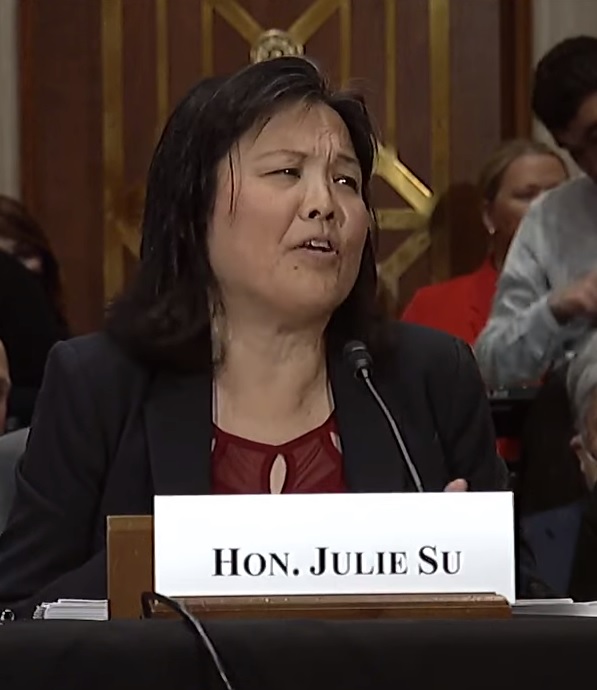
Julie Su — “acting” secretary of the Biden Labor Department due to bipartisan opposition barring her from the agency’s top job — is overseeing an attempt to sneak union boss power into the agricultural sector against Congress’ will.
WASHINGTON, DC – Federal labor policy in the United States provides a smorgasbord of powers to union bosses in the private sector, not the least of which are the powers to impose one-size-fits-all contracts on dissenting workers in a unionized workplace, and to force workers to pay dues in non-Right to Work states.
Traditionally that hasn’t been the case in the agricultural sector, where each state has the freedom to make its own labor policy. But in November 2023, the Biden Department of Labor announced a rule which could upend this balance and effectively impose on temporary agricultural employees portions of federal labor law that are overwhelmingly favorable to union bosses. The National Right to Work Foundation promptly filed comments exposing the slated rule as a Big Labor power grab.
Biden Admin Defies Congress by Granting Union Bosses Power Over Farmworkers
The proposed rule would assist union bosses with imposing monopoly bargaining privileges over temporary agricultural workers in the United States, including workers who don’t support a union. Among other things, the rule requires that employers fork over employee contact information at union bosses’ request — regardless of whether the union has any employee support. The proposed rule would also cajole employers into entering into so-called “neutrality agreements” with union bosses. “Neutrality agreements” typically require employers to censor information about the union and provide other aid to union bosses in their efforts to collectivize workers.
The comments cite multiple reasons as to why the Department of Labor lacks the legal authority to implement the proposed rule, such as the fact that Congress expressly excluded agricultural workers from federal labor statutes.
According to the comments, the Biden Department of Labor admitted in its rulemaking announcement that it is trying to impose parts of the National Labor Relations Act (NLRA) on
the agricultural sector, despite Congress’ intent.
“The Department not only lacks Congressional authorization to take this action, it is defying express Congressional intent to not subject these types of employees to provisions of the NLRA,” the comments state.
Comments: Union Power Grab Won’t Help Workers
The comments also point out that the provisions in the Department of Labor’s rule are unrelated to the rule’s stated purpose of helping agricultural workers avoid exploitation, and rather resemble a list of proposals to empower union officials at workers’ expense.
“The Department fails to explain how allowing unions to access employees’ personal information, to bargain for neutrality agreements, and to prevent employees from accessing information for and against unionization helps to alleviate the concerns identified in the proposed regulations,” the comments argue.
“The Department should not adopt the proposed regulation,” the comments conclude.
The Department of Labor’s notice of rulemaking comes as the Biden Administration is making a full court press to expand union boss legal privileges across the country. That includes the Biden National Labor Relations Board’s (NLRB) plan to wipe out the Foundation-backed Election Protection Rule, which eased the process by which workers could obtain votes to remove unpopular unions from their workplaces. The Biden NLRB seeks to make it more difficult for American private sector workers to exercise their right to remove unwanted unions, while giving union officials more tools to gain power in a workplace without even a vote.
“Despite the Department of Labor’s claims, the true underhanded goal of this rule is clear: handing union bosses more power to corral workers into union ranks, while cutting back on workers’ privacy and rights to resist unwanted unionization,” observed National Right to Work Foundation President Mark Mix.
“Temporary agricultural workers should not be used as pawns to expand union bosses’ sphere of control into the agricultural sector. But that’s exactly what the Biden Department of Labor is attempting in direct contradiction of the choice made by Congress not to subject such workers to federally imposed monopoly unionism.”
Foundation Helps Healthcare Workers Remove Unwanted Unions
The following article is from the National Right to Work Legal Defense Foundation’s bi-monthly Foundation Action Newsletter, September/October 2022 edition. To view other editions of Foundation Action or to sign up for a free subscription, click here.
Evidence of union boss “serious financial malpractice” exposed as workers seek to vote out SEIU

Nurse Brittany Burgess (front, center) led her fellow Mayo Clinic nurses in decertifying the Minnesota Nurses Association (MNA) union. She’s “extremely grateful” for Foundation support.
DETROIT, MI – Workers across America are increasingly fed up with union bosses’ self-serving so-called “representation.” National Right to Work Foundation legal aid requests are spiking from workers seeking assistance in filing decertification petitions to end union monopoly bargaining control in their workplaces. In 2021 alone, Foundation attorneys provided legal assistance in 54 National Labor Relations Board (NLRB) decertification efforts, which together sought to end union boss control of more than 7,000 workers.
This increased demand has continued in 2022, with healthcare workers in particular seeking the Foundation’s legal aid in exercising their legal right to free themselves from union ranks. In one such ongoing case, Foundation staff attorneys assisted Crystal Harper, an employee at Detroit’s Sinai-Grace Hospital, who along with coworkers battled to oust SEIU Healthcare Michigan union officials.
Harper’s initial petition was rejected after an NLRB regional official dubiously dismissed the petition on the grounds that “Midnight, February 8th” in the union monopoly contract was actually unambiguously a reference to the minute after 11:59 p.m. on May 7. This questionable interpretation of union officials’ sloppily written contract meant that the petition filed on the 8th was actually late under the controversial NLRB-created “contract bar” policy.
Undeterred, that decision was appealed and a second petition for a decertification vote was filed in May after the contract bar had expired and a vote was scheduled. Meanwhile, “substantiated allegations of serious financial malpractice” have come to light involving the SEIU local that were so glaring even SEIU International President Mary Kay Henry couldn’t ignore them, as she was pushed to use the SEIU’s “trusteeship” procedures to oust local officials and take full control of the local.
As a result, in June, Foundation President Mark Mix formally asked the Department of Labor and Department of Justice to investigate the serious allegations of financial and other wrongdoing by SEIU local officials. The letter calling for the federal investigation noted that “any internal SEIU International investigation will be insufficient [given the] long history of union officials attempting to ignore or downplay corruption in their own ranks.”
Foundation Counters Union Legal Tricks to Block Vote
Elsewhere in Michigan, lab technicians at Ascension Providence Rochester Hospital have finally won their effort to be free of unwanted so-called “representation” by union officials of the Office and Professional Employees International Union (OPEIU) Local 40.
During the protracted process, Foundation staff attorneys successfully fought off OPEIU union lawyers’ efforts to block the vote which cited the pending sale of the facility by Ascension to LabCorp as grounds for rejecting the workers’ request for an election. Union lawyers had urged the NLRB regional office to block a vote whether to remove the union on the grounds of an upcoming “cessation of operations” by the employer, a policy previously applied only to certification elections.
In briefs to the NLRB, Foundation staff attorneys countered that union attempts to block the vote were unjustified as a matter of law. Foundation attorneys also noted that the attempt to block the vote was likely a cynical attempt to keep power over the bargaining unit. If the sale ultimately went through, the union would have likely sought to block a decertification vote citing the NLRB-created “successor bar” that insulates union officials from decertification votes after a workplace’s change in ownership.
The Board ultimately rejected the union lawyers’ arguments and scheduled a decertification vote by mail-in ballot. However, rather than go forward with a vote they seemingly knew they were going to lose, OPEIU officials instead disclaimed interest in the unit, finally giving the workers the freedom from unwanted union representation they sought.
Meanwhile in Minnesota, multiple groups of healthcare workers are seeking decertification votes with Foundation legal aid. At the Mayo Clinic Health System in Mankato, Minnesota, approximately 500 nurses filed a petition for a vote to remove the Minnesota Nurses Association (MNA) union, while two separate units of Cuyuna of the lawsuit, Regional Medical Center healthcare workers located at facilities in Crosby, Baxter, Longville, and Breezy Point, Minnesota, filed for decertification votes to free themselves from the SEIU.
Hundreds of Minnesota Nurses Petition to Be Union Free
“I’m extremely grateful to have the free legal assistance of the National Right to Work Foundation in fighting for our right to hold a vote to remove the union,” commented Mayo Clinic Mankato nurse Brittany Burgess. “I can’t wait until the day when we are all finally free of the MNA.”
One likely reason for the increased decertification activity is Foundation-advocated reforms that were adopted by the NLRB in 2020 to curtail union officials’ abuse of so-called “blocking charges,” which they use to delay or block workers from exercising their right to decertify a union. However, with the Biden-appointed NLRB majority recently announcing it was starting rulemaking to overturn those reforms, Foundation staff attorneys are now gearing up to challenge the Biden Board’s attempt to give union bosses more power to trap workers in union ranks they oppose.
“Foundation staff attorneys will continue to assist workers in exercising their rights under federal law to hold decertification elections to remove so-called ‘representation’ opposed by most workers,” commented National Right to Work Foundation Vice President and Legal Director Raymond LaJeunesse. “The Biden NLRB is clearly prioritizing union boss power to the detriment of the rights of rank-and-file workers. Look no further than the fact that just as the Board seeks to expand the ability of union officials to impose unionization on workers through coercive ‘Card Checks’ without even secret-ballot votes, it simultaneously plans to make it easier for union lawyers to block workers from holding votes to remove a union.”
General Motors Worker Forces UAW Bosses to Stop Seizing Dues for Politics
Illegal seizures came after multi-billion-dollar Big Labor political spending

A massive UAW embezzlement scandal didn’t stop UAW officials from ignoring at least two attempts by Roger Clemons to exercise his right to stop subsidizing union political activity.
ROCHESTER, NY – Even after a sweeping federal corruption probe that has resulted in jail sentences for at least 12 union executives, it seems some United Auto Workers (UAW) officials haven’t learned their lesson regarding misuse of worker funds.
Rochester General Motors employee Roger Clemons this January won a settlement forcing UAW officials at his plant to stop illegally funneling money from his paycheck into union politics. Clemons filed federal charges in September 2021 against UAW Local 1097 and the UAW’s international branch, after union agents ignored his requests to opt-out of funding the union’s political agenda. He received free legal representation from National Right to Work Foundation staff attorneys.
A Foundation-won settlement required UAW international and local officials to give back to Clemons all money that was deducted from his paycheck in violation of the Foundation-won CWA v. Beck Supreme Court decision. Beck forbids union officials from forcing workers under their control to fund union politics.
Because New York State lacks Right to Work protections for its private sector workers, union officials can legally force workers to pay a reduced amount of union dues under threat of termination. In Right to Work states, union membership and all union financial support are strictly voluntary.
UAW Chiefs Repeatedly Violated Worker’s Beck Rights
Clemons stated in his September 2021 charge against UAW Local 1097 officials that UAW officials had a history of flouting his Beck rights, failing to reduce his union dues even after he ended his union membership and became a “Beck objector” in October 2019. “Only after Mr. Clemons filed an [earlier] unfair labor practice charge . . . did the union comply with the requirements of the law,” the charge noted, detailing that union officials finally sent him rebate checks in June and July 2020 for excess dues they took from his paycheck.
However, UAW officials continued to create obstacles for Mr. Clemons’ Beck rights. The September 2021 charge asserted that despite Clemons renewing his Beck objection in October 2020, he then did not receive “a single rebate check or a reduction in the dues deducted from his wages” for almost a year.
Clemons also charged General Motors for its role in enforcing the illegal dues deductions.
The settlement now forbids UAW officials from “accept[ing] dues or fees which have been deducted from the paycheck of Roger Clemons, or any other Beck objector, which are in excess of the amount we can lawfully charge to Beck objectors.” UAW officials also have returned dues that they seized from Clemons above the reduced Beck amount.
Union officials devote enormous sums to political activity. A report the National Institute for Labor Relations Research (NILRR) released in 2021 revealed that union officials’ own Department of Labor filings show over $2 billion in political spending during the 2020 election cycle, primarily from dues-stocked union general treasuries. Another study found that actual union spending on political and lobbying activities likely topped $12 billion during the 2020 cycle.
Union Bosses Likely to Splash Cash on 2022 Midterm Elections and Beyond
“Rank-and-file workers should know they have a right to refuse to fund union politics, especially with union political spending in 2020 having approached record numbers and midterm elections coming up,” commented National Right to Work Foundation Vice President and Legal Director Raymond LaJeunesse. “Workers under UAW control, like Mr. Clemons, have special reason to be on guard, given the UAW’s perennial interest in politics, and because several UAW officials now find themselves behind bars for embezzlement and corruption.”
Worker Advocate Demands Department of Labor and Department of Justice Investigate Michigan SEIU Local’s “Serious Financial Malpractice”
Michigan hospital workers seek to oust Healthcare Michigan union SEIU International recently put into trusteeship
Detroit, MI (June 6, 2022) – Today, National Right to Work Legal Defense Foundation President Mark Mix formally asked the Department of Labor, the Department of Justice, the U.S. Attorney of Michigan, and the Office of Labor-Management Standards to investigate serious allegations of financial wrongdoing by the Service Employees International Union (SEIU) affiliate Healthcare Michigan (HCMI). Foundation staff attorneys are providing free legal aid to workers at Sinai-Grace Hospital who are seeking a National Labor Relations Board (NLRB) decertification vote whether to remove HCMI officials from their workplace.
About the time the workers filed their second decertification petition to end the union’s so-called “representation” of the bargaining unit, the SEIU International announced it was putting the local into trusteeship due to serious and longstanding wrongdoing by local union officials. In her letter announcing the decision to take over the local, SEIU International President Mary Kay Henry concluded that there are “substantiated allegations of serious financial malpractice” and other issues of impropriety at HCMI.
Citing the SEIU’s trusteeship announcement, the National Right to Work Foundation President demanded that officials at the Department of Justice and Department of Labor also investigate HCMI union officials for illegally abusing their power, committing financial misdeeds, and possibly filing false reports with the Labor Department: “Any internal SEIU International investigation will be insufficient. There is a long history of union officials attempting to ignore or downplay corruption in their own ranks.”
The Sinai-Grace Hospital workers’ first petition seeking a vote to oust HCMI union officials was blocked after the NLRB sided with union lawyers in interpreting ambiguous union contract language to find that petition untimely. The sloppy contract language was negotiated by the union officials whom the SEIU International has now removed from power for, among other things, apparent malfeasance in properly accounting for how they spent workers’ dues money.
Undeterred by that NLRB ruling, the workers filed a second decertification petition after the contract with the vague language expired, again with sufficient number of signatures of Sinai-Grace Hospital employees to trigger the vote. NLRB Region 07 is expected to set dates to begin a decertification vote in the very near future.
“These latest developments show why these workers should not have been blocked in their earlier attempt to have a vote to oust HCMI from their workplace,” commented National Right to Work Foundation President Mark Mix. “Union officials frequently look the other way when confronted with wrongdoing by others within the union hierarchy, so it is telling that even an SEIU International top boss says HCMI officials are unfit to run the local.”
“This situation demonstrates that it is time to end Big Labor’s government-granted power to impose its so-called ‘representation’ on workers who don’t want anything to do with a union,” continued Mix. “Rank-and-file workers should not have to navigate the NLRB’s labyrinth of rules for decertification elections just to escape an unwanted union, and individual workers should be allowed to decide for themselves whether to have a union represent them.”





National Right to Work Foundation Submits Comments Opposing Proposed DOL Rule Loosening Union Financial Disclosures
Comments: Rule will let huge number of unions escape meaningful scrutiny over how union bosses spend worker funds while providing no tangible benefits
Washington, DC (July 31, 2025) – The National Right to Work Foundation has just submitted comments regarding the Office of Labor Management Standards’ (OLMS) proposed rule to significantly reduce financial disclosures union officials are required to file with the Department of Labor. The comments warn that the slated rule will deprive millions of rank-and-file workers of vital information on how union officials spend their dues payments, especially spending on union political and ideological activities.
Current financial disclosure rules for unions mandate that unions with $250,000 or more in annual receipts file an LM-2 report with the Department of Labor, while unions with less revenue must only submit less-detailed LM-3 or LM-4 reports, both of which consist of only a few pages. The OLMS’ proposed rule would eliminate the requirement to turn in an LM-2 for all unions except those with $450,000 or more in annual receipts, meaning a large number of unions currently subject to LM-2 reporting would only be required to provide substantially less-comprehensive filings.
“The ‘cost’ of the proposed rule—the information that workers and others will no longer be able to learn about unions—is considerable,” the comments say. “The rule’s ostensible ‘benefit’—reducing union reporting burdens—is not supported by evidence and is insignificant…The costs of the proposed rule greatly outweigh its nonexistent benefits.”
New Rule Will Block Millions of Workers From Seeing Basic Details About Union Spending
The comments emphasize the wide impact of the proposed rule, especially among those who work in states that lack Right to Work protections and for that reason can be forced to pay union dues or fees just to keep their jobs. “OLMS data for the past year…shows over 7,700 filings from unions with receipts under $450,000 that are located in states that lack Right to Work laws,” the comments say. “These unions reported combined annual receipts of over $523 million, annual disbursements of over $514 million, and over 4 million members.
“The lack of more detailed reporting requirements for these unions therefore harms over 4 million workers by denying them meaningful details” regarding how union officials spend their hard-earned money, the comments explain.
Much of this omitted information will include details on how much money union officials spend on overhead and administration as opposed to representational activities in the workplace, not to mention what union bosses are contributing to often-divisive political causes. While LM-2 forms let workers quickly see these figures, the comments say, “[t]he proposed rule will deprive workers of this information about many unions because the LM-3 does not include these reporting categories.”
Knowing less about union political spending will also impede workers’ ability to enforce their rights under the Foundation-won Communications Workers of America v. Beck Supreme Court decision, the comments point out. Beck blocks union bosses from forcing nonmember workers under their control to pay for union ideological expenses or anything unrelated to representational activities. The comments point to contributions disclosed on LM-2s to groups such as ActBlue, Black Lives Matter, and the Democratic National Committee that would no longer be disclosed to workers if the proposed rule were implemented.
Comments Debunk Union ‘Burden’ Arguments Cited by OLMS
The comments also reveal that the main impetus OLMS cites for pushing this proposed rule – that the regulatory burden for unions is too large – has very little evidence to support it. An estimate that OLMS put out about the number of hours that the proposed requirements would save unions is “out of date, fails to account for modern…software, and is not even an estimate of the time it takes impacted unions to complete LM-2 reports, but rather is an estimate of the average time it takes all unions to complete LM-2 reports,” the comments say.
The comments conclude by asking OLMS to eliminate the current system of graduated filing thresholds and instead require all unions to file LM-2 reports. “The benefit of this change is self-evident: workers, the public, and the Department will receive more information about union finances, which in turn will lead to more informed workers and deter and uncover more union corruption,” the comments explain.
“America’s top union bosses are routinely caught abusing the funds they demand from millions of workers across the country, all while promoting divisive and often radical political causes at every level of government,” commented National Right to Work Foundation President Mark Mix. “Acting in the best interests of workers means providing more clarity on how employee money is spent, not less.
“Make no mistake: The OLMS’ proposed rule will benefit union bosses at the expense of rank-and-file workers. Every worker deserves to know the basic details of how their money is being spent by those who claim to ‘represent them,’ and the slated rule would deprive millions of workers of what little information they already have,” Mix added.