
NY Starbucks Baristas File Amicus Brief Opposing Reinstatement of Biden-Appointed NLRB Member Removed by President Trump
Starbucks employees have pending federal lawsuit challenging NLRB structure as unconstitutional, argue they could be harmed if member’s removal is blocked
Washington, DC (March 11, 2025) – The National Right to Work Foundation has just filed an amicus brief at the District of Columbia Circuit Court of Appeals for two upstate New York Starbucks baristas in a federal case that could determine the constitutionality of the structure of the National Labor Relations Board (NLRB).
The case, Wilcox v. Trump, concerns whether President Trump properly exercised his executive authority when he removed the Biden-appointed former chair of the NLRB, Gwynne Wilcox. Trump Administration lawyers argue, as baristas Ariana Cortes and Logan Karam have in their own pending lawsuit at the D.C. Circuit Court of Appeals, that the National Labor Relations Act (NLRA, the federal law authorizing the NLRB) violates the Constitution because it prevents the president from removing board members.
Cortes and Karam now join the Administration’s legal team in asking the D.C. Circuit Court to stay a lower court’s ruling that Wilcox be reinstated. Their brief notes that they, and others, could be directly harmed if Wilcox participates in an NLRB decision without being properly accountable to the President.
Cortes and Karam work at two separate Starbucks locations in the Buffalo, NY area. They both submitted petitions on behalf of their coworkers in 2023 with sufficient support to prompt the NLRB to hold votes to “decertify,” or remove, the Starbucks Workers United (SBWU) union from each of their stores. However, NLRB officials indefinitely delayed those union decertification elections on the basis of unproven charges leveled at the Starbucks Corporation by SBWU union officials. This led Cortes and Karam to file their own federal lawsuit – the first in the nation challenging the agency’s structure as unconstitutional as a whole.
The same issue regarding the NLRB’s constitutionality was fast-tracked in federal courts following President Trump’s firing of Biden-appointed NLRB Board Member Gwynne Wilcox, which she challenged as a violation of the NLRA’s board member removal protections. Trump Administration lawyers countered with arguments parallel to those in Cortes and Karam’s lawsuit, contending that NLRB members’ removal protections permit them to exercise substantial executive authority while being immune to presidential removal for the duration of their terms, something forbidden by U.S. Supreme Court decisions like Seila Law v. CFPB and Collins v. Yellen.
NLRB’s Hyper-Partisan Nature and Unique Powers Make Removal Protections Inappropriate
Cortes and Karam’s brief focuses on how the Board’s powers to enforce federal labor law, lack of technical expertise, and the partisan nature of its membership place it outside the Supreme Court’s concept of a federal agency where removal protections might be appropriate. It also argues that reinstating Wilcox would cause chaos because it would let her participate in deciding cases before the NLRB while her continued presence on the Board is still the subject of litigation.
“Cortes and Karam have a vital interest in the outcome of this case, and not only because it concerns the constitutionality of [NLRB member removal protections],” the amicus brief says. “Cortes and Karam do not want an individual the President properly removed from the Board because of her unsound rulings—Gwynne Wilcox—to decide their pending NLRB cases.”
“Ms. Cortes and Mr. Karam’s amicus brief points out what many workers who have litigated cases before the NLRB have learned the hard way – that the NLRB is a hyper-partisan agency often beholden to the interests of union bosses, yet masquerades as an impartial arbiter of workers’ rights,” commented National Right to Work Legal Defense Foundation President Mark Mix. “While the issue of the NLRB’s constitutionality is likely to ultimately end up before the Supreme Court, Ms. Cortes and Mr. Karam speak for many independent-minded workers around the country by urging the D.C. Circuit Court to bar Gwynne Wilcox from participating in Board decisions until this is fully sorted out.”
Professors Launch Landmark SCOTUS Bid to End Forced Union Association
The following article is from the National Right to Work Legal Defense Foundation’s bi-monthly Foundation Action Newsletter, September/October 2024 edition. To view other editions of Foundation Action or to sign up for a free subscription, click here.
NY law unconstitutionally forces professors under “representation” of anti-Semitic union
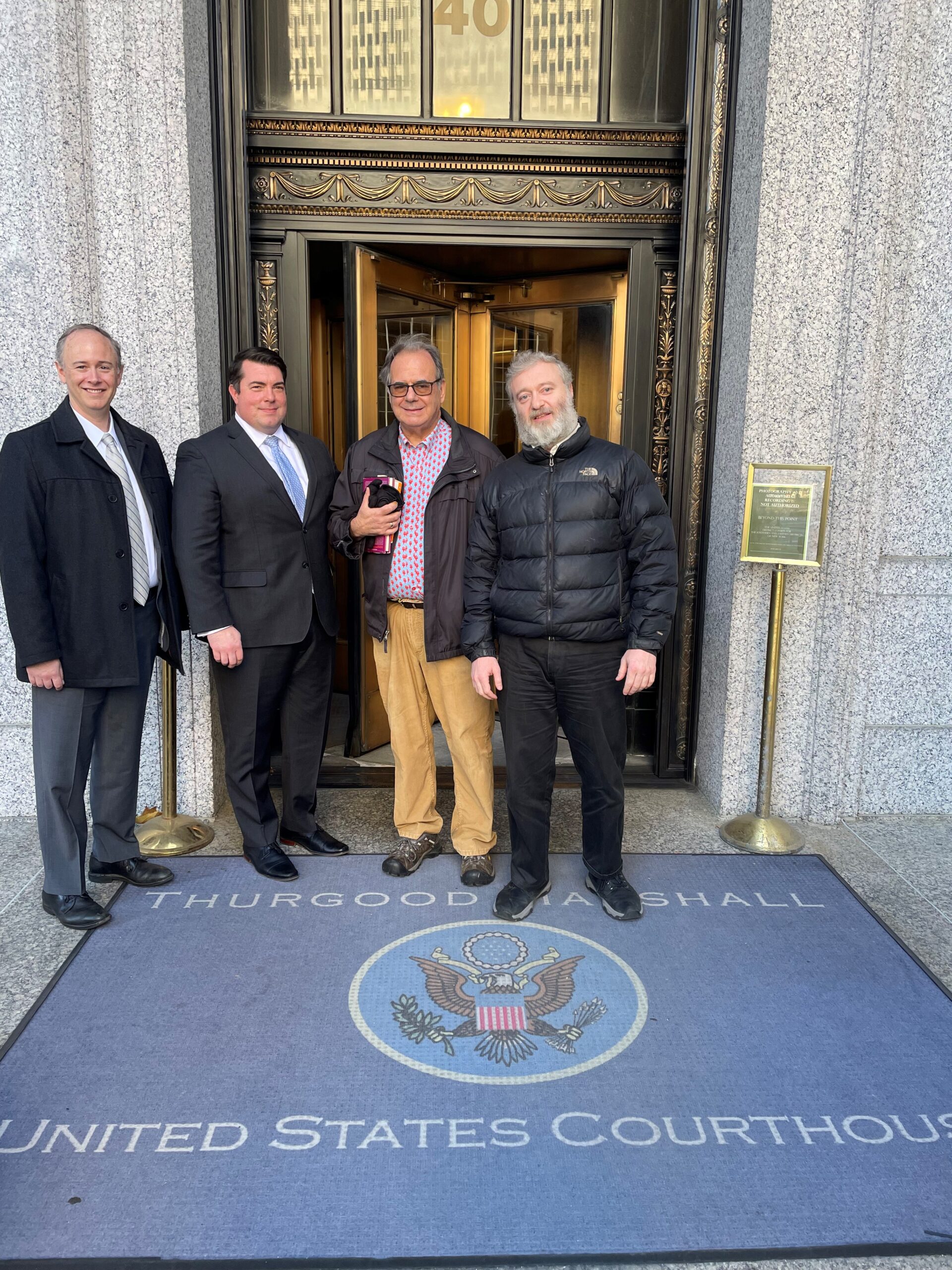
Together, (from left) Foundation Legal Director William Messenger, Fairness Center General Counsel Nathan McGrath, and CUNY Professors Mitchell Langbert and Avraham Goldstein seek to establish new protections against forced union association.
WASHINGTON, DC – Avraham Goldstein, a mathematics professor at the City University of New York (CUNY), wrote in a 2022 Wall Street Journal op-ed about the predicament that he and many of his Jewish colleagues face because New York law forces them under the “representation” of an anti-Israel union: “I had paid thousands of dollars in union dues for workplace representation, not for political statements or attacks on my beliefs and identity. I decided to resign my union membership and naively thought I could leave the union and its politics behind for good . . . I was wrong.”
It was this situation that led Avraham Goldstein, along with fellow professors Michael Goldstein, Frimette Kass-Shraibman, Mitchell Langbert, Jeffrey Lax, and Maria Pagano, to file a federal lawsuit against the Professional Staff Congress (PSC) union, CUNY, and State of New York officials in 2022. That lawsuit challenged New York State’s “Taylor Law,” which grants union bosses monopoly bargaining power in the public sector. Such power permits union bosses to speak and contract for public workers — including those that want nothing to do with the union.
Professors’ Petition: First Amendment Protects Union Dissenters
Staff attorneys from the National Right to Work Foundation and The Fairness Center have litigated the professors’ case up through the federal court system. Now they’re asking the U.S. Supreme Court to take their case and clarify that the First Amendment forbids union officials from foisting their voice and values on public sector workers who oppose the union.
“The core issue in this case is straightforward: can the government force Jewish professors to accept the representation of an advocacy group they rightly consider to be anti-Semitic? The answer plainly should be ‘no,’” the petition begins.
The High Court has recognized for decades how public sector monopoly bargaining burdens workers’ First Amendment freedom of association rights. In 1944, the Supreme Court’s decision in Steele v. Louisville & Nashville Railway Co. recognized how rail union bosses were manipulating their powers over the workplace to discriminate against African-American railway workers. The Supreme Court restated its concerns most recently in the 2018 Foundation-won Janus v. AFSCME decision, with the majority calling monopoly bargaining “a significant impingement on associational freedoms.”
Original Complaint Detailed Union Bosses’ Discrimination
The professors’ original complaint, filed in the U.S. District Court for the Southern District of New York, recounted that several of the professors chose to dissociate from PSC based on a host of discriminatory actions perpetrated by union agents and adherents — including a June 2021 union resolution that the professors viewed as “anti-Semitic, anti-Jewish, and anti-Israel.”
The complaint said Prof. Michael Goldstein “experienced anti-Semitic and anti-Zionist attacks from members of PSC, including what he sees as bullying, harassment, destruction of property, calls for him to be fired, organization of student attacks against him, and threats against him and his family.” Goldstein has needed a guard to accompany him on campus, the complaint noted.
Prof. Lax, the complaint explained, already received in a separate case a letter of determination from the Equal Employment Opportunity Commission (EEOC) “that CUNY and PSC leaders discriminated against him, retaliated against him, and subjected him to a hostile work environment on the basis of religion.” As their petition at the Supreme Court notes, these conflicts have significantly increased since the events of October 7.
Professors Could Create Groundbreaking Precedent
The petition asks the Supreme Court to take up the case and stop CUNY and the State of New York from letting PSC union bosses impose their “representation” on the professors.
“New York’s legal scheme forces these CUNY professors to associate with union officials who insult their identity and create a work environment rife with bullying and harassment. It’s hard to think of a more obvious violation of the First Amendment,” commented National Right to Work Foundation President Mark Mix. “It’s high time that the Justices finally acknowledge the First Amendment protects government employees from being forced to accept political ‘representation’ they adamantly oppose.”
Long Beach Worker Files Federal Lawsuit Challenging Structure of Biden Labor Board as Unconstitutional
New lawsuit challenges that National Labor Relations Board’s structure unconstitutionally shields both board members and judges from accountability
Washington, DC (August 22, 2024) – Nelson Medina, a Long Beach, CA-based employee of transportation company Savage Services, has just filed a federal lawsuit against the National Labor Relations Board (NLRB) challenging the Board’s makeup as unconstitutional. Medina, who is represented for free by National Right to Work Foundation staff attorneys, argues that the composition of the NLRB violates separation of powers doctrines enshrined in Article II of the U.S. Constitution because it shields NLRB bureaucrats from being removed by the President.
Medina’s case now joins three other constitutional challenges to the NLRB’s structure from Foundation-backed rank-and-file workers, including the first ever such lawsuit which Foundation attorneys filed on behalf of Buffalo, NY-based Starbucks employees Ariana Cortes and Logan Karam.
Medina’s lawsuit points to recent Supreme Court rulings, including Seila Law LLC v. CFPB and Collins v. Yellen, which emphasized that the President should have direct authority to remove executive officials who exercise significant authority. Medina argues that the NLRB’s structure, as defined by the National Labor Relations Act (NLRA), places unlawful limitations on the President’s power to oust NLRB officials even though they exercise significant executive authority.
The complaint, filed in the U.S. District Court for the District of Columbia, joins a similar suit at the same court from Medina’s colleague, Victor Avila. Both Avila’s and Medina’s lawsuits stem from unfair labor practice charges they each filed with Foundation aid against Teamsters union officials in their workplace, which dealt with illegal threats of violence against workers for not supporting the union and unlawful demands for dues payment, respectively. Both Avila and Medina argue they are entitled to have their cases heard by Board officials whose appointment complies with the requirements of the U.S. Constitution.
Challenge to Constitutionality of Federal Labor Board Targets Board Members and Administrative Law Judges
Medina’s lawsuit is unique in that it contests the NLRB’s removal protections on both Board members and Administrative Law Judges (ALJs). The suit argues that Board members exercise significant executive branch authority, yet are unconstitutionally protected from at-will presidential removal. ALJs, the suit argues, are subject to a removal process controlled by multiple layers of federal bureaucrats whom the President can’t remove at will, a structure prohibited by the Free Enterprise Fund v. PCAOB Supreme Court decision.
Board members are responsible for both creating NLRB policy and reviewing federal labor cases decided by regional NLRB offices, while ALJs conduct hearings in cases where the NLRB has chosen to prosecute a union or employer for violating the law.
Similar Lawsuits Crop Up Among Workers Nationwide
Beyond Savage Services, Foundation-backed Starbucks employees are also pursuing cases challenging the constitutionality of the structure of the NLRB. These employees have attempted to hold decertification votes to remove unwanted Starbucks Workers United (SBWU) union officials from their workplace, but NLRB officials blocked their cases based on unproven union allegations of employer meddling.
Ariana Cortes and Logan Karam, two Starbucks employees from New York, recently filed an appeal to the D.C. Circuit Court of Appeals in their lawsuit. They are appealing a District Court judge’s ruling that they lacked standing to bring their challenge. The ruling didn’t address the core constitutional arguments their lawsuit raised. Another Starbucks employee, Reed Busler, filed another similar lawsuit that is currently pending in the District Court for the Northern District of Texas.
“For too long, independent-minded employees who challenge union boss coercion that violates federal law have had to pursue their claims with unaccountable NLRB bureaucrats who exercise power in violation of the Constitution,” said National Right to Work Foundation President Mark Mix. “The National Labor Relations Board should not be a union boss-friendly kangaroo court run by powerful bureaucrats who exercise unaccountable power in violation of the Constitution, yet for too many workers, including those bringing these legal challenges, that is what the Labor Board has become.”
Foundation: Under Janus, Union Boss “Release Time” Violates AZ Constitution
The following article is from the National Right to Work Legal Defense Foundation’s bi-monthly Foundation Action Newsletter, March/April 2024 edition. To view other editions of Foundation Action or to sign up for a free subscription, click here.
So-called “official time” scheme puts tax dollars toward union politics, says Foundation brief
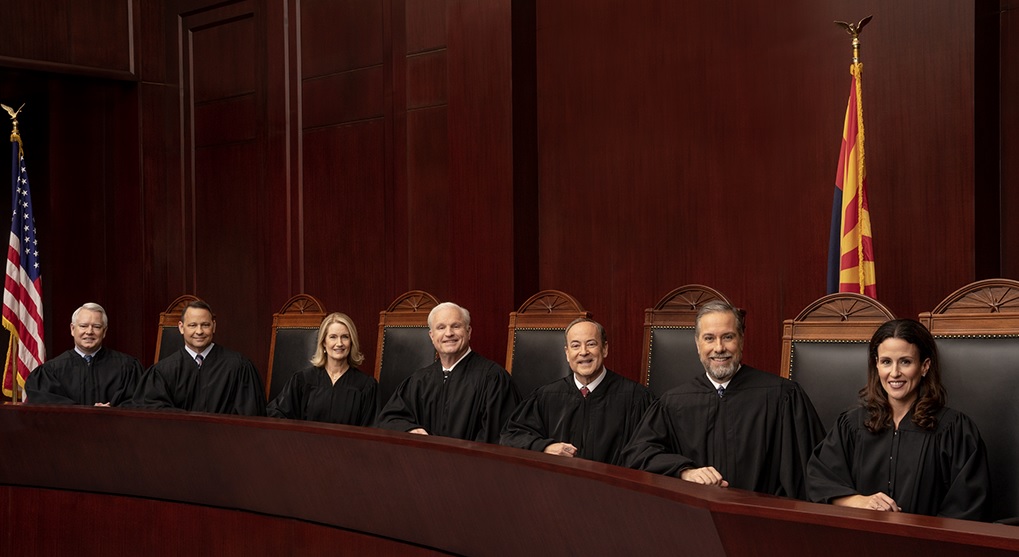
Foundation attorneys argue before the Arizona Supreme Court (above) and Texas Supreme Court that Janus’ ban on forcing public workers to fund union activities shows why state constitutions forbid the same coercion applied to taxpayers.
PHOENIX, AZ – The National Right to Work Foundation-won Janus v. AFSCME Supreme Court decision provided massive new protections for American public employees’ free association rights. In 2018, the Court recognized for the first time that forcing a public employee to pay union dues just to keep his or her job is a First Amendment violation.
The Janus decision, buoyed by National Right to Work Foundation follow-up enforcement actions, means today well over half a million public employees are free of mandatory union payments. Yet, the implications of Janus go even beyond the billions of dollars in previously mandatory dues payments that union bosses can no longer force workers to pay.
Underpinning the Janus ruling was Foundation attorneys’ core argument that all public sector union activities involve influencing the government, and are therefore inherently political speech. Because of this, Foundation staff attorneys now argue that applying Janus to the practice known as union “official time” or “release time” — where government union officials are paid tax money to conduct union business instead of government work — shows how the scheme violates multiple state constitutions.
Foundation Attorneys Bring Janus Expertise to Public Employee Lawsuit
In Arizona for example, Phoenix city employees Mark Gilmore and Mark Harder sued Phoenix mayor Kate Gallego in 2023 for engaging in a scheme that redirects taxpayer funds intended for public employees’ compensation toward political advocacy conducted by American Federation of State, County and Municipal Employees (AFSCME) Field II agents.
That case, Gilmore v. Gallego, is now before the Arizona Supreme Court, where Foundation attorneys filed a legal brief arguing that this so-called “release time” scheme violates Arizona’s Gift Clause, which forbids the government from paying out benefits to private parties that serve no public purpose.
The brief points out that, in Janus, the Supreme Court found that all government union bargaining is a form of lobbying designed to influence public policy for the benefit of the union. That means taxpayer subsidies of such union activities inherently violate the Arizona Constitution’s Gift Clause.
Phoenix’s Arrangement Pays Union Bosses to Lobby City
Phoenix’s “release time” scheme funnels taxpayer money into four full-time positions for union officials for the purpose of conducting union business, creates a bank of over 3,000 paid hours to be used by other union official employees for union purposes, and provides multiple other perks for union agents.
The policies unions lobby for “often are matters of substantial public concern, such as how much money the government expends on wages and benefits,” the Foundation’s brief reads. With its release time policy, the City is effectively paying individuals to lobby the City for a private advocacy organization and its members. The notion that this political advocacy serves a public purpose is untenable.”
Foundation attorneys are backing a similar lawsuit at the Texas Supreme Court. In Roger Borgelt v. City of Austin, Texas taxpayers are fighting a scheme that City of Austin officials are using to direct taxpayer dollars to Austin Firefighters Association union officials to conduct union business.
“Union bosses, who will often screech about ‘corporate welfare,’ are more than happy to arrange so-called ‘release time’ schemes in which taxpayer dollars are funneled toward supporting their massive lobbying efforts,” stated National Right to Work Foundation Vice President and Legal Director William Messenger. “Janus made it plain and simple that compelling public sector employees to fund union activities constitutes forced political speech, and courts everywhere have an obligation to declare such compulsion illegal when foisted on taxpayers.”
Foundation Lawsuit: Biden NLRB Structure Violates the U.S. Constitution
The following article is from the National Right to Work Legal Defense Foundation’s bi-monthly Foundation Action Newsletter, November/December 2023 edition. To view other editions of Foundation Action or to sign up for a free subscription, click here.
Groundbreaking suit filed for Starbucks employee who was denied vote to oust unwanted union bosses
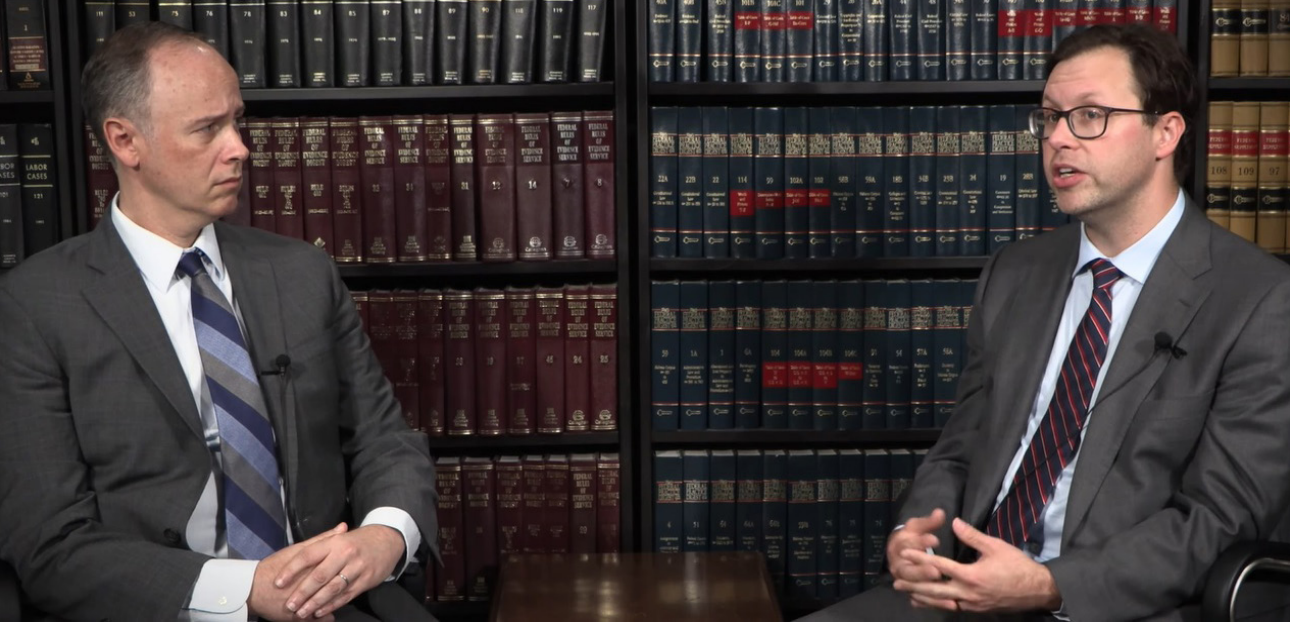
Starbucks employee Ariana Cortes’ Foundation attorney, Aaron Solem (right), is making a cutting-edge argument targeting the NLRB’s lack of accountability.
WASHINGTON, DC – The National Labor Relations Board (NLRB) is supposed to protect the right of workers to freely choose whether to associate with a union or not. The NLRB is also charged with holding unions and employers accountable when they violate worker rights. Too often, however, it has simply acted as an agency that generates policies to entrench union bosses’ power over workers while shielding union bosses from any kind of liability.
A new federal lawsuit from a National Right to Work Foundation-backed Starbucks employee, currently pending at the D.C. District Court, could upend the federal agency and result in a ruling that the current Labor Board’s structure violates the Constitution.
Employee Challenges NLRB Bureaucrats’ Protections from Presidential Removal
Ariana Cortes, a worker at the Buffalo, NY, “Del-Chip” Starbucks branch, hit the NLRB with the groundbreaking lawsuit in October, contending that the federal agency’s current structure violates the separation of powers mandated by the Constitution.
Cortes’ suit follows Foundation attorneys’ defense of her and her coworkers’ petition requesting a vote to remove Starbucks Workers United (SBWU) union officials from their workplace. Regional NLRB officials dismissed Cortes’ majority-backed petition based on SBWU allegations against Starbucks management that have no proven connection to Cortes and her coworkers’ desire for a union decertification vote.
Cortes’ lawsuit argues that because NLRB members cannot be removed at-will by the President, the NLRB’s structure violates Article II of the Constitution. Under Article II, the lawsuit contends, the President must have the power to remove officials that exercise substantial executive power.
Because the NLRB enforces federal labor law, manages union elections, and can issue legally binding rules and regulations, the lawsuit contends that the agency exercises substantial executive power. Therefore, it falls within the scope of the President’s power to remove officials at will. However, the National Labor Relations Act (NLRA), the law that established the NLRB, restricts the President’s ability to remove Board members except for neglect of duty or malfeasance.
“[T]hese restrictions are impermissible limitations on the President’s ability to remove Board members and violate the Constitution’s separation of powers. Thus, the Board, as currently constituted, is unconstitutional,” the complaint states.
Lawsuit: Unconstitutional NLRB Proceedings Must Stop
Cortes’ new federal lawsuit seeks a declaration from the District Court that the structure of the NLRB as it currently exists is unconstitutional.
“For too long the NLRB, especially the current Board, has operated as a union boss-friendly kangaroo court, complete with powerful bureaucrats who exercise unaccountable power in violation of the Constitution,” commented National Right to Work Foundation Vice President and Legal Director William Messenger. “The NLRB’s operation outside constitutional norms is easily exploited by Big Labor.”
“But as the story of Ms. Cortes shows, the NLRB’s unchecked power creates real harms for workers’ rights, especially when workers seek to free themselves from the control of union bosses they disagree with,” Messenger added.
Texas Starbucks Employee Challenges Federal Labor Board Structure as Unconstitutional in New Federal Lawsuit
Regional NLRB blocked employee and his coworkers from voting out union, new lawsuit now second pending worker-backed challenge to agency’s authority
Fort Worth, TX (January 24, 2024) – Reed Busler, an employee at the “Military Highway” Starbucks in Shavano Park, TX, is hitting the National Labor Relations Board (NLRB) with a federal lawsuit arguing the federal agency’s structure violates the separation of powers. The lawsuit, filed in the U.S. District Court for the Northern District of Texas, argues that the agency violates Article II of the Constitution by insulating NLRB Board Members from at-will removal by the President.
Busler’s lawsuit stems from an NLRB Regional Director’s dismissal of a petition he filed on behalf of his coworkers seeking an election to remove the Starbucks Workers United (SBWU) union from power at the coffee shop. Busler is receiving free legal aid in both proceedings from National Right to Work Legal Defense Foundation staff attorneys.
The National Labor Relations Act (NLRA), the law that established the NLRB, restricts a president’s ability to remove Board members except for neglect of duty or malfeasance. Busler’s complaint contends that these restraints violate “the fundamental separation of powers principle that the President must be free to remove executive officers at will,” as dictated by Supreme Court cases like Seila Law LLC v. CFPB (2020) and Collins v. Yellen (2021).
“Board Members are principal officers wielding substantial executive power. This includes the power to promulgate binding rules, to enforce the law through adjudicating unfair labor practice disputes and issuing remedies, to issue subpoenas, and to enforce the law through adjudicating representation proceedings,” reads the complaint. “By adjudicating Busler’s petition notwithstanding its unconstitutional structure, the Board is violating his right to have his petition adjudicated by politically accountable officials.”
Regional NLRB Trapped Workers in Union Despite Reports of Abrasive Behavior
Busler submitted his union decertification petition on November 16, 2023. The petition contained signatures from enough of his coworkers to trigger a vote to remove the union under NLRB rules. However, the NLRB Regional Director still blocked the vote based on unfair labor practice charges SBWU union officials filed against Starbucks, despite there being no proven connection between those allegations and Busler’s decertification petition.
The NLRB’s refusal to hold a union decertification vote means that Busler and his coworkers are still trapped under the “representation” of the SBWU union, despite numerous reports of SBWU agents’ combative and abrasive behavior at the store. In other filings in the NLRB case, Busler and his colleagues reported that SBWU officials ordered a divisive strike in which “[union] supporters outside the store were loud, boisterous, and were screaming at customers” and “would sometimes yell at other employees or tell partners that if they did not support Workers United they would be personally ostracized by other partners.”
“Moreover, I believe the other employees who signed my decertification petition did not do so because they were coerced or duped by anything Starbucks allegedly did wrong, but because the Union was a divisive force in our store and has now ignored our location for several months,” Busler stated in an NLRB filing.
Lawsuit Seeks to Stop NLRB from Exercising Unconstitutional Power Over Workers’ Case
Busler’s federal lawsuit seeks a declaration from the District Court that the structure of the NLRB as it currently exists is unconstitutional, and an injunction halting the NLRB from proceeding with his decertification case until his federal lawsuit is resolved. Busler now joins Buffalo, NY-based Starbucks worker Ariana Cortes in challenging the structure of the NLRB with free Foundation legal aid.
“The National Labor Relations Board should not be a union boss-friendly kangaroo court run by powerful bureaucrats who exercise unaccountable power in violation of the Constitution,” commented National Right to Work Foundation President Mark Mix. “Mr. Busler seeks to remove a union he and his colleagues oppose, and he is entitled to pursue that statutory right before an agency whose structure complies with the Constitution.”
Buffalo Starbucks Worker Files Groundbreaking Lawsuit Challenging Constitutionality of NLRB Structure
Regional NLRB blocked employee and her coworkers from voting out union majority disapproved of, new lawsuit challenges agency’s authority
Buffalo, NY (October 4, 2023) – Buffalo “Del-Chip” Starbucks employee Ariana Cortes has hit the National Labor Relations Board (NLRB) with a federal lawsuit, arguing that the federal agency’s current structure violates the separation of powers. The lawsuit, filed with the District Court for the District of Columbia, follows Cortes’ challenge to an NLRB Regional Director’s dismissal of her and her coworkers’ petition seeking a vote to remove Starbucks Workers United (SBWU) union officials from their store.
Cortes is receiving free legal aid in both proceedings from the National Right to Work Legal Defense Foundation. The lawsuit contends that, because NLRB Board Members cannot be removed at-will by the President, the NLRB’s structure violates Article II of the Constitution.
The National Labor Relations Act (NLRA), the law which established the Board, restricts a president’s ability to remove Board members except for neglect of duty or malfeasance. The complaint argues that “[t]hese restrictions are impermissible limitations on the President’s ability to remove Board members and violates the Constitution’s separation of powers. Thus, the Board, as currently constituted, is unconstitutional.”
“The Supreme Court made clear in Seila Law LLC v. CFPB, 140 S. Ct. 2183 (2020) and Collins v. Yellen, 141 S. Ct. 1761 (2021) that under Article II of the Constitution, the President must be able to remove federal officials who exercise substantial executive power,” the complaint states. “The five-member NLRB exercises substantial executive power because it issues binding rules, adjudicates unfair labor practices and representation disputes, issues subpoenas, and decides whether and how to direct and conduct elections in representation cases.”
Regional NLRB Dismisses Starbucks Employees’ Request to Vote Out Union
On April 28, Cortes filed a petition, backed by the majority of her coworkers, that requests the NLRB conduct a decertification election at her workplace to end the monopoly bargaining power of SBWU union officials. NLRB Region 3 dismissed Cortes’ petition based on unfair labor practice charges SBWU union officials filed against Starbucks, despite there being no proven connection between those allegations and the decertification petition.
Cortes’ Foundation-provided attorneys filed a Request for Review with the Board challenging this dismissal order. That appeal contrasted the standard the NLRB often applies to petitions to certify unions, which usually proceed with little to no delay, with the standard the NLRB applies to petitions to decertify unions, which are often hamstrung and delayed.
New Federal Lawsuit Seeks to Temporarily Enjoin Unconstitutional Proceedings
Cortes’ new federal lawsuit seeks a declaration from the District Court that the structure of the NLRB as it currently exists is unconstitutional, and an injunction halting the NLRB from proceeding with her decertification case until her federal lawsuit is resolved.
“For too long the NLRB, especially the current Board, has operated as a union boss-friendly kangaroo court, complete with powerful bureaucrats who exercise unaccountable power in violation of the Constitution,” commented National Right to Work Foundation President Mark Mix. “As the story of Ms. Cortes shows, the NLRB’s unchecked power creates real harms for workers’ rights, especially when workers seek to free themselves from the control of union bosses they disagree with.”
Featured Article: “The Future Looks Bright for the Right to Work Movement”
The Regulatory Review has ranked the essay entitled “The Future Looks Bright for the Right to Work Movement” by National Right to Work Foundation Vice President and Legal Director Raymond J. LaJeunesse, Jr. as one of the publication’s top essays in 2019.
The essay highlights successes in the ongoing fight against forced unionism through legal and legislative reform:
Thomas Jefferson famously said that it is “sinful and tyrannical” for government “to compel a man to furnish contributions of money for the propagation of opinions which he disbelieves and abhors.” That principle is consistent with the guarantees of freedom of speech and association enshrined in the U.S. Constitution’s First Amendment. Yet, some federal and state labor laws in this country have long authorized requirements that workers pay union dues as a condition of employment, requirements known as the “union shop” or “agency shop.” Increasingly, however, legislatures and courts are recognizing that workers have a constitutional right to work without being forced to subsidize a union.
Among recent achievements for the Right to Work movement are five new state Right to Work laws passed since 2012 and the landmark Foundation-won Janus v. AFSCME Supreme Court decision in June 2018.
The complete essay is available to read online here.





