
Employee Advocate Issues Legal Notice After Labor Board Fast-Tracks Union Control Over Workers Without Secret Ballot Votes
“Employees who are the targets of union organizing campaigns, and who do not want to be subject to monopoly union representation, must be vigilant about their rights after Cemex.”
Washington, DC (October 6, 2023) – The National Right to Work Legal Defense Foundation has released a special legal notice informing workers across the country about the National Labor Relations Board’s (NLRB) significant rollback of workers’ right to vote in secret ballot elections to determine whether or not to unionize. The Biden NLRB’s August ruling in the Cemex Construction Materials Pacific case effectively mandates the “card check” method of union installation, which lets union officials seize power in a workplace without winning an election, or even after workers vote against union affiliation in a secret ballot vote.
“Employees who are the targets of union organizing campaigns, and who do not want to be subject to monopoly union representation, must be vigilant about their rights after Cemex,” the notice warns. “Under Cemex, unions can impose their mandatory representation on employees quickly and without employees being able to vote on whether they want union representation.”
The card check process is a union organizing tactic in which a union becomes the monopoly representative of all employees in a unit—including employees who want nothing to do with the union—by collecting union authorization cards directly from a majority of workers. The lack of privacy during a card check exposes workers to coercive tactics from union officials, including misinformation about the true purpose of the cards or threats made against workers who refuse to sign.
The notice emphasizes that the Cemex ruling forces employers to make a decision after union bosses simply claim majority support that will often result in the union gaining power without a worker vote. Under Cemex, if a union claims a majority of workers signed union cards, within two weeks the employer must either “[r]ecognize the union as the monopoly representative of its employees without allowing employees to vote,” or petition the board to hold an election – though the NLRB can strip workers of their right to vote under this option if it believes the employer has committed an unfair labor practice, even if the employees themselves have done nothing wrong.
The full notice is available at: www.nrtw.org/Cemex
Workers Have Right to Campaign Against Unwanted Unions and Can Refuse to Sign Union Cards
The notice explains that all employees have the right to refuse to sign a union authorization card, and to revoke any union authorization card they previously signed. It also reminds workers that “it is a good practice to inform both the union and your employer in writing that you revoked the card so that the union and your employer do not wrongfully count you as a supporter of union representation during a card check.”
Workers also have the right to “sign and circulate cards or petitions against union representation, on non-work time and in non-work areas,” the notice states. Such petitions or cards can be used later to request the NLRB hold an election at the workplace to remove (or “decertify”) the union, and can also be provided to the employer as evidence to contest union claims of majority support.
The notice provides links to sample letters revoking union authorization cards and sample union decertification petitions. “If you have questions about your rights during a union organizing campaign, you can contact Foundation staff attorneys for more information and assistance with exercising your rights,” the notice concludes.
“Not that long ago, bipartisan opposition in Congress blocked legislation to mandate coercive card check unionization. In an unprecedented move, the Biden NLRB is bypassing Congress to mandate this abuse-prone process all on its own by federal fiat,” commented National Right to Work Foundation President Mark Mix. “Make no mistake, this is not about the rights or freedom of rank-and-file workers, but empowering union bosses to the detriment of regular workers and their freedom of choice.”
“While this is a significant blow to the rights of independent-minded workers, they still have options to oppose unwanted union representation. It’s vital that they know those rights going into this new legal landscape, and National Right to Work Foundation staff attorneys stand ready to defend their rights,” added Mix. “Foundation staff attorneys have a long history of helping employees challenge union card check schemes, and workers should not hesitate to contact the Foundation for free legal aid if they believe union organizers are attempting to use Cemex to impose a union in their workplace.”
Passaic, NJ, Woodworking Employees Win Two-Year Legal Battle to Oust Unwanted Carpenters Union Officials
Patella employees’ ordeal shows how union officials trap workers in unions they oppose, yet Biden NLRB is moving to make union decertification even harder
Passaic, NJ (September 8, 2023) – Following the third attempt by employees of Passaic-based woodworking firm Patella to obtain a vote to remove them, Carpenters Local 252 union officials have backed down and abandoned the facility. The union’s disclaimer of interest, received last week by National Labor Relations Board (NLRB) Region 22, caps off a years-long legal battle between Patella employees and recalcitrant Carpenters union officials. The workers ousted the union with free legal aid from staff attorneys at the National Right to Work Legal Defense Foundation.
Patella employee Steve Urso led the effort to vote out the union, which began in July 2021 with the filing of a petition requesting an NLRB-administered vote to decertify the Carpenters union. Union officials used unverified allegations of employer misconduct, also known as “blocking charges,” to derail attempts by Urso and his colleagues to oust the union. Urso filed the most recent decertification petition near the end of August 2023, and instead of seeking to continue their control over the clearly dissatisfied Patella workers, Carpenters union officials finally moved to leave the facility.
Because New Jersey lacks Right to Work protections for its private sector workers, Carpenters union officials had the power to force Urso and his coworkers to pay at least some union dues as a condition of keeping their jobs. In contrast, in states with Right to Work laws, union bosses can’t enter agreements with employers that force employees to fork over a portion of their paychecks to the union just to get or keep a job.
Carpenters Union Used Unproven Allegations Against Management to Block Employees from Voting
“Carpenters union bosses completely ignored our wishes for years, and apparently thought violating our rights and continuing to collect dues was better than simply letting us vote on whether we thought they deserved to stay,” Urso commented. “It’s extremely unfair that Carpenters officials were able to manipulate NLRB rules and processes for as long as they did to keep us trapped under union ‘representation’ that we opposed, but we didn’t give up and we’re glad we’re finally out.”
After Urso submitted the first employee-backed decertification petition in July 2021, an election did occur, but the ballots were never tallied after Carpenters officials filed “blocking charges” against the employer. Carpenters union bosses stopped a vote from occurring at all after Urso’s second attempt, again using “blocking charges.” Patella management settled the charges in February, but afterward Carpenters union officials did not request any bargaining sessions with the employer.
The Carpenters union’s disclaimer of interest followed Urso’s third petition. Now that the NLRB has certified the disclaimer, Urso and his colleagues are finally free of the unwanted union.
Biden NLRB Seeks to Empower Union Officials While Undermining Workers Who Seek Votes
Urso and his colleagues’ hard-fought victory comes as the Biden NLRB in Washington, D.C., is attempting to make it even more difficult for workers to obtain votes to remove unwanted unions, while giving union officials more tools to gain power in a workplace without a vote. The NLRB will soon issue a final rule overturning the Election Protection Rule, a Foundation-backed 2020 reform which made commonsense improvements to the decertification process.
The Rule’s repeal will grant union officials even greater power to use “blocking charges” to stop union decertification elections from happening. The repeal will also block workers from seeking a union decertification vote for a year after union bosses attempt to impose unionization by “card check.”
The card check process lets union officials bypass the NLRB’s traditional secret ballot vote procedures and instead allege majority support by collecting union authorization cards directly from workers – often using coercive or intimidating tactics. Foundation attorneys are currently aiding a group of paramedics and EMTs in Sonora and Groveland, California, who were unionized by card check only to vote to remove Steelworkers union bosses a few months later.
“Instead of defending the individual rights of workers across the country who are seeking to vote out union officials they oppose, the Biden NLRB is instead trying to make it harder than ever for workers to obtain an election,” commented National Right to Work Foundation President Mark Mix. “As Mr. Urso, his colleagues, and countless other workers can attest, the NLRB process for workers to remove a union they oppose is already far too difficult.”
“The Biden NLRB’s continued moves to stifle worker decertification efforts demonstrate yet again that they and their union boss allies are focused on gaining greater control over workers and their pocketbooks – not on employees’ freedom of association,” added Mix.
New Flyer Employee Slams CWA Union with Federal Charges, Claims Union Lied to Employees to Attain “Majority Status”
Following suspect ‘card check,’ union bosses seek to invalidate worker-backed petition for secret ballot vote to oust union
Shepherdsville, KY (August 9, 2023) – An employee of bus manufacturer New Flyer has filed federal charges against his employer and the Communications Workers of America (CWA) union, maintaining that CWA officials illegally imposed union control over him and his coworkers despite the union lacking a demonstrated majority support among the workers. The employee, Gregory Mabrey, filed his charges at National Labor Relations Board (NLRB) Region 9 in Cincinnati with free legal aid from the National Right to Work Legal Defense Foundation.
Mabrey’s charges explain that CWA union officials gained power in his workplace through a process called “card check,” which bypasses the NLRB’s standard secret ballot election process for installing a union. Under card check, employees are denied the right to vote in private on whether they want the union in the workplace, and union officials can instead claim majority status by demanding union authorization cards directly from workers.
The card check scheme’s lack of privacy exposes workers to a variety of coercive behaviors from union officials who are seeking to collect cards from a majority of employees in a work unit. Workers often report being told signing the card only requests “more information” about the union or serves some other purpose, even though the card will be equivalent to a “vote” in favor of union representation. Workers have also experienced threats and unwanted home visits during card check campaigns.
Cards Union Bosses Used to Support “Majority Status” Claims Had Multiple Problems
Mabrey’s unfair labor practice charges report that his employer, New Flyer, recognized the CWA union despite multiple flaws with the union’s card check claim of majority status. The charges state that union officials “misrepresent[ed] to employees that the cards were for a single, restricted purpose other than to designate the Union as their representative,” and that “the Employer and CWA relied on authorization cards that employees revoked or cancelled prior to the date of recognition.”
To make matters even worse, the charges also point out that “the card check was based on a unit of employees that was smaller than the Employer-recognized bargaining unit.” This means that, even if CWA bosses hadn’t made misrepresentations or relied on cards that workers had actually revoked, the number of cards they submitted to support their claim of majority status may have been too small, even under the coercive card check regime.
Mabrey’s charges seek an NLRB prosecution of the union and employer for their respective roles in illegally granting CWA union officials monopoly bargaining powers over his coworkers.
NLRB Blocks Workers’ Attempt to Vote Out the Union, Even Amid Deception
Mabrey’s charges come as another New Flyer employee, Megan Sowder, is pressing for the NLRB to accept an employee-backed petition she submitted to the NLRB in June that asks for a secret ballot vote to remove the CWA union. Sowder sought to take advantage of a Foundation-backed reform the NLRB adopted in 2020, which gives workers a 45-day window to file for a secret ballot election after an employer notifies employees that it has recognized a union pursuant to a card check.
Filing for a secret ballot vote in this way counters the NLRB’s so-called “voluntary recognition bar,” which normally locks workers under union power for up to a year or more after a card check recognition.
However, as the Request for Review filed by Sowder’s Foundation staff attorneys points out, NLRB Region 9 wrongly dismissed Sowder’s petition. Although Sowder submitted the requisite number of signatures twice to support her petition for a decertification election (30% or more is required to trigger a vote), NLRB Region 9 dubiously claims that Sowder collected the signatures “too early” and that an arbitration meeting that modifies the unit also nullifies the petition. NLRB Region 9 even claims that it never received all the signatures, despite Sowder’s evidence of faxing them directly to NLRB Region 9.
“The Region’s error has caused severe prejudice to Sowder and the bargaining unit employees’ rights under [the National Labor Relations Act], and review should be granted to correct that error,” Sowder’s Request for Review to the full National Labor Relations Board in Washington, D.C., states.
Biden NLRB Plans to Eliminate Workers’ Ability to Challenge “Card Check” Drives
The New Flyer employees’ cases come as the Biden NLRB is poised to issue a final rule as soon as this month to overturn the 2020 Foundation-backed reforms that allow workers to challenge the imposition of union monopoly bargaining power via card check with a secret ballot election. Foundation attorneys filed comments opposing the Biden NLRB’s proposed rule to nix these provisions.
“This situation demonstrates exactly how rank-and-file workers’ rights will be further trampled if the Biden NLRB moves forward with its attempt to expand union bosses’ card check power and simultaneously restrict workers’ statutory right to hold decertificiation votes to remove unwanted unions,” commented National Right to Work Foundation President Mark Mix. “Even absent the misrepresentations CWA union bosses made to foist union so-called ‘representation’ on workers, such card check drives are inherently prone to union pressure tactics that would be grounds for invalidating an NLRB-supervised vote.”
“Meanwhile, despite a lack of evidence of true majority support, the NLRB has improperly denied two submissions of valid employee signatures from workers simply asking for a vote to challenge the invalid card check recognition,” added Mix. “It is not too late for the Biden Board to stop its rulemaking to eliminate the Election Protection Rule, and give rank-and-file workers some hope that their statutory right to decertify a union they oppose will not be steamrolled by the NLRB’s desire to protect incumbent union power.”
National Right to Work Foundation Opposes NLRB Push to Mandate Abusive ‘Card Check’ Unionization Process
Amicus brief in Starbucks case says NLRB General Counsel’s plan will expose workers to coercive union tactics and contradicts SCOTUS precedent
Washington, DC (March 16, 2023) – The National Right to Work Legal Defense Foundation has just submitted an amicus brief at the National Labor Relations Board (NLRB) in a case involving SEIU union organizers’ attempt to impose unionization on workers at Starbucks without a secret ballot vote. The Foundation’s brief, attached to the motion, defends workers at Starbucks and workplaces nationwide from Biden-appointed NLRB General Counsel Jennifer Abruzzo’s attempt to effectively mandate coercive “card check” organizing campaigns.
In card check campaigns, professional union organizers can pressure workers into signing cards that are then used at “votes” for unionization in lieu of an NLRB-supervised secret ballot vote.
In the ongoing Starbucks case, former union lawyer Abruzzo is attempting to resurrect the long-discredited Joy Silk NLRB theory, which would force union monopoly control on workers who have not had an opportunity to vote in secret on whether they want a union in the workplace. SEIU officials attempted to impose union control on Starbucks baristas using the so-called “card check” process, in which union agents can bypass the traditional secret ballot method of gaining power in a workplace and can obtain union “authorization cards” directly from workers – often using coercive or misleading tactics.
Card check schemes are recognized by court and NLRB precedents and even AFL-CIO organizing handbooks as inaccurate gauges of true employee support for union control. Despite this, the Joy Silk theory that NLRB General Counsel Abruzzo seeks to revive forbids employers from challenging the results of a card check unionization.
Employers can contest the results of a card check by asking the NLRB to conduct a secret ballot union vote among the employees. Conversely, under Joy Silk, the NLRB has the power to force both workers and employers under union control if an employer objects to the results of a card check.
“Now, the General Counsel seeks to upend five decades of settled law to resurrect Joy Silk,” says the amicus brief. “She seeks a regime of instant unionization through compulsory bargaining orders issued to any employer that refuses to recognize a union based on authorization cards, even though such cards were most assuredly not collected through ‘laboratory conditions.’”
Joy Silk Prioritizes Union Power Over Employees’ Will and Conflicts with Court Precedent
The Foundation’s brief argues that card check unionization drives are “notoriously unreliable” for determining whether a majority of employees in a workplace want a union. Because card check schemes lack NLRB oversight and do not permit employees to vote in private, the brief argues, the door is open for union agents to deploy many kinds of pressure tactics, including soliciting ballots, electioneering, keeping lists of employees who have or have not signed cards, and more.
As opposed to employees in a secret ballot election who vote quickly and privately, “[t]his is not true for an employee caught in the maw of a year-long card check campaign, who may be solicited repeatedly and, perhaps coercively, month after month until he or she signs,” the brief says. If General Counsel Abruzzo brings back Joy Silk, that would allow union bosses to “bypass secret ballot elections at will and secure a compulsory bargaining order virtually anytime they are able to collect a bare majority of authorization cards.”
The amicus brief also maintains that the Joy Silk standard is at odds with a large number of court precedents, including from the D.C. Circuit Court (where many NLRB decisions are appealed), other circuit courts, and the U.S. Supreme Court twice. All of these courts have declared at one time or another that “authorization cards are inferior to secret ballot elections,” the brief says.
General Counsel Abruzzo Seeks to Compel Workers into Union Ranks Despite More Than 90% of American Workers Rejecting Unionization
“NLRB General Counsel Abruzzo – a former CWA union official – continues to show her extremist views when it comes to overturning precedent in the pursuit of greater coercive powers for her former colleagues in Big Labor’s upper echelon,” commented National Right to Work Foundation President Mark Mix. “Inevitably, this comes at the expense of the rights of independent-minded American workers, who want the right to choose whether or not they wish to associate with a union, free from the well-documented coercive tactics union organizers deploy during card check drives.”
“Big Labor advocates previously at least understood that a sweeping change to federal labor law, like eliminating secret ballot elections to mandate ‘card check,’ would at least require an act of Congress,” Mix added. “But with the Card Check Forced Unionism Bill dying in 2010 due to bipartisan opposition, and the so-called ‘PRO-Act’ blocked in the last and current Congress, the Biden Administration is apparently moving forward to radically rewrite federal labor law by bureaucratic fiat.”
Casino Worker Challenges Order Installing Unwanted Union via ‘Card Check’
The following article is from the National Right to Work Legal Defense Foundation’s bi-monthly Foundation Action Newsletter, March/April 2022 edition. To view other editions of Foundation Action or to sign up for a free subscription, click here.
Ninth circuit panel signals willingness to end precedent allowing for imposition of union

NLRB officials stacked the deck against rank-and-file Red Rock Casino employees by imposing an unpopular union on them despite worker objections.
LAS VEGAS, NV – A large majority of the workers at Red Rock Casino in Las Vegas, Nevada voted “no” to unionization, but a federal district court judge ordered their employer to bargain with union officials anyway. Casino officials appealed, and Red Rock employee Raynell Teske supported their efforts to overturn the judge’s coercive order that overrides the choice workers made at the ballot box.
With free Foundation legal aid, Teske filed a brief arguing that the district judge had no reason to impose a union onto workers who had already soundly voted to reject it. A Ninth Circuit panel denied the initial appeal, but issued an unusual concurring opinion in which all three judges said they disagreed with that outcome, but were bound by Ninth Circuit precedent to uphold the district judge’s order.
Binding precedent can only be overturned through an en banc hearing before a larger Ninth Circuit panel. Red Rock lawyers filed for an en banc rehearing of their appeal. The court then ordered National Labor Relations Board (NLRB) lawyers defending the order to respond, another signal the judges may be willing to overturn this ridiculous precedent and rule in the workers’ favor. Teske filed a second amicus brief, urging the court to hear the case en banc.
Judge Overrides Workers’ Vote Against Union ‘Representation’
The situation at Red Rock began in December 2019, when the NLRB held a secret-ballot election on whether to unionize the Casino’s workers. Employees rejected union officials’ effort to become their monopoly bargaining “representatives” in an NLRB-supervised vote by a nearly 100-vote margin. Despite that outcome, NLRB Region 28 Director Cornele Overstreet sought a federal court injunction imposing the union over the workers’ objections.
On July 20, 2021, District Judge Gloria Navarro agreed with the NLRB Director’s request, and ordered Red Rock to bargain with union officials despite the employees’ vote against unionization. The judge said the order was justified because union officials claimed that, before the vote, a majority of workers had signed union authorization cards.
Teske’s amicus briefs argue those “Card Check” signatures don’t prove that union officials ever had majority support. She contends the level of union support was tested fairly by the secret-ballot election, in which workers voted 627-534 against unionization.
Her briefs point out that the NLRB and federal courts have long recognized that secret ballots are a more reliable way of gauging worker support for a union, because workers are often pressured, harassed, or misled by union organizers into signing cards.
Union officials know that Card Check signatures do not indicate solid worker support. The AFL-CIO admitted in its internal organizing handbook that it needed at least 75% Card Check support before having even a 50-50 chance of winning a secret-ballot election. Union bosses prefer Card Check unionization because they can more easily take control of workplaces where they lack popular support, and partisan NLRB appointees now are working to grant their wish.
Partisan NLRB Pushes Unreliable ‘Card Check’
Past legislative attempts to enact Card Check unionization, including the so-called “PRO Act,” pending in the U.S. Senate right now, faced bipartisan opposition. However, NLRB General Counsel Jennifer Abruzzo, a former high-ranking union lawyer, believes she can implement Card Check without congressional approval. Abruzzo has expressed interest in resurrecting a decades-old NLRB doctrine that allows unions to sue employers to try to force them to automatically bargain whenever the union possesses a pile of untested union cards.
“There is no reason why district court judges or NLRB bureaucrats should be able to override workers’ choice at the ballot box,” said National Right to Work Foundation Vice President Patrick Semmens. “A favorable ruling for Raynell Teske and her colleagues could provide legal ammunition for future workers if the NLRB tries to force them to accept union officials for whom they never even had a chance to vote.”
NLRB Cases Challenge Coercive ‘Neutrality Agreements’ Used to Impose Forced Unionism
The following article is from the National Right to Work Legal Defense Foundation’s bi-monthly Foundation Action Newsletter, March/April 2020 edition. To view other editions or to sign up for a free subscription, click here.
Housekeepers demand NLRB block unionization resulting from back-room “Card Check” deals
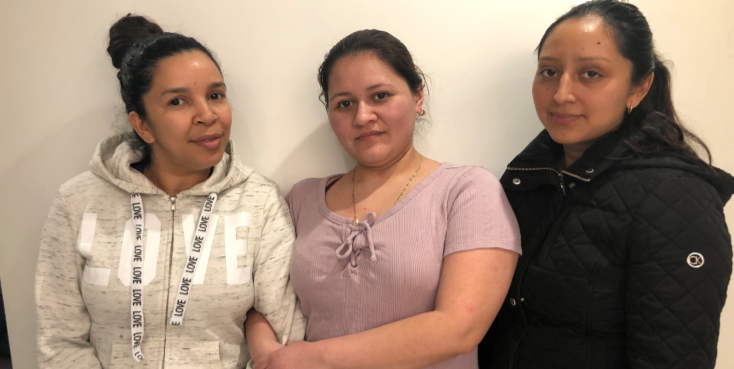
From left, housekeepers Lady Laura Javier, Cindy J. Alarcon Vasquez, and Yesica Perez Barrios are charging hotel officials and union bosses with illegally corralling workers into union ranks with a corrupted “Card Check” recognition.
SEATTLE, WA – Housekeeper Gladys Bryant was granted an appeal by the National Labor Relations Board (NLRB) General Counsel in her case challenging the use of a so-called “neutrality agreement” between UNITE HERE union officials and her employer to impose a union on the hotel’s workers.
Meanwhile, four Boston housekeepers have filed similar NLRB charges against their employer Yotel Boston and UNITE HERE Local 26, alleging that union officials violated federal law by imposing union representation on workers through a coercive “Card Check” drive with their employer’s assistance.
General Counsel Finds That UNITE HERE “Card Check” Unionization Was Tainted
Bryant filed the unfair labor practice charges after the UNITE HERE Local 8 union was installed at the Embassy Suites hotel in May 2018 through an oft-abused “Card Check” drive which bypassed the NLRB’s secret ballot election process.
As part of its so-called “neutrality agreement,” Embassy Suites agreed to give union organizers access to the hotel to meet and solicit employees. The agreement also provided union officials with a list of all employees’ names, jobs, and contact information to assist the union in collecting authorization cards from employees.
After NLRB Region 19 officials declined to prosecute the union or employer for violations of the National Labor Relations Act (NLRA), Bryant appealed the case to the NLRB General Counsel in January 2019. The NLRB General Counsel agreed with Bryant’s Foundation attorneys that Embassy Suites provided UNITE HERE’s organizing campaign with more than “ministerial aid” and thus violated the NLRA.
The NLRB has long held that an employer taints employees’ efforts to remove a union if it gives the employees support such as providing a list of bargaining unit employees or use of company resources. Bryant’s appeal successfully argued that the “ministerial aid” standard must also apply when an employer aids union officials’ efforts to gain monopoly bargaining power over workers.
Boston Housekeepers Argue Union “Card Check” Must Be Overturned
Faced with a similar situation, Boston-area housekeepers Cindy J. Alarcon Vasquez, Lady Laura Javier, Yesica Perez Barrios, and Danela Guzman filed unfair labor practice charges with the NLRB. With free legal aid from the National Right to Work Foundation, the housekeepers argue that UNITE HERE union officials violated federal law by imposing union representation on workers through a coercive “Card Check” drive with the assistance of their employer, Yotel Boston.
As in the Seattle case, they charge that Yotel Boston company officials provided UNITE HERE’s organizing campaign with more than “ministerial aid” and therefore illegally tainted the union’s installation as the employees’ exclusive representative in the workplace. The housekeepers charge union officials with violating the NLRA by requesting and accepting the illegal assistance, and the hotel for providing it.
“It is long past time that the NLRB put an end to this biased double standard that allows union bosses to abuse workers’ rights,” said National Right to Work Foundation Vice President and Legal Director Ray LaJeunesse. “The General Counsel is correct to finally recognize that what qualifies as more than ‘ministerial assistance and support,’ and thus violates the National Labor Relations Act, cannot depend on whether the employer is helping outside union organizers impose unionization on workers or assisting workers in exercising their right to remove an unwanted union.”
“These cases represent another breakthrough in the Foundation’s challenges to the pro-forced unionism skew at the NLRB,” added LaJeunesse.





