
MIT Graduate Students Defeat Discriminatory Dues Demands From Radical Campus Union
The following article is from the National Right to Work Legal Defense Foundation’s bi-monthly Foundation Action Newsletter, November/December 2024 edition. To view other editions of Foundation Action or to sign up for a free subscription, click here.
Union must cease forced dues, inform thousands of MIT graduate students of right to defund union politics
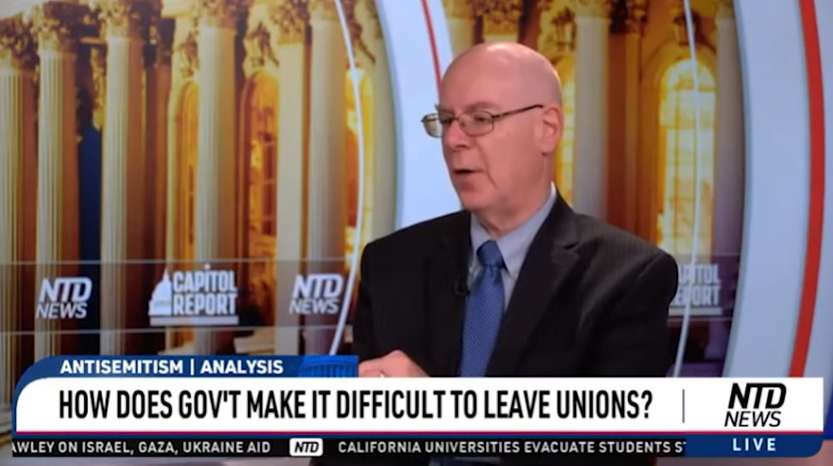
Foundation staff attorney Glenn Taubman, who aided the MIT graduate students in their legal victory, told NTD News his phone is “ringing off the hook” because university students and faculty nationwide are seeking ways to defund radical campus unions.
BOSTON, MA – “Jewish graduate students are a minority at MIT. We can’t remove the [Graduate Student Union (GSU)] or disabuse it of its antisemitism. But we also can’t support an organization that actively works toward the eradication of the Jewish homeland, where I have family living now.”
These were the words MIT Ph.D. student Will Sussman used to describe his, and other graduate students’, battle against radical union bosses at his campus, both in a Wall Street Journal op-ed and in June testimony before the U.S. House Committee on Education and the Workforce. GSU union officials gained the legal privilege to force MIT graduate students to pay dues or lose their academic work thanks to biased rulings by the National Labor Relations Board (NLRB) under both President Biden and President Obama. Since then, they’ve wasted no time in forcing even Jewish students with strong objections to the union’s anti-Israel agitating to fund their activities.
Students Battle Anti-Israel Sentiment Boosted by GSU Union Bosses
However, with free legal aid from National Right to Work Foundation staff attorneys, Sussman and his fellow Jewish graduate students Joshua Fried, Akiva Gordon, Adina Bechhofer, and Tamar Kadosh Zhitomirsky fought back against the GSU’s discriminatory dues demands. They each filed federal charges at the Equal Employment Opportunity Commission (EEOC), charging the GSU with denying them religious accommodations required by Title VII of the Civil Rights Act of 1964. Now they’ve won full accommodations that allow them to cut off all financial support for the union.
Separately, Foundation attorneys also filed federal unfair labor practice charges at the NLRB for Katerina Boukin, who objected on political grounds to the GSU’s ideological activity. Boukin sought to exercise her rights under the Foundation-won Communications Workers of America v. Beck Supreme Court decision, which lets workers who abstain from union membership opt-out of paying for the union’s political expenses.
In the wake of the October 7, 2023, attacks on Israel, Sussman and his fellow students experienced a massive wave of anti-Israel sentiment on MIT campus, including from GSU union chiefs.
“The blood had not yet dried when my colleagues at MIT declared, ‘Victory is Ours,’” related Sussman at a congressional hearing on anti- Semitism in unions. “The full-time GSU staff organizer told NBC10 Boston, ‘Those who rebel against oppression cannot be blamed for rebelling against that repression.’”
GSU Union Backed Off Unlawful Demands After Foundation Intervention
Sussman, Fried, Gordon, Bechhofer, and Zhitomirsky each requested in early 2024 that GSU union officials provide them with religious accommodations to paying union dues based on their objections to union officials’ extremist beliefs. Under federal law, such accommodations vary, but often take the form of letting the objector divert the dues from the offensive union to a 501(c)(3) charity instead. The GSU union’s brazen response was that “no principles, teachings or tenets of Judaism prohibit membership in or the payment of dues or fees to a labor union” and that no religious conflict existed because one of the founders of GSU’s parent union was himself Jewish.
The GSU union backed down after Foundation staff attorneys filed EEOC anti-discrimination charges in response to the lack of accommodation. The students have secured full religious accommodations and will pay money to charities of their choice, despite initial pushback from union bosses. The charities include American Friends of Magen David Adom and American Friends of Leket.
Katerina Boukin’s NLRB case was spurred by her disagreements with the union’s political stances on Israel. She stated that she was deeply offended by GSU’s “opposition to Israel and promotion of Leninist- Marxist global revolution” and that “[t]he GSU’s political agenda has nothing to do with my research as a graduate student at MIT, or the relationships I have with my professors and the university administration.”
“[Y]et outrageously they demand I fund their radical ideology,” Boukin said.
Foundation-Won Settlement Informs Students They Can Defund ‘Marxist’ Union
Foundation attorneys won a settlement for Boukin that not only returned illegally-seized dues to Boukin, but also required GSU bosses to inform the entire MIT graduate student body of their rights to invoke the Beck decision.
GSU bosses were forced to declare by email that they will not restrict the ability of those who resign their union memberships to cut off dues payments for political expenses and pay a reduced amount to the union. This email notice went out to approximately 3,000 MIT students.
Legal Protections Should Protect Employees’ Right to Object on Any Grounds
“The Foundation-backed MIT graduate students who fought these legal battles have earned well-deserved victories. But defending basic free association rights shouldn’t require such complicated litigation,” commented National Right to Work Foundation President Mark Mix.
“This ordeal at MIT should remind lawmakers that all Americans should have a right to protect their money from going to union bosses they don’t support, whether those objections are based on religion, politics, or any other reason.”
Jewish MIT Graduate Students Force Anti-Israel Union to Abandon Discriminatory Demands for Dues Payment
Settlement includes requirement that GSU union inform 3,000+ students of their right to refrain from paying for radical union political activities
Boston, MA (August 21, 2024) – Several Jewish graduate students at the Massachusetts Institute of Technology (MIT) have prevailed in their legal cases to cut off financial support to the MIT Graduate Student Union (GSU), an affiliate of the United Electrical (UE) union. The students, all of whom received free legal assistance from National Right to Work Foundation staff attorneys, objected to GSU union officials’ anti-Israel activities, particularly their support for the Boycott, Divestment, Sanctions (BDS) movement.
Because Massachusetts lacks Right to Work protections that make union membership and financial support voluntary, union officials at unionized private colleges like MIT can force graduate students to financially support a union under threat of losing their academic positions and work. However, this power is subject to limitations under federal anti-discrimination law and some Supreme Court decisions.
Foundation staff attorneys litigated federal charges at the Equal Employment Opportunity Commission (EEOC) in March for William Sussman, Joshua Fried, Akiva Gordon, Adina Bechhofer, and Tamar Kadosh Zhitomirsky, each of which stated that the union had demanded full dues payments even after they had each stated their religious objection to funding the union and asked for an accommodation as per Title VII of the Civil Rights Act of 1964. Such accommodations vary, but often take the form of letting the objector divert the dues from the offensive union to a 501(c)(3) charity instead.
Shortly after those filings, Foundation staff attorneys also filed federal unfair labor practice charges at the National Labor Relations Board (NLRB) for Katerina Boukin, who objected on political grounds to the GSU’s ideological activity and sought to exercise her rights under the Foundation-won Communications Workers of America v. Beck Supreme Court decision. In Beck, the Court ruled that union officials cannot force those who opt out of formal union membership (like Boukin) to pay dues or fees for union expenses not directly related to collective bargaining, even in a non-Right to Work state. GSU bosses denied Boukin’s Beck request on the specious grounds that she had missed a short union-concocted “window period” in which such an objection would be accepted.
Settlement Blocks Union Bosses from Using Student Money to Support Extremism
The students have now won a favorable NLRB settlement, and a favorable outcome of the EEOC charges, that fully vindicate their rights. The students who voiced religious objections (Sussman, Fried, Gordon, Bechhofer, and Zhitomirsky) have obtained accommodations under which they will pay no money to the union and will instead pay money to charities of their choice, despite initial pushback from union bosses. The charities include American Friends of Magen David Adom and American Friends of Leket.
Foundation attorneys scored for Katerina Boukin a settlement that will require GSU bosses to inform the entire MIT graduate student body of their rights to invoke the Beck decision. GSU bosses must declare by email that they will not restrict the ability of those who resign their union memberships to cut off dues payments for political expenses and pay a reduced amount to the union. This email notice will go out to approximately 3,000 MIT students.
The Jewish students’ efforts to assert their rights put on display the radicalism of GSU union officials. The students who asserted religious objections to supporting the union initially received form letters as responses to their requests, which callously claimed that “no principles, teachings or tenets of Judaism prohibit membership in or the payment of dues or fees to a labor union” and that no religious conflict existed because the founder of GSU’s parent union was himself Jewish. Through the Foundation-backed litigation, the students’ religious objections to supporting GSU were accommodated.
MIT Students Expose GSU Misdeeds to Congress & Nation
Both Will Sussman and Katerina Boukin publicly commented on how the GSU union’s public image was synonymous with political extremism and had little to do with academics. Boukin stated that she was deeply offended by the union’s “opposition to Israel and promotion of Leninist-Marxist global revolution” and that “[t]he GSU’s political agenda has nothing to do with my research as a graduate student at MIT, or the relationships I have with my professors and the university administration, yet outrageously they demand I fund their radical ideology.”
In July, Will Sussman appeared before the U.S. House Committee on Education and the Workforce to reveal even more details about his and his colleagues’ distressing experience with the GSU union. As Sussman testified, after the October 7 attacks on Israel, GSU union representatives voiced support for Hamas’ bloody “rebellion” and the GSU Vice President was even arrested for her behavior at an anti-Israel protest. “She was banned from campus but remains on [dues-funded] paid ‘union leave,’” Sussman stated.
“The Foundation-backed MIT graduate students who fought these legal battles have earned well-deserved victories. But defending basic free association rights shouldn’t require such lengthy litigation, and meaningful reforms are necessary to ensure union support is truly voluntary,” commented National Right to Work Foundation President Mark Mix. “Forcing GSU union officials to abandon their blatantly discriminatory dues practices is only the tip of the iceberg: Because Massachusetts lacks Right to Work protections, GSU still has the power to force the vast majority of MIT graduate students to subsidize some portion of their activities.
“Foundation attorneys are continuing to provide legal aid for all those who challenge the imposition of radical union agendas at places such as the University of Chicago, Dartmouth, and Johns Hopkins, and they are doing so for adherents of both Judaism and Christianity. But this ordeal at MIT should remind lawmakers that all Americans should have a right to protect their money from going to union bosses they don’t support, whether those objections are based on religion, politics, or any other reason,” Mix added.
NLRB Cases Challenge Coercive ‘Neutrality Agreements’ Used to Impose Forced Unionism
The following article is from the National Right to Work Legal Defense Foundation’s bi-monthly Foundation Action Newsletter, March/April 2020 edition. To view other editions or to sign up for a free subscription, click here.
Housekeepers demand NLRB block unionization resulting from back-room “Card Check” deals
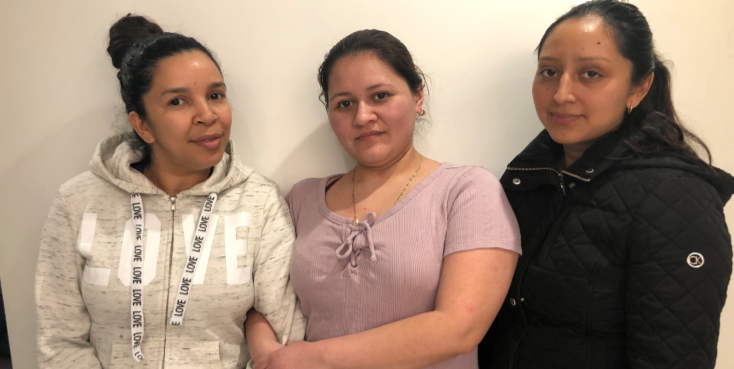
From left, housekeepers Lady Laura Javier, Cindy J. Alarcon Vasquez, and Yesica Perez Barrios are charging hotel officials and union bosses with illegally corralling workers into union ranks with a corrupted “Card Check” recognition.
SEATTLE, WA – Housekeeper Gladys Bryant was granted an appeal by the National Labor Relations Board (NLRB) General Counsel in her case challenging the use of a so-called “neutrality agreement” between UNITE HERE union officials and her employer to impose a union on the hotel’s workers.
Meanwhile, four Boston housekeepers have filed similar NLRB charges against their employer Yotel Boston and UNITE HERE Local 26, alleging that union officials violated federal law by imposing union representation on workers through a coercive “Card Check” drive with their employer’s assistance.
General Counsel Finds That UNITE HERE “Card Check” Unionization Was Tainted
Bryant filed the unfair labor practice charges after the UNITE HERE Local 8 union was installed at the Embassy Suites hotel in May 2018 through an oft-abused “Card Check” drive which bypassed the NLRB’s secret ballot election process.
As part of its so-called “neutrality agreement,” Embassy Suites agreed to give union organizers access to the hotel to meet and solicit employees. The agreement also provided union officials with a list of all employees’ names, jobs, and contact information to assist the union in collecting authorization cards from employees.
After NLRB Region 19 officials declined to prosecute the union or employer for violations of the National Labor Relations Act (NLRA), Bryant appealed the case to the NLRB General Counsel in January 2019. The NLRB General Counsel agreed with Bryant’s Foundation attorneys that Embassy Suites provided UNITE HERE’s organizing campaign with more than “ministerial aid” and thus violated the NLRA.
The NLRB has long held that an employer taints employees’ efforts to remove a union if it gives the employees support such as providing a list of bargaining unit employees or use of company resources. Bryant’s appeal successfully argued that the “ministerial aid” standard must also apply when an employer aids union officials’ efforts to gain monopoly bargaining power over workers.
Boston Housekeepers Argue Union “Card Check” Must Be Overturned
Faced with a similar situation, Boston-area housekeepers Cindy J. Alarcon Vasquez, Lady Laura Javier, Yesica Perez Barrios, and Danela Guzman filed unfair labor practice charges with the NLRB. With free legal aid from the National Right to Work Foundation, the housekeepers argue that UNITE HERE union officials violated federal law by imposing union representation on workers through a coercive “Card Check” drive with the assistance of their employer, Yotel Boston.
As in the Seattle case, they charge that Yotel Boston company officials provided UNITE HERE’s organizing campaign with more than “ministerial aid” and therefore illegally tainted the union’s installation as the employees’ exclusive representative in the workplace. The housekeepers charge union officials with violating the NLRA by requesting and accepting the illegal assistance, and the hotel for providing it.
“It is long past time that the NLRB put an end to this biased double standard that allows union bosses to abuse workers’ rights,” said National Right to Work Foundation Vice President and Legal Director Ray LaJeunesse. “The General Counsel is correct to finally recognize that what qualifies as more than ‘ministerial assistance and support,’ and thus violates the National Labor Relations Act, cannot depend on whether the employer is helping outside union organizers impose unionization on workers or assisting workers in exercising their right to remove an unwanted union.”
“These cases represent another breakthrough in the Foundation’s challenges to the pro-forced unionism skew at the NLRB,” added LaJeunesse.
Boston College Electrician Hits SEIU Union, College with Lawsuit for Religious Discrimination in Forced Union Fees Requirement
Instead of accommodating employee’s religious beliefs as required by federal law, SEIU union officials and college administrators repeatedly ignored and violated his rights
Boston, MA (November 20, 2019) — Ardeshir Ansari, an electrician who works for Boston College filed a Title VII religious discrimination lawsuit today against the college and Service Employees International Union 32BJ, District 615 (SEIU) with free legal assistance from National Right to Work Legal Defense staff attorneys.
Ardeshir Ansari objects to supporting the union based on deeply held religious beliefs. Under the local SEIU’s monopoly bargaining agreement at Boston College, however, he was told that he must join or financially support the SEIU or be fired. To avoid being fired, Ansari paid fees to the union, despite his sincere religious beliefs. Ansari is invoking Title VII of the Civil Rights Act of 1964, which prohibits discriminating against an individual based on his or her religious beliefs.
On October 1st last year, Ansari sent a letter to Boston College and the SEIU informing them of how his religious beliefs conflict with joining or financially supporting the union. He asked that his union fees be diverted to charity instead of being sent to the union, which is a long-established remedy for such a conflict. Instead of responding, the college continued to take a cut of his paycheck and send it to SEIU officials in violation of his sincerely held religious beliefs.
In January this year Ansari filed charges with the Equal Employment Opportunity Commission (EEOC) against the college and union officials, and the EEOC determined this summer that both Boston College and the SEIU had violated Title VII. In September, the EEOC gave Ansari a right-to-sue letter, which authorized him to file a lawsuit under Title VII against the college and the union.
Consequently, Foundation staff attorneys today filed a lawsuit on Ansari’s behalf against Boston College and the SEIU for illegally discriminating against Ansari for failing to reasonably accommodate his religious beliefs in violation of his rights under Title VII of the Civil Rights Act. The lawsuit further alleges that because Boston College made paycheck deductions for the SEIU despite Ansari’s notice of religious objections, and because Ansari would have been fired if he did not pay the fees, their actions constitute quid pro quo religious harassment.
The lawsuit asks that the college and SEIU local pay all fees deducted from Ansari’s paycheck to a charity mutually agreed upon and pay Ansari for damages for the emotional distress he has suffered while his rights have been violated for more than a year. It also asks the court to prevent the college from continuing to discriminate against his religious beliefs and asks that the union be required to inform workers that those with religious objections to the payment of union fees are entitled to pay those fees to a charity instead.
“Workers who have sincere religious objections to joining or funding a union are legally protected from being forced to violate their conscience,” said National Right to Work President Mark Mix. “No one should ever be forced to choose between keeping a job to provide for their family and violating their deeply held religious beliefs by supporting a union.”
“Ultimately, a Right to Work law that makes all union payments voluntary is the best solution to this type of illegal discrimination. That way, all workers who object to funding union activities are free to cut off such payments whether or not the nature of their opposition to the union is faith-based,” added Mix.





