
AT&T-BellSouth Workers Challenge Union-Concocted ‘Window Period’ Restrictions on Ending Dues
The following article is from the National Right to Work Legal Defense Foundation’s bi-monthly Foundation Action Newsletter, May/June 2025 edition. To view other editions of Foundation Action or to sign up for a free subscription, click here.
CWA officials trap dissenting workers, but case asks NLRB to declare ‘window period’ restrictions illegal

Jennifer Abruzzo went straight from being a top CWA union lawyer to being General Counsel of the Biden NLRB. Though President Trump fired her, that doesn’t mean that workers don’t still have to battle the anti-freedom policies she advanced.
MIAMI, FL – In August 2024, Communications Workers of America (CWA) union bosses ordered thousands of AT&T employees across the Southeast to abandon their jobs and go on strike. Unsurprisingly, despite union officials’ propaganda surrounding the strike, many workers disagreed with the decision.
“CWA union officials ordered us to abandon our jobs when many of us just wanted to keep working and supporting ourselves and our families,” commented Amanda Marc, a Miami-based worker for AT&T-BellSouth. “That’s bad enough, but now they’re putting up all these roadblocks to try to prevent those of us who don’t like the union’s agenda from stopping our money from flowing to them.”
Marc is referring to a situation that South Florida AT&T-BellSouth workers have been increasingly dealing with in the aftermath of the strike, which came to an end in September 2024. With free legal aid from National Right to Work Legal Defense Foundation staff attorneys, Marc and her coworker Sofia Hernaiz filed unfair labor practice charges against CWA union officials, detailing that the union hierarchy has ignored their requests to cut off dues payments and has continued to siphon money from their paychecks illegally. Additional charges for other AT&T-BellSouth workers are also being filed.
Dues Kept Flowing to Union After Workers Requested Stop
Marc and Hernaiz’s charges point out that CWA officials are imposing a “window period” scheme on workers who want to end financial support, limiting to just ten days per year the time in which workers can demand that dues deductions cease from their paychecks.
“This kind of behavior makes me feel like they’re really just interested in having control over us and taking our money,” Marc added. Marc and Hernaiz filed their charges with the National Labor Relations Board (NLRB), the agency responsible for enforcing federal labor law.
Marc’s charge in particular challenges the practice of imposing “window periods” as violating the National Labor Relations Act (NLRA): While the NLRA unfortunately allows union officials to prevent a worker from revoking his or her dues authorization card for the first year after it is initially signed, Marc’s charge notes that any further restrictions are unlawful.
“The unions have no statutory license to create tricky and arbitrary ‘window periods’ to force unwilling employees to keep paying dues,” Marc’s charges say.
Because Marc, Hernaiz, and their colleagues work in the Right to Work state of Florida, CWA union bosses are forbidden from forcing workers to pay any union dues or fees as a condition of keeping their jobs, though CWA union officials are trying to limit the exercise of this freedom with their window period scheme. In states that lack Right to Work protections, in contrast, union officials can force employees to pay fees to the union or be terminated, meaning even perfect “compliance” with a union boss’s arbitrary window period restriction would not get a worker out of forced union payments.
Marc and Hernaiz’s charges state that they, and many of their coworkers, resigned their union memberships in August 2024, which was around when CWA union officials ordered AT&T-BellSouth workers out on the strike. Despite the women’s requests to end union membership and stop financial support for the union, the charges read, CWA agents never responded to their requests to stop dues deductions, and never even informed them of the window period dates in which they would consider their requests valid.
Even worse, Hernaiz details in her charge that union officials tried to subject her to internal union discipline for not participating in the strike. Under federal law, union bosses cannot impose union proceedings on workers who are not union members. Foundation attorneys are in the process of aiding other AT&T-BellSouth workers targeted by such illegal discipline.
No Legal Justification for ‘Window Periods,’ New NLRB Should Toss Policy
“Federal labor law is supposed to protect the right of workers to decide freely whether they want to join or financially support a union,” commented National Right to Work Foundation President Mark Mix. “So-called ‘window periods’ exist only to restrict this freedom just so union officials can continue to funnel dues money from workers’ pockets straight into union agendas.
“The NLRB under the new Administration should recognize that this practice contradicts both worker freedom and federal law, and end it accordingly,” Mix added.
Following Foundation Legal Arguments, Trump Fires Biden-Appointed NLRB Bureaucrats
The following article is from the National Right to Work Legal Defense Foundation’s bi-monthly Foundation Action Newsletter, March/April 2025 edition. To view other editions of Foundation Action or to sign up for a free subscription, click here.
Foundation constitutional lawsuit first to argue presidents can remove Board members

President Trump appears intent on ending union bosses’ reign at the NLRB. One of his first actions was to axe Jennifer Abruzzo and Gwynne Wilcox, both ex-union bosses who constantly sought to beef up their cronies’ powers over employees.
WASHINGTON, DC – Joe Biden, a career lackey of Big Labor union bosses, spared no moment of his administration ensuring that his cronies at the top of America’s largest unions gained power at the expense of independent-minded workers.
Only minutes after being inaugurated in 2021, he began setting the stage for a Big Labor takeover of the federal government: He immediately fired Peter Robb, the general counsel for the National Labor Relations Board (NLRB) during Donald Trump’s first term. With Robb gone, Biden’s acting general counsel quickly quashed multiple National Right to Work Foundation-backed cases that would have otherwise received full NLRB consideration. When Biden filled the general counsel position, he picked Jennifer Abruzzo — a radical ex-Communications Workers of America (CWA) lawyer who was confirmed only because then-Vice President Kamala Harris broke a party-line deadlock in the Senate.
And Biden wasn’t finished. He filled two vacancies on the Board itself with Gwynne Wilcox and David Prouty — who had both worked for the radical Service Employees International Union (SEIU).
Biden’s crusade against worker freedom arguably culminated in the disastrous Cemex Construction Materials Pacific NLRB decision, which gave union officials the power to seize monopoly bargaining power in a workplace without winning a secret-ballot election among employees. The Biden Board also repealed key Foundation-backed reforms that (among other things) stopped union bosses from using so-called “blocking charges” alleging employer malfeasance to stop workers from voting in union removal elections they had requested.
Sudden End of Radical Biden Majority Creates Opportunities for Foundation Litigation
But, just a week after re-ascending to the White House, President Trump took immediate action to undo the damage to worker freedom caused by the historically-radical Biden NLRB. In late January, Trump took the crucial step of giving both Abruzzo and Wilcox the boot. That, combined with the fact that the Senate did not confirm Biden NLRB Chairman Lauren McFerran for another term, means Trump has the opportunity to appoint a pro-freedom majority to the Board before it considers any other cases.
“We hope that this signals the opening of a new chapter at the NLRB, where the agency will fulfill its statutory mandate to protect workers’ right to associate with unions if they choose, but will equally defend their right to refrain from all union activity,” commented National Right to Work Foundation President Mark Mix.
Trump Admin, Others Follow Foundation Lead in Arguing for Structural Board Change
By removing Wilcox, the Trump Administration is relying on arguments made in the Foundation’s groundbreaking cases challenging the structure of the NLRB. Foundation-backed Starbucks employees Ariana Cortes and Logan Karam filed the first-ever federal suit arguing that, as per the Constitution’s separation of powers principles, the president should be able to remove them at-will.
Cortes and Karam’s suit is currently pending at the D.C. Circuit Court of Appeals. Big Labor backers argue that board members like Wilcox have statutory protections that make them removable only in certain circumstances. But Board member protections are constitutionally questionable.
“President Trump made an excellent and decisive move to protect the freedom of American workers. Abruzzo’s and Wilcox’s track records were devastating for independent-minded employees,” observed Mix.
“We’re also encouraged by the Trump Administration’s apparent reliance on National Right to Work Foundation-backed workers’ cases to affirm the idea that NLRB members — like Wilcox — should be removable by the president at will. “The Foundation still has considerable legal work to do to reverse the damage done by the Biden NLRB, and removing a union partisan like Wilcox from the Board is just the first step towards restoring the rights and freedoms of workers opposed to union affiliation,” added Mix.
Forced Dues For Politics: CWA Union Hit with Federal Charge by Pennsylvania Metal Worker
The following article is from the National Right to Work Legal Defense Foundation’s bi-monthly Foundation Action Newsletter, July/August 2022 edition. To view other editions of Foundation Action or to sign up for a free subscription, click here.
CWA officials defied decades of law by rejecting worker’s resignation
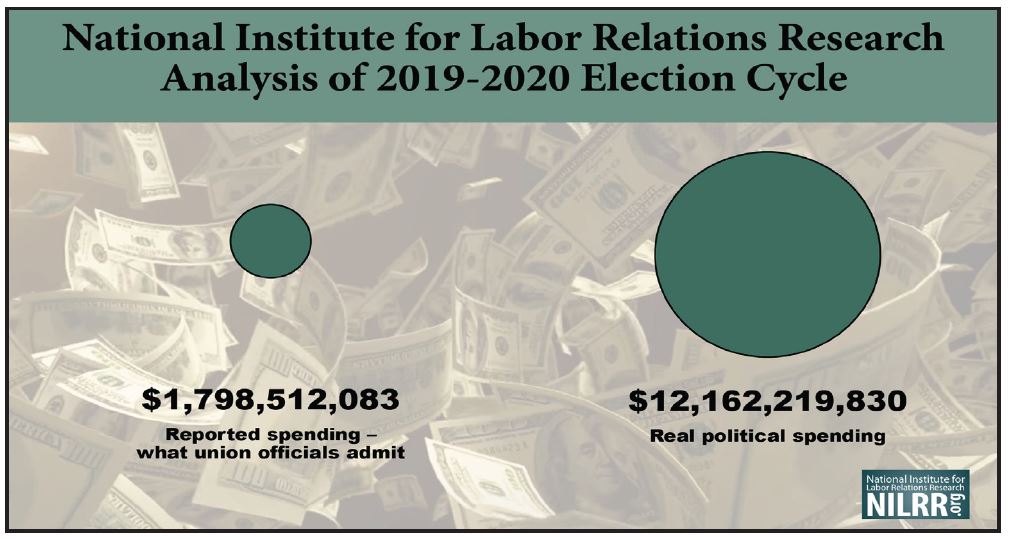
Coates’ case challenging illegal seizure of forced dues for politics comes after one analysis found that union officials likely spent over $12 billion on political activities during the 2019-2020 election cycle, far more than union officials publicly admit.
GALETON, PA – An employee of metal corporation Catalus hit a Communications Workers of America (CWA) union local this May with federal charges for illegally seizing full union dues from his paycheck, including dues for politics. Curtis Coates, a metal worker for Catalus, is receiving free legal aid from the National Right to Work Legal Defense Foundation.
Foundation attorneys filed Mr. Coates’ charges with National Labor Relations Board (NLRB) Region 6 in Pittsburgh, Pennsylvania. The Region is now investigating the charges.
CWA Union Officials Continue to Collect Dues from Worker, Despite Lack of Authorization
On October 20, 2021, Mr. Coates sent a message to CWA union officials declaring that he was resigning from his position as shop steward and terminating his union membership.
Because no union monopoly contract was in effect, under longstanding law, Coates should have been able to immediately cut all financial support for the CWA union which he no longer supports. The charges say a union official rebuffed both of Mr. Coates’ requests the next day, insisting that he had to remain both a union member and a shop steward.
From December 2021 to February 2022, Mr. Coates followed up with union officials several times via email and mail. He repeatedly asked when union officials would cease taking dues money from his paychecks and what process he had to follow to revoke his dues deduction authorization to stop money from being seized from his paychecks.
“To date, the Union has not responded . . . and dues and contributions continue to be deducted from his wages,” the charge reads. Because Pennsylvania currently lacks a Right to Work law, union officials can legally force employees to pay some union fees just to keep their jobs. However, those forced fees cannot be demanded when no union contract is in effect.
Further, even in states without Right to Work protections full union membership cannot be required. Additionally, under the U.S. Supreme Court’s decision in CWA v. Beck (1988), won by Foundation attorneys, forced fees are limited to only the part of union dues that union officials claim goes toward a union’s core “representational” functions and cannot be collected for other activities like union politics and lobbying.
Conflict of Interest: NLRB General Counsel is a Former CWA Union Official
Currently, the NLRB General Counsel is former CWA attorney Jennifer Abruzzo, who has expressed support for a number of policies which give union officials greater power to force workers into dues-paying union ranks, even without a vote. Foundation attorneys requested last year that Abruzzo recuse herself from a case involving an Oregon ABC cameraman who accused another CWA local of demanding illegal dues from him, including dues for politics.
Coates’ case represents another potential conflict of interest for Abruzzo, who has repeatedly sided with union officials against the rights of workers opposed to union affiliation.
“Mr. Coates’ right to refrain from funding union activities is being ignored by CWA union officials as they continue to unlawfully seize full union dues, which includes money used for union political activities,” commented National Right to Work Foundation Vice President Patrick Semmens. “This case shows why Pennsylvania workers need the protection of a Right to Work law to make all union payments strictly voluntary: So union bosses cannot so brazenly collect money to which they are not entitled under longstanding federal law.”
“Further, Mr. Coates’ case demonstrates the obvious conflict of interest that exists as Abruzzo, a former CWA lawyer, is charged with enforcing workers’ rights violated by her former CWA union colleagues,” Semmens added.





