
At Foundation’s Urging, NLRB Eliminates Barriers to Removing Unpopular Unions
The following article is from the National Right to Work Legal Defense Foundation’s bi-monthly Foundation Action Newsletter, July/August 2020 edition. To view other editions or to sign up for a free subscription, click here.
New rule curtails union boss tactics used to block employees’ right to vote out unions they oppose

The Foundation’s comments helped the NLRB scrap its policy allowing “blocking charges,” which IUOE bosses used to stymie Rieth-Riley worker Rayalan Kent and his coworkers’ right to vote them out.
WASHINGTON, DC – Following two rounds of comments from the National Right to Work Legal Defense Foundation and over 8,000 petitions from Right to Work supporters, the National Labor Relations Board (NLRB) has issued final rules substantially eliminating two pernicious tactics used by union bosses to stop workers from exercising their right to hold a vote to remove an unwanted union.
The NLRB’s new rules, finalized in April, dealt blows to the non-statutory “blocking charge” and “voluntary recognition bar” policies and to forced unionism schemes in the construction industry. All three reforms were encouraged by the Foundation’s initial January comments to the federal agency, which pressed the agency to get rid of all restrictions on decertification elections that are not mandated by the National Labor Relations Act (NLRA).
New Rule Knocks Down Three Rights Restrictions Targeted by Foundation
The new rule essentially eliminates union “blocking charges,” which union bosses file to prevent rank-and-file employees from exercising their right to vote to remove a union. Under the old rule, unions could block workers’ requested votes from taking place for months or even years by making one or multiple allegations against the employer, which were often unrelated to the employees’ decertification petition and frequently unsubstantiated.
Under the new rule, union charges cannot indefinitely stall the employees’ vote from taking place and in most instances the vote will occur without delay. Additionally, as the Foundation advocated, the NLRB modified its proposed rule so that after the employees vote, the ballots will be tallied and released in the vast majority of cases instead of being impounded and not counted.
This is a vast improvement on the NLRB’s original proposal to utilize a “vote and impound” system regarding employees’ decertification votes. Although such a system would have permitted employees to vote despite “blocking charges,” the results could have been withheld for months or years until the underlying “blocking charges” were resolved. Foundation staff attorneys argued against such a system in their January comments, pointing out that it would “frustrate and confuse employees who may have to wait years to see the election’s results,” while leaving the union in power the entire time.
The NLRB also substantially eliminated the so-called “voluntary recognition bar” policy. In the past, union officials had used this policy to block workers from requesting a secret-ballot election after the union had been installed as their monopoly bargaining agent through abuse-prone “Card Check” drives that bypass the NLRB-supervised secret-ballot election process. The Trump NLRB’s new rule reinstates a system secured by Foundation staff attorneys for workers in the 2007 Dana Corp. NLRB decision.
Under the Dana Corp. system, employees subject to “Card Check” drives and so-called “voluntary recognition” can promptly file for a secret-ballot election to contest the installation of a monopoly representative at their workplace. Despite thousands of workers using this process to secure secret-ballot votes after being unionized through “Card Checks,” the Obama NLRB overturned Dana in 2010 over the objections of Foundation staff attorneys in a case called Lamons Gasket.
Additionally, the NLRB made changes advocated by the Foundation’s January comments to crack down on schemes in the construction industry where employers and union bosses are allowed to unilaterally install a union in a workplace without first providing any proof of majority union support among the workers.
Foundation Fights to Enforce Workers’ Right to Remove Unwanted Unions
Foundation staff attorneys are currently providing free legal aid to several workers who are challenging union boss attempts to stymie their right to vote out an unwanted union, even in light of the new NLRB protections.
In Michigan, NLRB Region 7 officials stifled Rieth-Riley Construction Company employee Rayalan Kent’s decertification petition that he submitted for his coworkers. Region 7 officials told him that the election would be held up “pending the investigation” of charges filed by Operating Engineers (IUOE) union bosses against Rieth- Riley, but never explained to him why IUOE bosses’ allegations were significant enough to affect their right to vote.
Foundation staff attorneys in April submitted a request for review for Kent and his coworkers to the NLRB in Washington, D.C., asking that the Board immediately permit them to exercise their right to vote to remove the unpopular IUOE union.
“While this NLRB still has much more to do, the long-awaited new rules represent significant steps towards fully protecting the statutory right of employees under the NLRA to remove a union opposed by a majority of workers,” observed National Right to Work Foundation Vice President Patrick Semmens. “The ‘blocking charge’ policy that is finally being modified has always been particularly odious in its treatment of employee rights, for it allows union allegations against an employer to be grounds for blocking the statutory rights of employees who are not accused of any wrongdoing.”
“Foundation supporters, who deluged the NLRB with demands to safeguard the right of rank-and-file employees to vote, free of coercion, on whether or not union bosses are worthy to speak for them in the workplace, should be proud that their voices helped spur these important reforms,” Semmens added.
National Right to Work President Emphasizes Worker Freedom, Coming Challenges in Labor Day 2020 Statement
Mark Mix, president of the National Right to Work Legal Defense Foundation and the National Right to Work Committee, issued the following statement on the occasion of Labor Day 2020:
On this Labor Day, as our country strives to reopen and recover, we should all remember the sacrifices that America’s working men and women – including shelf stockers, delivery drivers, nurses, and other frontline workers – continue to make so our country can get through these uniquely challenging times. Many will pay lip service to honoring workers, but it will ring hollow absent a commitment to respect workers’ individual rights and trust each worker to decide for themselves what private organizations, including labor unions, to associate with or subsidize.
Thankfully, in the past decade America’s workers have seen significant advances in that field. The United States Supreme Court’s 2018 decision in Janus v. AFSCME, argued and won by National Right to Work Foundation staff attorneys, safeguarded the First Amendment right of every public worker to choose for themselves whether or not to fund a labor union. And since 2012, five new states have enacted Right to Work laws – meaning a majority of states now protect that same fundamental freedom for private sector workers. Not since the 1950s have we seen such a large expansion of state Right to Work laws in one decade.
Meanwhile, at the urging of workers represented by Foundation staff attorneys, the National Labor Relations Board continues to eliminate policies that trap workers in unwanted union ranks for months or even years, even when an overwhelming majority wants the union out of their workplace. These are significant advances in employee freedom, but there remains much more to do.
Millions of Americans can still be fired for refusing to pay union bosses they don’t want and never asked for. Plus, even where the law protects workers from forced union dues it often takes vigilant legal enforcement to get union officials to respect those rights. Meanwhile millions more American workers are forced to accept the one-size-fits-all “representation” of these union bosses, even if they think they would be better off without it.
And Big Labor’s top officials in their shiny multi-million-dollar headquarters continue to double down on compulsion. Instead of earning the voluntary support of those whom they claim to represent like private organizations, union bosses continue to look to government to grant them more special powers to compel workers to associate with unions against their will.
This is especially demonstrated by the overwhelming forced-dues-funded support from top union bosses for Joe Biden, whose platform includes wiping out every state Right to Work law by federal fiat, authorizing federal bureaucrats to impose forced dues contracts over the objections of both businesses and individual workers, and by mandating the abuse-prone “card check” process so union bosses can corral millions of workers into unions without even a secret-ballot vote.
But the American people know this is not the future workers want or deserve – they overwhelmingly agree with the Right to Work principle that no employee should be forced to join or support a union as a condition of keeping their jobs.
So this Labor Day, and come November, think back to the hardworking individuals who served you throughout the pandemic and remember: They deserve a choice. Let’s celebrate American workers by being vigilant for attempts to undercut their freedoms.
In the News: “Foundation Sues to Give Public Employees Their Right Not to Pay Union Dues”
The National Right to Work Foundation-won Janus v. AFSCME U.S. Supreme Court decision allows public employees to stop paying dues or fees to a union at any time they choose. Janus affirmed that the First Amendment protects government workers from supporting a union against their wishes.
But ever since the Janus decision in June 2018, many union bosses have refused to comply with the High Court’s decision. So Foundation staff attorneys have filed dozens of cases across the country to enforce the Janus decision and compel union bosses to respect the First Amendment rights of the workers they claim to “represent.”
Journalist Mark Tapscott recently reported on a number of these cases for The Epoch Times, including a newly filed case for a police officer serving on the front lines in Las Vegas:
Las Vegas Police Officer Melodie DePierro is the latest in a growing line of public sector employees suing in federal court to demand recognition of their rights under a 2018 Supreme Court decision.
DePierro’s action was filed in the U.S. District Court for Nevada against the Las Vegas Metropolitan Police Department (LVMPD) and the local Police Protective Association (PPA) union.
In Janus v American Federation of State, County and Municipal Employees (AFSCME) decided by a 5-4 vote in June 2018, the high court ruled that public sector employees cannot be forced to pay union dues in the form of agency fees without being given a chance to consent or refuse the deduction.
DePierro noted in her suit that the department’s monopoly bargaining agreement with the union only allowed a 20-day window of opportunity to request agency fee refunds and that she had never agreed to the deduction in the first place.
Right-to-Work advocates cheered Janus as a landmark decision that would prompt millions of employees at all levels of government to demand an end to hundreds of millions of dollars in agency fees that helped fund partisan union political activities with which they disagreed.
…
“Instead of respecting her First Amendment Janus rights, PPA union bosses have decided to keep imposing an unconstitutional policy on her just to keep her hard-earned money rolling into their coffers,” NRTWLDF President Mark Mix said in a statement announcing the suit.
“The High Court made perfectly clear in Janus that affirmative consent from employees is required for any dues deductions to occur. Yet PPA union bosses are clearly violating that standard here,” Mix said.
…
A week before the DePierro filing, NRTWLDF attorneys issued a special notice to more than 28,000 Ohio state employees advising them of their right not to pay agency fees. The notice was part of a settlement of the foundation’s suit against the state government and the Ohio Civil Service Employees Association, AFSCME Local 11 (OCSEA).
Other Janus suits currently working their way through the courts include NRTWLDF actions against the Chicago Teachers Union, the Alaska State Employees Association (ASEA), the United Teachers of Los Angeles (UTLA), California Service Employees International Union (SEIU), the University Professional and Technical Employees (UPTE) union and the University of California, and the Township of Ocean Education Association (TOEA), New Jersey Education Association (NJEA) and the National Education Association (NEA) unions. The latter suit has reached a federal appeals court.
Read the entire article online at The Epoch Times here.
Workers Win Over $30K After Challenging Teamsters Forced-Dues Scheme
The following article is from the National Right to Work Legal Defense Foundation’s bi-monthly Foundation Action Newsletter, July/August 2020 edition. To view other editions or to sign up for a free subscription, click here.
Cases demonstrate Teamsters union bosses’ widespread use of illegal coercive tactics
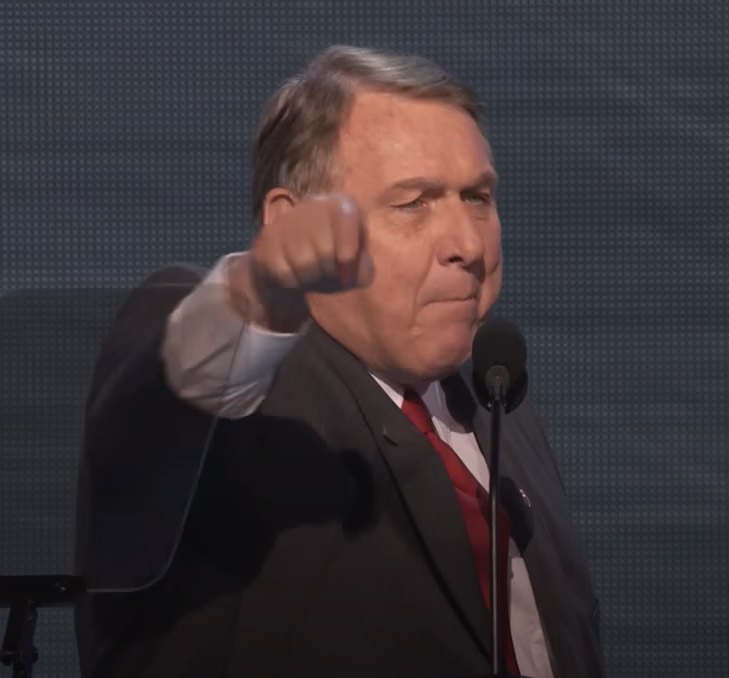
Notorious union boss James Hoffa heads the Teamsters union, which is subjecting workers nationwide and across industries to illegal schemes.
MINNEAPOLIS, MN – With free legal aid from National Right to Work Foundation staff attorneys, workers have won multiple settlements after Teamsters union bosses refused to respect their legal rights not to support a union as a condition of employment.
In one settlement, Minnesota employees James Connolly and Charles Winter won $30,000 in back pay from their former employer after they were illegally fired for choosing not to formally join the Teamsters Local 120 union.
Meanwhile, Milwaukee factory employee Tyler Lewis secured a settlement with Teamsters “General” Local Union No. 200. Union officials had denied his right under Wisconsin’s Right to Work Law and the National Labor Relations Act (NLRA) to not financially subsidize a union.
Two Minnesota Employees Obtain $30,000 in Back Pay
Connolly and Winter each filed unfair labor practice charges against both the Teamsters and their former employer, building materials company OMG Midwest, after they were unlawfully fired.
The two workers charged that company and union officials falsely told them several times that union membership was required as a condition of employment. Both men charged that the misinformation about membership and their firings violated Section 7 of the NLRA, which protects the “right to refrain from any or all” union activities.
In addition to winning $30,000 in back pay from their former employer, the settlement stipulates that OMG Midwest take additional action. The company must “remove all references to the termination” from the two employees’ personnel files, post notices at OMG’s facility in Belle Plaine, Minnesota, and distribute those notices individually to all employees. The notices will explain that workers cannot be forced to join a union as a condition of employment.
In a later settlement, Teamsters bosses were ordered to refrain from telling “employees or applicants that union membership is a condition of employment” and to inform employees “of their right to be non-members.” Additionally, the Teamsters will reimburse any employee who worked at OMG Midwest who chooses to become a non-member for the difference between full union dues and the portion payable by non-member objectors under the Foundation-won Supreme Court decision in CWA v. Beck.
“It is good news that Mr. Connolly and Mr. Winter have won these settlements which require their former employer and Teamsters union bosses to make reparations for violating longstanding worker protections. But such instances of abuse will continue unless Minnesota legislators pass Right to Work protections for their state’s private sector employees,” commented National Right to Work Foundation Vice President and Legal Director Raymond LaJeunesse. “This case demonstrates, yet again, why Teamsters bosses have a well-earned reputation for using coercive tactics against workers who refuse to toe the union line.”
Milwaukee Worker Receives Refund of Union Dues in Foundation-Won Settlement
Under the terms of the settlement for Lewis, Teamsters Local 200 officials agreed to repay union dues, plus interest, seized from Lewis’ paycheck after he resigned his union membership and revoked his dues deduction authorization.
After he was hired to work at Snap-on Logistics Company, a union official told Lewis that he must become a union member and authorize the deduction of union dues from his paycheck. That union demand violated longstanding law dating back to 1963.
In September 2019, Lewis resigned from the union and revoked his authorization of dues deductions. But union bosses refused to honor Lewis’ request to stop union dues deductions and continued to seize dues from his paycheck.
In response, Lewis filed an unfair labor practice charge with the NLRB with the assistance of Foundation staff attorneys. The favorable settlement secured for Lewis resolves his charge. Lewis’ charge against the Teamsters pointed out that the monopoly bargaining contract was signed after the effective date of Wisconsin’s Right to Work Law. Therefore, the so-called “union security” clause in the contract was illegal and he should never have been forced to pay any amount to the union.
“This settlement for Mr. Lewis is yet another victory for the rights of all Wisconsin workers. However, it should not take federal labor charges for union bosses to acknowledge the basic rights of employees in the Badger State,” said LaJeunesse.
Right to Work-Flouting UAW Bosses Pay Back Thousands to MI Paramedics
The following article is from the National Right to Work Legal Defense Foundation’s bi-monthly Foundation Action Newsletter, July/August 2020 edition. To view other editions or to sign up for a free subscription, click here.
Settlements come in Foundation-supported cases as UAW top brass face massive corruption scandal

Joe Biden promises to increase UAW bosses’ coercive power over workers, even as the criminal probe engulfs the union’s upper echelon. Former UAW President Gary Jones’ house had already been raided by FBI agents when this photo was taken.
FLINT, MI – As a result of a settlement won in a National Right to Work Legal Defense Foundation-supported state court case against United Automobile Workers (UAW) Local 708 union bosses, Skylar Korinek, Donald McCarty and 261 other STAT Emergency Medical Services employees received $31,000 in damages. The lawsuit challenged the union’s and company’s violations of Michigan’s Right to Work Law. The settlement is in addition to $26,000 previously won for STAT employees in a separate federal administrative case brought by Foundation staff attorneys.
The victory comes as former UAW President Gary Jones becomes the latest top UAW official to plead guilty in a years-long federal investigation into racketeering and embezzlement among the UAW hierarchy. Court documents say that Jones and other UAW despots misspent millions in union money, much of it forced union dues, on lavish limousine lifestyles, including months-long Southern California luxury golf vacations complete with private villas, custom-made Napa wine and $60,000 in cigar-buying sprees.
Revelations Keep Coming in Sweeping Investigation of UAW Hierarchy
The expanding probe, which has involved FBI raids on UAW officials’ homes where stashes of pilfered cash and luxury items were discovered, has already resulted in the convictions of at least 14 people, including at least 11 UAW agents.
Jones’ guilty plea is expected to be part of a deal that will include his assistance in prosecuting his predecessor, former UAW President Dennis Williams. Further, according to The Detroit News, current UAW President Rory Gamble is under investigation for taking kickbacks from Detroit vendors after awarding them lucrative UAW merchandise contracts.
“The UAW scandal is yet another reminder that compulsory unionism breeds corruption. Even though Michigan’s Right to Work Law should protect workers from being forced to subsidize union boss activities, UAW bosses’ preferred operating model still is extorting workers to pay dues or be fired,” observed National Right to Work Foundation Vice President and Legal Director Raymond LaJeunesse. “Even in states like Michigan with Right to Work laws on the books, union bosses will attempt to force workers like Korinek and McCarty to pay dues. Only vigorous enforcement of Right to Work protections through the Foundation’s legal aid program stops them.”
Settlement Nixes Illegal Contract Clause Imposed by Union and Employer
The five-figure settlement won in the Foundation-supported state case supplements an earlier National Labor Relations Board (NLRB) settlement last year that secured Korinek, McCarty and 168 other STAT emergency workers $26,000 in refunds from UAW. That settlement stemmed from NLRB charges filed by Foundation staff attorneys for the two against UAW and STAT for deducting union dues from the workers’ paychecks without authorization.
The state class-action lawsuit for Korinek and McCarty also revealed that STAT and UAW officials had entered into a monopoly bargaining agreement in 2015 that contained a so-called “union security” agreement. That agreement required STAT employees to join and fund UAW or lose their jobs in violation of Michigan’s Right to Work Law, which protects workers from having to pay union dues or fees as a condition of employment. At that point, the law had been in effect for more than two years.
As part of the settlement approved on May 19, 2020, UAW officials and STAT agreed not to include an agreement that requires workers to join or financially support UAW in any monopoly bargaining contract for as long as Michigan’s Right to Work Law is in effect.
Since Michigan passed its Right to Work Law, which became effective in March 2013, Foundation staff attorneys have brought more than 120 enforcement cases for Michigan workers subjected to coercive union boss tactics.
Chicago Educators Hit CTU Union with Federal Lawsuit for Stonewalling Janus Rights
The following article is from the National Right to Work Legal Defense Foundation’s bi-monthly Foundation Action Newsletter, July/August 2020 edition. To view other editions or to sign up for a free subscription, click here.
Union bosses using “escape period” schemes to block First Amendment right to cut off dues

CTU bosses tried to block Ifeoma Nkemdi’s First Amendment Janus right to end dues deductions from her paycheck. Now she is fighting back with a federal lawsuit.
CHICAGO, IL – Ifeoma Nkemdi, a second-grade teacher at Newberry Math and Science Academy, and Joanne Troesch, a Technology Coordinator at Jones College Prep, didn’t want to abandon their students during an October 2019 strike ordered by Chicago Teachers Union (CTU) bosses against the city’s public schools.
“I didn’t feel they needed to be away from school, period,” Nkemdi told The Wall Street Journal editorial board about her students. “Time away was going to be detrimental.”
While researching how to exercise their right to keep working despite the union boss strike order, the two women also discovered their First Amendment right to refuse to subsidize the union. The Supreme Court recognized this right in the landmark 2018 Janus v. AFSCME decision, which was argued and won by National Right to Work Foundation staff attorneys.
Though they both submitted requests to CTU officials in October 2019 exercising their rights to end union membership and cut off all dues deductions, union bosses notified the two educators that they would continue to seize dues from each of their paychecks for almost another year, citing an “escape period” scheme that purports to limit attempts by educators to exercise their Janus rights to just one month per year.
Suit: Union Bigwigs Never Informed Teachers of Right to Cut Off Dues
Now, with free legal aid from the Foundation, Nkemdi and Troesch are suing CTU and the Chicago Board of Education in the U.S. District Court for the Northern District of Illinois for violating their First Amendment rights as recognized by the Supreme Court in the Janus decision.
In Janus, the High Court struck down mandatory union fees as a violation of the First Amendment rights of government employees. The Court ruled that any dues taken without a government worker’s affirmative consent violate the First Amendment, and further made it clear that these rights cannot be restricted absent a clear and knowing waiver.
“I just want the Janus case to be respected,” Nkemdi said of educators’ First Amendment rights to the Chicago Tribune. “I want people’s constitutional rights, the right to work to be established. I don’t feel like we should be ignoring the Supreme Court on that issue.”
Their suit asks the District Court to order CTU and the Board of Education to stop enforcing the unconstitutional “escape period,” as well as inform bargaining unit employees of their First Amendment right under Janus to stop the deduction of union dues at any time.
The complaint also requests that the court allow workers to retroactively demand back dues seized without their consent by CTU bosses and order refunds of all dues seized under the illegal “escape period” policy from Nkemdi, Troesch and all other educators who submitted requests to cut off dues.
Union Bosses Slammed with Foundation Suits Nationwide
Foundation staff attorneys are continuing to assist public employees around the country in eliminating illegal restrictions on the exercise of their Janus freedoms, resulting already in at least six favorable settlements where union boss schemes were ended and unlawful dues refunded.
In Alaska, Christopher Woods, a Vocational Instructor at the Goose Creek Correctional Center, filed a federal lawsuit in March challenging a similar “escape period” scheme with free Foundation legal assistance. His complaint says that he joined the Alaska State Employees’ Association (ASEA) upon being hired in 2013 “because he was told by a union representative that he had no choice.”
His complaint now asks the U.S. District Court for the District of Alaska to order ASEA officials and the State of Alaska to refund all dues seized illegally under the scheme.
“In non-Right to Work states where politicians have historically granted union bosses the power to force both private and public sector workers to pay them or be fired — such as Illinois and Alaska — union bosses may feel emboldened to keep imposing illegal schemes on public servants to curtail their First Amendment Janus rights,” commented National Right to Work Foundation President Mark Mix. “However, Janus is the law, and the Foundation will file as many lawsuits for public workers as is necessary to ensure that union bosses stop enriching themselves by violating the constitutional rights of the employees they claim to represent.”
Delaware Mountaire Employee Submits Brief Urging Labor Board to Scrap Controversial Policy Blocking Votes to Oust Unions
Union lawyers aim to use non-statutory “contract bar” to have workers’ ballots to remove union destroyed and never counted
Washington, DC (August 21, 2020) – Staff attorneys at the National Right to Work Legal Defense Foundation have just filed a brief urging the National Labor Relations Board (NLRB) in Washington, D.C., to overturn its non-statutory “contract bar” policy. That policy allows union bosses to block workers from exercising their right to vote them out of a workplace for up to three years.
The “contract bar” is not provided for in the text of the National Labor Relations Act (NLRA), which the NLRB administers, but is the result of past Board decisions designed to entrench union bosses. The policy overrides workers’ right, explicitly guaranteed by the NLRA, to hold secret ballot elections to “decertify” ―i.e., remove―a union that lacks majority support.
The brief is the latest development in a case filed by Delaware-based Mountaire Farms poultry processing employee Oscar Cruz Sosa in February 2020. Cruz Sosa filed a petition, signed by hundreds of his coworkers, seeking a vote to decertify the United Food and Commercial Workers (UFCW) Local 27 union.
Cruz Sosa also filed federal unfair labor practice charges in April against the UFCW union for illegally seizing dues from his and other employees’ paychecks, and for making an uninvited visit to his house and threatening him after he submitted the petition for a vote to remove the union. He is receiving free legal aid from the Foundation in filing these charges and in defending his and his coworkers’ right to oust the union.
UFCW officials argued after the petition’s filing that the “contract bar” should block Cruz Sosa and his coworkers from even having an election, but the NLRB Regional Director in Baltimore held that the vote should proceed because the union’s contract with Mountaire Farms contains an invalid forced dues clause.
Not content to accept that result and move forward to an election, UFCW union lawyers asked the full NLRB in Washington to review the Regional Director’s decision.
Responding for Cruz Sosa, Foundation staff attorneys urged that the decision allowing a vote should stand, but because the union appealed the decision Foundation attorneys countered that, if the NLRB did decide to review the case, it should reconsider the non-statutory “contract bar” policy.
On June 23, the NLRB in Washington granted the union’s request for a review of the case and also accepted the Foundation attorneys’ argument that the entire “contract bar” doctrine should be reconsidered. The NLRB invited the parties and amici to file briefs. The case should be fully briefed and ready for a decision by early October.
Foundation staff attorneys argue in their latest brief that the “contract bar,” in addition to having no basis in the text of the NLRA, arbitrarily curtails workers’ right under the statute to vote to remove a union that a majority of them oppose. The brief states: “Over many decades the contract bar has trapped countless employees in an unwanted exclusive bargaining relationship and made the union the employees’ master and the employees ‘prisoners of the Union.’ . . . Far from ensuring the NLRA’s neutrality concerning employees’ decision to select a union or be unrepresented, the contract bar entrenches incumbent unions by keeping them in power almost indefinitely.”
The brief also points out that the idea of a “contract bar” was rejected by the NLRB in 1936, shortly after the NLRA was passed, and that the contract bar wrongly shields union officials from accountability when they cannot deliver on the often farfetched assurances union organizers make to gain the support of workers.
The brief emphasizes that the only “bar” explicitly sanctioned by the NLRA is the “election bar,” which immunizes unions from decertification attempts for one year after employees have voted in an NLRB election. In light of that, the brief maintains that, if the NLRB declines to fully eliminate the non-statutory “contract bar,” that bar should be limited to a similar one-year period, and should provide a window for workers to vote quickly after a contract has been executed.
The Board has impounded the ballots from Mountaire workers’ decertification vote, which took place in June and July, pending its decision in the case. If Cruz Sosa and his Foundation staff attorneys prevail before the Board, the workers’ votes will be counted. If the UFCW is successful, the workers’ votes will be destroyed and never tallied.
“Federal labor law, above all else, is supposed to protect the right of workers to freely choose who will be their voice in the workplace. It’s hard to imagine a policy more contrary to that than the ‘contract bar,’” observed National Right to Work Foundation President Mark Mix. “Blocking workers’ right to vote out an unwanted union for up to three years just because union officials and an employer came to a contract between themselves serves no purpose other than to insulate self-interested union bosses from being held accountable by the rank-and-file workers that the union officials claim to represent. You don’t have to look any further than the growing scandal at the United Auto Workers union to see how this works.”
“We hope that the NLRB will eliminate this coercive policy and free not only Cruz Sosa and his coworkers at Mountaire from the government-enforced grip of unwanted union bosses, but countless other employees across the country who face similar situations,” Mix added.
Legal Victory: West Virginia Supreme Court Unanimously Upholds Right to Work
The following article is from the National Right to Work Legal Defense Foundation’s bi-monthly Foundation Action Newsletter, July/August 2020 edition. To view other editions or to sign up for a free subscription, click here.
Foundation attorneys filed 10 legal briefs defending Right to Work from union boss legal attack
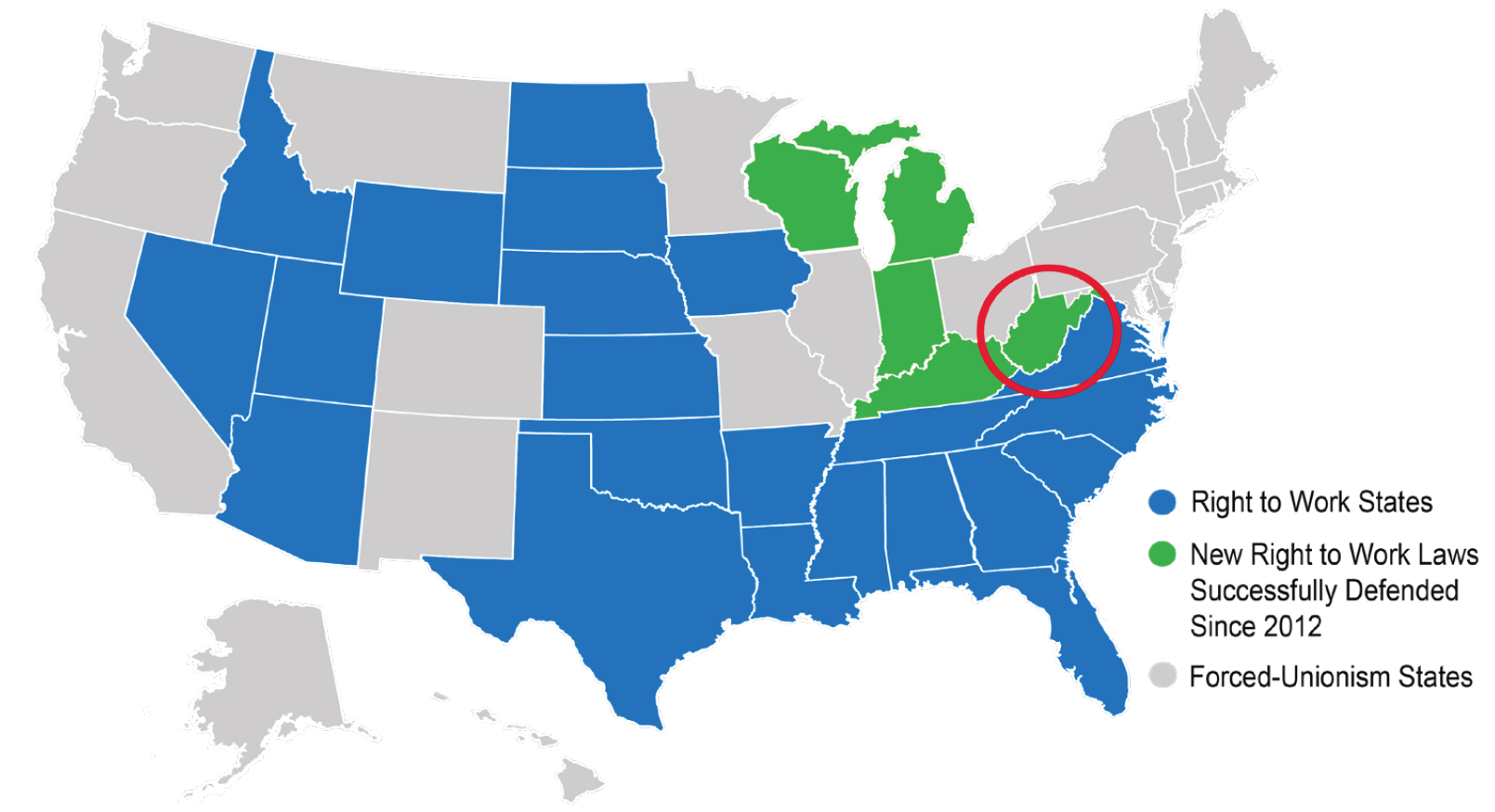
The Foundation added West Virginia to the list of states where it has successfully helped defend Right to Work since 2012. Now the state’s motto, “Montani Semper Liberi” (“Mountaineers are Always Free”) applies to the state’s workers.
CHARLESTON, WV – The West Virginia Supreme Court closed the book on a case brought by union lawyers seeking to overturn the state’s popular Right to Work Law, which protects Mountain State workers from being forced to pay dues or fees to a union as a condition of employment. Foundation staff attorneys filed 10 briefs in defense of Right to Work, including briefs submitted for pro-Right to Work employees who wanted the freedom to cut off financial support for unions in their workplace.
Ultimately, the West Virginia Supreme Court rejected outrageous arguments from union lawyers that union hierarchies have a legal “right” to a portion of a worker’s paycheck because that worker is also forced to accept their so-called “representation.” In their ruling, the justices repeatedly cited the landmark 2018 Foundation-won Janus v. AFSCME decision in which the U.S. Supreme Court ruled that requiring public sector employees to pay union dues as a condition of employment is a First Amendment violation.
In the decision, Justice Evan Jenkins wrote for the majority that West Virginia’s Right to Work Law “does not violate constitutional rights of association, property, or liberty” and that states are “expressly authorized under federal law” to prohibit union bosses from requiring dues or fees as a condition of employment. Justice Jenkins also maintained that Janus provides strong support for the law.
The West Virginia Legislature passed Right to Work over then-Governor Earl Ray Tomblin’s veto in February 2016, making West Virginia the 26th Right to Work state. The Foundation immediately offered free legal assistance to employees who had questions about exercising their rights.
Foundation Attorneys Spring into Action as Soon as Protections Enacted
The Foundation also created a special task force to defend the West Virginia law, which began applying to collective bargaining agreements that were entered into, modified, renewed or extended after July 1, 2016.
On June 27, 2016, lawyers for several state unions brought a case (later renamed West Virginia AFL-CIO, et al. v. Governor James C. Justice, et al.) in an attempt to overturn the popular law. Polling consistently shows that Americans overwhelmingly back Right to Work laws. A poll of union households even found that 80 percent of union members supported the Right to Work principle that union membership and dues payment should be voluntary and not required as a condition of employment.
Despite decades of precedent upholding such laws, Judge Jennifer Bailey of the Kanawha County Circuit Court issued a February 2017 order at the behest of union lawyers, granting a preliminary injunction that purported to block the law. The union lawyers’ primary arguments in this case for why the Right to Work protections for workers should be overturned had already been rejected by a Federal Court of Appeals and the Indiana Supreme Court. They also ran counter to nearly 70 years of legal precedent, including U.S. Supreme Court decisions, upholding the constitutionality of state Right to Work laws.
Foundation staff attorneys filed legal briefs for Reginald Gibbs, who worked as a lead slot machine technician with the Greenbrier Hotel in White Sulphur Springs, West Virginia, and Donna Harper, who worked as a laundry aide and nursing assistant at the Genesis HealthCare Tygart Center in Fairmont, West Virginia. Harper’s brief explained that because she had exercised her right under the Right to Work protections to refrain from subsidizing the Teamsters union at her workplace, killing those protections would result in her being fired.
Union Boss Attacks on Right to Work in Other States Successfully Turned Back
“The West Virginia Supreme Court’s unanimous decision to safeguard the right to freely choose whether or not one will financially support a union marks a great victory for Mountain State employees,” observed National Right to Work Foundation President Mark Mix. “Workers who disapprove of union boss activities can rest assured that they cannot be terminated for refusing to tender dues to a union, and those who want to support union activities may do so uninhibited.”
In addition to West Virginia, Foundation staff attorneys have successfully pursued legal action in recent years to defend and enforce new Right to Work laws in Indiana, Michigan, Wisconsin and Kentucky, all of which have passed Right to Work protections for employees since 2012.
Delaware Poultry Worker Charges UFCW Brass with Illegal Dues Deductions, Threats
The following article is from the National Right to Work Legal Defense Foundation’s bi-monthly Foundation Action Newsletter, July/August 2020 edition. To view other editions or to sign up for a free subscription, click here.
Foundation attorneys assist worker leading effort to oust unpopular union

Employees at the Selbyville, DE, Mountaire Farms plant were subjected to an illegal forced-dues clause by UFCW union bosses, who for months have also tried to block their right to vote on whether union officials deserve to stay.
SELBYVILLE, DE – With free legal aid from National Right to Work Foundation staff attorneys, Mountaire Farms employee Oscar Cruz Sosa hit United Food and Commercial Workers (UFCW) Local 27 union bosses with federal unfair labor practice charges. The charges assert that union officials violated his and his coworkers’ rights by enforcing an illegal forced-dues provision in the monopoly bargaining contract, and that union bosses threatened him for spearheading a petition for a vote to remove the union.
Cruz Sosa’s charges come after the National Labor Relations Board (NLRB) Region 5 Director in Baltimore rejected union arguments that the decertification election Cruz Sosa and his coworkers requested should be blocked. Under a controversial NLRB-created policy known as the “contract bar,” employees’ statutory right to hold a decertification vote to remove a union can be blocked for up to three years when a union contract is in place.
However, under longstanding precedent the “contract bar” to decertification does not apply when the monopoly bargaining contract in place contains an unlawful forced-dues clause.
Worker Deflects Union Legal Attack by Exposing Illegal Forced-Dues Clause
Prior to this charge, the NLRB Region 5 Director found that the contract between Mountaire Farms and UFCW union officials illegally required workers to immediately pay union dues upon being hired, instead of providing new hires a 30-day grace period the federal labor statute and longstanding precedent require. Because Delaware lacks Right to Work protections for its employees, Cruz Sosa and his coworkers can be required to pay union fees to keep their jobs.
The NLRB Region 5 Director thus ruled that the vote Cruz Sosa and his coworkers requested should proceed, and scheduled the vote to decertify the union. Cruz Sosa’s unfair labor practice charge, citing that decision’s finding that the forced-dues clause is unlawful, asks the NLRB to order union officials to refund all dues and fees seized from him and his coworkers under the auspices of that illegal clause.
Even after they were unable to block the election with the “contract bar,” UFCW union officials did not give up. In fact, union lawyers have initiated at least three other “blocking charges” against the employer in a last-ditch effort to block the vote, another common tactic used by union bosses to halt or delay workers’ attempts to vote them out.
UFCW union officials’ attempts to stifle the decertification effort didn’t end there. They also asked that any vote be delayed and changed to a“mail-in” vote, even though it had already been scheduled to take place in person on the premises where the workers work every day. In the responses to the union attempts to scuttle the planned vote, Cruz Sosa’s Foundation-provided attorneys argued that the vote should go forward as scheduled, because on-site elections are the NLRB’s preferred method for conducting elections, and the on-site vote was announced to workers weeks ago.
Cruz Sosa also alleged that a UFCW agent came to his house uninvited back in March. The agent warned him “that the decertification process being undertaken was ‘illegal’” and that a court battle was coming, according to his charge filed at NLRB Region 5.
Union Agents Threaten Worker after He Attempts to Exercise Rights
Cruz Sosa’s charge states that this was “threatening” and “coercive behavior” and a clear attempt to restrain him and his coworkers in the exercise of their right under the National Labor Relations Act to vote out an unwanted union.
“The threats and dues deductions in this case show how union bosses regularly trample workers’ rights in order to keep forced dues rolling into their coffers,” observed National Right to Work Foundation Vice President Patrick Semmens. “We hope that NLRB Region 5 will immediately prosecute the union for these violations, and ultimately order the union to refund all dues and fees collected from Mountaire Farms workers under the unlawful forced-dues clause.”
Semmens continued: “While UFCW officials were caught red-handed in this case, these types of forced union dues abuses will continue until Delaware workers have the protection of a Right to Work law, which ensures that all union membership and financial support are strictly voluntary.”
Las Vegas Police Officer Hits Union with Lawsuit for Seizing Union Dues in Violation of First Amendment Rights
Union officials enforced illegal “escape period” scheme to limit First Amendment right to cut off dues
Las Vegas, NV (August 13, 2020) – An officer of the Las Vegas Metropolitan Police Department (LVMPD) is suing both the Las Vegas Police Protective Association (PPA) union and the police department for illegally seizing union dues from her paycheck. The complaint, filed in the US District Court for the District of Nevada, states that officials of the PPA union and LVMPD illegally curtailed the officer’s First Amendment rights under the landmark 2018 Janus v. AFSCME Supreme Court decision by making the unlawful deductions. The officer is represented by National Right to Work Legal Defense Foundation staff attorneys.
In Janus, which was argued and won by Foundation staff attorneys, the High Court ruled that forcing public sector workers to subsidize a union hierarchy as a condition of employment violates the First Amendment. The justices also declared that union dues can only be deducted from a public sector employee’s pay with an affirmative and knowing waiver of his or her First Amendment right not to pay union dues.
According to officer Melodie DePierro’s complaint, she began working for LVMPD in 2006 and voluntarily joined the PPA union at that time. In January 2020 she first tried to exercise her Janus rights, sending letters to both union officials and LVMPD that she was resigning her membership. The letters demanded a stop to all union dues being taken from her paycheck. Her complaint reports that union and police department agents rejected that request, and did so again after she renewed her demands in February 2020. As of the filing of her lawsuit, full union dues are still being seized from her paycheck.
Union officials asserted that the monopoly bargaining contract between PPA and LVMPD only permitted employees to cut off union dues deductions within an “impermissibly narrow escape period between October 1 and October 20 each year,” DePierro’s complaint says. Her lawsuit points out that she “never signed any dues deduction authorization form agreeing to the restrictive escape period of 20 days contained” in the monopoly bargaining contract.
The complaint argues that the 20-day “escape period” imposed by union officials and the police department “caused and continues to cause deduction of and collection of dues from DePierro, who does not consent to paying union dues” and explains that this is “impermissible under Janus.” DePierro is demanding that the US District Court declare the “escape period” scheme unconstitutional, forbid PPA and LVMPD from further enforcing it, and order PPA and LVMPD to refund all dues that were unlawfully withheld from her pay since she tried to stop the deductions, plus interest.
With free legal aid from Foundation staff attorneys, public servants across the country have successfully challenged and overturned similar “escape period” policies. Just last month, a Foundation-backed lawsuit for four State of Ohio employees resulted in the elimination of such a scheme for almost 30,000 state workers. In nearby California, Ventura County Community College District math professor Michael McCain filed a class-action lawsuit which last year freed both him and his colleagues from another union-created “escape period.”
“Officer DePierro is working hard to keep Las Vegas safe during its reopening. Instead of respecting her First Amendment Janus rights, PPA union bosses have decided to keep imposing an unconstitutional policy on her just to keep her hard-earned money rolling into their coffers,” commented National Right to Work Foundation President Mark Mix. “The High Court made perfectly clear in Janus that affirmative consent from employees is required for any dues deductions to occur. Yet PPA union bosses are clearly violating that standard here.”





