
Michigan Worker Petitions NLRB to Apply New “Blocking Charge” Rule Protecting Right of Workers to Remove Unwanted Unions
Workers blocked from simply holding a vote to remove unpopular ATU union for months following union bosses’ unproven claims
Lansing, MI (April 8, 2020) – A Lansing transportation worker has just submitted a petition to the National Labor Relations Board (NLRB) in Washington, D.C., requesting that the Board permit her and her coworkers to vote whether to remove the Amalgamated Transit Union (ATU) from power at their workplace. The petition was filed with free legal aid from National Right to Work Legal Defense Foundation attorneys and responds to “blocking charges” ATU officials filed against her employer which have delayed the election.
The petition comes after the NLRB issued a final rule last week reforming the process by which union “blocking charges” are handled. “Blocking charges” are filed by union officials to prevent rank-and-file employees from exercising their right to vote whether to remove a union. The new rules generally permit employees to proceed with a vote whenever they demonstrate the necessary showing of interest. In the past unions could stay in power by blocking workers’ votes for months or even years while often unrelated allegations against employers were litigated. The new rule is set to go into effect this June.
According to this petition, the employee, Sandy Harris, filed a request for an election to remove the union in November 2019. Before her request was filed, the petition says, ATU union bosses filed “blocking charges” against her employer, Transdev Services. The NLRB Regional Director in Detroit then blocked the vote from taking place without an investigation or a hearing into whether the charges have merit. Harris’ petition notes that five months have now passed since an election was requested and that further delays are likely to occur now due to the impact of coronavirus on the NLRB’s operations.
In light of the NLRB’s new rules, Harris’ petition contends that the NLRB should process the employees’ request for a decertification election now and permit them to vote as soon as reasonably possible. This, according to the petition, would “vindicate the employees’ right to petition for a decertification election” under the National Labor Relations Act (NLRA), and prevent them from being “stuck in limbo” while waiting for the new rules to take effect this June. The petition also points out that union lawyers could and are likely to challenge the NLRB’s new rules in court, which could further slow the process.
The NLRB cited comments the Foundation submitted earlier this year dozens of times when it issued the final rule last week. Those comments pointed out that the NLRB’s old rules regarding “blocking charges” served only to keep union bosses in power while forbidding employees from exercising their right to vote to eliminate unwanted unions, and were merely the product of forced unionism-friendly board decisions, and not required by the NLRA itself.
“NLRB Region 7, by clinging to outdated, union boss-friendly rules, has allowed the ATU to remain in power at Ms. Harris’ workplace while needlessly stifling Ms. Harris’ and her coworkers’ right to vote out an unwanted union from their workplace,” commented National Right to Work Foundation President Mark Mix. “The NLRB should quickly enforce the new protections for employees.”
“It is outrageous that union officials continue to contend that workers’ right under the National Labor Relations Act to a decertification vote should be restricted based on unproven allegations of employer conduct,” added Mix.
Worker Advocate Encouraged by National Labor Relations Board Rule Rolling Back Barriers to Workers Voting Out Unions
Reform follows changes long advocated by National Right to Work Foundation, which has litigated hundreds of cases for workers seeking to oust unwanted unions
Washington, DC (April 1, 2020) – Citing comments from the National Right to Work Legal Defense Foundation, the National Labor Relations Board (NLRB) today formally issued a final rule eliminating some of the barriers that workers face when attempting to exercise their right to vote to remove an unwanted union.
National Right to Work Foundation President Mark Mix issued the following statement on the NLRB’s final rule:
While this NLRB still has much more to do, this long-awaited rule represents a significant step forward towards fully protecting the statutory right of employees under the Act to remove a union opposed by a majority of workers.
The blocking charge policy that is finally being modified has always been particularly odious in its treatment of employee rights, in that it allows union officials’ allegations against an employer to be grounds for blocking the statutory rights of employees who are not accused of any wrongdoing. Needless to say, in any other context, union bosses would be howling about employer conduct being used as grounds for blocking employees’ rights under the Act, yet here they support nullifying workers’ rights on the basis of any unproven allegation.
There are still additional non-statutory barriers to decertification that should to be eliminated, but we are encouraged that the Board took this step and thankful it made modifications to the proposed rule as advocated by the Foundation in its comments.
The rule reforms how the NLRB deals with union “blocking charges,” which are filed by union officials to prevent rank-and-file employees from exercising their right to vote to remove a union. Under the old rules, unions could block workers’ requested votes from taking place for months or even years by making allegations against the employer.
Under the new rule, union unfair labor practice charges cannot stall a vote from taking place. Additionally, and in apparent response to the Foundation’s comments, the NLRB modified its proposed rule so that in most cases ballots will be counted and not impounded, with the tallies released promptly.
The NLRB also substantially eliminated the so-called “voluntary recognition bar,” which was used by union officials to block workers from requesting a secret ballot election after a union was installed as the monopoly bargaining agent through an abuse-prone “card check” drive that bypassed the NLRB-supervised election process. The Trump NLRB did so by reinstating a system secured by Foundation staff attorneys for workers in the 2007 Dana Corp. NLRB decision. Although thousands of workers used the Dana process to secure secret ballot votes after being unionized through abusive card checks, the Obama NLRB voided employees’ Dana rights in 2010.
Additionally, the NLRB adopted the changes supported by the Foundation’s January comments to crack down on construction industry schemes through which employers and union bosses unilaterally install a union in a workplace without first providing proof of majority union support among the workers. Foundation staff attorneys represented a victim of such a scheme in a key case (Colorado Fire Sprinkler, Inc.) that ended when a U.S. Circuit Court of Appeals panel unanimously reversed the Obama Board and ruled for the worker who had been unionized despite no evidence of majority employee support for the union.
Full Foundation Action January/February 2020 Newsletter Now Online
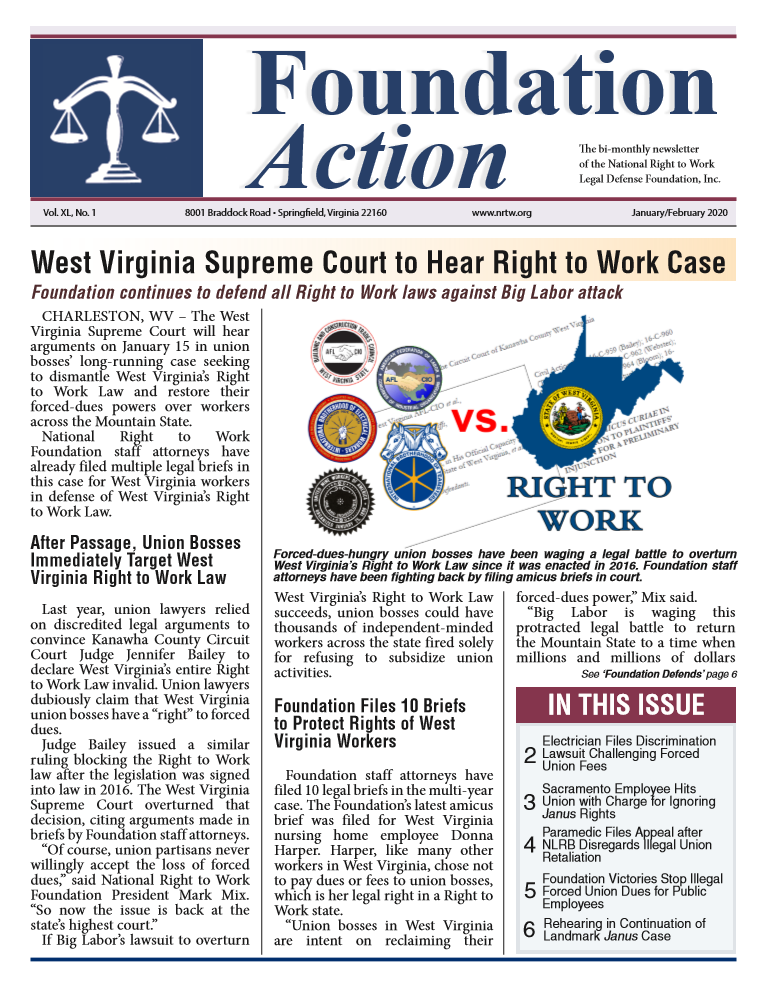
All articles from the January/February issue of Foundation Action are now on the website.
In this issue:
- West Virginia Supreme Court to Hear Right to Work Case
- Electrician Files Discrimination Lawsuit Challenging Forced Union Fees
- Sacramento Employee Hits Union with Charge for Ignoring Janus Rights
- Paramedic Files Appeal after NLRB Disregards Illegal Union Retaliation
- Foundation Victories Stop Illegal Forced Union Dues for Public Employees
- Rehearing in Continuation of Landmark Janus Case
Recent articles can be found here. To sign up for a free copy of the newsletter via mail please see the form at the bottom of the page.
Alaska Vocational Instructor Files Lawsuit against Union, State Challenging Dues Seizures in Violation of First Amendment
Alaska Governor attempted to affirmatively protect state employees’ Janus rights with Executive Order, but union bosses are blocking its enforcement
Anchorage, AK (March 31, 2020) – An Alaska prison employee has just filed a federal class-action lawsuit against the Alaska State Employees’ Association (ASEA) union and State of Alaska for restrictions on his and his coworkers’ First Amendment right to refrain from subsidizing a union. The lawsuit was filed in the U.S. District Court for the District of Alaska with free legal aid from National Right to Work Foundation staff attorneys.
The lawsuit, filed by Christopher Woods, says the ASEA union’s dues deduction scheme violates his and his coworkers’ First Amendment rights under the 2018 Foundation-won Janus v. AFSCME U.S. Supreme Court decision. The union scheme forbids employees from exercising their right to cut off union dues except during an annual 10-day “escape period.” However, in Janus, the high court ruled that no public sector employee can be forced to pay union dues or fees as a condition of employment, and that the First Amendment is violated when union officials deduct dues from the paychecks of public sector employees without their affirmative and knowing consent.
Woods began working as a Vocational Instructor at Goose Creek Correctional Center in 2013 and joined the union “because he was told by a union representative that he had no choice,” according to the lawsuit. His complaint reports that, on November 26, 2019, he sent an email to ASEA officials exercising his Janus right to “stop [his] union dues withdrawal.” A union official replied to him the same day and rebuffed his request, telling Woods that “he could only ‘opt out and not be a union member with written notice to this office’” within a 10-day period each year before the date he signed his original dues deduction authorization card.
Woods persisted on December 2, 2019, submitting to both ASEA officials and the payroll office of the Corrections Department another email asking to cut off dues. Although the payroll office confirmed to both Woods and the ASEA that it had received the request, an ASEA official responded by merely telling the payroll office that she was “still communicating with [Woods] on the matter,” the complaint says. Woods reports in his lawsuit that he has “not received any further communications” from either the ASEA or the payroll office, and that full dues are still being seized from his paychecks.
Woods’ lawsuit asks the District Court to rule that the ASEA union’s “escape period” enforced by the state and the deduction of union dues from his and other state employees’ paychecks without their clear, knowing consent violates his and his coworkers’ First Amendment rights. It also requests refunds of illegally seized dues for himself and his coworkers. Alaska Department of Administration Commissioner Kelly Tshibaka is named as a party in her official capacity only, due to the State of Alaska’s role in the unconstitutional dues deductions.
The federal lawsuit comes after an Anchorage Superior Court Judge put a hold on Alaska Gov. Mike Dunleavy’s order last year that all public sector unions in the state must obtain clear consent from all workers before deducting any union dues or fees, as Janus requires. That judge opined that Janus applies only to workers who are not formal union members, despite the fact that unions use their dues deduction policies to block workers from stopping dues even after they have resigned from formal union membership.
“Once again, Alaska union bosses are demonstrating that they will violate the First Amendment rights of the employees they claim to represent if it means stuffing their pockets with more forced dues,” commented National Right to Work Foundation President Mark Mix. “Ironically Alaska has taken the lead in attempting to proactively protect its employees’ First Amendment rights, but because union bosses have successfully resisted the Governor’s Executive Order so far this lawsuit is necessary.”
Wood’s legal team includes two Foundation staff attorneys who have successfully challenged forced union dues schemes in the U.S Supreme Court, not only in the landmark 2018 Janus case, but also in two earlier cases – Knox v. SEIU (2012) and Harris v. Quinn (2014). Foundation staff attorneys are currently litigating more than 30 cases for workers seeking to vindicate their First Amendment rights under the Janus precedent.
Rehearing in Continuation of Landmark Janus Case
The following article is from the National Right to Work Legal Defense Foundation’s bi-monthly Foundation Action Newsletter, January/February 2020 edition. Foundation staff attorneys are currently asking the U.S. Supreme Court to review the continuation of Mark Janus’ case. To view other editions or to sign up for a free subscription, click here.
Union bosses refuse to return dues seized in violation of First Amendment

A favorable decision for Mark Janus at the Seventh Circuit could be the next step toward public employees getting back millions of dollars that were seized from them by union bosses in violation of their First Amendment rights.
WASHINGTON, D.C. – Mark Janus won a landmark victory for American workers in 2018 when the Supreme Court acknowledged in Janus v. American Federation of State, County, and Municipal Employees (AFSCME) Council 31 that requiring public sector workers to pay union fees as a condition of employment infringed their First Amendment rights.
However, the coffers of the AFSCME union bosses who once had monopoly bargaining power over Janus — and the coffers of countless other unions around the country — are still flush with dues money that was seized from employees without their “affirmative and knowing” consent as the decision requires.
National Right to Work Foundation staff attorneys who represent Janus, along with attorneys from the Illinois-based Liberty Justice Center, have filed a petition to the Seventh Circuit Court of Appeals for a rehearing en banc in the continuation of his case. Janus seeks a ruling that will make AFSCME union officials return thousands of dollars in dues that were taken from his paycheck in violation of Janus since March 23, 2013. If the rehearing is granted, Janus’ case will be heard before 12 judges of the Seventh Circuit.
A three-judge panel of the Seventh Circuit refused to remedy AFSCME bosses’ unconstitutional conduct last November despite the High Court’s noting in Janus that union officials have been “on notice” for years that mandatory fees likely would not comply with the heightened level of First Amendment scrutiny articulated in the 2012 Knox v. SEIU Supreme Court decision, also won by Foundation staff attorneys.
“Mark Janus is simply asking the Seventh Circuit to remedy the years of unconstitutional conduct AFSCME bosses have perpetrated at his and other public sector workers’ expense,” observed National Right to Work Foundation Vice President Patrick Semmens.
At stake for Mark Janus is over $3,000 of his money that was seized by union officials in violation of his First Amendment rights. But a ruling in his favor could have a nationwide impact, setting a federal precedent that would be cited in dozens of other cases seeking refunds of dues taken unlawfully by public sector union bosses. Foundation staff attorneys are currently litigating more than 30 Janus-related cases that collectively seek more than $120 million in refunds.
Foundation Victories Stop Illegal Forced Union Dues for Public Employees
The following article is from the National Right to Work Legal Defense Foundation’s bi-monthly Foundation Action Newsletter, January/February 2020 edition. To view other editions or to sign up for a free subscription, click here.
Settlements end Big Labor restrictions on workers exercising Janus rights in New Mexico, Ohio

Shopping for a refund: Ohio school bus driver Donna Fizer won a refund of illegally seized dues after fighting schemes meant to block public employees from exercising their rights under the Foundation-won Janus decision.
CINCINNATI, OH – National Right to Work Legal Defense Foundation staff attorneys continue to win settlements for workers who have been trapped by arbitrary union-created “escape periods” or “window periods,” which violate workers’ rights by preventing them from stopping dues deductions.
In the 2018 Foundation-won Janus v. AFSCME decision, the U.S. Supreme Court held that requiring public sector employees to pay union bosses is unconstitutional. Yet, union bosses continue to tell workers they can only stop dues deductions during limited periods. After Foundation-backed lawsuits, however, they often choose to settle with workers rather than face Foundation staff attorneys in court.
In November, Ohio bus driver Donna Fizer won a settlement against Ohio Association of Public School Employees (OAPSE). With Foundation legal aid, Fizer sued OAPSE for continuing to take money from her paycheck after she resigned her union membership, which violates the Janus ruling’s protection of her First Amendment rights.
Workers Win Battles Coast to Coast Stopping Unconstitutional Dues
Fizer’s victory came when Foundation staff attorneys filed a federal lawsuit for her, contending the dues seizures OAPSE made from her paycheck after she resigned her union membership infringed her rights under Janus.
OAPSE bosses had told Fizer that she couldn’t leave the union except during a union-created “escape period” and continued to take a portion of her paycheck. As a result of the settlement, union bosses refunded her the money they seized under the illegal policy.
After the 2018 Janus ruling, Fizer notified school board officials she was “immediately withdrawing [her union] membership” and exercising her First Amendment Janus right to cut off union dues deductions.
The school district treasurer quickly complied and stopped the deductions from her paycheck, but OAPSE bosses responded by filing a grievance which alleged that Fizer could not revoke except within a tiny, union-created “escape period” that occurs only 10 days every few years. They demanded that the school district continue to illegally take money from Fizer.
Faced with a federal lawsuit union officials quickly settled the case, vindicating her rights. As part of the settlement, OAPSE bosses returned to Fizer all the dues they took from her paycheck since the date of her membership revocation, and further notified the district to cease any further deduction of union dues from her paycheck.
In October, Foundation attorneys won a settlement for New Mexico information technology worker David McCutcheon and 67 of his coworkers, who collectively received over $15,000 in refunds of dues seized by Communications Workers of America (CWA) bosses in violation of their Janus rights.
Foundation Wins Class Action Janus Lawsuit in New Mexico
McCutcheon works as an IT technician at New Mexico’s Department of Information Technology and was forced to pay union dues as a member before the 2018 Janus decision. After the Foundation-won victory, McCutcheon attempted to end the dues payments only to be told he could only do so during a brief two-week period in December, a violation of his rights under Janus.
Again, instead of fighting the lawsuit in court, CWA officials opted to settle the case. As part of the settlement agreement, CWA officials removed the union-created “escape period.” The union also paid back fully, plus interest, all dues taken from McCutcheon and others who had attempted to exercise their First Amendment rights under Janus but were blocked from doing so because of the “escape period” restrictions.
“Local 7076 and CWA will not enter into any [union contract] with the State of New Mexico that restricts to a yearly window period the time when a bargaining unit member may revoke a previously authorized dues deduction authorization,” the settlement reads.
“Union officials have no legal right to hold workers hostage in forced-dues ranks because of brief, arbitrary union-created window periods,” said National Right to Work Foundation Vice President and Legal Director Ray LaJeunesse. “It’s telling that these union bosses are settling in court rather than continuing to litigate these cases. It shows that the law, because of the Janus ruling, favors workers, not the interests of union bosses who want to trap them.”
Since the Janus decision in 2018, Foundation attorneys have litigated more than 30 cases seeking to enforce and expand the Janus victory, with others being filed all the time.
Gompers Preparatory Academy Educators File Response to SDEA Union Bosses’ Continued Attempts to Block Vote to Remove Union
Disastrous AB5 sponsor sides with union officials against teachers who remain trapped under union monopoly
San Diego, CA (March 27, 2020) – With free legal aid from the National Right to Work Legal Defense Foundation, educators at San Diego’s Gompers Preparatory Academy (GPA) are urging California Public Employment Relations Board (PERB) officials to let a secret-ballot vote proceed that could remove San Diego Education Association (SDEA) union bosses from power at the school. GPA teachers filed a response to union “blocking charges” brought against the school which could stall, for another year, the teachers’ right to a decertification election.
SDEA officials installed the union at the school in January 2019 after conducting a controversial “card check” drive, bypassing the more reliable method of a secret-ballot election whether to choose a union as the monopoly representative of all educators in the school. GPA transitioned from being a regular public school to a charter preparatory academy in 2005 as the result of a campaign by parents, teachers, and administrators who believed that school district and union bureaucracies were not serving the students’ interests, especially by failing to combat gang violence and teacher attrition at the school.
GPA parents and educators have accused union agents of sowing division at the school, including by supporting anti-charter school legislation, making unnecessary and disparaging comments to school leadership during bargaining sessions, and plotting to prevent the California NAACP from giving the school’s director, Vincent Riveroll, an award for helping minority students succeed.
Dr. Kristie Chiscano, who teaches chemistry to 10th and 11th grade students at GPA, began circulating a petition for a vote to decertify the union in October 2019. She soon obtained the signatures of well over the number of her fellow educators necessary to trigger a PERB-supervised secret-ballot vote to remove the union.
But, in December of last year, union officials preemptively filed a charge against the school seeking “that the certification year be extended.” That would block the educators’ right to remove the union from their workplace for another year despite no evidence or even an allegation that any educator violated the law. Such meritless “blocking charges” are a regular tactic union lawyers use to block rank-and-file employees from holding secret-ballot elections that may result in the removal of union officials from power.
Dr. Chiscano sought free legal aid from Foundation staff attorneys to decertify the union, and is now fighting to counter union “blocking charges.” The response filed with the PERB argues that the allegations union officials are making against the school’s leadership have no connection to the decertification effort and should not serve as grounds to deny the teachers’ right to a secret-ballot decertification vote. “PERB should thus proceed with a secret-ballot election as soon as practicable so Petitioner Chiscano and her fellow Gompers employees can exercise their right” to vote the union out, the response argues.
Meanwhile, California State Assemblywoman Lorena Gonzalez has jumped into the controversy on the side of SDEA union bosses. In a letter to GPA leadership she attacked the Right to Work Foundation simply for providing legal aid to GPA educators as they seek to exercise their right to hold a decertification election. The Foundation has provided legal aid to thousands upon thousands of teachers, including many charter school teachers.
Gonzalez, who regularly sides with union bosses over rank-and-file workers, introduced California’s disastrous AB 5 measure, which was written by union lobbyists and designed to foist union monopoly representation and forced union dues on independent contractors across the state of California. The bill has already led to a significant drop in opportunities for many workers across the state.
“SDEA union bosses are continuing to manipulate legal procedures to keep the educators they claim to represent trapped in union ranks instead of just letting them exercise their right to hold a decertification election,” commented National Right to Work Foundation President Mark Mix. “Foundation staff attorneys will continue to fight for Dr. Chiscano and her fellow educators until they are able to decide, free of coercion, who will speak for them in the workplace.”
Mix continued: “All these educators seek is a secret ballot vote to see whether a majority of their colleagues want the disruptive union out of their school. It is disgraceful but not surprising that Assemblywoman Gonzalez, who is elected by secret ballot, is opposing these teachers’ attempt to exercise their legal rights.”
Minnesota Building Materials Employees Win $30,000 after Illegally Being Fired at Behest of Teamsters Union Bosses
Workers receive back pay from employer but charges against Teamsters for union officials’ role in illegal termination and rights violations are still pending
Minneapolis, MN (March 25, 2020) – Two Minnesota building materials employees won a settlement in their unfair labor practice cases charging their former employer, OMG Midwest, for illegally firing them after the workers refused to formally join the Teamsters Local 120 union. The two workers charged that company and union officials told them several times – falsely – that union membership was required as a condition of employment. The settlement was won with free legal aid from National Right to Work Legal Defense Foundation staff attorneys.
As a result of the settlement, OMG Midwest will now pay over $30,000 in back pay to the two men. They will also “remove all references to the termination” from the two employees’ personnel files, post notices at OMG’s Belle Plaine, Minnesota, facility, and distribute those notices to individual employees. The notices will explain that workers cannot be forced to join a union as a condition of employment. Charges against the union for violating the two workers’ rights are still pending.
James Connolly recounted in his charges that he asked Teamsters officials via email on April 9, 2019, whether or not he would be compelled into joining the union as part of the job. The same day a union official wrongly replied, “Sorry James but yes you do have to join.” Later, on May 1, a representative of OMG Midwest reiterated the same false information to Connolly. Connolly responded to the company in a May 9 email, in which he repeated his unwillingness to formally join the Teamsters. OMG Midwest fired Connolly the next day. Connolly then filed unfair labor practice charges against OMG Midwest and the Teamsters union at National Labor Relations Board (NLRB) Region 18 with Foundation aid.
Later, in June, Charles Winter filed similar charges against OMG Midwest and the Teamsters union. Winter reported in his charges that at a company-wide meeting a Teamsters representative had told him and other employees that union membership is required in order to get or keep a job. When Winter later received an email from a company representative reiterating the false information that union membership was compulsory, Winter replied on May 20 holding firm that he would not join. He was fired in an email from the same company representative that same day.
Winter’s charge also alleged that the union membership form that Teamsters officials gave him was missing a legally-required estimate of the reduced union fees that union nonmembers would be required to pay under the Foundation-won CWA v. Beck Supreme Court decision.
Both men’s charges argued that the misinformation about membership and their firings clearly violated Section 7 of the National Labor Relations Act (NLRA), which protects the “right to refrain from any or all” union activities. Winter also charged that the union violated his right under Beck to be a nonmember and pay only the part of union dues directly germane to bargaining. As part of the settlement, OMG Midwest is required to include “a Notice of Beck Rights” in the rights notices it will disseminate to all bargaining unit employees.
Because Minnesota has not enacted Right to Work protections for employees, union bosses can have private sector workers fired for not paying fees to a union. However, union officials can only require workers to pay the portion of dues allowed by Beck and must follow certain Beck procedures before seizing such forced fees from workers who are not union members.
“Although it’s good news that Mr. Connolly and Mr. Winter have won these settlements which require OMG Midwest to make reparations for violating longstanding worker protections, the fact is that Mr. Connolly’s and Mr. Winter’s charges against the Teamsters union are still pending,” observed National Right to Work Foundation President Mark Mix. “NLRB Region 18 must swiftly prosecute Teamsters Local 120 officials so these two men’s rights can be fully vindicated.”
Mix added: “Ultimately, Minnesota legislators need to pass Right to Work protections for their state’s private-sector employees which will ensure that union bosses must use persuasion – not illegal intimidation or threats of firing – to secure the support of workers.”
Paramedic Files Appeal after NLRB Disregards Illegal Union Retaliation
The following article is from the National Right to Work Legal Defense Foundation’s bi-monthly Foundation Action Newsletter, January/February 2020 edition. To view other editions or to sign up for a free subscription, click here.
Appeal to NLRB General Counsel comes just months after Region 14 was reversed in similar case

Paramedic Jarod Aubuchon is appealing his case against Teamsters officials after they punished him for informing his coworkers of their rights to resign union membership and pay reduced dues.
St. LOUIS, MO – Jarod Aubuchon, a St. Louis-area paramedic who charged Teamsters Local 610 union officials with illegal retaliation after he tried to inform his coworkers of their right to pay reduced union dues, is filing an appeal in his case to the National Labor Relations Board (NLRB) General Counsel in Washington, D.C. He is represented free of charge by National Right to Work Legal Defense Foundation staff attorneys.
Aubuchon’s appeal comes after the October 2019 dismissal of his case by NLRB Region 14 officials in St. Louis. Region 14 was reversed by the NLRB General Counsel in a similar union retaliation case this summer, which was also brought by Foundation staff attorneys.
Union Officials Vow Punishments after Worker Posted Rights Notices
Aubuchon discovered the right of private sector workers under the Foundation-won CWA v. Beck Supreme Court decision to resign union membership and pay a reduced portion of union dues. Because Missouri is not a Right to Work state, private sector workers can still be compelled to pay part of union dues as a condition of employment.
Beck, won by Foundation staff attorneys in 1988, guarantees that employees who are not union members can only be required to pay fees to a union for expenses that are directly germane to bargaining, such as contract administration.
Armed with this new knowledge, Aubuchon posted flyers in common areas of his workplace informing his coworkers of their Beck rights. According to his charge, Teamsters agents responded by tearing down these notices and later demanding that his employer, Medic One, discipline him for the postings. Actions by union officials that cause an employer to discriminate against workers on such grounds are prohibited by the National Labor Relations Act (NLRA).
Aubuchon resigned his own union membership and asserted his Beck rights. Aubuchon’s charge states that neither his resignation nor his Beck rights have been acknowledged by Teamsters bosses, and full dues are still being seized from his paychecks.
Employee Appeals to NLRB General Counsel with Free Foundation Legal Aid
After NLRB Region 14 officials rejected his case, Aubuchon petitioned the NLRB General Counsel to overturn the decision and order remedies for the retaliation he experienced from Teamsters officials.
“They spend union money on political activism without consideration of its members,” Aubuchon said of Teamsters officials to the St. Louis Record after his appeal was filed. “We have a right to not have our money used in that manner and in the end I hope employees are better educated on their rights and how to exercise them.”
In July 2019, the General Counsel reversed Region 14 officials’ dismissal of a similar case brought by Foundation staff attorneys for Kansas City-area hospital worker Kacy Warner. Warner charged officials of the National Nurses Organizing Committee (NNOC) union with illegally interfering with a petition she was circulating for a vote to remove the union. That included tearing down flyers she had hung in bathrooms and other common areas in her workplace informing employees of the petition. In her case the NLRB General Counsel reversed Region 14’s dismissal and ordered region officials to prosecute the charge.
Region 14 officials were also overturned by the full Labor Board in October 2019 after the Region dismissed a petition for a vote to remove the union from St. Elmo, Illinois-based ConAgra Foods worker Robert Gentry’s workplace. United Food and Commercial Workers (UFCW) union bosses had attempted multiple times to stop workers at the plant from exercising the right to vote out the union.
“The NLRB is charged with enforcing workers’ rights under the National Labor Relations Act, yet there is a disturbing pattern of Region 14 failing to enforce the rights of rank-and-file workers when doing so advances the interests of union bosses,” commented National Right to Work Foundation Vice President Patrick Semmens. “It should not take an appeal to Washington, D.C., for workers to have their rights fully protected against union boss abuses.”





