
Grand Rapids GE Worker Slams UAW Union Officials with Federal Charges After Being Terminated for Refusing Membership
In months following repeal of Michigan Right to Work law, workers across the state are standing up to oppose union coercion
Grand Rapids, MI (July 30, 2024) – Richard Howard, an employee at General Electric (GE) Aviation Systems’ Grand Rapids facility, has slammed his employer and United Auto Workers (UAW) Local 330 union officials with two sets of federal charges. He maintains that union officials illegally instigated his termination after he refused to become a formal union member.
Howard’s charges come as Michigan workers increasingly seek to challenge union bosses’ legal powers in the wake of Michigan’s repeal of its Right to Work law. The repeal, which became effective this February, re-granted union officials the privilege to demand workers pay union dues or fees just to keep a job. So far this year, Foundation staff attorneys have already filed more than twice as many cases to defend Michigan workers’ rights than through all of 2023.
Howard filed his federal Unfair Labor Practice charges at Region 7 of the National Labor Relations Board (NLRB) in Detroit with free legal aid from the National Right to Work Legal Defense Foundation. Because Howard’s reasons for wanting to dissociate from the union stemmed from his Christian beliefs, something he had made clear when objecting to demands that he sign a union card, he also filed anti-discrimination charges against the UAW and GE with the Equal Employment Opportunity Commission (EEOC).
Howard’s charges state that, after the Right to Work repeal became effective, both GE and UAW agents told Howard and his colleagues that “they had 60 days to become Union members, sign dues checkoffs, and pay full dues to the Union.” Howard knew that union membership couldn’t be compulsory even in a non-Right to Work environment, but many conversations he had with officials of the union and GE about other options proved fruitless.
The NLRB is the agency responsible for enforcing federal labor law in the private sector. Even in states like Michigan that lack Right to Work protections, and allow for forced-fee requirements, longstanding federal law under cases like General Motors v. NLRB prevents union bosses from requiring workers to become formal union members. The Foundation-won Communications Workers of America v. Beck Supreme Court decision additionally forbids union bosses in non-Right to Work states from forcing workers who refrain from union membership to pay money for any activities beyond the union’s bargaining functions, such as political expenditures.
For religious objectors to union activity, Title VII of the Civil Rights Act of 1964 requires union officials to attempt to accommodate such workers. While Title VII accommodations take different forms from case to case, they generally eliminate any obligation the worker has to pay dues money directly to the union. One common accommodation is permitting a worker to pay an amount equivalent to dues or fees to a charity.
“I have repeatedly voiced my objections to the UAW and everything they stand for, including my religious objections to the union’s political activity. My rights may be limited due to the repeal of Michigan’s Right to Work law, but the union has acted like they don’t exist at all,” Howard said. “It is shameful that rather than respect my religious freedom and other workplace rights, the union instigated my firing.”
GE, UAW Wrongly Told Worker Membership Was Required
Howard’s charges describe how union and company officials stonewalled him when he asked about what options he had to opt out of the union: “Everyone he spoke to in both the Employer’s management and the Union told him that he was required to sign the union membership and dues deduction authorization card or he would be terminated and that he had no other options.” Even offers by Howard to pay a reduced amount of union dues as a nonmember (as per Beck) or pay money to a charity as a religious objector were rebuffed.
Finally, during an April meeting Howard had with GE and UAW agents, both parties threatened that he would be fired if he did not sign a union membership form and dues deduction authorization form within six days. Six days after the meeting, GE terminated Howard, and UAW union officials refused to file a grievance for him challenging the termination.
Worker Seeks Federal Injunction After Unlawful Union-Instigated Firing
Howard’s NLRB charges argue that the employer’s and union’s threats to fire him and the firing itself violated his right under Section 7 of the National Labor Relations Act (NLRA) to refrain from union activity. The charges also contend that UAW officials never informed him in writing of exactly what his obligations were before demanding his firing, a violation of the NLRB’s Philadelphia Sheraton Corp. precedent. The NLRB charges finally request that the NLRB seek a federal court order telling GE and UAW to immediately cease the illegal activity, something known as a “10(j) injunction”.
Howard’s EEOC charges state that both UAW and GE officials have failed to accommodate him or even consider his religious objection (as required by Title VII) and have ignored or shot down every attempt by him to seek an accommodation.
“The flurry of new cases that Foundation staff attorneys are litigating for Michigan workers shows that, post-Right to Work repeal, union bosses aren’t stopping at re-imposing their forced-dues legal power on workers. They seem to view the repeal as a license to force workers to associate with them in any way possible,” stated National Right to Work Foundation President Mark Mix. “As these recent cases demonstrate, Michigan workers deserve more freedom from union boss coercion – not less – and Michigan workers aren’t going to let their freedoms go without a fight.
“Workers may have any number of reasons for wanting to withhold their money from a union – religious reasons, financial reasons, or just because they believe union officials aren’t doing a good job,” Mix added. “That’s why the voluntarism of Right to Work is so important, and why every American worker deserves such protections.”
Full Foundation Action May/June 2024 Newsletter Now Online
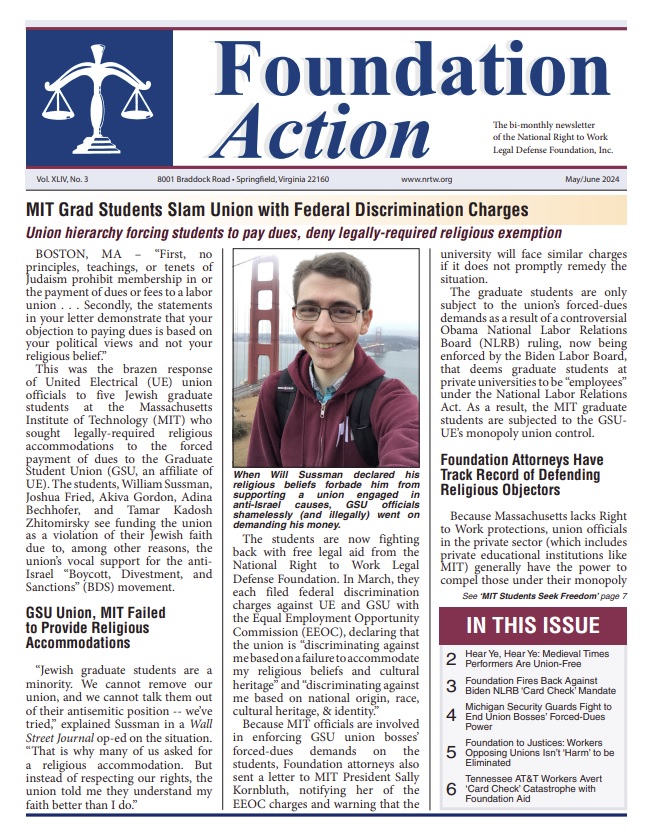 All articles from the May/June 2024 issue of Foundation Action are now online.
In this issue:
- MIT Grad Students Slam Union with Federal Discrimination Charges
- Hear Ye, Hear Ye: Medieval Times Performers Are Union-Free
- Foundation Fires Back Against Biden NLRB ‘Card Check’ Mandate
- Michigan Security Guards Fight to End Union Bosses’ Forced-Dues Power
- Foundation to Justices: Workers Opposing Unions Isn’t ‘Harm’ to be Eliminated
- Tennessee AT&T Workers Avert ‘Card Check’ Catastrophe with Foundation Aid
Recent articles can be found here. To sign up for a free copy of the newsletter via mail please see the form at the bottom of this page.
CUNY Professors Ask U.S. Supreme Court to Hear Case Challenging Forced Association with Antisemitism-Linked Union
NY law forces professors to be represented by hostile union bosses, but SCOTUS ruling could free public workers nationwide from unwanted union power
Washington, DC (July 22, 2024) – Six City University of New York (CUNY) professors are asking the U.S. Supreme Court to hear their federal civil rights lawsuit charging Professional Staff Congress (PSC) union officials with forcing them to accept the union’s so-called “representation” in violation of their First Amendment rights. The professors, five of whom are Jewish, oppose the PSC union’s public statements and other actions as being strongly anti-Semitic and anti-Israel.
The professors, Avraham Goldstein, Michael Goldstein, Frimette Kass-Shraibman, Mitchell Langbert, Jeffrey Lax, and Maria Pagano, are receiving free legal aid from the National Right to Work Legal Defense Foundation and The Fairness Center. The lawsuit challenges aspects of New York State’s “Taylor Law”, which grants union bosses monopoly bargaining power in the public sector. This permits union bosses to speak and contract for public workers, including those that want nothing to do with the union. In addition to opposing the union’s extreme ideology, the professors oppose being forced into a “bargaining unit” of instructional staff who share the union’s objectionable beliefs or have employment interests diverging from their own.
The professors’ petition of certiorari points out that the High Court has recognized for decades how public sector monopoly bargaining burdens workers’ First Amendment freedom of association rights. In 1944, the Supreme Court’s decision in Steele v. Louisville & Nashville Railway Co. recognized how rail union bosses were manipulating their powers over the workplace to discriminate against African-American railway workers. The Supreme Court restated its concerns most recently in the 2018 Foundation-won Janus v. AFSCME decision, with the majority calling monopoly bargaining “a significant impingement on associational freedoms.”
The petition also counters lower courts’ mistaken assertions that the Supreme Court’s 1984 Minnesota State Board for Community Colleges v. Knight decision disposes of the CUNY professors’ case. As the petition points out, Knight only dealt with public employees’ ability to participate in union meetings and not with the professors’ legal argument that being forced to accept the bargaining power and “representation” of union officials is a violation of First Amendment free association rights. With lower courts so frequently misinterpreting Knight, the petition argues the Supreme Court is needed to clarify the issue, and apply the proper First Amendment analysis to the New York laws’ forced-representation scheme.
“The core issue in this case is straightforward: can the government force Jewish professors to accept the representation of an advocacy group they rightly consider to be anti-Semitic? The answer plainly should be ‘no,’” the petition begins. “The First Amendment protects the rights of individuals, and especially religious dissenters, to disaffliate themselves from associations and speech they abhor.”
“Knight did not sanction a state forcing Jewish faculty members who are ardent Zionists to accept the representation of a union that supports policies they consider anti-Israel,” the petition continues. “The Court should grant this petition to clarify Knight and make clear that the First Amendment protects individuals’ right to dissociate themselves from advocacy groups that support policies contrary to their deeply held beliefs.”
Law Forces Jewish CUNY Professors to Associate with Anti-Israel PSC Union
The professors’ original complaint recounted that several of the professors chose to dissociate from PSC based on a host of discriminatory actions perpetrated by union agents and adherents, including a June 2021 union resolution that the professors viewed as “anti-Semitic, anti-Jewish, and anti-Israel.”
The complaint said Prof. Michael Goldstein “experienced anti-Semitic and anti-Zionist attacks from members of PSC, including what he sees as bullying, harassment, destruction of property, calls for him to be fired, organization of student attacks against him, and threats against him and his family.” Goldstein has needed a guard to accompany him on campus, the complaint noted.
Prof. Lax, the complaint explained, already received in a separate case a letter of determination from the Equal Employment Opportunity Commission (EEOC) “that CUNY and PSC leaders discriminated against him, retaliated against him, and subjected him to a hostile work environment on the basis of religion.” Prof. Lax “has felt marginalized and ostracized by PSC because the union has made it clear that Jews who support the Jewish homeland, the State of Israel, are not welcome,” said the complaint. As their petition of certiorari notes, these conflicts have significantly increased since October 7.
SCOTUS Asked to Overturn Laws Imposing Union Power on Public Workers
The petition asks the Supreme Court to take up the case and stop CUNY and the State of New York from letting PSC union bosses impose their “representation” on the professors. It also demands that the court declare unconstitutional Section 204 of New York’s Taylor Law to the extent that it compels the professors under union power.
Issues with union monopoly bargaining power in the academic sphere came into the national spotlight just this month, when the U.S. House Committee on Education and the Workforce held a hearing on fighting antisemitism in unions. There, Will Sussman, a Ph.D. student at the Massachusetts Institute of Technology, testified about how the law forces him and other graduate students across the nation to associate with union bosses that perpetrate divisive protests and denigrate Israel. Sussman, who is Jewish, filed federal discrimination charges against the MIT Graduate Student Union (GSU-UE).
“New York’s legal scheme forces these CUNY professors to associate with union officials who insult their identity and create a work environment rife with bullying and harassment. It’s hard to think of a more obvious violation of the First Amendment,” commented National Right to Work Foundation President Mark Mix. “The Supreme Court has expressed concerns with monopoly bargaining for decades, and it’s high time that the justices finally acknowledge the First Amendment protects government employees from being forced to associate with political so-called ‘representation’ they adamantly oppose.”
Nurses at Ascension Genesys Hospital Slam Teamsters Local 332 Officials with Federal Charges for Illegal Dues Demands
In months following repeal of Michigan Right to Work law, workers across the state are standing up to oppose forced dues
Flint, MI (July 19, 2024) – Two nurses at Ascension Genesys Hospital in Grand Blanc Township, MI, have hit the Teamsters Local 332 union with federal unfair labor practice charges, maintaining that union bosses threatened to fire them and other nurses if they didn’t sign forms authorizing union officials to deduct dues straight out of their paychecks. The nurses, Madrina Wells and Lynette Doyle, filed their unfair labor practice charges at the National Labor Relations Board (NLRB) with free legal aid from National Right to Work Foundation staff attorneys.
The charges from Wells and Doyle are the most recent in a flurry of Foundation-backed cases for Michigan workers who are seeking to challenge or escape union bosses’ coercive power in the wake of Michigan’s repeal of its Right to Work law. Since the repeal became effective this February, union bosses have had the legal power to require workers to pay union dues or fees as a condition of employment. In states with Right to Work protections, union membership and all union financial support are strictly voluntary.
The NLRB is the agency responsible for enforcing federal labor law in the private sector. Even in states like Michigan that lack Right to Work protections, and allow for forced-fee requirements, longstanding federal law prohibits union bosses from requiring workers to authorize the direct deduction of union dues from their paychecks. The Foundation-won Communications Workers of America v. Beck Supreme Court decision additionally forbids union bosses in non-Right to Work states from forcing workers to pay money for any activities beyond the union’s bargaining functions, such as political expenditures.
NLRB agents will now investigate Wells’ and Doyle’s charges. According to both, Teamsters officials threatened them “and similarly situated employees with termination of their employment if they refused to complete and submit a dues check-off authorization by July 12th.”
“I already had issues with Teamsters bosses illegally demanding money from me when Right to Work was in force,” commented Mardrina Wells. “Back then, I at least knew that I was defending my right to pay nothing at all to Teamsters bosses I disapprove of. It’s ridiculous that they now have the power to force me to pay them, but I’ll defend what rights I do have.”
Post-Right to Work, Michigan Workers Battle New Union Boss Privileges
In a party-line 2023 vote, Michigan legislators repealed Right to Work at the behest of union special interests, ending workers’ ability to decide for themselves whether or not union officials deserve their dues money. The imposition of union bosses’ power to force employees to “pay up or be fired” came despite polling showing Michiganders, including those in union households, overwhelmingly opposed the elimination of workers’ Right to Work protections.
After the repeal became effective this February, workers from across the Great Lakes State sought help from National Right to Work Foundation staff attorneys in escaping union bosses’ forced-dues demands. Foundation-backed workers from MV Transportation in Ypsilanti and Brown Motors in Petoskey just scored victories earlier this week, as NLRB officials certified their majority votes to strip Amalgamated Transit Union and Teamsters union officials respectively of their power to demand dues as a condition of employment. Such a vote, known as a “deauthorization election,” is triggered when 30% of employees in a work unit express support for one on a petition.
Foundation attorneys are also aiding Grand Rapids-based security guard James Reamsma and his coworkers posted at government buildings across Western Michigan with a deauthorization vote against United Government Security Officers of America (UGSOA) union officials. Reamsma expressed that, in the wake of the Right to Work repeal, “UGSOA union officials have threatened to have everyone who does not join the union fired.”
“Michigan union bosses prioritize seizing dues over respecting workers’ individual rights, and have only been emboldened by the legislature’s partisan repeal of Right to Work,” observed National Right to Work Foundation President Mark Mix. “But Michigan workers have been increasingly standing up to defend what rights they still have against union coercion, and it’s important that every worker learn those rights as union officials continue to exploit the new forced-unionism environment.”
Tennessee AT&T Workers Avert ‘Card Check’ Catastrophe with Foundation Aid
The following article is from the National Right to Work Legal Defense Foundation’s bi-monthly Foundation Action Newsletter, May/June 2024 edition. To view other editions of Foundation Action or to sign up for a free subscription, click here.
CWA union officials tried to lock workers in inescapable unit without vote

President Biden, a longtime ally of radical CWA union officials, has stocked the National Labor Relations Board with ex-union lawyers who are manipulating labor law to give union bosses more options to trap workers in unions without a vote.
TENNESSEE – Over the years, National Right to Work Foundation staff attorneys have successfully represented countless workers across the country who have opposed union officials’ attempts to force them under monopoly bargaining via the coercive “card check” process. Unsurprisingly, workers prefer to cast ballots in secret, as opposed to having that right snatched in favor of a scheme where union bosses can intimidate workers into signing a card “authorizing” union control.
Fortunately, workers can turn to the Foundation for free legal aid in fighting coercive card check unionization. For example, in March, Denis Hodzic and his fellow In-Home Experts from AT&T Mobility locations across Tennessee successfully challenged a card check campaign by Communications Workers of America (CWA) union bosses that would have almost certainly confined them in the union for the rest of their careers with the company.
Union Bosses Tried to Trap Workers, Then Fled When Faced with Actual Vote
CWA agents installed themselves over Hodzic’s work unit — which was comprised of over 100 AT&T In-Home Experts — by card check. Shortly after, however, Hodzic filed a petition asking the National Labor Relations Board (NLRB) to hold a “decertification vote” to remove the union. Roughly two-thirds of his work unit signed the petition demanding a secret-ballot vote on the union’s presence.
CWA union officials filed objections in an attempt to stop the election, but an NLRB Regional Director rejected these and ruled that a decertification election should go forward. Before the vote could occur, CWA union officials filed paperwork disclaiming interest in continuing their control over the workers — likely to avoid an embarrassing rejection by employees at the ballot box.
Had Hodzic and his coworkers’ effort not succeeded, NLRB documents indicate that they would have been integrated into a nationwide bargaining unit comprised of thousands of employees, which would have made petitioning for a vote to kick out the union virtually impossible.
Biden NLRB Boosting Card Check Despite Unreliability
Cases like Hodzic’s serve as potent reminders that card check doesn’t represent the true will of workers vis-à-vis bringing in a union. Even AFL-CIO organizing guidelines admit that employees often sign cards during a card check to “get the union off my back.”
Despite this, the Biden NLRB is rapidly increasing union bosses’ ability to corral workers into a union via card check while cutting down workers’ ability to vote in secret-ballot union elections. In the August 2023 Cemex decision, the agency greatly expanded union bosses’ power to overturn elections that don’t go in their favor if an employer requests such an election to challenge a card check.
The Biden NLRB is also conducting rulemaking to overturn the Election Protection Rule (EPR), a set of Foundation-backed reforms that the NLRB adopted in 2020. The EPR permits employees to submit decertification petitions within a 45-day window after the finalization of a card check. This process was originally established by Foundation attorneys in the 2007 Dana Corp. NLRB case. Though this decision was later overturned by the Obama NLRB, “Dana elections” were codified in the EPR.
Hodzic and his colleagues were able to request their election under the auspices of this policy.
“The NLRB Election Protection Rule was essential for us to rely on as we went through the process of seeking resolution to our tricky situation,” Hodzic commented. “The 45-day petition window needs to remain regardless of which group holds the majority position in Washington . . . . [W]e hope that lawmakers see the necessity of having this rule in place, and that both unions and employers abide by the laid-out NLRB processes to ensure fair representation and protection of workers.”
“While Mr. Hodzic’s story had a happy ending, his situation illustrates just how dire things will get once the Biden NLRB’s anti-freedom agenda is fully realized,” commented National Right to Work Foundation Vice President and Legal Director William Messenger. “While American union bosses may desire a world in which they can force employees into inescapable work units without even a vote, Foundation attorneys will continue to fight for workers’ right to choose freely whether they want union control or not.”
Foundation to Justices: Workers Opposing Unions Isn’t ‘Harm’ to be Eliminated
The following article is from the National Right to Work Legal Defense Foundation’s bi-monthly Foundation Action Newsletter, May/June 2024 edition. To view other editions of Foundation Action or to sign up for a free subscription, click here.
Brief in Starbucks-related SCOTUS case counters Labor Board attempts to impose union control
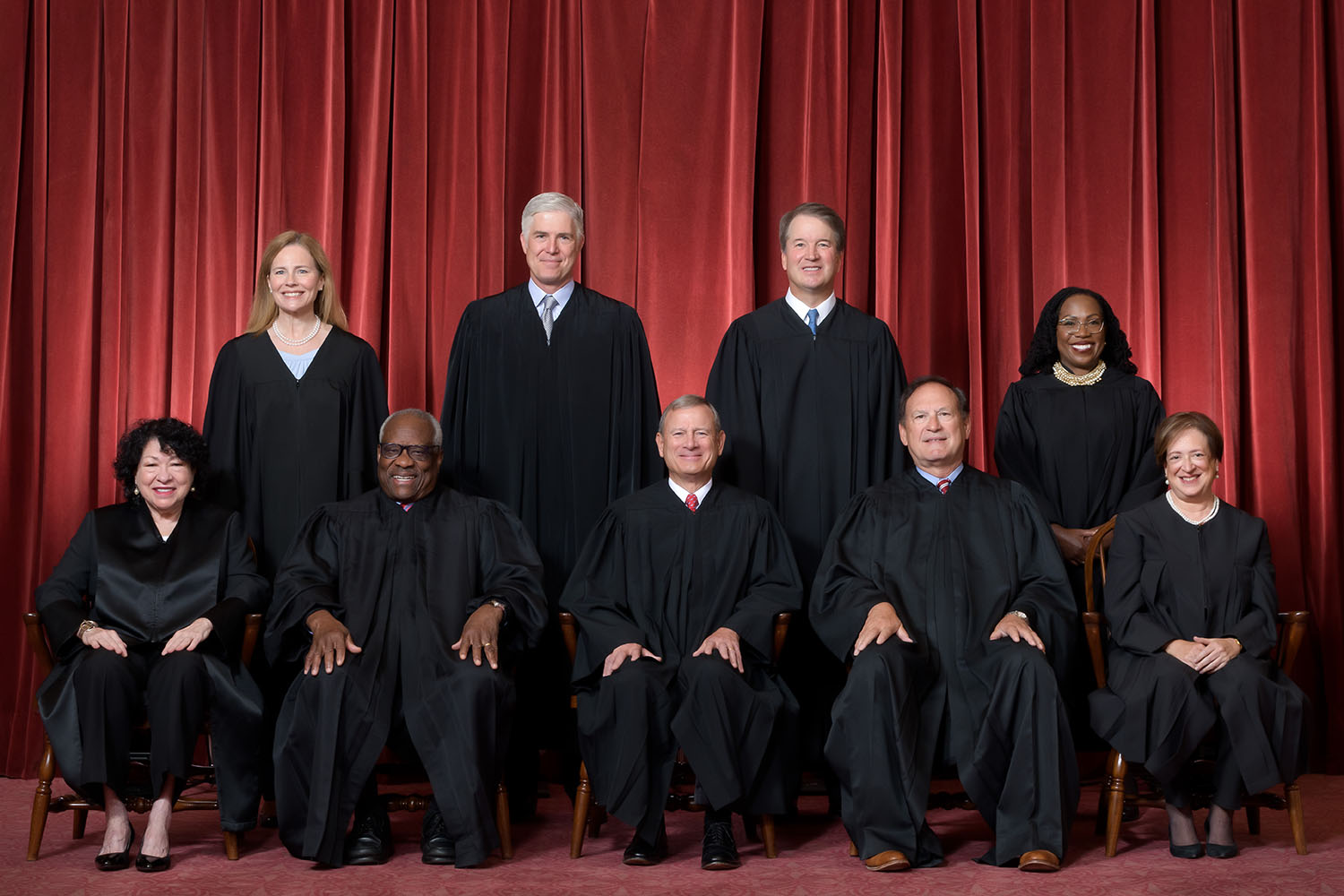
With the Supreme Court reviewing the standard used when the NLRB seeks injunctions that cement unions in power, the Foundation told the High Court such injunctions should not be allowed to infringe on workers’ legitimate right, under federal labor law and the Constitution, to oppose unionization.
WASHINGTON, DC – “Heads I win, tails you lose”: That’s how a brief filed by National Right to Work Foundation staff attorneys with the U.S. Supreme Court describes the Biden National Labor Relations Board’s (NLRB) argument that worker opposition to a union should count as a reason to impose union bosses’ demands on a workplace. The Supreme Court agreed to hear a case on this issue in January, with arguments scheduled for late April.
“Evidence that employees support a union is taken to mean they want to support the union,” the brief says. “Evidence that employees oppose a union is taken to mean their employer must have wrongfully caused the employees not to support the union. All evidence conveniently leads to the conclusion desired by current NLRB leadership: employees should support unions.”
The Foundation’s brief before the High Court in Starbucks v. McKinney discusses how NLRB officials use this radical assumption to urge federal courts to hit employers with “10(j) injunctions” that coerce the employers to give into certain union-demanded behavior. As Foundation attorneys explain, the NLRB often tells courts that worker discontent with a union is a “harm” that the courts should rectify with a 10(j) injunction.
Foundation in Starbucks Case: Worker Opposition to a Union is a Basic Right
Foundation staff attorneys push back on this theory in their legal brief, arguing that an employee’s decision to not support a union is not a “harm,” but a “legitimate choice [they] have a right to make” under both the National Labor Relations Act (NLRA) and the First Amendment to the Constitution.
Union bosses and their allies in the NLRB want the U.S. Supreme Court to establish a rule in Starbucks v. McKinney that permits injunctions against employers if their alleged conduct could potentially coerce workers into not supporting a union. Foundation attorneys instead argue that “the Court must require the NLRB to prove employees were unlawfully coerced not to support a union because, absent such proof, employees have every right to make that choice” (emphasis added).
Starbucks Workers Challenging NLRB Constitutionality
In addition to fighting cynical attempts by Biden NLRB bureaucrats to turn worker opposition to unions into a reason to beef up union officials’ coercive power, Foundation attorneys are assisting two groups of Starbucks workers with federal lawsuits challenging the constitutionality of the Biden NLRB as a whole.
The newest effort comes from San Antonio, TX-area Starbucks employee Reed Busler and his coworkers. They submitted a petition to the NLRB containing enough employee signatures to prompt a vote to “decertify,” or remove, the SBWU union. But an NLRB Regional Director blocked the vote based on union allegations of employer misconduct that have no proven connection to Busler and his colleagues’ effort to vote out the union. Busler himself noted in an NLRB filing that the move to decertify started “because the Union was a divisive force in our store” and ignored workers.
Busler has filed a federal lawsuit against the NLRB arguing its structure violates the Constitution’s separation of powers doctrine because NLRB Board Members are insulated from at-will removal. The lawsuit seeks an injunction that halts the NLRB from proceeding with his decertification case until his federal lawsuit is resolved.
“Starbucks is becoming ‘ground zero’ for several key battles over worker freedom,” commented National Right to Work Foundation Vice President Patrick Semmens. “Underlying a large portion of the drama is the NLRB’s flawed theory that workers’ exercise of their right to oppose unions is an evil to be eradicated, which unions and their allies in the NLRB bureaucracy are trying to use to force down their agenda on workplaces across the country.
“An even bigger issue, however, is the fact that the NLRB has for decades operated as a kangaroo court run by powerful bureaucrats who exercise unaccountable power in violation of the Constitution,” Semmens added. “American employees shouldn’t be forced to fight for their rights in such a pro-union boss environment.”
Employees at Eight Philadelphia International Airport Restaurants May Soon Vote Out Unite Here Union Bosses
Federal labor board in Philadelphia rejected all union arguments for blocking employee-requested election; vote now scheduled for July 17
Philadelphia, PA (July 10, 2024) – After almost five months of litigation, Kale Mulugeta and her coworkers at various restaurants throughout Philadelphia International Airport will finally get a chance to vote on whether to remove Unite Here Local 274 union officials from power. Mulugeta, who is receiving free legal aid from National Right to Work Foundation staff attorneys, spearheaded the effort by filing a petition requesting such a vote – which is known as a “decertification election” – with National Labor Relations Board (NLRB) Region 4 in Philadelphia in February.
Mulugeta’s petition contained signatures from over 60% of her coworkers at New York Ice Cream, Inc., which operates two Dunkin Donuts locations, three Smashburger locations, two Jamba Juice locations, and one Bruegger’s Bagels location at Philadelphia International Airport. NLRB rules only require that 30% of a work unit express interest in having a union decertification election in order to trigger such an election.
After months of delay caused by union litigation, NLRB Region 4 announced in a June 27 Decision and Direction of Election that the election will occur on July 17 at Philadelphia International Airport.
Because Pennsylvania lacks Right to Work protections for its private sector workers, Unite Here union officials are empowered by law to demand Mulugeta and her coworkers pay union dues just to keep their jobs. In contrast, in Right to Work states, union membership and union financial support are strictly voluntary. If a majority of the New York Ice Cream employees vote on July 17 to remove the Unite Here union, they will be free from both the union’s bargaining power and forced-dues demands.
Union Bosses Tried to Portray Dues-Paying Employee as “Manager’s Agent” to Stop Vote
NLRB Region 4’s Decision and Direction of Election puts an end to nearly five months of litigation over Mulugeta’s petition. Unite Here union officials tried to argue that Mulugeta, who in addition to other restaurant duties often serves as a translator between managers and Amharic-speaking restaurant staff, was ineligible to submit the petition because she was an agent of the manager and not a rank-and-file employee. The union claimed she was ineligible despite the fact that she pays money to the union as a condition of staying employed.
The NLRB Region 4 Director rejected these union arguments, stating that “the record is devoid of any witness testimony from employees showing their perception of Mulugeta’s authority, or whether they believed that Mulugeta spoke for and on behalf of the Employer…”
“As such, Mulugeta’s role as a bilingual employee serving solely as the Employer’s interpreter is insufficient to elevate her status to that of an agent or apparent agent [of the employer],” the decision states.
The decision also threw out union contentions that Mulugeta and some of her other colleagues were “managerial employees” and thus outside the bargaining unit and ineligible to vote. “There is no evidence that Mulugeta [and her colleagues] attend any management meetings…or that they have any authority to formulate or effectuate high-level policy on behalf of the Employer,” the decision states.
Unite Here Local 274 Facing Second Removal Attempt by PHL Employees Since 2023
Mulugeta and her coworkers aren’t the only workers at Philadelphia International Airport that Foundation staff attorneys have aided recently in voting out Unite Here Local 274. In May 2023, employees at the airport’s location of Guava & Java voted to remove the union 32-9 after obtaining a vote with free Foundation legal aid.
“Ms. Mulugeta and her coworkers’ situation demonstrates the struggles that rank-and-file employees face when trying to exercise their right to free themselves from a union hierarchy that they don’t believe serves their interests,” commented National Right to Work Foundation President Mark Mix. “Workers face legal resistance from union lawyers themselves. But it also doesn’t help that the perennially pro-union boss Biden NLRB has been pushing policy after policy designed to aid union bosses in trapping workers under union ‘representation.’
“Ms. Mulugeta and her coworkers deserve this chance to finally exercise their rights, and Foundation staff attorneys are proud to help them,” Mix added.
U.S. House Committee Spotlights Need for Employee Protections Against Forced Funding of Extremist Unions
Jewish MIT graduate student forced to pay dues to anti-Israel GSU union will testify alongside National Right to Work Foundation staff attorney
Washington, DC (July 9, 2024) – Today, Massachusetts Institute of Technology (MIT) Ph.D. student Will Sussman, who is receiving free legal aid from the National Right to Work Foundation in filing federal anti-discrimination charges against union bosses on campus, is testifying before the U.S. House Committee on Education and the Workforce.
Sussman is testifying alongside veteran Foundation staff attorney Glenn Taubman, who is providing free legal representation to Sussman and other MIT graduate students challenging forced-dues demands from the MIT Graduate Student Union (GSU-UE, an affiliate of the United Electrical Workers union).
The hearing, being held by Rep. Bob Good (R-VA) in the Subcommittee on Health, Employment, Labor, and Pensions (HELP), was called to focus on how union bosses have used their government-granted powers to force Jewish and other employees to associate with and fund unions – even as union officials are propping up increasingly radical protests and other objectionable activities on college campuses and workplaces across the country.
Jewish MIT Graduate Student: BDS-Linked Union Refused to Grant Religious Accommodation
Sussman, who is Jewish, objects to the anti-Israel advocacy of the GSU union, including the union’s endorsement of the “Boycott, Divestment and Sanctions” (BDS) movement. He and four other Jewish graduate students sent letters to GSU union officials earlier this year requesting religious accommodations to union dues payment.
Title VII of the Civil Rights Act of 1964 requires union officials to accommodate those that have religious objections to subsidizing union activities; in practice this usually entails letting the student pay an amount equivalent to dues to a charity. However, GSU union officials’ initial response was to brush aside students’ requests, claiming they didn’t understand their own faith and that their objections were actually political and not religious in nature.
“The union denied my request, telling me in a letter that ‘no principles, teachings or tenets of Judaism prohibit membership in or the payment of dues or fees to a labor union,’ that one of UE’s founders was Jewish, and that opposition to BDS isn’t a position I hold for religious reasons. In other words, UE thinks it understands my faith better than I do,” Sussman’s testimony reads.
Sussman is one of six MIT graduate students that Foundation attorneys are representing in federal proceedings against the GSU union.
Biden NLRB Policy Lets Union Officials Seize Control Over Graduate Students
As Foundation attorney Glenn Taubman’s testimony describes, partisan rulings by the National Labor Relations Board (NLRB) have bypassed Congress and given union bosses the ability to seize control over graduate students: “The current travesty of herding graduate students into anti-semitic unions finds its source with the Obama-Biden National Labor Relations Boards, which have by fiat turned graduate students into graduate employees – subject to unionization under the NLRA and, of course, the payment of forced union dues as a condition of their academic careers,” Taubman’s testimony reads.
Giving unions such monopoly bargaining power not only permits union bosses to dictate the conditions of graduate students’ academic work, but also gives them the power to force students to pay dues in states that lack Right to Work laws (like Massachusetts).
Even worse, union bosses are able to conduct disruptive strikes that stunt academic progress and frequently have outrageous political elements that have no connection to academics: For example, the recent strike United Auto Workers (UAW) union officials engineered against the University of California system was designed to defend anti-Israel rioters who were suspended and pressure university administrators into divesting from companies supporting Israel.
“Mr. Sussman’s situation should provide to American legislators a harrowing example of the kind of harm workers experience when union bosses seize monopoly bargaining power and become the mouthpiece for an entire workplace,” commented National Right to Work Foundation President Mark Mix. “The NLRB under Biden and Obama has done even more damage by expanding this coercion into academia, where campus unions have fomented unprecedented division all while threatening dissenting students with the loss of their academic work if they don’t pay up to support radical union activities.”
“National Right to Work legislation would ensure that those trapped under unwanted union influence can protect their hard-earned money from flowing into union bosses’ pockets,” Mix added. “Ultimately, though, no individual should be forced under union bosses’ so-called ‘representation’ against their will, no matter whether the source of their opposition is religious, political, or any other reason.”





