
Flight Attendant Asks SCOTUS to Hear Case Challenging Union Boss Scheme to Discriminate Against Nonmembers
Petition: Ninth Circuit wrongly ruled that federal labor law lets union officials take away on-the-job benefits for refusal to pay union fees
Washington, DC (April 23, 2025) – Flight attendant Ali Bahreman has just filed a petition asking the U.S. Supreme Court to hear his case challenging a Transportation Workers Union (TWU) contract that deprived him of his ability to use his seniority to bid on flight assignments and secure other valuable job benefits. Bahreman, who refrained from formal union membership, is arguing that a union monopoly contract between Allegiant Airlines management and TWU union bosses violated the Railway Labor Act (RLA) by conditioning flight attendants’ “bidding privileges” on their payment of fees to the union.
The RLA governs employment arrangements like Bahreman’s in the rail and air industries. The RLA is a federal law that permits union officials and employers to enforce so-called “union security agreements” that require workers in a unionized workplace to pay union fees to keep their jobs.
Bahreman’s petition points out that although the RLA grants union officials the power to enter into contracts that require payment of union fees as a condition of employment, it has long been illegal for unions to enter into contracts that otherwise discriminate against certain classes of workers, like nonmembers. This goes all the way back to the 1944 Steele Supreme Court precedent that created what the court called the “Duty of Fair Representation” (DFR) in order to save the RLA from being declared unconstitutional after union officials used their power to impose a contract that discriminated against workers based on their race.
The petition argues that not only does the Ninth Circuit Court of Appeals’ decision upholding the discriminatory scheme conflict with opinions from other federal courts of appeal, but if left in place, the decision calls into question the constitutionality of union exclusive bargaining powers under both the RLA and the National Labor Relations Act (NLRA):
“Having unraveled the DFR, the Ninth Circuit’s decision allows unions to wield congressionally delegated exclusive representation power without the DFR’s limitations. That raises ‘serious constitutional questions’ regarding exclusive representation’s constitutionality…
“Ensuring that the Ninth Circuit’s decision does not dismantle employees’ RLA and NLRA speech and associational freedoms from forced unionism is of national importance. The Ninth Circuit’s decision jeopardizes employees’ ability to do their jobs free from union coercion, hostility, and discrimination in the workplace.”
Petition Exposes That Lower Court Decision in Favor of TWU Allows Union Bosses to Discriminate in Workplace
The petition comes after the Ninth Circuit Court of Appeals puzzlingly ruled that the RLA permits union officials to enforce contracts that require employers to eliminate on-the-job benefits from workers who refuse to pay union fees. Bahreman’s petition goes on to explain that the Ninth Circuit’s reasoning greenlights discrimination by union bosses in their treatment of union members and nonmembers, which flies in the face of the duty of fair representation that federal law imposes on all union officials.
Federal law permits union officials to extend their monopoly bargaining powers over all workers in a unit, including those who oppose the union, but requires that union officials not discriminate against nonmembers. Therefore, the petition says, monopoly bargaining itself should be reexamined if the Ninth Circuit’s ruling is upheld.
“Mr. Bahreman’s case shows how deep the rabbit-hole of union boss legal privileges goes,” commented National Right to Work Foundation President Mark Mix. “The Ninth Circuit’s decision turns the U.S. Supreme Court’s ‘duty of fair representation’ on its head, and exposes the underlying constitutional tensions that the Court identified long ago in the 1944 Steele High Court decision.
“Originally created in Steele as a bulwark against union bosses wielding their monopoly representation and forced dues powers to discriminate, the Ninth Circuit’s reinterpretation of the DFR doctrine allows union officials to engage in discrimination to coerce fee payment from union dissidents,” added Mix. “The Supreme Court should take Mr. Bahreman’s case to settle the circuit split and make it clear that Big Labor officials cannot wield their extraordinary government-granted powers to undermine the working conditions of workers who oppose union affiliation.”
Professors Launch Landmark SCOTUS Bid to End Forced Union Association
The following article is from the National Right to Work Legal Defense Foundation’s bi-monthly Foundation Action Newsletter, September/October 2024 edition. To view other editions of Foundation Action or to sign up for a free subscription, click here.
NY law unconstitutionally forces professors under “representation” of anti-Semitic union
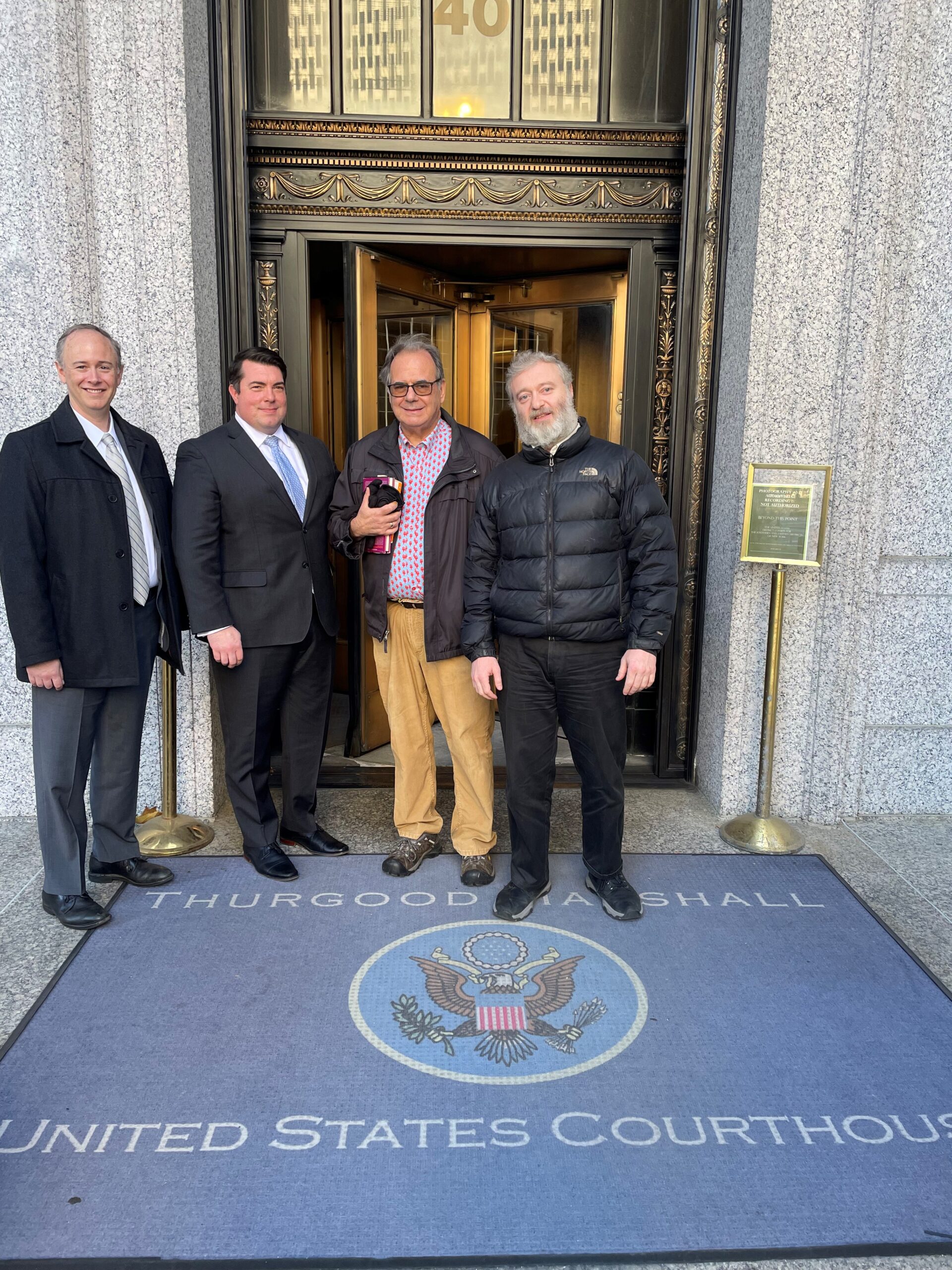
Together, (from left) Foundation Legal Director William Messenger, Fairness Center General Counsel Nathan McGrath, and CUNY Professors Mitchell Langbert and Avraham Goldstein seek to establish new protections against forced union association.
WASHINGTON, DC – Avraham Goldstein, a mathematics professor at the City University of New York (CUNY), wrote in a 2022 Wall Street Journal op-ed about the predicament that he and many of his Jewish colleagues face because New York law forces them under the “representation” of an anti-Israel union: “I had paid thousands of dollars in union dues for workplace representation, not for political statements or attacks on my beliefs and identity. I decided to resign my union membership and naively thought I could leave the union and its politics behind for good . . . I was wrong.”
It was this situation that led Avraham Goldstein, along with fellow professors Michael Goldstein, Frimette Kass-Shraibman, Mitchell Langbert, Jeffrey Lax, and Maria Pagano, to file a federal lawsuit against the Professional Staff Congress (PSC) union, CUNY, and State of New York officials in 2022. That lawsuit challenged New York State’s “Taylor Law,” which grants union bosses monopoly bargaining power in the public sector. Such power permits union bosses to speak and contract for public workers — including those that want nothing to do with the union.
Professors’ Petition: First Amendment Protects Union Dissenters
Staff attorneys from the National Right to Work Foundation and The Fairness Center have litigated the professors’ case up through the federal court system. Now they’re asking the U.S. Supreme Court to take their case and clarify that the First Amendment forbids union officials from foisting their voice and values on public sector workers who oppose the union.
“The core issue in this case is straightforward: can the government force Jewish professors to accept the representation of an advocacy group they rightly consider to be anti-Semitic? The answer plainly should be ‘no,’” the petition begins.
The High Court has recognized for decades how public sector monopoly bargaining burdens workers’ First Amendment freedom of association rights. In 1944, the Supreme Court’s decision in Steele v. Louisville & Nashville Railway Co. recognized how rail union bosses were manipulating their powers over the workplace to discriminate against African-American railway workers. The Supreme Court restated its concerns most recently in the 2018 Foundation-won Janus v. AFSCME decision, with the majority calling monopoly bargaining “a significant impingement on associational freedoms.”
Original Complaint Detailed Union Bosses’ Discrimination
The professors’ original complaint, filed in the U.S. District Court for the Southern District of New York, recounted that several of the professors chose to dissociate from PSC based on a host of discriminatory actions perpetrated by union agents and adherents — including a June 2021 union resolution that the professors viewed as “anti-Semitic, anti-Jewish, and anti-Israel.”
The complaint said Prof. Michael Goldstein “experienced anti-Semitic and anti-Zionist attacks from members of PSC, including what he sees as bullying, harassment, destruction of property, calls for him to be fired, organization of student attacks against him, and threats against him and his family.” Goldstein has needed a guard to accompany him on campus, the complaint noted.
Prof. Lax, the complaint explained, already received in a separate case a letter of determination from the Equal Employment Opportunity Commission (EEOC) “that CUNY and PSC leaders discriminated against him, retaliated against him, and subjected him to a hostile work environment on the basis of religion.” As their petition at the Supreme Court notes, these conflicts have significantly increased since the events of October 7.
Professors Could Create Groundbreaking Precedent
The petition asks the Supreme Court to take up the case and stop CUNY and the State of New York from letting PSC union bosses impose their “representation” on the professors.
“New York’s legal scheme forces these CUNY professors to associate with union officials who insult their identity and create a work environment rife with bullying and harassment. It’s hard to think of a more obvious violation of the First Amendment,” commented National Right to Work Foundation President Mark Mix. “It’s high time that the Justices finally acknowledge the First Amendment protects government employees from being forced to accept political ‘representation’ they adamantly oppose.”
Ontario, CA-Based Dependable Highway Express Employees Force Out Teamsters Local 63 Union Officials
Tension escalated between workers and union after Teamsters officials threatened termination of worker who revealed union boss salaries
Ontario, CA (April 2, 2024) – Following a majority-backed petition to remove the Teamsters union, employees at Los Angeles-based transportation company Dependable Highway Express have successfully ousted Teamsters Local 63 union officials from their workplace. John Cwiek, the employee who led his coworkers in the effort to remove the union, received free legal aid from the National Right to Work Legal Defense Foundation.
Cwiek filed a union decertification petition in March, asking the National Labor Relations Board (NLRB) to hold a vote at his workplace to determine if the Teamsters union should continue its control over Dependable Highway Express employees. The NLRB is the federal agency responsible for enforcing federal labor law, which includes administering elections to install (or “certify”) and remove (or “decertify”) unions.
Cwiek’s petition contained signatures from a nearly 2-1 majority of employees at Dependable Highway Express’ Ontario location, far more than the 30% needed to trigger a vote under NLRB rules. However, before the NLRB could hold a decertification vote, Teamsters officials filed a “disclaimer of interest” announcing they were ending their “representation” of the work unit.
Because California lacks Right to Work protections for its private sector workers, Teamsters union officials had the power to force Cwiek and his colleagues to pay fees to the union as a condition of keeping their jobs. In Right to Work states, in contrast, union membership and all union financial support are strictly voluntary. Following the disclaimer, Cwiek and his coworkers are now free of the union’s forced-dues demands and its control over their working conditions.
Ontario Trucking Employee Faced Retaliation for Revealing Union Boss Salaries
Prior to their ouster, Teamsters union officials stirred tension in the workplace by threatening Cwiek, who in January sent letters to his coworkers containing publicly-available Department of Labor data on Teamsters bosses’ salaries. In retaliation for Cwiek sending the letters, a union official appeared at Cwiek’s workplace the next day, made accusations against him, and threatened that Cwiek wouldn’t be working at Dependable Highway Express by the next contract period.
These types of threats are illegal under the National Labor Relations Act (NLRA), which protects employee speech critical of union officials, and protects employees’ right to refrain from union activities if they so choose. With Foundation aid, Cwiek separately filed federal charges against Teamsters Local 63 in February over this behavior. That charge was dropped in light of the union’s disclaimer of interest, and Cwiek remains employed at Dependable Highway Express.
“I am deeply troubled by the blatant retaliatory actions taken by officials at Teamsters Local 63 in response to expressing the views of myself and several other hard-working drivers at Dependable Highway Express,” Cwiek commented at the time. “We will not be deterred by their bullying tactics and the baseless accusations they levy against myself and others.
“I hope that the actions of the officials from Teamsters Local 63 serve as a clear example to my colleagues that the union cannot dispute the facts of their incompetence in representing us, so they must resort to intimidation and slanderous accusations,” Cwiek added. “We will remain steadfast in our pursuit of a better future for ourselves and our families.”
SoCal Teamsters Officials Have Penchant for Threatening Workers
National Right to Work Foundation staff attorneys are currently helping other transportation industry employees in Southern California oppose unwanted Teamsters union influence. The NLRB recently issued a complaint against Teamsters Local 848 union officials at Savage Services’ Long Beach facility, where employee Victor Avila filed federal charges against union bosses for threatening him and his coworkers with violence for not supporting the union. The complaint begins the NLRB’s formal prosecution of the union for its malfeasance.
“Mr. Cwiek’s battle and the struggles of other transportation workers across Southern California show exactly why Right to Work protections are so necessary,” commented National Right to Work Foundation President Mark Mix. “While it’s illegal to threaten workers for opposing the union or merely revealing truthful information, workers should never be forced to pay a union hierarchy that perpetrates such threats. On a more fundamental level, however, the choice should be completely with individual workers as to whether union officials have earned a cut of their hard-earned paychecks.”





