
Starbucks Workers Nationwide Rising Up Against Union Representation
The following article is from the National Right to Work Legal Defense Foundation’s bi-monthly Foundation Action Newsletter, September/October 2023 edition. To view other editions of Foundation Action or to sign up for a free subscription, click here.
Foundation provides free legal aid to Starbucks employees looking to remove unions
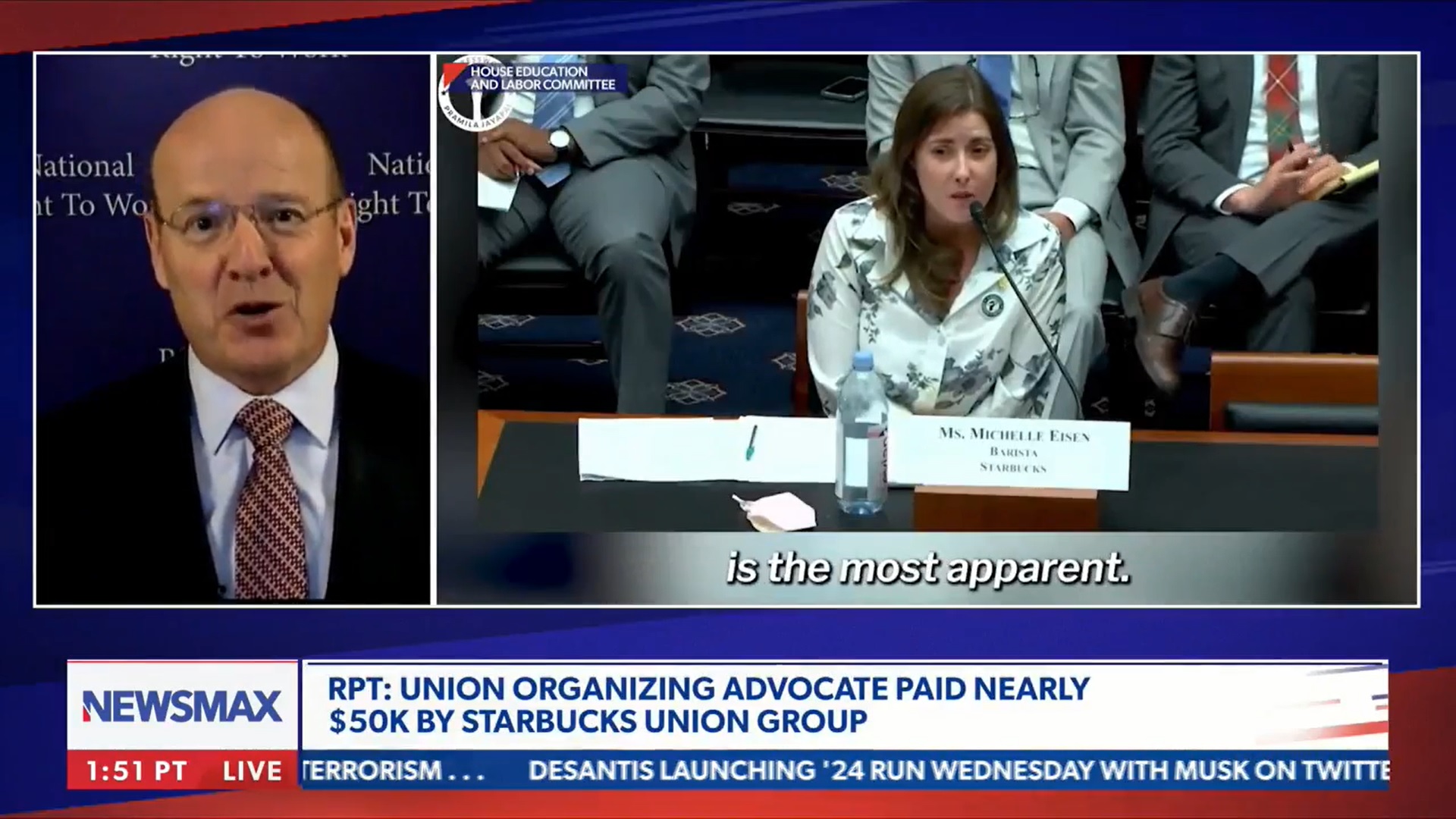
Mark Mix appeared on Newsmax TV this summer to discuss reports that union bosses spent millions to infiltrate Starbucks workforces with union agitators, many of whom hid their affiliations from their coworkers and even Congress.
WASHINGTON, DC – Union bosses and their bought-and-paid-for political allies like Sen. Bernie Sanders and Rep. Alexandria Ocasio-Cortez have been touting the unionization of some Starbucks locations as a breakthrough for Big Labor. But Starbucks employees under union control are increasingly realizing the drawbacks of having union bosses in the workplace and are banding together to say “NO” to union power.
In the last few months, employees at Starbucks locations in Manhattan and Buffalo, NY, Pittsburgh, PA, Minneapolis, MN, and Salt Lake City, UT, have all filed decertification petitions at the National Labor Relations Board (NLRB), requesting the agency hold elections at their stores to remove the Starbucks Workers United (SBWU) union. All have received free legal aid from National Right to Work Foundation attorneys.
But SBWU union officials — boosted by operatives from their notorious puppeteer, the Service Employees International Union (SEIU) — are fighting tooth and nail to remain in power at Starbucks locations where workers want them gone.
SBWU union officials are flooding the National Labor Relations Board (NLRB) with unrelated charges of alleged employer wrongdoing in an attempt to stall these decertification petitions.
Starbucks Worker’s Brief Blasts NLRB Double Standard on Elections
In June, Foundation staff attorneys filed a Request for Review with the NLRB in Washington, D.C., as a part of a case for Buffalo Starbucks worker Ariana Cortes. This request asks the Board to reverse an NLRB Regional Director’s order dismissing Cortes and her coworkers’ majority-backed petition for a decertification election on whether to remove SBWU.
The filing emphasizes that the employees want an election to remove a union that lacks the support of a majority of the workers. Employee free choice is a fundamental principle of the National Labor Relations Act (NLRA), and by denying these employees an election, the Board is undermining free choice.
The brief also observes the basis for blocking the vote is contradicted by the NLRB allowing union-backed certification elections to proceed with little or no delay. The result is that the SEIU is like a roach motel, easy to enter but impossible to leave.
Efforts to Boot SBWU Increasing Across Country
“They have treated us like pawns, promising us that we could remove them after a year if we no longer wanted their representation, and are now trying to stop us from exercising our right to vote,” Cortes said of SBWU union bosses. “It’s obvious they care more about power and control than respecting our individual rights.”
Cortes and her coworkers are not the only workers to become disillusioned with SBWU.
Foundation attorneys recently began representing employees at Starbucks branches at Pittsburgh’s Penn Center East, the Mall of America in Bloomington, MN, and Cottonwood Heights in the Salt Lake Valley, UT, who also submitted petitions demanding decertification votes on SBWU union officials.
“SBWU union bosses have not looked out for the interests of me and my fellow employees,” commented Pittsburgh Starbucks employee Elizabeth Gulliford. “We simply want to exercise our right to vote out a union that we don’t believe has done a good job, and both SBWU and Starbucks should respect that right and our final decision.”
The Starbucks employee-led decertification attempts all took place about one year after union power was installed at these stores — meaning workers seized the opportunity to decertify nearly as soon as legally possible. Federal labor law prevents workers from exercising their right to remove an unpopular union for at least one year after the union is installed.
Biden NLRB Propping Up Union Boss Attempts to Squash Votes
“It is becoming increasingly obvious that SBWU officials seek to extend their power over as many Starbucks workers as possible, with little regard for the employees they claim to ‘represent,’” commented National Right to Work Foundation Vice President and Legal Director William Messenger. “And as we’ve seen in Ms. Cortes’ case in Buffalo, Biden NLRB officials are more than willing to indulge union bosses’ legal maneuvers to cling onto power even when workers have clearly had enough.”
“SBWU officials should not seek to disenfranchise the Starbucks workers they claim to ‘represent’ as those workers try to flee the SBWU’s clutches,” Messenger added. “The union officials’ conduct shows why fundamental changes must be made to the NLRB’s election processes to better protect employee free choice.”
Workers Nationwide Press NLRB to Scrap Policy Blocking Right to Vote Out Unions
The following article is from the National Right to Work Legal Defense Foundation’s bi-monthly Foundation Action Newsletter, March/April 2021 edition. To view other editions or to sign up for a free subscription, click here.
Foundation cases contend ‘contract bar’ must be eliminated to protect employee freedom
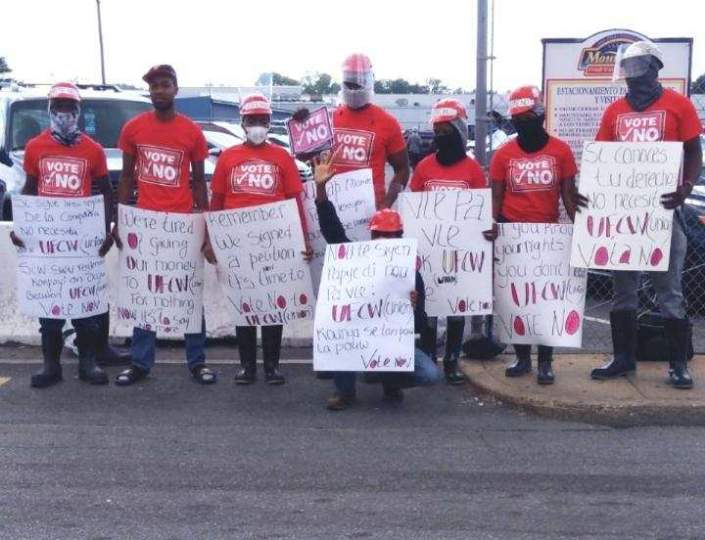
Foundation staff attorneys are assisting Delaware poultry workers in challenging UFCW bosses’ attempts to use the “contract bar” to trap them in union ranks.
WASHINGTON, DC – Foundation attorneys in January filed a Request for Review to the full National Labor Relations Board (NLRB) in Washington, D.C. The Request defends the right of Virginia Transdev workers to have a vote to remove unpopular Office and Professional Employees International Union (OPEIU) Local 2 bosses from power at their workplace.
The Transdev employees, who work at the Fairfax Connector bus service in Northern Virginia, now join Foundation-backed workers in Delaware and Puerto Rico, all of whom are urging the NLRB to eliminate the “contract bar.” That is a non-statutory NLRB policy which forbids employees from exercising their right to vote out an unpopular union in an NLRB-supervised “decertification election” for up to three years after their employer and union finalize a monopoly bargaining contract.
Foundation attorneys point out in each of these cases that the “contract bar” appears nowhere in the National Labor Relations Act (NLRA), the federal law the NLRB is charged with enforcing, and is merely the result of past union boss-friendly decisions by the Board. They also argue that the bar undermines workers’ basic right under the NLRA to remove unions that lack majority support.
“The ‘contract bar’ undermines the fundamental objective of federal labor law: Employee free choice. It makes rank-and-file employees prisoners of an unpopular union, with no way out for up to three years,” commented National Right Work Foundation President Mark Mix. “This inevitably creates an environment in which, as these employees can certainly attest, it’s impossible to hold self-serving union bosses accountable because workers are denied the right to vote them out.”
Unpopular OPEIU Bosses Went Behind Workers’ Backs to Sign Contract
The petitioner in the Transdev workers’ case, Amir Daoud, submitted a petition on November 10, 2020, signed by the necessary number of his coworkers to trigger a “decertification election” in his workplace. This was after news had gotten around that an OPEIU union agent had told some employees in October he had “negotiated a new agreement” with Transdev management and “‘intended’ to sign it without a ratification vote.” Workers had already voted down an earlier union boss-promoted monopoly bargaining contract in June.
Foundation attorneys filed a Request for Review, which notes that the union agent didn’t inform Daoud and his coworkers of when he planned to approve the new contract — until after Daoud filed the petition. The new contract was signed by union agents on October 30 and Transdev representatives on October 31.
NLRB Region 5 in Baltimore dismissed Daoud and his coworkers’ decertification petition on December 22, ruling that the “contract bar” applied because the employees’ petition was submitted just after the new contract was signed, even though the employees had no way of knowing whether or when that signing would occur.
This prompted Daoud to ask the NLRB in Washington to review the case. Because Daoud recently accepted a job with Transdev outside the OPEIU’s monopoly bargaining control, the Request for Review asks the NLRB to recognize his coworker Sheila Currie as the new petitioner to represent the interests of the workers who signed the decertification petition.
The Request exposes the arbitrariness of the “contract bar,” pointing out that the NLRB Regional Director applied it “merely because the Union ‘won the race’ and signed the contract ten days” before Daoud submitted the petition, even though the petition clearly demonstrated the employees’ interest in voting the union out.
VA and Puerto Rico Cases Follow Groundbreaking Effort by DE Poultry Workers
The Virginia Transdev employees, and a Puerto Rico armored transit guard who submitted a similar Request for Review on behalf of his coworkers with Foundation aid in January, are now battling the “contract bar” like Delaware Mountaire Farms poultry worker Oscar Cruz Sosa and his coworkers. For almost a year now, Cruz Sosa and his fellow employees have been fighting United Food and Commercial Workers (UFCW) union bosses’ attempts to use the “contract bar” to block their valid petition for a decertification vote. The Mountaire employees are now waiting for the NLRB to issue a ruling on their case.
In that case, UFCW officials claim that the “contract bar” should apply to bar any elections at Mountaire, despite an NLRB Regional Director’s decision allowing the vote because the union contract contains an invalid forced-dues clause.
When the UFCW bosses asked the full NLRB to review the Region’s order allowing the election, Cruz Sosa’s attorneys filed a brief urging that, if the Board granted review, it should use the opportunity to review the entire non-statutory “contract bar” policy. The Board is now doing just that. The UFCW union bosses are even arguing that the impounded ballots already cast by Mountaire workers should be destroyed, claiming the election should never have been held.
The Requests for Review submitted by Foundation staff attorneys for the Puerto Rico guard and Virginia Transdev employees each request that the NLRB should either grant review or least hold the case until a decision is issued in Cruz Sosa’s case.





