
Builders FirstSource Workers Join Other KY Construction Industry Workers in Ending Teamsters Local 89 ‘Representation’
Majority of workers backed petitions calling for Teamsters removal as second workplace ejects Teamsters Local 89 bosses in recent weeks
Louisville, KY (October 2, 2025) – Kenneth Moore, an employee of Builders FirstSource, and his coworkers have been freed from the hold of Teamsters Local 89 union bosses after Builders FirstSource ended its recognition of the Teamsters as the workers’ “representative.” The employer took this decision following a petition signed by a majority of the workers demanding that Builders FirstSource end the recognition of the Teamsters.
This development comes after Moore filed a petition last month at the National Labor Relations Board (NLRB) seeking a decertification election to remove the union from his workplace. Moore filed his petition at the NLRB with free legal aid from National Right to Work Foundation staff attorneys. Moore and his colleagues now join Chris Smith and other IMI – Irving Materials drivers who were successful in removing the Teamsters Local 89 in Scottsville, KY last month.
The NLRB is the federal agency responsible for enforcing the National Labor Relations Act and adjudicating disputes between employers, unions, and individual employees.
Thanks to the 2019 Right to Work Foundation-won Johnson Controls NLRB decision, workers seeking to remove unwanted union bosses can also do so by submitting a majority-backed petition asking their employer to stop recognizing the union. If there is a dispute about the petition, the NLRB can administer a secret-ballot vote to assess the employees’ opposition to the union.
The workers’ petition to Builders FirstSource managers provided the company with proof that the majority of their employees do not support the Teamsters presence at their facility. In compliance with the Johnson Controls decision, the employer withdrew the Teamsters’ recognition.
Moore and his Builders FirstSource colleagues are amongst the most recent workers who have made strides to remove the Teamsters from their workplaces. According to the NLRB’s owns statistics, over the past 12 months over 20% of all decertification cases involved the Teamsters union.
Kentucky is one of the 26 states with a Right to Work law that protects workers by making union affiliation and dues payment strictly voluntary. However, even in Right to Work states, union officials can still impose monopoly bargaining control upon all workers within a workplace, even those who oppose the union.
“These two groups of Kentucky workers are the latest to come to the conclusion that the interests that Teamsters bosses are pursuing are at odds with the wishes of the rank and file,” commented National Right to Work Foundation President Mark Mix. “The Foundation will continue to assist workers in their efforts to free themselves from the Teamsters or any other unwanted so-called ‘representation.’”
IBEW Local 16 Folds in Case Concerning Illegal $1.29 Million Retaliatory ‘Fine’ Threat Against Local Electrician
Union bosses imposed illegal limitations on resigning union membership, told electrician he would be fined for starting new business unless he signed with the union
Evansville, IN (September 30, 2025) – Brian Head, an Evansville-based electrician, has vindicated his federal labor rights against the International Brotherhood of Electrical Workers (IBEW) Local 16 union. Head filed federal charges after IBEW union officials threatened him with a $1.29 million internal disciplinary fine even though he had validly resigned his union membership. He filed the charges at the National Labor Relations Board (NLRB) with free legal aid from National Right to Work Foundation staff attorneys.
The settlement requires union officials to rescind all fines against Head, expunge all records of them, and refrain from interfering with workers who exercise their right to resign their union membership in the future. The union is also required to notify other workers of their legal right to resign their union membership without restriction, and be free of any attempt to impose internal union fines post-resignation.
Fine Threats Came After Electrician Refused to Hand Over Business to Union Power
The NLRB is the federal agency responsible for enforcing the National Labor Relations Act (NLRA) and adjudicating disputes between employers, unions, and individual employees. Head’s charges document that he had resigned his IBEW union membership on March 27, 2025, in a notarized letter that IBEW officials acknowledged receiving. However, the union’s reply letter claimed that “[i]t is a six-month process before the resignation is finally effective.”
The NLRA forbids restricting the right of workers to resign their union memberships. Section 7 of the NLRA enshrines workers’ right to refrain from union membership. Furthermore, union bosses cannot impose discipline or fines upon nonmember workers.
IBEW Local 16 union officials began retaliating against Head after he resigned his union membership and announced he was purchasing a non-union electrical firm. Head refused to sign an IBEW Letter of Assent, which would have likely forced his employees under union control without any kind of worker vote.
Following Head declining to hand over his business to a union he was no longer legally affiliated with, IBEW Local 16 officials sent Head correspondence on May 1 demanding he appear before a union tribunal. Head later received a letter from IBEW Local 16 bosses on June 9 finding him “guilty” of violating the union’s constitution and imposing a “$1.29 Million dollar fine” as a penalty.
Foundation-Won Settlement Forces IBEW to Inform Workers of Rights
An NLRB Regional Director reviewed Head’s charges against IBEW union officials’ overreach, and made a merit determination in his favor, finding that the IBEW Local 16 union officials violated Head’s rights under the NLRA. IBEW union officials quickly decided to back down and settle rather than go to trial against the NLRB and Head’s Foundation lawyers. In addition to expunging their million-dollar-plus retaliatory fine, the settlement details that IBEW bosses must stop informing workers that there are restrictions on the right to resign one’s union membership. Additionally, they must inform all their members of their rights under the NLRA, and post the settlement on the union’s website.
“The Foundation is pleased to have assisted Mr. Head as he challenged IBEW union bosses’ attempt to illegally extort him after he had followed all legal procedures necessary to break free from the union,” commented National Right to Work Foundation President Mark Mix. “IBEW union bosses’ use of strong-arm tactics demonstrates that they value maintaining control over Indiana electricians far above respecting those electricians’ individual rights.
“Whenever union bosses violate the rights of any American worker, Foundation attorneys are ready to assist in their defense,” Mix added.
California Nurse Adds New Claim in Federal Labor Board Case Against United Nurses Association of California
Charge: union officials illegally demanded nurse join union, plus maintain illegal policy that restricts right to cut off funding for political spending
Woodland Hills, CA (September 5, 2025) – Sarah Warthemann, a nurse at Kaiser Permanente, has just filed new charges in her ongoing case against the United Nurses Association of California (UNAC) union challenging union officials’ illegal demands that she pay full union dues or be fired. Warthemann’s charges were filed at the National Labor Relations Board (NLRB) with free legal aid from National Right to Work Foundation staff attorneys.
Her original charges, filed in July, stated that UNAC union bosses illegally threatened her with termination of her employment at the hospital if she did not formally join the union. Now, the amended charges also challenge union policies that require nonmembers to opt-out of paying for union political and ideological activities.
The NLRB is the federal agency responsible for enforcing the National Labor Relations Act (NLRA) and adjudicating disputes between employers, unions, and individual employees. The charges allege UNAC union bosses are violating Warthemann and all other nurses’ NLRA Section 7 right to refrain from participating in or supporting union activities.
Because California lacks Right to Work protections, UNAC union bosses can impose union monopoly bargaining contracts that force employees to pay union dues or fees as a condition of employment. By comparison, in neighboring Right to Work states like Arizona and Nevada, union membership and all union financial support are strictly voluntary.
However, under Communications Workers of America v. Beck, a landmark Foundation-won Supreme Court case, even where forced dues are authorized, union officials cannot compel workers to fund activities unrelated to union bargaining, like union political activities. The charges note that UNAC officials have “repeatedly demanded payment from [Warthemann] for non-chargeable political and ideological expenditures without [her] affirmative consent” and argue that these demands represent illegal coercion under the NLRA.
“As the facts of this case demonstrate, the NLRB needs to step up to protect workers from being trapped into paying full union dues, including the portion used for union political activism,” observed National Right to Work Foundation President Mark Mix. “Union bosses are not above the law, they cannot be permitted to threaten and bully workers into paying dues that go towards union political activities that many workers find objectionable.”
St. Louis-Area Worker Battles Illegal Union Threats to Get Non-Members Fired
The following article is from the National Right to Work Legal Defense Foundation’s bi-monthly Foundation Action Newsletter, March/April 2025 edition. To view other editions of Foundation Action or to sign up for a free subscription, click here.
After divisive strike, IAM bosses demand non-members pay illegal ‘reinstatement fee’ to work

Robert Jacobs, an employee of power management company Eaton, filed federal charges showing IAM bosses clearly can’t manage their power: They are threatening union non-members with hundreds in illegal fees.
TROY, IL – “They’re threatening our jobs and livelihoods.”
This is how Robert Jacobs, an employee for power management company Eaton Corporation, described how International Association of Machinists (IAM) union bosses were treating him and his colleagues who dissented from the union’s agenda in an interview with the St. Louis Business Journal.
IAM officials ordered hundreds of Eaton employees at its St. Louis-area facility to strike in October 2024, which alienated many workers and made them question union bosses’ motives. Jacobs described seeing union agents take photos of his license plate during the strike and how he suspected union agents were following him home.
IAM Anti-Worker Activity Only Increased After Disruptive Strike Order
But for Jacobs and other workers, that was only the beginning of IAM’s coercive conduct. After the strike concluded, many Eaton employees chose to exercise their right to resign their union memberships. Even in states like Illinois that lack Right to Work protections, private sector workers are free to end their union memberships, even if union officials enforce a contract that requires non-members to pay some fees as a condition of employment.
Instead of respecting this right, IAM union officials began retaliating against those who wanted to cut ties with the union. With free legal assistance from the National Right to Work Foundation, Jacobs slammed the IAM with federal charges for threatening to get him and other employees who resigned union membership fired unless they pay hundreds in “reinstatement fees” concocted by the union. The National Labor Relations Board (NLRB) is now reviewing his charges.
“I and several of my colleagues don’t want to be part of the IAM union, but we are required by law to pay fees to union bosses just to keep our jobs,” commented Jacobs.
“That’s already something that we don’t want to do. But IAM officials are going even further and hitting us with hundreds of dollars in made-up fees just because we exercised our right to not be union members.”
IL Worker: Mandatory ‘Reinstatement Fee’ Not Permitted by Federal Law
Under federal labor law, which the NLRB is charged with enforcing, private sector employees have an absolute right to resign union membership. This right is codified in the National Labor Relations Act (NLRA), and was affirmed by landmark U.S. Supreme Court decisions such as General Motors v. NLRB.
Federal law further spells out that neither employers nor union officials can compel private sector workers to participate in union activities or refrain from such activities.
According to Jacobs’ federal charge, which was filed on the last day of 2024, “the Union is presently threatening Charging Party and [other employees who resigned from the union] with termination if they fail to pay a $306 ‘reinstatement fee’ by January 2025.” The charge argues that the IAM union is violating Eaton employees’ rights under Section 7 of the NLRA, which safeguards employees’ “right to refrain from any or all of ” union activities.
According to the Business Journal, IAM officials’ letter demanding this payment was what prompted him to contact Foundation attorneys. “[I]f you do not remit the total sum indicated in the enclosed letter within 30 days from receipt of this letter, the Union will be required to seek your termination from employment,” the letter read.
“Instead of seeking to win Eaton employees’ voluntary support, IAM union officials have decided to effectively extort the workers they claim to ‘represent,’” commented National Right to Work Foundation Vice President and Legal Director William Messenger. “Threatening to terminate workers if they don’t pay a fee which is apparently intended to punish those who don’t want union bosses speaking for them tarnishes employee rights and freedom.
“While we’re confident that Foundation attorneys will help Mr. Jacobs prevail in beating this illegal scheme, this case shows what self-interested union bosses will do to demand fealty from workers, and why all American workers deserve the Right to Work freedom to cut off financial support for such union hierarchies,” Messenger added
Dartmouth, MIT, Vanderbilt Graduate Students Challenge Forced Unionism
The following article is from the National Right to Work Legal Defense Foundation’s bi-monthly Foundation Action Newsletter, January/February 2025 edition. To view other editions of Foundation Action or to sign up for a free subscription, click here.
Foundation-backed students defend rights as union bosses seek more power at universities

Ben Logsdon is a Ph.D. student in mathematics at Dartmouth College. But it doesn’t take a genius to realize that union officials’ refusals to accommodate his religious objections just don’t add up.
HANOVER, NH – Just weeks after National Right to Work Foundation staff attorneys triumphed in anti-discrimination cases for Jewish Massachusetts Institute of Technology (MIT) graduate students who sought to stop forced dues payments to a radically anti-Israel union, union officials began creating other problems for university students.
In nearby New Hampshire, Dartmouth graduate student Benjamin Logsdon sought free Foundation legal aid against Graduate Organized Laborers of Dartmouth (GOLD-UE) union officials. The GOLD union — which is an affiliate of the same United Electrical (UE) union involved in the Foundation’s MIT cases — is forcing Logsdon to accept the union’s monopoly “representation” powers against his will, even after he voiced his religious objections to the union’s radical stances on the conflict against Israel.
Grad Students Exposed to Union Coercion & Privacy Violations
Meanwhile, several graduate students at Vanderbilt University in Nashville, TN, are pushing back against an attempt by Vanderbilt Graduate Workers United (VGWU, an affiliate of United Auto Workers) union bosses to impose union control over them and their colleagues. Specifically, three students are seeking to intervene in a federal case in which VGWU union officials are illegally demanding the university hand over the students’ private information to aid in their unionization campaign. Foundation staff attorneys filed motions for intervention for these students in October 2024.
Foundation attorneys are arguing that union officials severely violate students’ rights in both of these cases. However, the reason that union officials are in power on college campuses at all traces back to flawed rulings from the National Labor Relations Board (NLRB) under both the Obama Administration and Biden Administration. These rulings subject graduate students to pro-Big Labor provisions of the National Labor Relations Act (NLRA), which create issues for students’ freedom both inside and outside the classroom.
Logsdon, a Christian Ph.D. student in mathematics at Dartmouth, slammed the GOLD union with federal anti-discrimination charges in September 2024 at the Equal Employment Opportunity Commission (EEOC). According to those charges, shortly after the GOLD union finalized its first monopoly bargaining contract with the Dartmouth administration, he sent a letter to United Electrical General Secretary-Treasurer Andrew Dinkelaker explaining that he objected to being affiliated with GOLD on religious grounds and needed an accommodation.
“I sought to be removed from the UE and GOLD-UE bargaining unit as a reasonable accommodation,” Logsdon’s Foundation-backed charges say.
Dinkelaker refused to offer Logsdon an accommodation that “satisf[ied] [his] religious conscience or beliefs,” according to the charges, which violated his rights under Title VII of the Civil Rights Act of 1964.
Courts have recognized a variety of Title VII religious accommodations over the years for men and women who have religious objections to union affiliation, including paying an amount equivalent to union dues to a charity instead of union bosses. However, Logsdon seeks a different accommodation: to remove himself from union bosses’ control entirely.
At Vanderbilt, three students who identify themselves in legal documents as “John Doe 1,” “John Doe 2,” and “Jane Doe 1” are contending in their Foundation-backed motions for intervention that the Family Educational Rights and Privacy Act (FERPA) forbids the Vanderbilt administration from disclosing their personal information to any third parties without their permission, including the VGWU union.
At the union’s behest, NLRB Region 10 has already hit the Vanderbilt administration with a pair of subpoenas demanding personal student info, while ignoring objections from several students expressing concern at the disclosure.
So far Vanderbilt has resisted the NLRB’s subpoenas, and fortunately a federal court has temporarily allowed the university to refuse to comply with them.
The Foundation-backed students’ motions to intervene argue that the subpoenas “are an attempt to violate FERPA’s protections, privileging union interests over the graduate students[’] privacy rights.” It also points out that FERPA allows students to seek “protective action” if a university receives a subpoena seeking their personal information, as in this case.
The Vanderbilt students and their Foundation attorneys are demanding an opportunity to properly defend their privacy interests under FERPA. Foundation attorneys have already filed Requests for Review asking the NLRB in Washington, DC, to weigh in on the matter.
Union Monopoly Power Has No Place at Universities
“Graduate students around the country are discovering that union bosses don’t respect their individual rights and would rather use students as pawns to force their demands on a university administration, or advance an extreme political agenda,” commented National Right to Work Foundation Vice President and Legal Director William Messenger.
“Union monopoly bargaining is a system particularly ill-suited to an academic environment. Indeed, it is wrong for anyone to have a union monopoly imposed on them against their will and then be forced to pay union dues under threat of termination.”
SoCal AT&T Employee Hits Company and CWA Union With Federal Charges for Illegal Collusion to Unionize Workers
Charge: Union left after employees demanded vote to kick union out; now back as unlawful ‘company union’ under backroom deal
Los Angeles, CA (October 22, 2024) – Matthew Gonzales, an In-Home Expert for AT&T Mobility in Southern California, has just filed federal charges against both his employer and officials of the Communications Workers of America (CWA) union. Gonzales maintains that AT&T and CWA officials have colluded to force workers under the control of a “company union” in violation of federal labor law. Gonzales filed the charges at the National Labor Relations Board (NLRB) with free legal aid from National Right to Work Legal Defense Foundation staff attorneys.
The charges state that the CWA union and company started this arrangement despite the fact that there is no evidence of majority employee support for a union, and despite the fact that CWA union officials voluntarily abandoned Gonzales’ unit of In-Home Experts just last month after a large number of employees demanded an election to remove CWA from power (but before that vote could occur). According to the charges, despite the union’s formal departure, a CWA notice declared shortly after that “[n]ew hires will immediately be included in the [union] bargaining unit” and that AT&T would even help conduct a campaign to add existing workers to the union’s monopoly bargaining ranks.
The National Labor Relations Act (NLRA), which is administered by the NLRB and governs labor relations in the private sector, disallows the formation of company unions. Specifically, it prohibits employers from “dominat[ing] or interfer[ing] with the formation or administration of any [union]” or “coerc[ing] employees in the exercise of [their] rights” to either participate or not participate in a union.
Gonzales’ charge argues that AT&T’s and CWA’s actions have “violated employee free choice guaranteed by Section 7 of the [NLRA] by allowing CWA to act as their exclusive representative without majority [support],” and “given CWA unmerited opportunities to foist exclusive representation on unwilling employees.” Further, Gonzales maintains that a “Memorandum of Agreement of Voluntary Recognition” that AT&T and CWA are using to spell out this scheme actually amounts to a monopoly bargaining contract, and has been used to justify restrictions against Gonzales for opposing the union campaign.
CWA Union Officials Want Illicit ‘Second Bite at Apple’ After Being Forced Out by Employees
Gonzales’ charges detail that, roughly a month after he and his coworkers had successfully forced the CWA union out by petitioning for a union decertification vote, CWA released notices to the work unit in late September stating that a survey would soon be released to determine which employees to add to a separate “bargained-for unit” controlled by the union. It also stated that “[a]ll employees hired into the IHX department after this process is complete will be protected under our collective bargaining agreement.”
On October 8, the charges say, Gonzales visited an AT&T facility on his own time to observe an event that CWA officials held to drum up support for joining the union-controlled unit. At the union’s behest, an AT&T official asked him to leave, reasoning that the union and employer had an “agreement” that allowed CWA to campaign at the facility. Gonzales responded by asserting that the agent was stopping him from exercising his rights to oppose the union drive.
“The company representative said that [Gonzales] must receive permission to campaign or discuss labor organizing on the premises and that she did not know where he could go to receive such permission,” the charges state.
AT&T Employee Wants Federal Court Order to Stop Illegal Union Campaign, Which Could Soon Have Nationwide Impact
Gonzales is asking that the NLRB seek a federal court injunction “to prevent CWA from continuing its membership drive, its collection of dues, and its attempts to coerce non-bargained for employees into any unit without a secret ballot election.” He also seeks to revive his and his coworkers’ petition seeking a vote to remove the union.
“Union officials will often use rhetoric portraying employers as ‘bad guys’ that employees can only defeat by submitting to union power, but are more than willing to accept illegal employer assistance if it will help them sweep more workers into dues-paying ranks,” commented National Right to Work Foundation President Mark Mix. “In Mr. Gonzales’ case, this tactic is especially shameful because he and his coworkers already forced CWA union officials into abandoning the workplace just before their so-called ‘representation’ of employees was about to be put to a secret ballot vote. Not only that, but CWA union officials claim that this bargain they’ve struck with AT&T will also apply to other units of employees across the country that have similarly rejected the union.
“Instead of facing the will of the employees, it looks like CWA officials would prefer to finagle themselves into the workplace with the backing of AT&T in total violation of federal law,” Mix added. “Our attorneys will defend the right of AT&T In-Home Experts to freely choose whether they want a union or not, and will get to the bottom of this scheme.”
Starbucks Employee Takes Case Challenging Federal Labor Board Structure as Unconstitutional to Court of Appeals
NY Starbucks workers are challenging NLRB that refuses to let them hold decertification votes to remove unwanted SBWU union
Washington D.C. (June 10, 2024) – Ariana Cortes and fellow plaintiff Logan Karam, two Starbucks employees from New York, are taking their groundbreaking lawsuit against the National Labor Relations Board (NLRB) to the D.C. Circuit Court of Appeals. The lawsuit, initially filed by Cortes, and later joined by Karam, follows NLRB officials’ refusal to process their respective petitions requesting a vote to remove Starbucks Workers United (SBWU) union officials from their workplace.
The lawsuit, filed with free legal aid from the National Right to Work Legal Defense Foundation, argues that the NLRA violates Article II of the Constitution by shielding NLRB Board Members from being removed at the discretion of the President. The appeal challenges the District Court decision that dismissed the lawsuit on the grounds that the plaintiffs lack legal standing. That decision did not address the underlying claim regarding whether the Labor Board’s structure complies with the requirements of the Constitution.
Multiple Starbucks Employees Are Suing the NLRB
On April 28, 2023, Cortes submitted a petition, supported by a majority of her colleagues, asking the NLRB to hold a decertification election at her workplace to remove SBWU union officials’ bargaining powers over workers at the store. However, NLRB Region 3 rejected Cortes’ petition, citing unfair labor practice accusations made by SBWU union officials against Starbucks. Notably, there was no established link between these allegations and the employees’ decertification request.
Similarly, Karam filed a decertification petition seeking a vote to remove the union at his Buffalo-area Starbucks store. Like Cortes’s petition, NLRB officials refuse to allow the vote to take place, citing claims made by SBWU officials. As a result the workers remain trapped under union “representation” they oppose.
Their lawsuit is not the only instance where Starbucks employees are challenging the constitutionality of the NLRB with free legal representation by National Right to Work Foundation staff attorneys. Reed Busler, an employee at the “Military Highway” Starbucks in Shavano Park, TX, brought a similar federal lawsuit against the NLRB in January, contending that the agency’s structure violates the separation of powers. Busler’s petition seeking a vote to remove the SBWU remains pending before the NLRB.
“Workers should never be trapped in union ranks they oppose, and they certainly shouldn’t be trapped on the whims of powerful bureaucrats who exercise unaccountable power in violation of the U.S. Constitution,” stated Mark Mix, President of the National Right to Work Foundation. “Despite the wishes of Big Labor and the NLRB who appear intent on squashing free speech and exercising unfettered power, federal labor law is not exempt from the requirements of the highest law of the land.”
Foundation Lawsuit: Biden NLRB Structure Violates the U.S. Constitution
The following article is from the National Right to Work Legal Defense Foundation’s bi-monthly Foundation Action Newsletter, November/December 2023 edition. To view other editions of Foundation Action or to sign up for a free subscription, click here.
Groundbreaking suit filed for Starbucks employee who was denied vote to oust unwanted union bosses
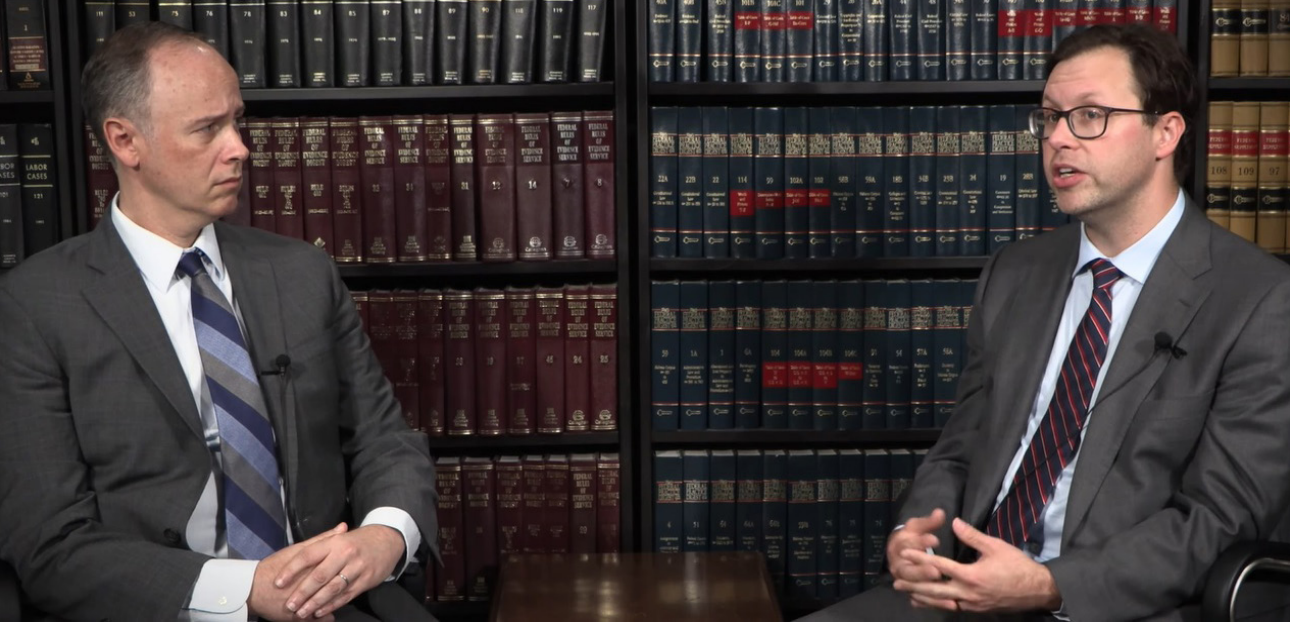
Starbucks employee Ariana Cortes’ Foundation attorney, Aaron Solem (right), is making a cutting-edge argument targeting the NLRB’s lack of accountability.
WASHINGTON, DC – The National Labor Relations Board (NLRB) is supposed to protect the right of workers to freely choose whether to associate with a union or not. The NLRB is also charged with holding unions and employers accountable when they violate worker rights. Too often, however, it has simply acted as an agency that generates policies to entrench union bosses’ power over workers while shielding union bosses from any kind of liability.
A new federal lawsuit from a National Right to Work Foundation-backed Starbucks employee, currently pending at the D.C. District Court, could upend the federal agency and result in a ruling that the current Labor Board’s structure violates the Constitution.
Employee Challenges NLRB Bureaucrats’ Protections from Presidential Removal
Ariana Cortes, a worker at the Buffalo, NY, “Del-Chip” Starbucks branch, hit the NLRB with the groundbreaking lawsuit in October, contending that the federal agency’s current structure violates the separation of powers mandated by the Constitution.
Cortes’ suit follows Foundation attorneys’ defense of her and her coworkers’ petition requesting a vote to remove Starbucks Workers United (SBWU) union officials from their workplace. Regional NLRB officials dismissed Cortes’ majority-backed petition based on SBWU allegations against Starbucks management that have no proven connection to Cortes and her coworkers’ desire for a union decertification vote.
Cortes’ lawsuit argues that because NLRB members cannot be removed at-will by the President, the NLRB’s structure violates Article II of the Constitution. Under Article II, the lawsuit contends, the President must have the power to remove officials that exercise substantial executive power.
Because the NLRB enforces federal labor law, manages union elections, and can issue legally binding rules and regulations, the lawsuit contends that the agency exercises substantial executive power. Therefore, it falls within the scope of the President’s power to remove officials at will. However, the National Labor Relations Act (NLRA), the law that established the NLRB, restricts the President’s ability to remove Board members except for neglect of duty or malfeasance.
“[T]hese restrictions are impermissible limitations on the President’s ability to remove Board members and violate the Constitution’s separation of powers. Thus, the Board, as currently constituted, is unconstitutional,” the complaint states.
Lawsuit: Unconstitutional NLRB Proceedings Must Stop
Cortes’ new federal lawsuit seeks a declaration from the District Court that the structure of the NLRB as it currently exists is unconstitutional.
“For too long the NLRB, especially the current Board, has operated as a union boss-friendly kangaroo court, complete with powerful bureaucrats who exercise unaccountable power in violation of the Constitution,” commented National Right to Work Foundation Vice President and Legal Director William Messenger. “The NLRB’s operation outside constitutional norms is easily exploited by Big Labor.”
“But as the story of Ms. Cortes shows, the NLRB’s unchecked power creates real harms for workers’ rights, especially when workers seek to free themselves from the control of union bosses they disagree with,” Messenger added.
Right to Work Foundation SCOTUS Brief: Workers Exercising Right to Oppose Unions Isn’t “Harm” to Be Eliminated
In case to be heard by Court, Foundation argues NLRB wrongly asserts that independent-minded opposition to unions can justify injunctions
Washington, DC (February 29, 2024) – The National Right to Work Foundation has filed an amicus brief in Starbucks Corporation v. McKinney, a case set to be argued before the U.S. Supreme Court later this term that has major implications for the rights of workers who oppose union power in their workplaces.
In the brief, Foundation staff attorneys argue that federal courts should reject National Labor Relations Board (NLRB) requests for preliminary injunctions when the Labor Board claims employee discontent with a union is a “harm” that should be redressed. These injunctions, called 10(j) injunctions, are frequently used by the NLRB to force employers into certain union-demanded behavior, despite the NLRB not having fully adjudicated the underlying union allegations.
The brief points out that an employee’s decision not to support a union is not a harm that needs to be addressed, but rather a “legitimate choice employees have a right to make” under both the National Labor Relations Act (NLRA) and the First Amendment to the Constitution.
“Only if the NLRB can prove an employee was coerced by an employer to oppose a union against his or her will can that employee’s lack of support for the union be considered any sort of a harm to be redressed,” the brief says. “If the NLRB cannot muster such evidence, then the fact that employees are exercising their statutory and constitutional rights…provides no basis for [an] injunction.”
Foundation: Courts Shouldn’t Accept NLRB’s Assumption that Workers Want to Join Unions
In the Starbucks v. McKinney case, the NLRB sought an injunction at the behest of Starbucks Workers United (SBWU-SEIU) union officials against Starbucks for unfair labor practices the company allegedly committed at a location in Memphis, Tennessee. A major reason cited by the NLRB for the requested injunction was the fact that workers may choose to oppose the union if the injunction isn’t issued.
The case presents the question of what standard courts should use when evaluating whether to grant NLRB-requested injunctions under the NLRA. The Foundation brief opposes the lax standard that the NLRB and union officials are urging courts to use when deciding whether to issue injunctions.
That standard asks only whether alleged unfair labor practices could potentially coerce workers into not supporting a union. Foundation attorneys argue that “the Court must require the NLRB to prove employees were unlawfully coerced not to support a union because, absent such proof, employees have every right to make that choice” (emphasis added).
Foundation-Backed Starbucks Workers Disprove Specious NLRB Theory
Foundation staff attorneys are currently representing Starbucks employees at several locations across the country who seek to vote out (or “decertify”) the SBWU union. In the brief, Foundation attorneys point out that the NLRB in a similar case (Leslie v. Starbucks Corp.) cited a Foundation-backed union decertification case as a reason that an injunction should be issued against the company – despite the fact that the workers themselves say their opposition to the union had nothing to do with the conduct the union was challenging in that case.
“In taking this position, the NLRB has created a self-satisfying ‘heads I win, tails you lose’ dynamic for itself,” the brief reads. “Evidence that employees support a union is taken to mean they want to support the union. Evidence that employees oppose a union is taken to mean their employer must have wrongfully caused the employees not to support the union. All evidence conveniently leads to the conclusion desired by current NLRB leadership: employees should support unions.”
The case is set to be argued before the Supreme Court on Tuesday, April 23, with a decision expected by the end of the High Court’s term in June.
“The Biden NLRB is working hand in glove with unions to advance a standard that treats worker dissent from unions as a harm to be eradicated, rather than a decision made by competent adults,” commented National Right to Work Foundation President Mark Mix. “The Supreme Court in Starbucks v. McKinney must reject the idea that NLRB bureaucrats can simply twist evidence of legitimate worker discontent with unions into a tool to aid union bosses in gaining leverage over businesses and employees.”





