
Starbucks Baristas File Brief Urging Supreme Court to Allow President to Remove Rogue Agency Officers
National Right to Work Foundation-backed federal case for Starbucks employees was first federal case to argue that NLRB officials can’t be shielded from the President’s oversight
Washington, DC (October 20, 2025) – Two Starbucks employees represented by the National Right to Work Legal Defense Foundation have filed an amicus brief at the United States Supreme Court in the case Trump v. Slaughter. The brief argues that restrictions on the President’s authority to fire members of executive bodies, such as the National Labor Relations Board (NLRB) or the Federal Trade Commission (FTC), are unconstitutional, violating the separation of powers.
The amicus brief was filed on behalf of Ariana Cortes and Logan Karam, two New York Starbucks employees who challenged the constitutionality of the structure of the NLRB in a separate federal court case with the assistance of Foundation staff attorneys.
Since 2023, Foundation staff attorneys have pioneered the legal argument that the NLRB’s structure is unconstitutional because it places restrictions on the President’s authority to fire the NLRB’s members, despite it being part of the executive branch of government. This disconnect exemplifies the problem of federal bureaucrats operating as an unaccountable, “headless fourth branch,” something clearly at odds with the government’s constitutional structure.
Now, the Trump Administration is using this same argument as a justification to fire members of the FTC. Rebecca Slaughter, a Biden appointee to the FTC, has sued to be reinstated, and the case is now before the Supreme Court. The Foundation-backed amicus brief argues that as the Court considers the FTC, it must keep in mind that other so-called “independent agencies” that wield executive power, such as the NLRB, must be subject to Presidential control and removal.
Supreme Court May Reverse Humphrey’s, Must Recognize Its Limitations
Trump v. Slaughter provides the Supreme Court an opportunity to reverse its decision in the 1935 case Humphrey’s Executor v. United States, in which the Court crafted an exception to the general rule that the President can remove principal officers at will under Article II of the U.S. Constitution. In theory, Humphrey’s exempted agencies that exercised “quasi-judicial” or “quasi-legislative” power, but not those that exercise executive power.
But regardless of the Court’s reevaluation of the case, “the NLRB fails the Humphrey’s Executor test,” the brief argues.
“The NLRB is a policymaking body that enforces the [National Labor Relations Act] based on its legal conclusions, not scientific or technical judgments,” write Foundation staff attorneys. “[T]he Board does not exercise quasi-legislative or quasi-judicial authority. It exercises executive power in everything it does.”
The brief concludes with the Foundation’s legal argument that Humphrey’s “cannot neuter the President’s ability to supervise those who exercise substantial parts of [executive] power.” Therefore, the Supreme Court “should make clear that the President’s removal power applies to every agency that exercises executive power, including the NLRB.”
Clear Separation of Powers Would Support Workers’ Individual Rights
A proper understanding of the limitations of Humphrey’s when it comes to executive bodies like the NLRB would support workers like Cortes and Karam as they exercise their individual rights. Cortes and Karam are trying to exercise their right to remove local union bosses from their respective workplaces. But non-statutory policies enforced by the pro-Big Labor Biden NLRB have stymied their efforts. Success in this case could help ensure that Cortes and Karam receive a fair judgment from the NLRB in their cases.
“Unaccountable and biased NLRB bureaucrats have caused direct harm to independent-minded workers and their individual rights, and the Supreme Court should rightfully restore the proper separation of powers, including at the NLRB,” commented National Right to Work Foundation President Mark Mix. “We are proud that the very legal arguments made by Foundation attorneys are now being utilized by this administration to dismantle the unaccountable fourth branch of government and restore proper constitutional structure.”
Following Foundation Legal Arguments, Trump Fires Biden-Appointed NLRB Bureaucrats
The following article is from the National Right to Work Legal Defense Foundation’s bi-monthly Foundation Action Newsletter, March/April 2025 edition. To view other editions of Foundation Action or to sign up for a free subscription, click here.
Foundation constitutional lawsuit first to argue presidents can remove Board members

President Trump appears intent on ending union bosses’ reign at the NLRB. One of his first actions was to axe Jennifer Abruzzo and Gwynne Wilcox, both ex-union bosses who constantly sought to beef up their cronies’ powers over employees.
WASHINGTON, DC – Joe Biden, a career lackey of Big Labor union bosses, spared no moment of his administration ensuring that his cronies at the top of America’s largest unions gained power at the expense of independent-minded workers.
Only minutes after being inaugurated in 2021, he began setting the stage for a Big Labor takeover of the federal government: He immediately fired Peter Robb, the general counsel for the National Labor Relations Board (NLRB) during Donald Trump’s first term. With Robb gone, Biden’s acting general counsel quickly quashed multiple National Right to Work Foundation-backed cases that would have otherwise received full NLRB consideration. When Biden filled the general counsel position, he picked Jennifer Abruzzo — a radical ex-Communications Workers of America (CWA) lawyer who was confirmed only because then-Vice President Kamala Harris broke a party-line deadlock in the Senate.
And Biden wasn’t finished. He filled two vacancies on the Board itself with Gwynne Wilcox and David Prouty — who had both worked for the radical Service Employees International Union (SEIU).
Biden’s crusade against worker freedom arguably culminated in the disastrous Cemex Construction Materials Pacific NLRB decision, which gave union officials the power to seize monopoly bargaining power in a workplace without winning a secret-ballot election among employees. The Biden Board also repealed key Foundation-backed reforms that (among other things) stopped union bosses from using so-called “blocking charges” alleging employer malfeasance to stop workers from voting in union removal elections they had requested.
Sudden End of Radical Biden Majority Creates Opportunities for Foundation Litigation
But, just a week after re-ascending to the White House, President Trump took immediate action to undo the damage to worker freedom caused by the historically-radical Biden NLRB. In late January, Trump took the crucial step of giving both Abruzzo and Wilcox the boot. That, combined with the fact that the Senate did not confirm Biden NLRB Chairman Lauren McFerran for another term, means Trump has the opportunity to appoint a pro-freedom majority to the Board before it considers any other cases.
“We hope that this signals the opening of a new chapter at the NLRB, where the agency will fulfill its statutory mandate to protect workers’ right to associate with unions if they choose, but will equally defend their right to refrain from all union activity,” commented National Right to Work Foundation President Mark Mix.
Trump Admin, Others Follow Foundation Lead in Arguing for Structural Board Change
By removing Wilcox, the Trump Administration is relying on arguments made in the Foundation’s groundbreaking cases challenging the structure of the NLRB. Foundation-backed Starbucks employees Ariana Cortes and Logan Karam filed the first-ever federal suit arguing that, as per the Constitution’s separation of powers principles, the president should be able to remove them at-will.
Cortes and Karam’s suit is currently pending at the D.C. Circuit Court of Appeals. Big Labor backers argue that board members like Wilcox have statutory protections that make them removable only in certain circumstances. But Board member protections are constitutionally questionable.
“President Trump made an excellent and decisive move to protect the freedom of American workers. Abruzzo’s and Wilcox’s track records were devastating for independent-minded employees,” observed Mix.
“We’re also encouraged by the Trump Administration’s apparent reliance on National Right to Work Foundation-backed workers’ cases to affirm the idea that NLRB members — like Wilcox — should be removable by the president at will. “The Foundation still has considerable legal work to do to reverse the damage done by the Biden NLRB, and removing a union partisan like Wilcox from the Board is just the first step towards restoring the rights and freedoms of workers opposed to union affiliation,” added Mix.
NY Starbucks Baristas File Amicus Brief Opposing Reinstatement of Biden-Appointed NLRB Member Removed by President Trump
Starbucks employees have pending federal lawsuit challenging NLRB structure as unconstitutional, argue they could be harmed if member’s removal is blocked
Washington, DC (March 11, 2025) – The National Right to Work Foundation has just filed an amicus brief at the District of Columbia Circuit Court of Appeals for two upstate New York Starbucks baristas in a federal case that could determine the constitutionality of the structure of the National Labor Relations Board (NLRB).
The case, Wilcox v. Trump, concerns whether President Trump properly exercised his executive authority when he removed the Biden-appointed former chair of the NLRB, Gwynne Wilcox. Trump Administration lawyers argue, as baristas Ariana Cortes and Logan Karam have in their own pending lawsuit at the D.C. Circuit Court of Appeals, that the National Labor Relations Act (NLRA, the federal law authorizing the NLRB) violates the Constitution because it prevents the president from removing board members.
Cortes and Karam now join the Administration’s legal team in asking the D.C. Circuit Court to stay a lower court’s ruling that Wilcox be reinstated. Their brief notes that they, and others, could be directly harmed if Wilcox participates in an NLRB decision without being properly accountable to the President.
Cortes and Karam work at two separate Starbucks locations in the Buffalo, NY area. They both submitted petitions on behalf of their coworkers in 2023 with sufficient support to prompt the NLRB to hold votes to “decertify,” or remove, the Starbucks Workers United (SBWU) union from each of their stores. However, NLRB officials indefinitely delayed those union decertification elections on the basis of unproven charges leveled at the Starbucks Corporation by SBWU union officials. This led Cortes and Karam to file their own federal lawsuit – the first in the nation challenging the agency’s structure as unconstitutional as a whole.
The same issue regarding the NLRB’s constitutionality was fast-tracked in federal courts following President Trump’s firing of Biden-appointed NLRB Board Member Gwynne Wilcox, which she challenged as a violation of the NLRA’s board member removal protections. Trump Administration lawyers countered with arguments parallel to those in Cortes and Karam’s lawsuit, contending that NLRB members’ removal protections permit them to exercise substantial executive authority while being immune to presidential removal for the duration of their terms, something forbidden by U.S. Supreme Court decisions like Seila Law v. CFPB and Collins v. Yellen.
NLRB’s Hyper-Partisan Nature and Unique Powers Make Removal Protections Inappropriate
Cortes and Karam’s brief focuses on how the Board’s powers to enforce federal labor law, lack of technical expertise, and the partisan nature of its membership place it outside the Supreme Court’s concept of a federal agency where removal protections might be appropriate. It also argues that reinstating Wilcox would cause chaos because it would let her participate in deciding cases before the NLRB while her continued presence on the Board is still the subject of litigation.
“Cortes and Karam have a vital interest in the outcome of this case, and not only because it concerns the constitutionality of [NLRB member removal protections],” the amicus brief says. “Cortes and Karam do not want an individual the President properly removed from the Board because of her unsound rulings—Gwynne Wilcox—to decide their pending NLRB cases.”
“Ms. Cortes and Mr. Karam’s amicus brief points out what many workers who have litigated cases before the NLRB have learned the hard way – that the NLRB is a hyper-partisan agency often beholden to the interests of union bosses, yet masquerades as an impartial arbiter of workers’ rights,” commented National Right to Work Legal Defense Foundation President Mark Mix. “While the issue of the NLRB’s constitutionality is likely to ultimately end up before the Supreme Court, Ms. Cortes and Mr. Karam speak for many independent-minded workers around the country by urging the D.C. Circuit Court to bar Gwynne Wilcox from participating in Board decisions until this is fully sorted out.”
Buffalo Starbucks Barista Counters NLRB’s Move to Trap Workers in Union
The following article is from the National Right to Work Legal Defense Foundation’s bi-monthly Foundation Action Newsletter, January/February 2024 edition. To view other editions of Foundation Action or to sign up for a free subscription, click here.
Appeals Court brief defends workers’ right to oppose and decertify union
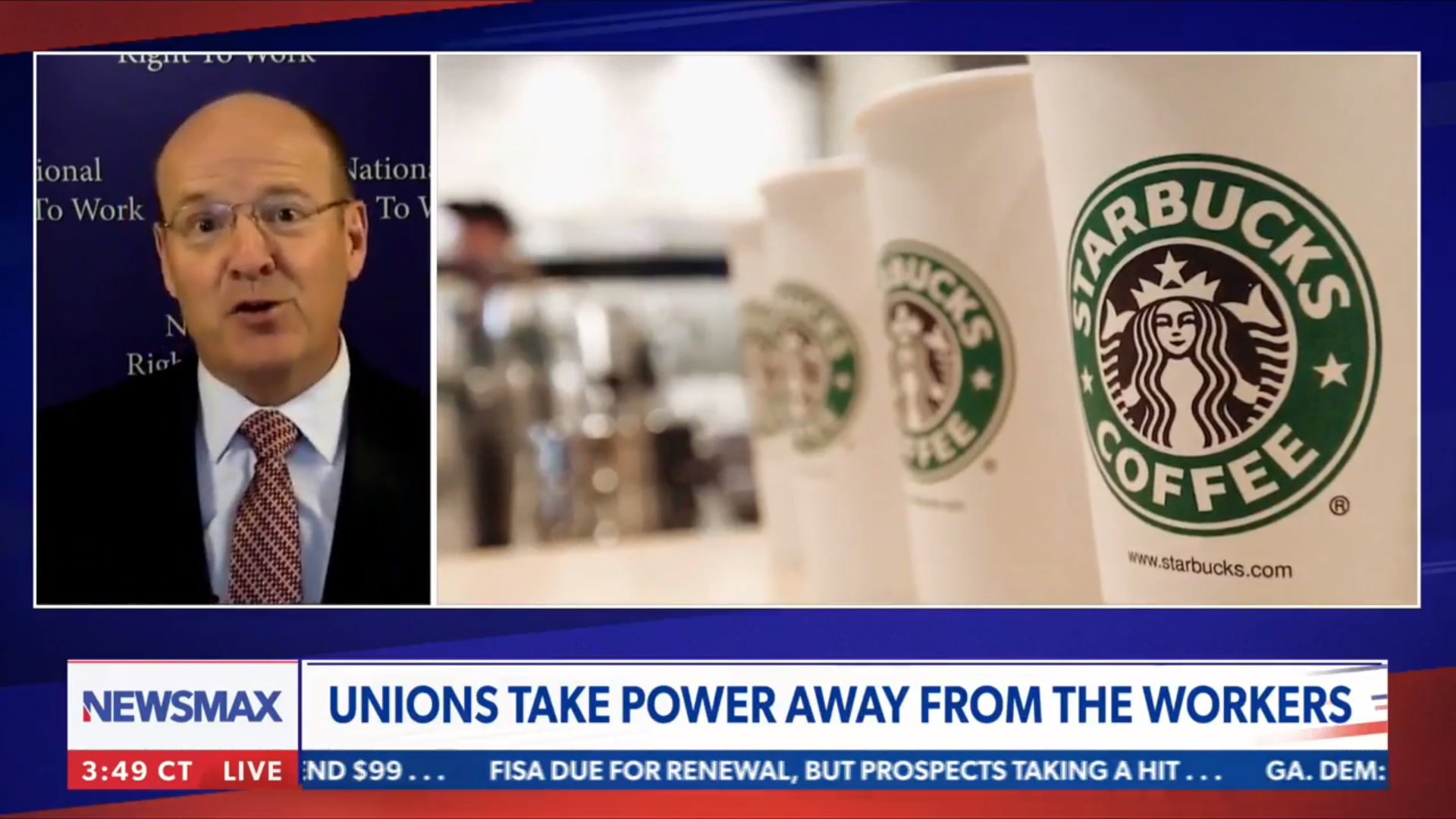
As Mark Mix explained on Newsmax TV, SBWU officials spent millions to infiltrate Starbucks with covert union agitators. That led to some of the first unionized Starbucks stores in Buffalo, NY, but now Buffalo baristas are trying to oust SBWU.
BUFFALO, NY – Although the National Labor Relations Board (NLRB) is charged with neutrally enforcing federal labor law, it has a notorious reputation for strengthening union officials’ power while diminishing the rights of workers opposed to union representation. Even with this biased history, the Biden Labor Board has already established itself as the most radically pro-forced unionism board in history.
The NLRB’s ideological bias is most apparent in its massive campaign to impose coercive unionism on Starbucks workers, while repeatedly blocking and undermining Starbucks employees’ attempts to remove unwanted union representation. While agency officials have approved hundreds of petitions for votes to bring the Starbucks Workers United (SBWU) union in, it has not let any of the roughly 20 worker-backed petitions seeking votes to remove the union advance to an election.
NLRB Cites Workers’ Desire to Oust Union as Reason to Impose Union
The NLRB’s anti-worker tactics have reached a new frontier. The NLRB is now citing a petition to remove the union as a reason why the union should not be removed and should serve as the basis for an injunction against Starbucks. NLRB lawyers are asking the Second Circuit Court of Appeals to overturn a District Court ruling and issue an injunction that would force Starbucks to engage in bargaining talks with the union, despite the fact that the decertification petition proves that a majority of employees at a Buffalo, NY, Starbucks want to throw the union out.
The decertification petition in question was collected by Starbucks barista Ariana Cortes. Cortes sought a vote to remove SBWU from her workplace, but the NLRB has refused to conduct the election. National Right to Work Legal Defense Foundation staff attorneys represent Cortes and Starbucks employees in nine other locations where workers are seeking votes to remove the SBWU. Now staff attorneys have filed a legal brief for Cortes and fellow Buffalo Starbucks employee Logan Karam in the Second Circuit Court of Appeals, countering the NLRB’s latest outrageous maneuver.
Cortes’ brief attacks the NLRB’s strategy as condescending toward workers. It argues the NLRB’s view that Cortes’ decertification must be stopped to protect workers is rooted in the wrongful idea that workers cannot think for themselves and lack independent reasons for wanting to get rid of a union.
Foundation Brief: NLRB Denies Workers’ Agency, Free Choice
“In reality, Cortes collected her petition because of the Union’s anti-employee behavior,” the brief says.
Foundation attorneys also contend in Cortes’ brief that what the NLRB is seeking from the Second Circuit — a 10(j) injunction under the National Labor Relations Act (NLRA) that will force Starbucks managers into working with SBWU union bosses to craft a monopoly bargaining contract — is extreme. Such injunctions can only be ordered when the harm done to workers in their absence would be “irreparable.” Foundation attorneys argue Cortes’ and other employees’ attempts to decertify do not make any injuries suffered by the union “irreparable.”
Dangerous Precedent Set If Court Grants Injunction That Undermines Right to Remove Unwanted Unions
If the Second Circuit grants the NLRB’s request for an injunction on behalf of SBWU union bosses, it would be the first time that a federal court has ordered a Starbucks store to engage in bargaining with union bosses on the basis of an employee’s decertification petition.
“The NLRB is digging an even deeper grave for employees trying to exercise their rights to remove an unwanted union from their workplace,” commented National Right to Work Foundation President Mark Mix. “The Board’s attempt to twist the limited employee rights to throw out a union into a reason to force a union upon employees is a new low.
“Ariana Cortes and Logan Karam are taking a courageous stand to ensure their coworkers aren’t disenfranchised and trapped under a union hierarchy they oppose, and we’re proud to support them,” Mix added.
Buffalo Starbucks Baristas Blast National Labor Relations Board’s Move to Trap Workers in Union at Court of Appeals
NLRB lawyers claim workers’ opposition to union “justifies” union being imposed on unwilling employees
Buffalo, NY (November 28, 2023) – Ariana Cortes and Logan Karam, Starbucks partners in the Buffalo area, have just filed an amicus brief in the Second Circuit Court of Appeals case Leslie v. Starbucks Corp. In the case, NLRB officials are attempting to prosecute Starbucks for misconduct alleged by SEIU-affiliated Workers United union officials. The NLRB cites a petition that Cortes and her coworkers filed seeking a vote to remove the union as a reason why Starbucks management should be subjected to a court-ordered injunction.
Cortes and Karam, who are represented for free by National Right to Work Legal Defense Foundation staff attorneys, challenge this legal maneuver in their brief. The employee’s brief argues that the NLRB’s strategy treats workers as if they have no agency of their own and have no independent reasons for wanting to get rid of a union.
“Given the biases of the current Board, it is disheartening ― but not surprising ― to see the NLRB claim Cortes’ petition is the product of Starbucks’ alleged unfair labor practices,” the brief states. “Its own records show that nothing could be further from the truth. In reality, Cortes collected her petition because of the Union’s anti-employee behavior.”
The employees’ brief also contends that the relief NLRB lawyers are seeking from the Second Circuit – a 10(j) injunction under the National Labor Relations Act (NLRA) that will force Starbucks managers into working with SBWU union bosses to craft a monopoly bargaining contract – is extreme. Such injunctions can only be ordered when the harm done to workers in their absence would be “irreparable.” Foundation attorneys argue that the fact that Cortes and other employees have attempted to decertify does not make any injuries suffered by the union “irreparable.”
“The NLRB’s argument it needs an injunction to suppress decertification efforts already underway―which have already garnered majority support―is a tacit admission it is seeking to alter the status quo, not preserve it,” states the brief.
Cortes is also receiving Foundation legal aid in a case challenging the constitutionality of the NLRB’s structure. That case, currently pending at the D.C. District Court, argues that the structure of the NLRB is unconstitutional.
Dangerous Precedent Set If Court Grants Anti-Worker Injunction
If the Second Circuit grants the NLRB’s request for an injunction on behalf of SBWU union bosses, it would be the first time that a federal court has ordered a Starbucks store to engage in bargaining with union bosses on the basis of an employee’s decertification petition. This would be a horrendous precedent for independent-minded Starbucks workers across the country.
Starbucks workers all across the country have submitted decertification petitions seeking votes to remove SBWU union bosses, including at least nine groups of employees who are utilizing free Foundation legal aid. The NLRB would be able to use the federal court precedent to make the dubious argument that union bargaining should be mandated simply because employees want a chance to oust the union.
“The NLRB is digging an even deeper grave for employees trying to exercise their rights to remove an unwanted union from their workplace,” commented National Right to Work Foundation President Mark Mix. “The Board’s attempt to twist employees’ desire to exercise their right to throw out a union into a reason to force a union upon them is a new low.”
“Ariana Cortes and Logan Karam are taking a courageous stand to ensure their coworkers aren’t disenfranchised and trapped under a union hierarchy they oppose, and we’re proud to support them,” Mix added.





