
Foundation-Backed Workers Notch Victories Over Dues-Hungry UAW Bosses
The following article is from the National Right to Work Legal Defense Foundation’s bi-monthly Foundation Action Newsletter, July/August 2023 edition. To view other editions of Foundation Action or to sign up for a free subscription, click here.
UAW caught using threats and coercion to illegally seize workers’ dues
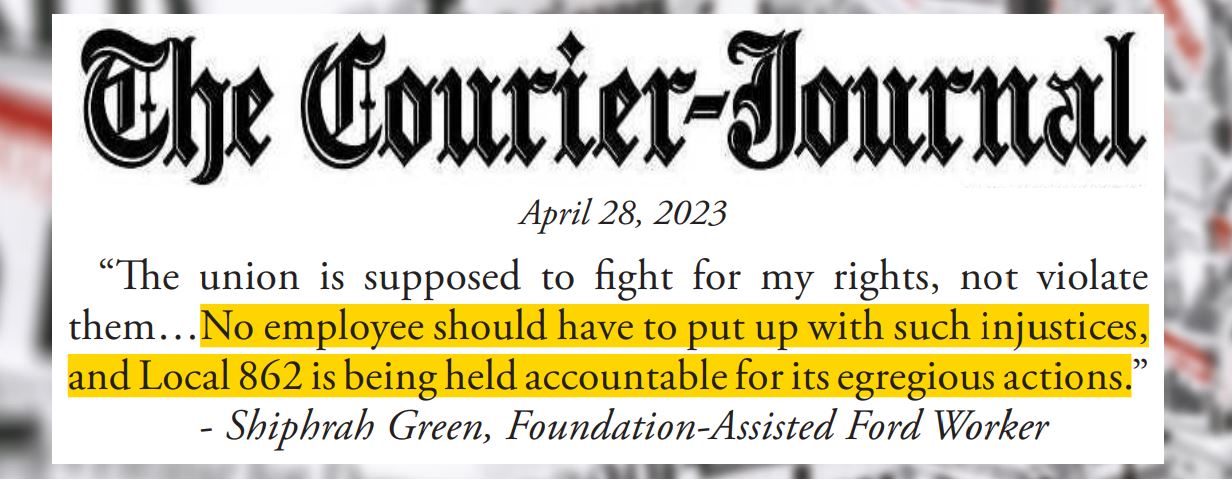
Ford employee Shiphrah Green excoriated UAW bosses in the Louisville Courier Journal over their blatant disregard for her rights. Foundation attorneys are helping her and others battle the notoriously corrupt union.
LOUISVILLE, KY – United Auto Workers (UAW) union officials have a well-deserved reputation for looking out for their own interests while throwing rank-and-file workers under the bus. The most prominent recent example is the corruption and embezzlement scandal, in which federal investigators revealed that UAW officials had siphoned millions of dollars in workers’ money to fund opulent golf vacations in luxury condos and private villas, spa and amusement park visits, $60,000 cigar-buying sprees, and much more.
But the federal corruption probe that led to eleven top UAW bosses pleading guilty, including former union presidents Gary Jones and Dennis Williams, is hardly the only time greedy UAW bosses abused their government-granted monopoly bargaining powers.
In a series of recent cases brought by National Right to Work Foundation staff attorneys against the UAW, workers are utilizing the Foundation’s free legal aid to vindicate their rights in the face of illegal dues demands by UAW officials.
Foundation-won Settlements Force UAW to Return Money to KY, IA Workers
Shiphrah Green, an employee of Ford Motor Company’s Louisville Assembly Plant, prevailed over UAW Local 862 bosses with free Foundation legal aid in April. UAW bosses were forced to settle and return money they had unlawfully taken from Green’s pay.
Green’s federal charges against the union maintained not only that UAW officials had made her jump through unnecessary hoops to exercise her right to cut off union dues, but also that UAW bosses made threats against her job when she tried to resign, with one union official warning her “if it were up to me, you’d lose your job for leaving the union.” Green’s settlement also forced UAW officials to refrain from such illegal threats in the future.
Meanwhile in Iowa, four employees of air filter manufacturer Donaldson won a recent settlement in which UAW officials were required to return over $1,000 in illegally-seized dues.
In each Donaldson worker’s case, UAW bosses had either refused to stop dues deductions despite producing no original documentation showing the workers had consented to such deductions in the first place, or had kept seizing money after an employee resigned union membership and revoked authorization to deduct dues, which should have been effective in stopping the flow of dues.
Because Ms. Green and the Donaldson workers reside in Right to Work states, the Foundation-won cases mean they will be free from all union financial support going forward.
Philly Public Defender Hits UAW with Charges
Even in non-Right to Work states where union officials have the power to compel workers to pay some fees under threat of termination, UAW bosses still go far beyond what is legal in their greedy forced-dues demands.
For example, Foundation staff attorneys recently filed a case for Philadelphia public defender Brunilda Vargas. Vargas, a vocal opponent of the UAW’s unionization drive, was told by UAW organizers that the union would reduce her and her coworkers’ wages if they did not grant the union the power to automatically deduct union dues directly from their paychecks.
Not only is the threat illegal, but further, employees can never be required to authorize automatic dues deductions from their paychecks under long-established federal law. This is true even in a state like Pennsylvania where workers lack the protection of a Right to Work law. Vargas’ charge, filed in June, is now being investigated.
“American workers likely have a plethora of reasons for wanting nothing to do with UAW union officials, including but not limited to the dizzying corruption in the union that has led to so many union officials going to prison,” commented National Right to Work Foundation Vice President Patrick Semmens. “As Foundation attorneys have experienced, UAW officials will often resort to clearly illegal methods to squeeze money out of dissenting workers in violation of federal law.”
“Union bosses who cannot convince workers to pay union dues voluntarily should not be allowed to seize union dues under threat of termination,” Semmens added.
Former Connecticut State Trooper Wins Over $250,000 in Political Discrimination Suit
The following article is from the National Right to Work Legal Defense Foundation’s bi-monthly Foundation Action Newsletter, July/August 2023 edition. To view other editions of Foundation Action or to sign up for a free subscription, click here.
CSPU union upended trooper’s career after he refused to fund union politics
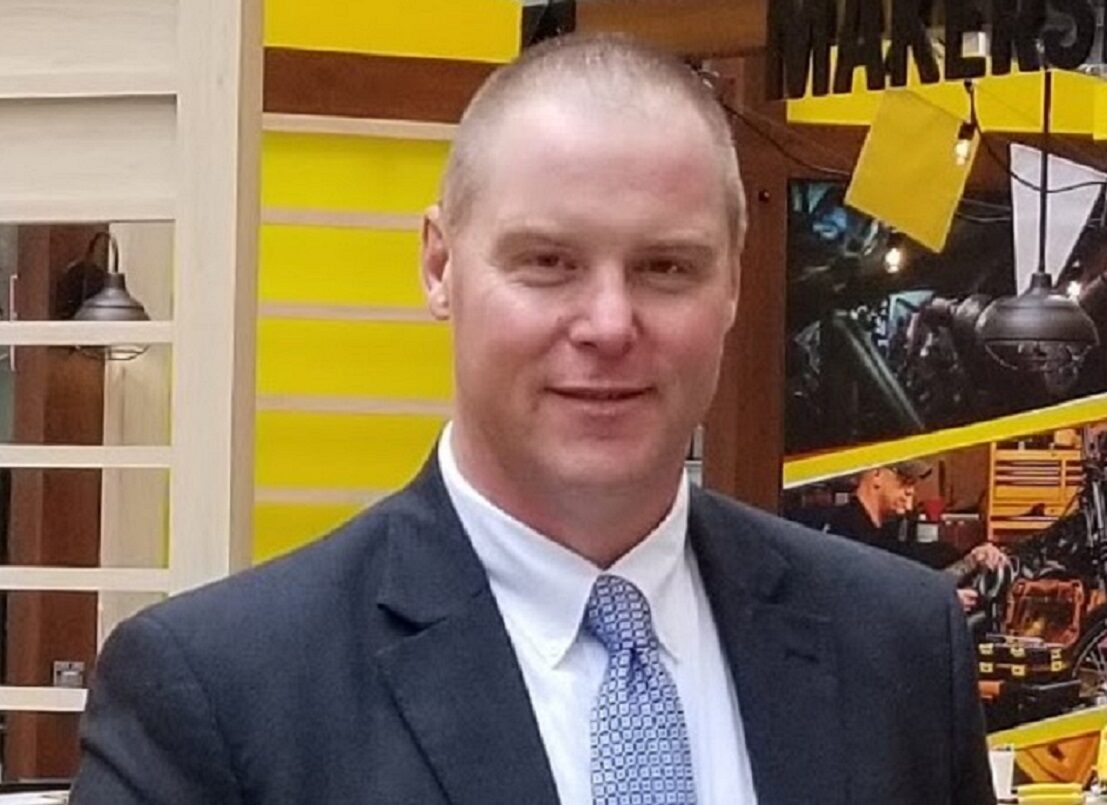
Joseph Mercer fought back with free Foundation legal aid when the CSPU union blocked his promotion because he challenged union political activities and told others about their rights.
HARTFORD, CT – In 2015, then-Connecticut State Trooper Joseph Mercer received a promotion to Operations Sergeant of the Emergency Services Unit, a position that gave him significant responsibility over emergency services training and field operations. Mercer gained this prestigious position through his seventeen years of experience as a trooper, which included a tense situation with an armed suspect barricaded in a hotel.
But behind the scenes, Mercer was a target of Connecticut State Police Union (CSPU) officials, who resented Mercer because of his resistance to funding union politics with his own money. After CSPU President Andrew Matthews filed two baseless grievances against Mercer, the Department of Emergency Services and Public Protection (DESPP) demoted him to a position that offered fewer overtime opportunities and involved less time in the field.
Mercer slammed CSPU and DESPP officials with a federal lawsuit in 2016 with free legal aid from the National Right to Work Foundation, accusing police union officials of retaliating against him for exercising his right to stop funding union politics.
This April, Foundation attorneys forced CSPU and DESPP to back down and settle the case. Both parties must now pay $260,500 as a condition of ending the suit.
CSPU Union President Targeted Dissident Trooper Immediately After Promotion
Just a month after Mercer received his promotion, CSPU President Matthews filed a grievance over Sergeant Mercer’s appointment.
Matthews’ grievance claimed that there had been no “selection process” to fill the position, despite the fact that none of Sergeant Mercer’s union-member predecessors had undergone any particular kind of selection process before they got the job. Matthews also filed a second baseless grievance, alleging Mercer had mismanaged the incident involving the armed suspect barricaded in a hotel. State police officials had never expressed dissatisfaction with how Mercer handled the situation.
In October 2015, after meeting in private with the union president, then-DESPP Commissioner Dora Schriro transferred Mercer out of his Operations Sergeant position to an administrative post. Prior to this demotion, Mercer had received no warnings, reprimands, or other disciplinary actions regarding the incident referenced in Matthews’ grievance. Mercer filed his lawsuit with Foundation aid in February 2016.
Mercer’s Foundation attorneys cranked up the heat on both the union and DESPP officials in May 2022, when a District Court judge ordered DESPP Commissioner James Rovella, who had replaced Schriro, to turn over additional documents that might provide insight into the circumstances surrounding Mercer’s firing.
Rather than follow through with the judge’s discovery order and continue the fight against Mercer, CSPU and DESPP reversed course and settled the case in April 2023. The settlement categorizes the vast majority of the $260,500 payout as “compensatory damages” due directly to Mercer.
Settlement Underscores Importance of Public Servants’ Janus Rights
“We are proud to have defended Sergeant Mercer’s rights and secured him a settlement that vindicates his free association,” commented National Right to Work Foundation Vice President and Legal Director William Messenger. “However, it’s disgraceful that CSPU union officials targeted Mercer, a dedicated public safety officer, with such a retribution scheme in the first place. Public servants should not have to endure multi-year lawsuits just so they can refrain from supporting union politics they oppose.”
“Situations like these demonstrate why the Foundation-won Janus v. AFSCME decision, which the U.S. Supreme Court decided while Mercer’s case was ongoing, is so important,” Messenger added. “As demonstrated in Mercer’s case, unelected union officials often wield their enormous clout over government to serve the union’s self interests over the public interest and employee interests. That’s why it’s vital that public employees can exercise their First Amendment Janus right to cut off all financial support for union officials this way.”





