
Foundation Blasts Biden Plan to Sneak Union Monopoly Power into Agricultural Sector
The following article is from the National Right to Work Legal Defense Foundation’s bi-monthly Foundation Action Newsletter, January/February 2024 edition. To view other editions of Foundation Action or to sign up for a free subscription, click here.
Comments expose DOL rule’s rigging of agricultural visa program to favor union organizers
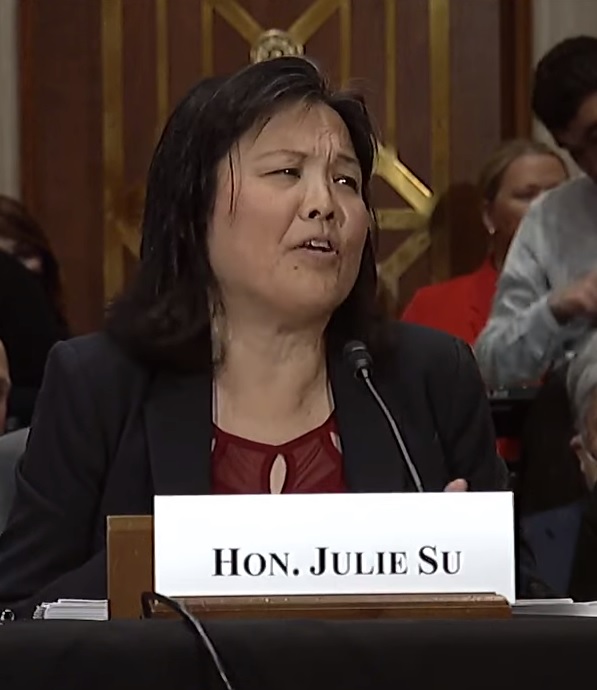
Julie Su — “acting” secretary of the Biden Labor Department due to bipartisan opposition barring her from the agency’s top job — is overseeing an attempt to sneak union boss power into the agricultural sector against Congress’ will.
WASHINGTON, DC – Federal labor policy in the United States provides a smorgasbord of powers to union bosses in the private sector, not the least of which are the powers to impose one-size-fits-all contracts on dissenting workers in a unionized workplace, and to force workers to pay dues in non-Right to Work states.
Traditionally that hasn’t been the case in the agricultural sector, where each state has the freedom to make its own labor policy. But in November 2023, the Biden Department of Labor announced a rule which could upend this balance and effectively impose on temporary agricultural employees portions of federal labor law that are overwhelmingly favorable to union bosses. The National Right to Work Foundation promptly filed comments exposing the slated rule as a Big Labor power grab.
Biden Admin Defies Congress by Granting Union Bosses Power Over Farmworkers
The proposed rule would assist union bosses with imposing monopoly bargaining privileges over temporary agricultural workers in the United States, including workers who don’t support a union. Among other things, the rule requires that employers fork over employee contact information at union bosses’ request — regardless of whether the union has any employee support. The proposed rule would also cajole employers into entering into so-called “neutrality agreements” with union bosses. “Neutrality agreements” typically require employers to censor information about the union and provide other aid to union bosses in their efforts to collectivize workers.
The comments cite multiple reasons as to why the Department of Labor lacks the legal authority to implement the proposed rule, such as the fact that Congress expressly excluded agricultural workers from federal labor statutes.
According to the comments, the Biden Department of Labor admitted in its rulemaking announcement that it is trying to impose parts of the National Labor Relations Act (NLRA) on
the agricultural sector, despite Congress’ intent.
“The Department not only lacks Congressional authorization to take this action, it is defying express Congressional intent to not subject these types of employees to provisions of the NLRA,” the comments state.
Comments: Union Power Grab Won’t Help Workers
The comments also point out that the provisions in the Department of Labor’s rule are unrelated to the rule’s stated purpose of helping agricultural workers avoid exploitation, and rather resemble a list of proposals to empower union officials at workers’ expense.
“The Department fails to explain how allowing unions to access employees’ personal information, to bargain for neutrality agreements, and to prevent employees from accessing information for and against unionization helps to alleviate the concerns identified in the proposed regulations,” the comments argue.
“The Department should not adopt the proposed regulation,” the comments conclude.
The Department of Labor’s notice of rulemaking comes as the Biden Administration is making a full court press to expand union boss legal privileges across the country. That includes the Biden National Labor Relations Board’s (NLRB) plan to wipe out the Foundation-backed Election Protection Rule, which eased the process by which workers could obtain votes to remove unpopular unions from their workplaces. The Biden NLRB seeks to make it more difficult for American private sector workers to exercise their right to remove unwanted unions, while giving union officials more tools to gain power in a workplace without even a vote.
“Despite the Department of Labor’s claims, the true underhanded goal of this rule is clear: handing union bosses more power to corral workers into union ranks, while cutting back on workers’ privacy and rights to resist unwanted unionization,” observed National Right to Work Foundation President Mark Mix.
“Temporary agricultural workers should not be used as pawns to expand union bosses’ sphere of control into the agricultural sector. But that’s exactly what the Biden Department of Labor is attempting in direct contradiction of the choice made by Congress not to subject such workers to federally imposed monopoly unionism.”





National Right to Work Foundation Submits Comments Opposing Proposed DOL Rule Loosening Union Financial Disclosures
Comments: Rule will let huge number of unions escape meaningful scrutiny over how union bosses spend worker funds while providing no tangible benefits
Washington, DC (July 31, 2025) – The National Right to Work Foundation has just submitted comments regarding the Office of Labor Management Standards’ (OLMS) proposed rule to significantly reduce financial disclosures union officials are required to file with the Department of Labor. The comments warn that the slated rule will deprive millions of rank-and-file workers of vital information on how union officials spend their dues payments, especially spending on union political and ideological activities.
Current financial disclosure rules for unions mandate that unions with $250,000 or more in annual receipts file an LM-2 report with the Department of Labor, while unions with less revenue must only submit less-detailed LM-3 or LM-4 reports, both of which consist of only a few pages. The OLMS’ proposed rule would eliminate the requirement to turn in an LM-2 for all unions except those with $450,000 or more in annual receipts, meaning a large number of unions currently subject to LM-2 reporting would only be required to provide substantially less-comprehensive filings.
“The ‘cost’ of the proposed rule—the information that workers and others will no longer be able to learn about unions—is considerable,” the comments say. “The rule’s ostensible ‘benefit’—reducing union reporting burdens—is not supported by evidence and is insignificant…The costs of the proposed rule greatly outweigh its nonexistent benefits.”
New Rule Will Block Millions of Workers From Seeing Basic Details About Union Spending
The comments emphasize the wide impact of the proposed rule, especially among those who work in states that lack Right to Work protections and for that reason can be forced to pay union dues or fees just to keep their jobs. “OLMS data for the past year…shows over 7,700 filings from unions with receipts under $450,000 that are located in states that lack Right to Work laws,” the comments say. “These unions reported combined annual receipts of over $523 million, annual disbursements of over $514 million, and over 4 million members.
“The lack of more detailed reporting requirements for these unions therefore harms over 4 million workers by denying them meaningful details” regarding how union officials spend their hard-earned money, the comments explain.
Much of this omitted information will include details on how much money union officials spend on overhead and administration as opposed to representational activities in the workplace, not to mention what union bosses are contributing to often-divisive political causes. While LM-2 forms let workers quickly see these figures, the comments say, “[t]he proposed rule will deprive workers of this information about many unions because the LM-3 does not include these reporting categories.”
Knowing less about union political spending will also impede workers’ ability to enforce their rights under the Foundation-won Communications Workers of America v. Beck Supreme Court decision, the comments point out. Beck blocks union bosses from forcing nonmember workers under their control to pay for union ideological expenses or anything unrelated to representational activities. The comments point to contributions disclosed on LM-2s to groups such as ActBlue, Black Lives Matter, and the Democratic National Committee that would no longer be disclosed to workers if the proposed rule were implemented.
Comments Debunk Union ‘Burden’ Arguments Cited by OLMS
The comments also reveal that the main impetus OLMS cites for pushing this proposed rule – that the regulatory burden for unions is too large – has very little evidence to support it. An estimate that OLMS put out about the number of hours that the proposed requirements would save unions is “out of date, fails to account for modern…software, and is not even an estimate of the time it takes impacted unions to complete LM-2 reports, but rather is an estimate of the average time it takes all unions to complete LM-2 reports,” the comments say.
The comments conclude by asking OLMS to eliminate the current system of graduated filing thresholds and instead require all unions to file LM-2 reports. “The benefit of this change is self-evident: workers, the public, and the Department will receive more information about union finances, which in turn will lead to more informed workers and deter and uncover more union corruption,” the comments explain.
“America’s top union bosses are routinely caught abusing the funds they demand from millions of workers across the country, all while promoting divisive and often radical political causes at every level of government,” commented National Right to Work Foundation President Mark Mix. “Acting in the best interests of workers means providing more clarity on how employee money is spent, not less.
“Make no mistake: The OLMS’ proposed rule will benefit union bosses at the expense of rank-and-file workers. Every worker deserves to know the basic details of how their money is being spent by those who claim to ‘represent them,’ and the slated rule would deprive millions of workers of what little information they already have,” Mix added.