
Casino Worker Challenges Order Installing Unwanted Union via ‘Card Check’
The following article is from the National Right to Work Legal Defense Foundation’s bi-monthly Foundation Action Newsletter, March/April 2022 edition. To view other editions of Foundation Action or to sign up for a free subscription, click here.
Ninth circuit panel signals willingness to end precedent allowing for imposition of union

NLRB officials stacked the deck against rank-and-file Red Rock Casino employees by imposing an unpopular union on them despite worker objections.
LAS VEGAS, NV – A large majority of the workers at Red Rock Casino in Las Vegas, Nevada voted “no” to unionization, but a federal district court judge ordered their employer to bargain with union officials anyway. Casino officials appealed, and Red Rock employee Raynell Teske supported their efforts to overturn the judge’s coercive order that overrides the choice workers made at the ballot box.
With free Foundation legal aid, Teske filed a brief arguing that the district judge had no reason to impose a union onto workers who had already soundly voted to reject it. A Ninth Circuit panel denied the initial appeal, but issued an unusual concurring opinion in which all three judges said they disagreed with that outcome, but were bound by Ninth Circuit precedent to uphold the district judge’s order.
Binding precedent can only be overturned through an en banc hearing before a larger Ninth Circuit panel. Red Rock lawyers filed for an en banc rehearing of their appeal. The court then ordered National Labor Relations Board (NLRB) lawyers defending the order to respond, another signal the judges may be willing to overturn this ridiculous precedent and rule in the workers’ favor. Teske filed a second amicus brief, urging the court to hear the case en banc.
Judge Overrides Workers’ Vote Against Union ‘Representation’
The situation at Red Rock began in December 2019, when the NLRB held a secret-ballot election on whether to unionize the Casino’s workers. Employees rejected union officials’ effort to become their monopoly bargaining “representatives” in an NLRB-supervised vote by a nearly 100-vote margin. Despite that outcome, NLRB Region 28 Director Cornele Overstreet sought a federal court injunction imposing the union over the workers’ objections.
On July 20, 2021, District Judge Gloria Navarro agreed with the NLRB Director’s request, and ordered Red Rock to bargain with union officials despite the employees’ vote against unionization. The judge said the order was justified because union officials claimed that, before the vote, a majority of workers had signed union authorization cards.
Teske’s amicus briefs argue those “Card Check” signatures don’t prove that union officials ever had majority support. She contends the level of union support was tested fairly by the secret-ballot election, in which workers voted 627-534 against unionization.
Her briefs point out that the NLRB and federal courts have long recognized that secret ballots are a more reliable way of gauging worker support for a union, because workers are often pressured, harassed, or misled by union organizers into signing cards.
Union officials know that Card Check signatures do not indicate solid worker support. The AFL-CIO admitted in its internal organizing handbook that it needed at least 75% Card Check support before having even a 50-50 chance of winning a secret-ballot election. Union bosses prefer Card Check unionization because they can more easily take control of workplaces where they lack popular support, and partisan NLRB appointees now are working to grant their wish.
Partisan NLRB Pushes Unreliable ‘Card Check’
Past legislative attempts to enact Card Check unionization, including the so-called “PRO Act,” pending in the U.S. Senate right now, faced bipartisan opposition. However, NLRB General Counsel Jennifer Abruzzo, a former high-ranking union lawyer, believes she can implement Card Check without congressional approval. Abruzzo has expressed interest in resurrecting a decades-old NLRB doctrine that allows unions to sue employers to try to force them to automatically bargain whenever the union possesses a pile of untested union cards.
“There is no reason why district court judges or NLRB bureaucrats should be able to override workers’ choice at the ballot box,” said National Right to Work Foundation Vice President Patrick Semmens. “A favorable ruling for Raynell Teske and her colleagues could provide legal ammunition for future workers if the NLRB tries to force them to accept union officials for whom they never even had a chance to vote.”
Workers Who Voted Against Union Oppose Order Forcing Union on Them
The following article is from the National Right to Work Legal Defense Foundation’s bi-monthly Foundation Action Newsletter, November/December 2021 edition. To view other editions of Foundation Action or to sign up for a free subscription, click here.
Biden NLRB seeks to overturn vote of Red Rock Casino workers against Unite Here
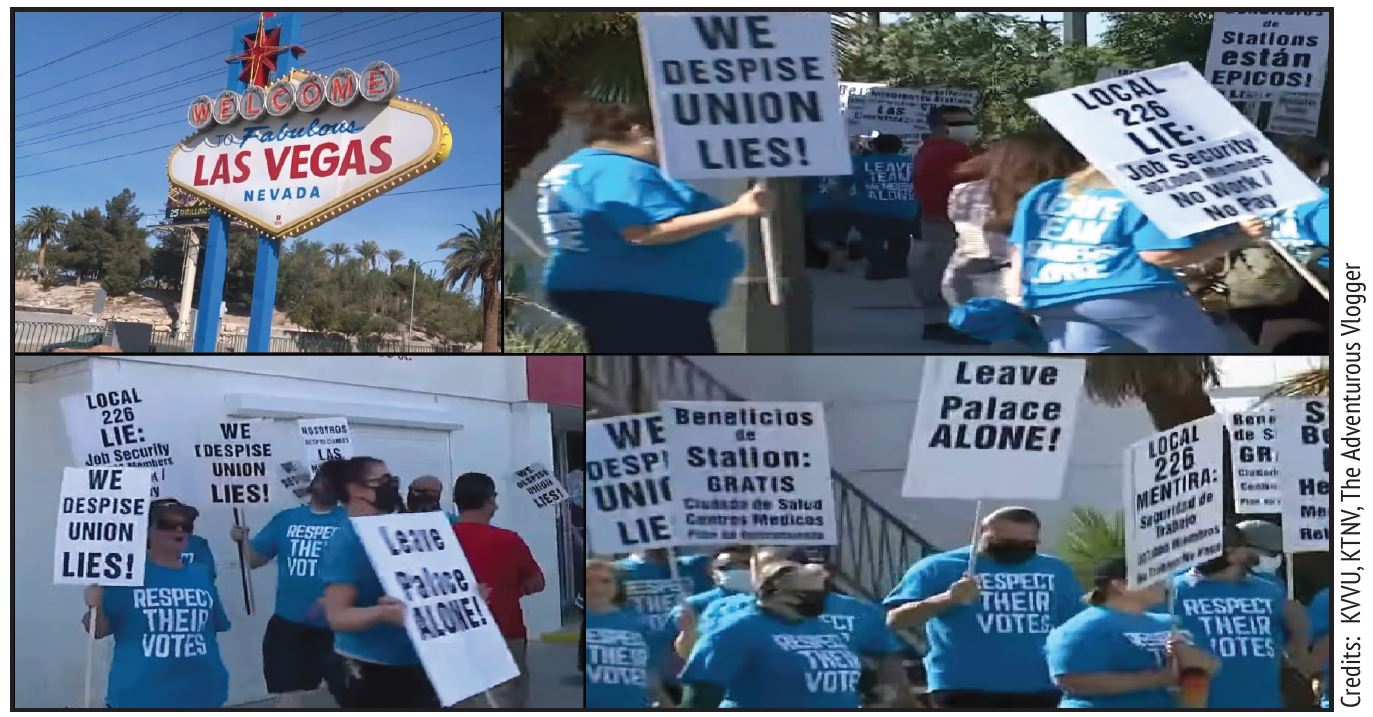
Red Rock Casino employees bearing the messages “We Despise Union Lies” and “Respect Their Votes” protested outside Culinary Union headquarters in Las Vegas after union bosses tried to block Red Rock Casino workers’ emphatic vote to remove the union.
LAS VEGAS, NV – A large majority of the workers at Red Rock Casino in Las Vegas, Nevada, voted “no” to unionization, but a federal district court judge later issued an order forcing their employer to bargain with union officials anyway.
The Casino appealed the judge’s order to the U.S. Court of Appeals for the Ninth Circuit. National Right to Work Legal Defense Foundation attorneys assisted Red Rock food service employee Raynell Teske for free in filing her legal brief at the Ninth Circuit, arguing the judge was wrong to impose a union monopoly on the workers after the union had already lost an election.
Judge Overrides Workers’ Election Choice
In December 2019, the National Labor Relations Board (NLRB) administered a secret-ballot election on whether to unionize Red Rock. A majority of those voting rejected union officials’ effort to become their monopoly bargaining “representatives.”
Nevertheless, NLRB Region 28 Director Cornele Overstreet sought a federal court injunction demanding the union be imposed over the workers’ objections. On July 20, 2021, notoriously partisan Judge Gloria Navarro, appointed by Barack Obama, granted the NLRB Director’s request. She fired off a rare “Gissel” order forcing Red Rock to bargain with union officials despite the employees’ vote against unionization. The judge based her order on union officials’ claim that a majority of workers had signed union authorization cards before the vote. Teske’s legal brief argues that those “card check” signatures are unreliable, and not reason enough to conclude the union ever had majority support. After all, the level of union support was tested by the secret-ballot election and the results were clear: union officials received only 40% support from the eligible employees’ votes. As the Supreme Court has long recognized, secret ballots are a far more reliable way of gauging worker support for a union, because workers are often pressured, harassed, or misled by union organizers into signing cards.
Union Handbook Admits: ‘Card Check’ Is Unreliable
Unions themselves know that “card check” signatures do not reliably indicate worker support. The AFL-CIO admitted in its 1989 organizing handbook that it needed at least 75% card check support before having even a 50-50 chance of winning a secret-ballot election. An earlier guidebook acknowledged that some workers sign cards just to “get the union off my back.” Teske’s brief argues the union’s possession of so-called “cards” does not give union officials permission to take over, especially after they lost a secret-ballot election.
Brief: A Judge’s Order Shouldn’t Overturn Workers’ Clear Choice
The Foundation-aided brief urges that the “Gissel” order be overturned and says that imposing the union’s monopoly power despite the workers’ vote against it treats workers “like children” who did not understand what they were doing when they voted against union affiliation.
“Ms. Teske and her coworkers chose to reject unionization at the ballot box, but Judge Navarro decided to use her power to overturn the election,” said National Right to Work Foundation Vice President and Legal Director Raymond LaJeunesse. “Time and time again, we see workers pressured, misled and even bribed to sign union cards, which is why ‘Card Check’ is widely accepted as unreliable, especially compared to an NLRB-supervised secret-ballot election.”
“The Court of Appeals should promptly overturn Judge Navarro’s coercive order, and restore the actual choice workers made at the ballot box. Federal judges and NLRB bureaucrats cannot be allowed to override workers’ choices,” added LaJeunesse.
Opposition Filed to Judge’s Order Imposing Culinary Union on Workers who Rejected Union in Secret Ballot Vote
Red Rock Casino workers vote against unionization, but nearly 2 years later judge ordered employer to bargain with union officials
Las Vegas, NV (August 24, 2021) – A large majority of the workers at Red Rock Casino in Las Vegas, Nevada voted “no” to unionization, but a federal district court judge is forcing their employer to bargain with union officials anyway.
The Casino is appealing the judge’s order at the U.S. Court of Appeals for the Ninth Circuit. Now Red Rock employee Raynell Teske has filed an amicus brief arguing the judge was wrong to impose the union on the workers, given the rejection of the union in the election. National Right to Work Legal Defense Foundation attorneys assisted Teske for free in filing the amicus brief with the appellate court.
In December 2019, the National Labor Relations Board held a secret ballot election whether to unionize Red Rock. A sizable majority of those voting rejected union officials’ effort to become their monopoly bargaining representatives. Despite that vote, NLRB Region 28 Director Cornele Overstreet filed a federal court injunction action seeking to have the union imposed over the workers’ objections.
On July 20, 2021, Judge Gloria Navarro agreed with the NLRB Director’s request, and issued a “Gissel” order forcing Red Rock to bargain with union officials despite the employees’ vote against unionization. The judge said the order was justified because, prior to the vote, union officials claimed that a majority of workers had signed union authorization cards.
Teske’s amicus brief argues those “card check” signatures are unreliable, and not reason enough to conclude the union ever had majority support. She contends the level of union support was tested fairly by the secret-ballot election, in which workers voted 627-534 against unionization. Secret ballots are a far more reliable way of gauging worker support for a union, because workers are often pressured, harassed, or misled by union organizers into signing cards.
Unions themselves know that “card check” signatures do not indicate solid worker support. The AFL-CIO admitted in its 1989 organizing handbook that it needed at least 75% card check support before having even a 50-50 chance of winning a secret ballot election. An earlier guidebook acknowledged that some workers sign cards just to “get the union off my back.”
Teske’s brief argues the union’s possession of so-called “cards” is an insufficient legal basis for imposing unionization, especially after a secret ballot election in which the union lost. It agrees with the employer that the “Gissel” order should be overturned, and that Teske and her coworkers should not be subjected to monopoly bargaining by a union they rejected in an NLRB-supervised secret ballot election.
This is not the only case in which union bosses are battling casino employees in court. Red Rock’s parent company, Station Casinos, also owns Palms Casino in Las Vegas, where employees filed a petition to decertify union officials in March, 2021. Union lawyers blocked the petition with a slew of charges that were accepted by NLRB bureaucrats as reason to block the workers’ petition. The Palms Casino worker represented by National Right to Work Foundation attorneys who filed the petition is appealing the decision to block the vote he requested.
“Ms. Teske and her coworkers had good reasons to reject the union. It is outrageous that the judge’s order imposing unwanted unionization brushes aside the workers’ contrary preference clearly demonstrated in the secret ballot vote,” said National Right to Work Legal Defense Foundation President Mark Mix. “There have been countless examples of workers being pressured, misled and even bribed to sign union cards, which is why ‘Card Check’ is widely accepted as unreliable, especially compared to an NLRB-supervised secret ballot election.”
“If federal labor law is to be about defending the rights and freedoms of rank-and-file workers, then the Court of Appeals should promptly overturn Judge Navarro’s order substituting the wishes of NLRB bureaucrats for the actual choice workers made at the ballot box,” added Mix.





