
Starbucks Employees File Brief with Appeals Court in Case Challenging Constitutionality of Labor Board Structure
NY Starbucks workers are challenging NLRB that refuses to hold votes to remove unwanted SBWU union
Washington D.C. (October 16 2024) – New York Starbucks employees Ariana Cortes and Logan Karam have filed the opening brief with the D.C. Circuit Court of Appeals in their groundbreaking lawsuit challenging the structure of the National Labor Relations Board (NLRB) as unconstitutional. The lawsuit, initially filed by Cortes, and later joined by Karam, follows NLRB officials’ refusal to process their respective petitions requesting a vote to remove Starbucks Workers United (SBWU) union officials from their workplace.
The lawsuit states that the National Labor Relations Act of 1935 (NLRA) violates Article II of the Constitution by shielding NLRB Board Members from being removed at the discretion of the president. The appeal challenges a District Court decision that dismissed the lawsuit on the grounds that the plaintiffs lack legal standing. That decision did not address the underlying claim regarding whether the Labor Board’s structure complies with the requirements of the Constitution.
The brief, filed with free legal aid from the National Right to Work Legal Defense Foundation, thoroughly refutes the District Courts decision that Cortes and Karams lack standing to challenge the constitutionality of the Board, and also argues why the Court should side with the plaintiffs on the merits of their constitutional challenge against the NLRB.
Starbucks Employees Are Being Denied Their Right to Vote
On April 28, 2023, Cortes submitted a petition, supported by a majority of her colleagues, asking the NLRB to hold a decertification election at her Buffalo-area “Del-Chip” Starbucks store to remove SBWU union officials’ bargaining powers over workers. However, NLRB Region 3 rejected Cortes’ petition, citing unfair labor practice accusations made by SBWU union officials against the Starbucks Corporation. Notably, there was no established link between these allegations and the employees’ decertification request.
Similarly, Karam filed a decertification petition seeking a vote to remove the union at his Buffalo-area Starbucks store. Like Cortes’ petition, NLRB officials refuse to allow the vote to take place, citing claims made by SBWU officials. As a result the workers remain trapped under union “representation” they oppose.
“The lower court’s decision was wrong in finding that Cortes’ and Karam’s case lacked standing, as both have business before the NLRB right now and also did at the time their lawsuit was filed,” commented National Right to Work Foundation President Mark Mix. “We’re hopeful that the D.C. Court of Appeals will agree, and sides with these workers who are entitled to have their decertification case adjudicated by a Labor Board whose structure complies with the Constitution.”
“Despite the wishes of Big Labor and the NLRB who appear intent on squashing the rights of workers opposed to unionization and exercising unfettered power, federal labor law is not exempt from the requirements of the highest law of the land,” added Mix.
Foundation Lawsuit: Biden NLRB Structure Violates the U.S. Constitution
The following article is from the National Right to Work Legal Defense Foundation’s bi-monthly Foundation Action Newsletter, November/December 2023 edition. To view other editions of Foundation Action or to sign up for a free subscription, click here.
Groundbreaking suit filed for Starbucks employee who was denied vote to oust unwanted union bosses
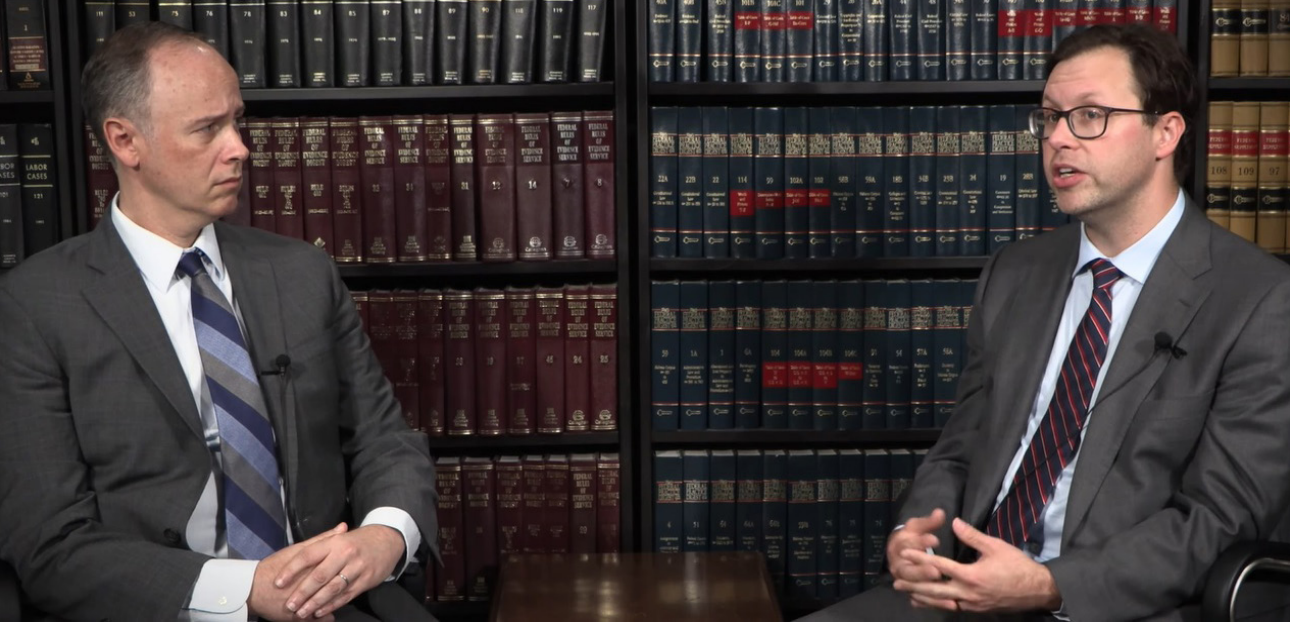
Starbucks employee Ariana Cortes’ Foundation attorney, Aaron Solem (right), is making a cutting-edge argument targeting the NLRB’s lack of accountability.
WASHINGTON, DC – The National Labor Relations Board (NLRB) is supposed to protect the right of workers to freely choose whether to associate with a union or not. The NLRB is also charged with holding unions and employers accountable when they violate worker rights. Too often, however, it has simply acted as an agency that generates policies to entrench union bosses’ power over workers while shielding union bosses from any kind of liability.
A new federal lawsuit from a National Right to Work Foundation-backed Starbucks employee, currently pending at the D.C. District Court, could upend the federal agency and result in a ruling that the current Labor Board’s structure violates the Constitution.
Employee Challenges NLRB Bureaucrats’ Protections from Presidential Removal
Ariana Cortes, a worker at the Buffalo, NY, “Del-Chip” Starbucks branch, hit the NLRB with the groundbreaking lawsuit in October, contending that the federal agency’s current structure violates the separation of powers mandated by the Constitution.
Cortes’ suit follows Foundation attorneys’ defense of her and her coworkers’ petition requesting a vote to remove Starbucks Workers United (SBWU) union officials from their workplace. Regional NLRB officials dismissed Cortes’ majority-backed petition based on SBWU allegations against Starbucks management that have no proven connection to Cortes and her coworkers’ desire for a union decertification vote.
Cortes’ lawsuit argues that because NLRB members cannot be removed at-will by the President, the NLRB’s structure violates Article II of the Constitution. Under Article II, the lawsuit contends, the President must have the power to remove officials that exercise substantial executive power.
Because the NLRB enforces federal labor law, manages union elections, and can issue legally binding rules and regulations, the lawsuit contends that the agency exercises substantial executive power. Therefore, it falls within the scope of the President’s power to remove officials at will. However, the National Labor Relations Act (NLRA), the law that established the NLRB, restricts the President’s ability to remove Board members except for neglect of duty or malfeasance.
“[T]hese restrictions are impermissible limitations on the President’s ability to remove Board members and violate the Constitution’s separation of powers. Thus, the Board, as currently constituted, is unconstitutional,” the complaint states.
Lawsuit: Unconstitutional NLRB Proceedings Must Stop
Cortes’ new federal lawsuit seeks a declaration from the District Court that the structure of the NLRB as it currently exists is unconstitutional.
“For too long the NLRB, especially the current Board, has operated as a union boss-friendly kangaroo court, complete with powerful bureaucrats who exercise unaccountable power in violation of the Constitution,” commented National Right to Work Foundation Vice President and Legal Director William Messenger. “The NLRB’s operation outside constitutional norms is easily exploited by Big Labor.”
“But as the story of Ms. Cortes shows, the NLRB’s unchecked power creates real harms for workers’ rights, especially when workers seek to free themselves from the control of union bosses they disagree with,” Messenger added.





