
DOJ Attorney Battles Biden Admin Union Power Grab Over Justice Department
The following article is from the National Right to Work Legal Defense Foundation’s bi-monthly Foundation Action Newsletter, March/April 2025 edition. To view other editions of Foundation Action or to sign up for a free subscription, click here.
Foundation attorneys challenge last minute DOJ unionization in violation of FLRA case law

NTEU union bosses backed Kamala Harris for President, but when voters rejected her, NTEU union officials and the Biden-Harris Administration hastily moved to install the union at the DOJ in an apparent attempt to obstruct Trump’s priorities.
WASHINGTON, DC – In states across the country, union officials go to great lengths to gain more political influence, and will often violate established law to do so.
As veteran Department of Justice attorney Jeffrey Morrison is discovering, federal agencies are no exception. Morrison is challenging a last-minute attempt by National Treasury Employees Union (NTEU) bosses to gain monopoly bargaining control over attorneys at both the DOJ Civil Rights Division (CRT, where Morrison is employed) and the DOJ Environment and Natural Resources Division (ENRD).
The unionization campaign was fast-tracked just days after Trump’s November election victory, in an apparent attempt to formally hand NTEU union officials power over the divisions prior to inauguration day. Morrison’s legal action asks the Federal Labor Relations Authority (FLRA) to formally review the actions by the Biden DOJ and NTEU officials. The FLRA is the federal agency responsible for adjudicating disputes between federal employees, union officials, and agencies within the federal government.
Brief: DOJ Holdovers and NTEU Bosses Colluded to Flout Existing Law
Morrison, who is receiving free legal aid from the National Right to Work Foundation, contends in filings before the FLRA that the NTEU’s scheme violates an existing FLRA decision in which the agency ruled that CRT attorneys did not comprise a work unit appropriate for unionization.
DOJ management raised this exact concern about the CRT unit with the FLRA after NTEU union bosses began their campaign, but the DOJ dropped its opposition just days after the November federal elections.
Morrison is asking the FLRA to review the decision of the Regional Director to allow the election to go forward in the CRT and ENRD divisions without properly considering if these divisions are an appropriate unit under the law.
Morrison’s filings (called “Applications for Review”) came after DOJ management and NTEU union officials agreed that the CRT and ENRD were work units appropriate for unionization. His Applications for Review point out that a prior FLRA decision, Antitrust Division, held that CRT lawyers “did not have a separate and distinct community of interest from other DOJ trial attorneys” and for that reason couldn’t stand as a distinct bargaining unit.
“[T]he Authority determined this very unit to not be an appropriate unit…The Regional Director’s failure to comply with current, binding Authority precedent is in error and must be reversed,” the Application for Review says regarding the CRT attorneys. This same argument is applied to the ENRD division because it is similarly situated to CRT in the DOJ hierarchy.
FLRA Failed to Conduct Investigation Into NTEU’s Union Scheme
Morrison’s applications also contend that the FLRA “fail[ed] to conduct an independent investigation into the appropriateness of the unit,” despite the law requiring that the FLRA make such a finding.
“An agency agreeing with a union that a unit is appropriate does not mean that unit is actually appropriate. Agencies, like DOJ here, cannot usurp the Authority’s role in deciding unit appropriateness…” say the Applications for Review.
“Right before power changed hands in Washington, DC, NTEU union bosses and DOJ bureaucrats appear to have colluded to flout longstanding precedent that says Justice Department attorneys cannot legally be unionized division by division,” commented National Right to Work Foundation President Mark Mix.
“The FLRA has ignored established precedent to let this hasty unionization attempt go through, and our attorneys are proud to assist Mr. Morrison in opposing this maneuver.”
Right to Work Foundation Submits Legal Brief Opposing Biden “Project Labor Agreement” Rule for Federal Construction Projects
Amicus brief at Eleventh Circuit Court of Appeals exposes rule as discriminating against nonunion workers and contractors in violation of Constitution
Atlanta, GA (June 4, 2025) – The National Right to Work Legal Defense Foundation filed an amicus brief in Associated Builders and Contractors v. General Services Administration, a federal case that concerns the legality of the Biden Administration’s edict ordering federal agencies to contract only with unionized firms on most federal construction projects.
The Foundation’s brief explains that such arrangements, also known as “Project Labor Agreements” (PLAs), violate both the Constitution and conflict with federal law by discriminating against workers and employers who have chosen not to associate with a labor union. The case is currently pending at the Eleventh Circuit Court of Appeals in Atlanta.
“Foundation attorneys have represented [employees] in cases to protect their right to refrain from subsidizing unions,” the amicus brief reads. “The Foundation has an interest in this case because it concerns whether the federal government can lawfully require construction workers to abide by union project labor agreements (PLAs) to work on certain federal projects.”
Biden PLA Order Violates Constitutional Rights of Workers and Employers
The amicus brief contends that the Biden Administration’s PLA mandate contravenes the Constitution in a number of ways, including by “forc[ing] workers into a mandatory agency relationship with a union” under which union officials become their sole “voice” on workplace issues. The brief cites both the Supreme Court’s decision in the Foundation-won Janus v. AFSCME case and similar Eleventh Circuit precedent, which hold that workers’ First Amendment right of free association is violated by compulsory union “representation” for employees who don’t want and never asked for a union.
The Biden Administration’s PLA mandate is also inconsistent with federal law, the amicus brief maintains, because it requires employers and unions to enter into labor contracts with one another. According to the brief, this is a power that the National Labor Relations Act (NLRA), which governs private employers, denies to the federal government. The Federal Property and Administrative Services Act (FPASA), which controls federal contracts, “does not empower federal agencies to take actions that are impermissible under the NLRA,” the brief says.
Foundation Comments: PLA Rule Is ‘Naked Political Payback’
The Foundation submitted comments opposing the Biden Administration’s rule in 2022, exposing that “[t]here is no legitimate legal or policy basis for forcing employees and contractors to abide by union-only PLAs to work on major federal construction projects,” and that the executive order was “naked political payback by the current administration to its union supporters.”
“The Biden Administration’s PLA mandate is a slap in the face to nearly 90 percent of American construction workers, who have chosen not to affiliate with a union,” commented National Right to Work Foundation President Mark Mix. “It also forces taxpayers to pick up the tab on the enormous costs of inefficient union work rules.
“Nonunion employers and construction workers who refrain from union membership deserve a fair shake at working on important federal projects. The Biden Administration’s bald-faced attempt to enrich its union boss allies is illegal in a multitude of ways and should be blocked immediately,” Mix added.
Dartmouth, MIT, Vanderbilt Graduate Students Challenge Forced Unionism
The following article is from the National Right to Work Legal Defense Foundation’s bi-monthly Foundation Action Newsletter, January/February 2025 edition. To view other editions of Foundation Action or to sign up for a free subscription, click here.
Foundation-backed students defend rights as union bosses seek more power at universities

Ben Logsdon is a Ph.D. student in mathematics at Dartmouth College. But it doesn’t take a genius to realize that union officials’ refusals to accommodate his religious objections just don’t add up.
HANOVER, NH – Just weeks after National Right to Work Foundation staff attorneys triumphed in anti-discrimination cases for Jewish Massachusetts Institute of Technology (MIT) graduate students who sought to stop forced dues payments to a radically anti-Israel union, union officials began creating other problems for university students.
In nearby New Hampshire, Dartmouth graduate student Benjamin Logsdon sought free Foundation legal aid against Graduate Organized Laborers of Dartmouth (GOLD-UE) union officials. The GOLD union — which is an affiliate of the same United Electrical (UE) union involved in the Foundation’s MIT cases — is forcing Logsdon to accept the union’s monopoly “representation” powers against his will, even after he voiced his religious objections to the union’s radical stances on the conflict against Israel.
Grad Students Exposed to Union Coercion & Privacy Violations
Meanwhile, several graduate students at Vanderbilt University in Nashville, TN, are pushing back against an attempt by Vanderbilt Graduate Workers United (VGWU, an affiliate of United Auto Workers) union bosses to impose union control over them and their colleagues. Specifically, three students are seeking to intervene in a federal case in which VGWU union officials are illegally demanding the university hand over the students’ private information to aid in their unionization campaign. Foundation staff attorneys filed motions for intervention for these students in October 2024.
Foundation attorneys are arguing that union officials severely violate students’ rights in both of these cases. However, the reason that union officials are in power on college campuses at all traces back to flawed rulings from the National Labor Relations Board (NLRB) under both the Obama Administration and Biden Administration. These rulings subject graduate students to pro-Big Labor provisions of the National Labor Relations Act (NLRA), which create issues for students’ freedom both inside and outside the classroom.
Logsdon, a Christian Ph.D. student in mathematics at Dartmouth, slammed the GOLD union with federal anti-discrimination charges in September 2024 at the Equal Employment Opportunity Commission (EEOC). According to those charges, shortly after the GOLD union finalized its first monopoly bargaining contract with the Dartmouth administration, he sent a letter to United Electrical General Secretary-Treasurer Andrew Dinkelaker explaining that he objected to being affiliated with GOLD on religious grounds and needed an accommodation.
“I sought to be removed from the UE and GOLD-UE bargaining unit as a reasonable accommodation,” Logsdon’s Foundation-backed charges say.
Dinkelaker refused to offer Logsdon an accommodation that “satisf[ied] [his] religious conscience or beliefs,” according to the charges, which violated his rights under Title VII of the Civil Rights Act of 1964.
Courts have recognized a variety of Title VII religious accommodations over the years for men and women who have religious objections to union affiliation, including paying an amount equivalent to union dues to a charity instead of union bosses. However, Logsdon seeks a different accommodation: to remove himself from union bosses’ control entirely.
At Vanderbilt, three students who identify themselves in legal documents as “John Doe 1,” “John Doe 2,” and “Jane Doe 1” are contending in their Foundation-backed motions for intervention that the Family Educational Rights and Privacy Act (FERPA) forbids the Vanderbilt administration from disclosing their personal information to any third parties without their permission, including the VGWU union.
At the union’s behest, NLRB Region 10 has already hit the Vanderbilt administration with a pair of subpoenas demanding personal student info, while ignoring objections from several students expressing concern at the disclosure.
So far Vanderbilt has resisted the NLRB’s subpoenas, and fortunately a federal court has temporarily allowed the university to refuse to comply with them.
The Foundation-backed students’ motions to intervene argue that the subpoenas “are an attempt to violate FERPA’s protections, privileging union interests over the graduate students[’] privacy rights.” It also points out that FERPA allows students to seek “protective action” if a university receives a subpoena seeking their personal information, as in this case.
The Vanderbilt students and their Foundation attorneys are demanding an opportunity to properly defend their privacy interests under FERPA. Foundation attorneys have already filed Requests for Review asking the NLRB in Washington, DC, to weigh in on the matter.
Union Monopoly Power Has No Place at Universities
“Graduate students around the country are discovering that union bosses don’t respect their individual rights and would rather use students as pawns to force their demands on a university administration, or advance an extreme political agenda,” commented National Right to Work Foundation Vice President and Legal Director William Messenger.
“Union monopoly bargaining is a system particularly ill-suited to an academic environment. Indeed, it is wrong for anyone to have a union monopoly imposed on them against their will and then be forced to pay union dues under threat of termination.”
Foundation Demands Recusal of Former SEIU Lawyers Appointed to Labor Board
The following article is from the National Right to Work Legal Defense Foundation’s bi-monthly Foundation Action Newsletter, November/December 2021 edition. To view other editions of Foundation Action or to sign up for a free subscription, click here.
Biden NLRB appointees have blatant conflicts of interest in case brought by SEIU officials
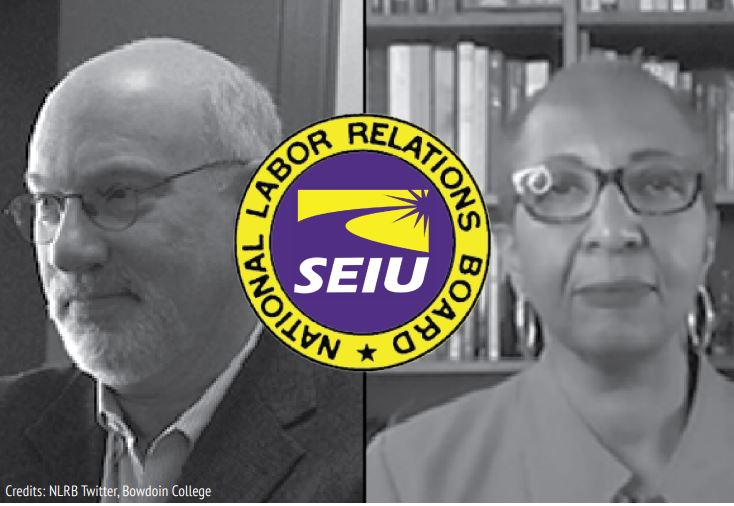
Foundation attorneys demand that the NLRB IG stop David Prouty (left) and Gwynne Wilcox, fresh off tenures as high-ranking SEIU lawyers, from derailing efforts to ensure workers can resist union influence they oppose.
WASHINGTON, DC – The National Right to Work Legal Defense Foundation submitted a letter to the National Labor Relations Board (NLRB) Inspector General (IG) and chief ethics officer, urging them to remove NLRB members David Prouty and Gwynne Wilcox from involvement in an ongoing federal case and any cases brought by Foundation-assisted workers against Service Employees International Union (SEIU) affiliates.
Prouty and Wilcox were both appointed to the Board by President Biden. Prior to their appointment, both were lawyers for influential SEIU affiliates. The NLRB members, including Prouty and Wilcox, are currently being sued by the SEIU in federal court over a rule finalized by the Trump NLRB. That rule clarified that a company that does not exercise direct control over employee wages and working conditions cannot be charged with unfair labor practices committed by its related entities, such as franchisees.
Union officials want to change that so-called “joint employer” standard to launch top-down organizing campaigns to target workers for monopoly unionization. During such campaigns, union officials often attack companies in the press and through coordinated litigation in order to get employer assistance in imposing unionization on workers, including by bypassing the secret ballot vote process for unionization.
Workers Regularly Charge SEIU Union Affiliates with Rights Violations
The letter from Foundation President Mark Mix points out Prouty and Wilcox’s recusal is of particular interest to the Foundation because “Foundation Staff Attorneys frequently provide free legal representation to employees involved in litigation before the National Labor Relations Board against SEIU or its affiliates,” and that the same considerations “should mandate the recusal of Member Wilcox and Member Prouty in those cases as well.”
Each year, Foundation staff attorneys handle more than 100 cases brought for workers at the NLRB challenging union violations of workers’ rights. SEIU affiliates are among the most often cited in those cases for violating federal law. Just since 2018, Foundation attorneys have assisted workers in 67 cases against SEIU affiliates, over half of which have been at the NLRB.
The letter also asks that the NLRB IG “apply the same level of vigor in examining their conflicts as he did in matters involving former Board Member William J. Emanuel.” Although the NLRB finalized its “joint employer” standard through the rulemaking process, an earlier 2017 case decision that would have adopted the same standard was gutted because the NLRB IG ruled that then-Member Emanuel should have recused himself.
The Foundation’s letter details Member Prouty’s history as General Counsel of SEIU Local 32BJ, a powerful SEIU affiliate. It further points out that Member Prouty “played a key role in opposing the Board’s final rule on joint employment,” personally signing comments against the rule, which is further evidence of his specific conflict of interest in the pending case.
Letter: Ex-SEIU Board Member Even Headed Up Group at ‘Core’ of Litigation
Member Wilcox’s conflicts go even deeper, according to the Foundation’s letter. It notes that Member Wilcox was at the forefront of a union campaign that openly opposed the NLRB’s “joint employer rule,” a campaign that is “specifically named as interested in, and a core part of, the Litigation” against that rule.
The Biden Administration has gone above and beyond in its efforts to entrench union boss influence at the NLRB. Just minutes after being inaugurated, President Biden took the unprecedented step of firing then-NLRB General Counsel Peter Robb, who still had 11 months left on his Senate-confirmed term. Robb had aggressively supported cases in which workers sought to free themselves from coercive union boss-created schemes.
Foundation Also Calls Out NLRB General Counsel
Robb’s replacement, Biden appointed Jennifer Abruzzo, is a former Communications Workers of America (CWA) union lawyer who, Freedom of Information Act (FOIA) records requests from the Foundation revealed, was half of a two-person Biden NLRB transition team that engineered Robb’s first-of-its-kind ouster.
In a separate letter, Foundation staff attorneys have demanded Abruzzo’s recusal from an ongoing NLRB case brought by an ABC cameraman against a CWA affiliate.
The letter points out that, while at the CWA International as special counsel, Abruzzo was responsible for the very legal policies that CWA affiliates are bound to follow, including the one challenged by the worker’s Foundation-provided attorneys in the case.
“The Biden Administration has already displayed some of the most biased and politically motivated behavior at the NLRB since the agency’s inception, all in an attempt to unfairly rig the system to favor Biden’s union boss political allies over protecting workers’ individual rights,” commented National Right to Work Foundation President Mark Mix. “If Prouty and Wilcox’s obvious conflicts of interest are unaddressed in this case, the message from the Board will be clear that ethics policies and recusal rules no longer apply now that pro-union boss Biden appointees are in power.”





Foundation Blasts Biden Plan to Sneak Union Monopoly Power into Agricultural Sector
The following article is from the National Right to Work Legal Defense Foundation’s bi-monthly Foundation Action Newsletter, January/February 2024 edition. To view other editions of Foundation Action or to sign up for a free subscription, click here.
Comments expose DOL rule’s rigging of agricultural visa program to favor union organizers
Julie Su — “acting” secretary of the Biden Labor Department due to bipartisan opposition barring her from the agency’s top job — is overseeing an attempt to sneak union boss power into the agricultural sector against Congress’ will.
WASHINGTON, DC – Federal labor policy in the United States provides a smorgasbord of powers to union bosses in the private sector, not the least of which are the powers to impose one-size-fits-all contracts on dissenting workers in a unionized workplace, and to force workers to pay dues in non-Right to Work states.
Traditionally that hasn’t been the case in the agricultural sector, where each state has the freedom to make its own labor policy. But in November 2023, the Biden Department of Labor announced a rule which could upend this balance and effectively impose on temporary agricultural employees portions of federal labor law that are overwhelmingly favorable to union bosses. The National Right to Work Foundation promptly filed comments exposing the slated rule as a Big Labor power grab.
Biden Admin Defies Congress by Granting Union Bosses Power Over Farmworkers
The proposed rule would assist union bosses with imposing monopoly bargaining privileges over temporary agricultural workers in the United States, including workers who don’t support a union. Among other things, the rule requires that employers fork over employee contact information at union bosses’ request — regardless of whether the union has any employee support. The proposed rule would also cajole employers into entering into so-called “neutrality agreements” with union bosses. “Neutrality agreements” typically require employers to censor information about the union and provide other aid to union bosses in their efforts to collectivize workers.
The comments cite multiple reasons as to why the Department of Labor lacks the legal authority to implement the proposed rule, such as the fact that Congress expressly excluded agricultural workers from federal labor statutes.
According to the comments, the Biden Department of Labor admitted in its rulemaking announcement that it is trying to impose parts of the National Labor Relations Act (NLRA) on
the agricultural sector, despite Congress’ intent.
“The Department not only lacks Congressional authorization to take this action, it is defying express Congressional intent to not subject these types of employees to provisions of the NLRA,” the comments state.
Comments: Union Power Grab Won’t Help Workers
The comments also point out that the provisions in the Department of Labor’s rule are unrelated to the rule’s stated purpose of helping agricultural workers avoid exploitation, and rather resemble a list of proposals to empower union officials at workers’ expense.
“The Department fails to explain how allowing unions to access employees’ personal information, to bargain for neutrality agreements, and to prevent employees from accessing information for and against unionization helps to alleviate the concerns identified in the proposed regulations,” the comments argue.
“The Department should not adopt the proposed regulation,” the comments conclude.
The Department of Labor’s notice of rulemaking comes as the Biden Administration is making a full court press to expand union boss legal privileges across the country. That includes the Biden National Labor Relations Board’s (NLRB) plan to wipe out the Foundation-backed Election Protection Rule, which eased the process by which workers could obtain votes to remove unpopular unions from their workplaces. The Biden NLRB seeks to make it more difficult for American private sector workers to exercise their right to remove unwanted unions, while giving union officials more tools to gain power in a workplace without even a vote.
“Despite the Department of Labor’s claims, the true underhanded goal of this rule is clear: handing union bosses more power to corral workers into union ranks, while cutting back on workers’ privacy and rights to resist unwanted unionization,” observed National Right to Work Foundation President Mark Mix.
“Temporary agricultural workers should not be used as pawns to expand union bosses’ sphere of control into the agricultural sector. But that’s exactly what the Biden Department of Labor is attempting in direct contradiction of the choice made by Congress not to subject such workers to federally imposed monopoly unionism.”