
Austin Worker Files 5th Foundation-Backed Lawsuit Arguing NLRB Violates US Constitution
The following article is from the National Right to Work Legal Defense Foundation’s bi-monthly Foundation Action Newsletter, January/February 2025 edition. To view other editions of Foundation Action or to sign up for a free subscription, click here.
Case joins others for employees nationwide arguing Labor Board’s structure is illegal
Dallas Mudd helps connect people with the social services they need, and his and many other workers’ ability to do their important work shouldn’t be stymied because unaccountable NLRB bureaucrats are forcing union “representation” on them.
AUSTIN, TX – In November, Dallas Mudd, an employee for online social service coordination platform Findhelp, filed a federal lawsuit against the National Labor Relations Board (NLRB) on the grounds that the agency’s structure is unconstitutional. Mudd’s case, filed in the U.S. District Court for the Northern District of Texas, is the latest in a series of legal actions by National Right to Work Foundation staff attorneys for employees challenging the NLRB’s authority.
Mudd’s case comes after he filed a decertification petition with the NLRB, seeking a vote to remove the Office & Professional Employees International Union (OPEIU) from his workplace. However, NLRB officials blocked the vote, disenfranchising Mudd and his colleagues on the basis of unproven charges union bosses made against Findhelp. Mudd appealed the decision to the full NLRB in Washington, D.C., while also filing a federal lawsuit to challenge NLRB members’ removal protections.
Shortly after the lawsuit was filed, Mudd’s Foundation attorney also asked the Northern District Court of Texas to issue a preliminary injunction stopping the NLRB from adjudicating his appeal until the issue of the NLRB’s constitutionality is resolved. Mudd argues that he is suffering ongoing and irreparable harm by being forced to navigate a statutory process before an agency that he claims is unconstitutionally structured.
Constitutional Challenge: A Broader Legal Campaign
Meanwhile, in its own case against the NLRB, Findhelp has successfully secured an injunction against the NLRB in a federal district court making arguments similar to those raised by Mudd.
Mudd’s lawsuit follows four other constitutional challenges backed by the National Right to Work Foundation, targeting the NLRB’s structure. This includes a case for New York Starbucks employees Ariana Cortes and Logan Karam, who filed the first constitutional challenge to NLRB Board Member protections.
Their case is currently being briefed at the D.C. Circuit Court of Appeals, but since their groundbreaking lawsuit, numerous major employers have utilized the arguments first made in federal court by Foundation staff attorneys to challenge the radically pro-union boss BidenHarris NLRB.
“Independent-minded workers should not be forced to depend on biased agencies staffed by bureaucrats who exercise power in violation of the Constitution,” said National Right to Work Foundation Vice President Patrick Semmens.
“The Constitution does not permit a powerful federal agency to operate as the judge, jury, and executioner without proper oversight.
“Contrary to the wishes of Big Labor bosses, federal labor law is not exempt from the requirements of the U.S. Constitution,” added Semmens.
Healthcare Employees in PA, MN Oust Unions with Foundation Aid
The following article is from the National Right to Work Legal Defense Foundation’s bi-monthly Foundation Action Newsletter, March/April 2024 edition. To view other editions of Foundation Action or to sign up for a free subscription, click here.
Over 270 workers now free of AFSCME at Philly hospital; Steelworkers union booted in MN
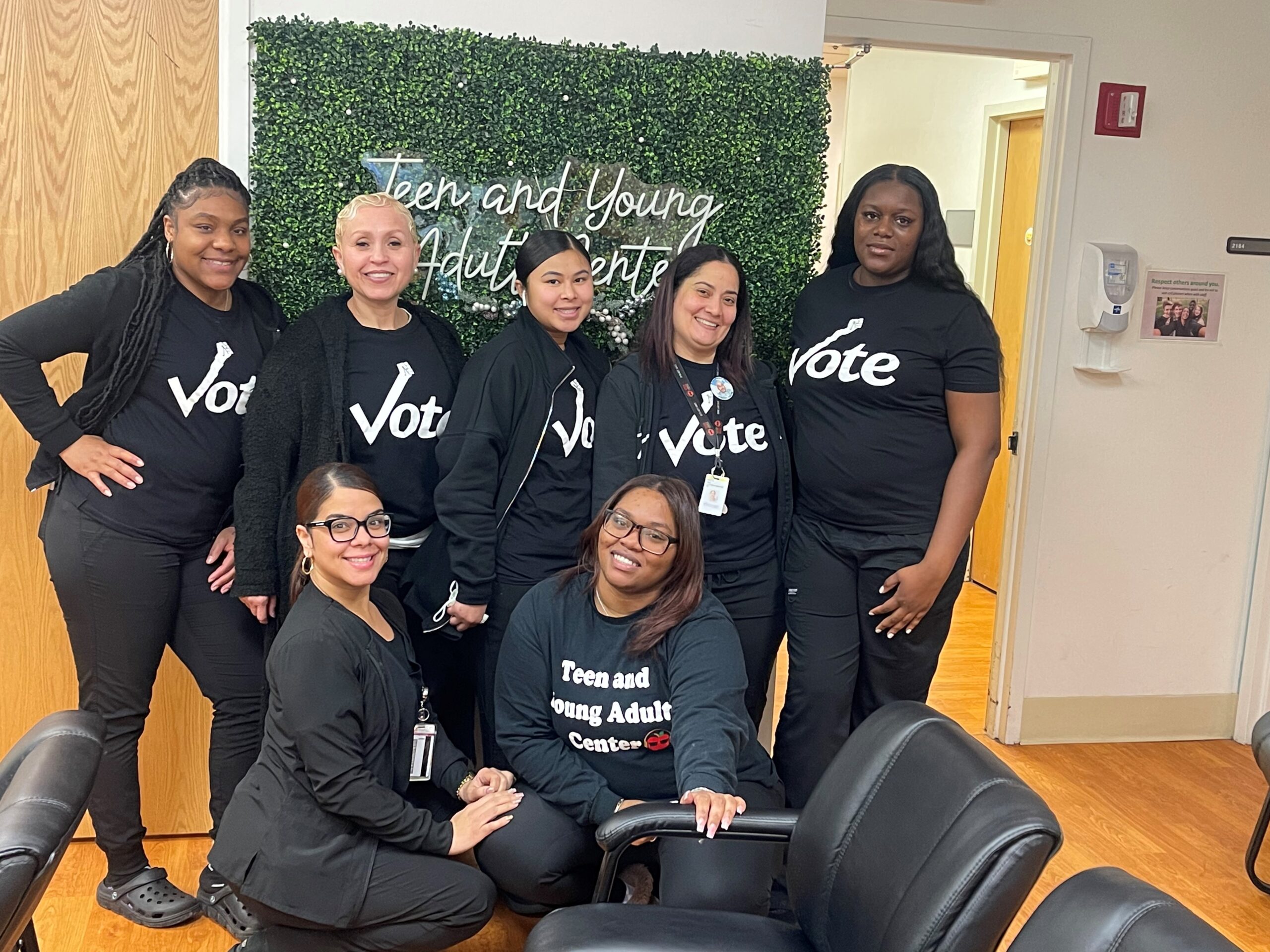
After being told by a union official that “the union isn’t going anywhere,” outpatient service coordinator Shidiah Jackson (back right) and her coworkers led a successful effort to kick the AFSCME union out of St. Christopher Hospital.
PHILADELPHIA, PA – In December 2023, National Right to Work Foundation-supported workers added two new victories to the growing string of successful union decertification efforts around the country.
In Philadelphia, a 270+ worker unit comprised of medical assistants, office coordinators, medical secretaries, and many other support employees voted by a nearly 60% margin to remove the American Federation of State, County and Municipal Employees (AFSCME) union from St. Christopher’s Hospital for Children.
Outpatient service coordinator Shidiah Jackson led the union decertification effort with free legal advice from the Foundation.
In Austin, MN, patient care specialist Erin Krulish and other support workers at the Austin Mayo Clinic location forced Steelworkers union officials out of their facility. That ouster follows multiple recent union removals involving other Minnesota healthcare employees, including nurses at Mankato Mayo Clinic, support staff at Mankato Mayo Clinic, and nurses at St. James Mayo Clinic, all of whom received free Foundation legal aid.
Both Krulish and Jackson kick-started these efforts by submitting decertification petitions to the National Labor Relations Board (NLRB). Each petition contained enough signatures from employees interested in having a union removal vote to prompt the NLRB to hold such a vote.
Healthcare Professionals Free of Monopoly Bargaining and Forced Dues
Both Pennsylvania and Minnesota lack Right to Work protections for their private sector workers, meaning that union officials had the power to enter into contracts with management that would force Krulish, Jackson, and their coworkers to pay union dues or fees just to keep their jobs. In contrast, in Right to Work states, union membership and all union financial support are strictly voluntary.
Steelworkers Officials Depart MN Clinic to Avoid Likely Embarrassing Vote
If a majority of workers vote against a union in a decertification vote or otherwise force a union out, the union loses not only its ability to demand forced dues from employees, but also its monopoly bargaining power.
Such power permits union officials to dictate the contract provisions of all employees in a unit, even those who oppose or voted against the union’s presence in the first place.
The effort by Krulish and her coworkers at Mayo Clinic Austin to remove the Steelworkers union was unique in that they had already stripped union officials of their forced dues power through a “deauthorization election,” which can be petitioned for in the same way as a decertification election. In December 2022, Krulish and her fellow employees voted 49-17 to revoke the union’s power to compel them to pay dues.
Deauthorization is the only way employees in non-Right to Work states can stop a union from seizing dues from workers as a condition of employment, outside of completely decertifying the union.
Krulish and her coworkers resorted to this option because the NLRB’s questionable “contract bar” doctrine prevented them from kicking the union out in December 2022, simply because the union’s contract was still active.
After experiencing a big loss in the deauthorization election, Steelworkers officials likely knew another devastating defeat was coming after Krulish filed her decertification petition. They departed the hospital before the election could take place.
Philly Workers Reject One-Size-Fits-All Union Bureaucracy
In an interview with The Philadelphia Inquirer, Jackson related that she had no contact with the union until she tried to ask for a raise she felt she had earned, at which point hospital administrators said her salary and benefits were a union matter. When she voiced her displeasure with the situation to the union and asked what the union actually did for her, a union official suggested her views didn’t matter anyway because “the union isn’t going anywhere.”
“OK, we’ll see about that,” she told the union agent, according to the Inquirer. Soon after, she proceeded with her decertification effort, which ultimately resulted in the overwhelming vote among her colleagues for ending the union’s so-called “representation.”
“It seems that American medical employees are discovering that union officials’ one-size-fits-all ‘representation’ doesn’t always work to their benefit, nor does it help them take better care of their patients,” commented National Right to Work Foundation President Mark Mix. “It’s easy to see why healthcare workers would want to avoid compulsory dues payments, or being ordered to strike and abandon their patients during a busy time.
“Those in the healthcare industry should know that they have a right to petition the NLRB for a vote to remove a union, and that National Right to Work Foundation staff attorneys can assist them through this daunting process,” Mix added.





