
Hospital Employees Fight Forced Unionization by Bureaucrat Fiat
The following article is from the National Right to Work Legal Defense Foundation’s bi-monthly Foundation Action Newsletter, May/June 2019 edition. To view other editions or to sign up for a free subscription, click here.
Workers were forced under SEIU’s ‘representation’ despite overwhelming opposition

Employees at Lehigh Valley Hospital – Schuylkill East were freed from union bosses’ scheme that forced them to subsidize the politically active SEIU.
WASHINGTON, D.C. – The National Labor Relations Board (NLRB) unanimously overturned a Regional Director’s decision that forced Pennsylvania hospital employees under the so-called “representation” of union bosses, even though the workers opposed the union and had rejected an SEIU organizing drive.
National Right to Work Foundation staff attorneys filed a brief in the case for employees to support the challenge to the Regional Director’s decision.
In 2016, employees at Lehigh Valley Hospital-Schuylkill East completely rejected Service Employees International Union (SEIU) officials’ attempts to unionize their workplace. Union organizers did not even file a petition for an election, which required the signatures of 30% of the hospital workers.
Employees at a separate facility, Schuylkill South, had been unionized for several decades.
SEIU agreed to a plan where some Schuylkill South workers were transferred to Schuylkill East, but kept under the union’s monopoly bargaining representation. Union officials then claimed that the entire Schuylkill East workforce should be included in the monopoly bargaining unit, based in part on the presence of these unionized workers.
In October 2017, NLRB Regional Director Dennis Walsh ordered that Schuylkill East workers should be forced into the slightly larger Schuylkill South monopoly bargaining unit, citing the NLRB’s “accretion” policy that grants union officials the power to absorb workers into a larger unionized workplace without their input. The employees were never given a vote.
Walsh had previously been suspended one month without pay by the NLRB, following an investigation into his use of his position with the NLRB to solicit contributions to a pro-union scholarship fund from union officials with cases at the NLRB. Reports indicate that the SEIU was one of the unions that made payments to Walsh’s fund.
The employer challenged Walsh’s ruling at the NLRB in Washington, D.C., and successfully halted SEIU’s coercive unionization scheme.
“This ruling is a much-needed victory for workers over a shameful union power-grab aided and abetted by a demonstrably partisan Regional Director, who only a few years ago was suspended for his pro-union conduct that violated NLRB ethics rules,” said Mark Mix, president of the National Right to Work Foundation. “Despite the workers in this case successfully resisting an SEIU organizing drive, union bosses attempted to game the NLRB system to force these workers into union forced-dues ranks. The unanimous Board decision overturning the Regional Director’s order is evidence of just how radical the accretion in this case was, and how the accretion doctrine undermines the premise of the National Labor Relations Act which is supposedly based on the idea that workers have a say in whether or not they are unionized.”
Appeals Court Affirms Ruling That Union Bosses Violated Michigan’s Right to Work Law
The following article is from the National Right to Work Legal Defense Foundation’s bi-monthly Foundation Action Newsletter, March/April 2019 edition. To view other editions or to sign up for a free subscription, click here.

When teacher union bosses flouted Michigan’s Right to Work Law, Ron Conwell turned to Foundation staff attorneys to enforce his rights.
Teacher’s case resulted in first fine against union officials for illegal forced dues requirement
DETROIT, MI – When union bosses informed teacher Ron Conwell that he must pay union fees or lose his job, he sought free legal aid from Foundation attorneys to challenge the requirement as illegal under Michigan’s popular Right to Work protections.
Michigan’s Right to Work Law went into effect on March 28, 2013. Contracts or agreements entered into after the law went into effect must respect workers’ right to refrain from the payment of any union dues or fees as a condition of employment.
Worker Halts Union’s Illegal Attempt to Extend Forced Fees for Teachers
The Clarkston Education Association (CEA) and Michigan Education Association (MEA) illegally extended the forced-dues clause in their monopoly bargaining agreement with Clarkston Community Schools after the Right to Work Law took effect.
In August 2015, Conwell resigned his union membership. Later that month, union officials informed him that he was still required to pay union fees or be fired.
“It seemed like to me that the union was trying to find some way to take the law that was put into place so that I had a right to decide, and then take that decision away from me,” Conwell said.
Foundation attorneys brought charges for Conwell to challenge the union bosses’ coercion.
In 2017, the Michigan Employment Relations Commission (MERC) ruled that CEA and MEA violated the state’s Right to Work protections for public employees by illegally extending and enforcing a forced-dues clause. The Commission ordered the unions to stop threatening employees with termination based on the clause.
MERC also held that Clarkston Community Schools officials violated the law by agreeing to union officials’ demands for the illegal extension. MERC fined both the school district and the unions, making the case the first of its kind in which violators of the Right to Work law were fined.
Union lawyers appealed the ruling but were met with defeat, as the Appeals Court affirmed MERC’s ruling and fine, upholding workers’ Right to Work protections.
The victory demonstrates that the Foundation’s legal aid program remains vital to protect independent-minded workers from Big Labor’s coercive tactics.
Foundation staff attorneys have litigated more than 100 cases in Michigan since Right to Work legislation was signed into state law in December 2012.
“Michigan workers can celebrate that the decision upholds their right to work without paying forced tribute to union bosses,” said Ray LaJeunesse, vice president of the National Right to Work Foundation. “Yet it also shows that workers need to keep fighting against coercion, as Michigan union bosses have repeatedly violated the state’s Right to Work laws in their efforts to keep their forced dues money stream flowing. Foundation staff attorneys continue to assist dozens of independent-minded workers in resisting Big Labor’s orchestrated campaign to undermine Right to Work in Michigan.”
Foundation Fights to Enforce Janus Victory and Halt Big Labor’s Coercive Tactics
The following article is from the National Right to Work Legal Defense Foundation’s bi-monthly Foundation Action Newsletter, March/April 2019 edition. To view other editions or to sign up for a free subscription, click here.
Foundation attorneys litigating more than 25 cases for public employees over Janus rights violations
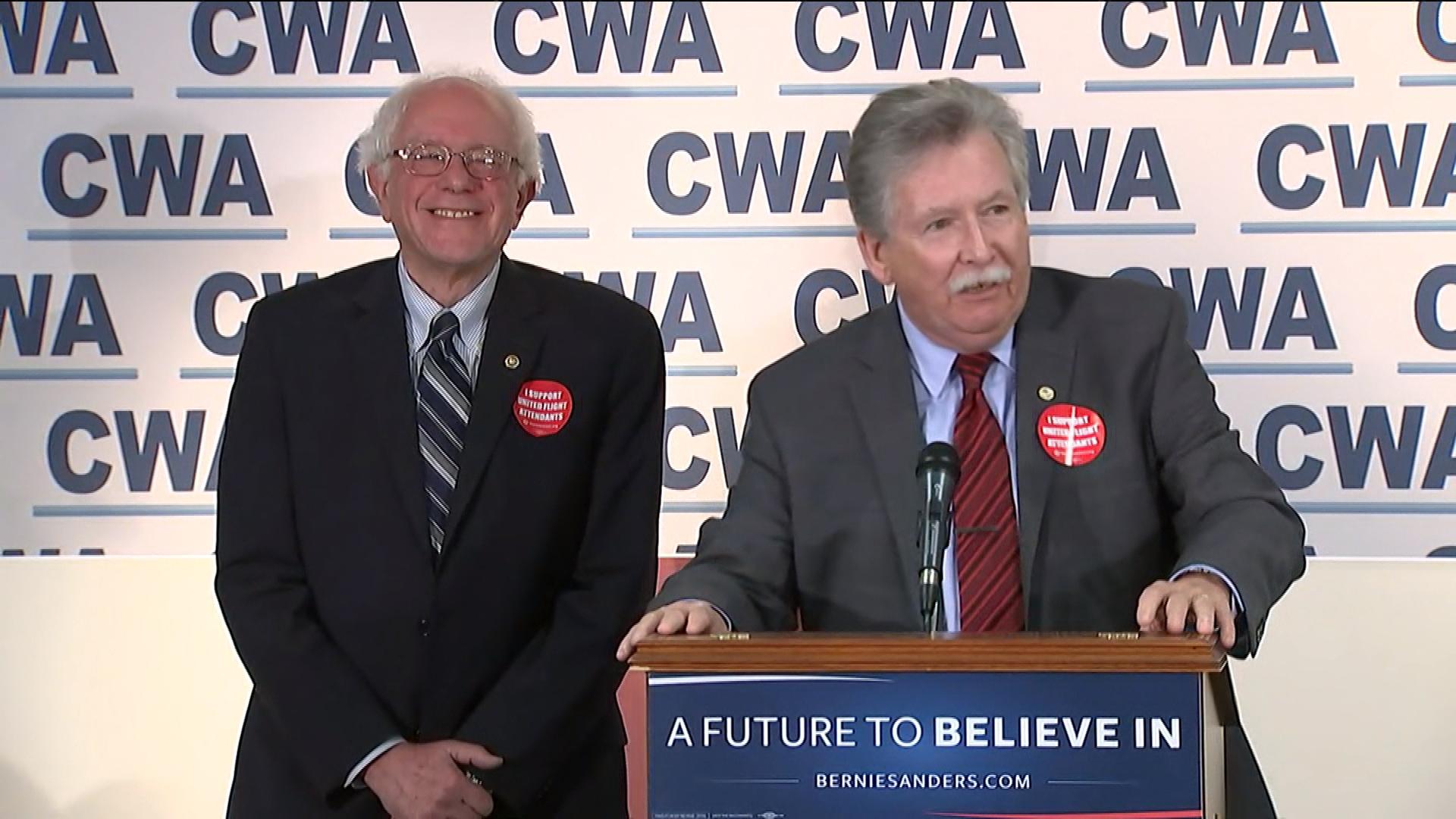
CWA union officials, led by top boss Chris Shelton (pictured right with self declared socialist Senator Bernie Sanders), began seizing full union membership dues from David McCutcheon’s paychecks in violation of his Janus rights.
SANTA FE, N.M. – Although the U.S. Supreme Court has ruled that forced union fees for public sector workers are unconstitutional, much work remains before civil servants are free from union bosses’ coercion.
In the landmark victory in Janus v. AFSCME in June 2018, briefed and argued by Foundation staff attorneys, the Supreme Court ruled that charging any government employee union fees as a condition of employment violates the First Amendment. The Court also affirmed that unions may only collect fees when an employee gives clear and affirmative consent.
Already, Foundation staff attorneys are litigating more than 25 lawsuits from California to New Jersey to enforce the Janus decision, and new requests from public employees for assistance in enforcing their Janus rights continue to stream in.
Civil Servants Fight Union Bosses’ ‘Window Period’ Schemes
Despite the Supreme Court’s ruling, union officials seek to maintain their forced-fees coffers by stifling the rights of the workers they claim to represent. Foundation attorneys have filed several class action lawsuits challenging union officials’ “window period” schemes, arbitrary windows of time limiting when employees can exercise their First Amendment right to refrain
from subsidizing a union.
Two such cases (see page 1) have already settled in favor of the workers challenging union attempts to trap them in forced dues, but in the others union bosses still refuse to back down from their coercive schemes.
In New Mexico, David McCutcheon, an IT technician at New Mexico’s Department of Information Technology, was forced to pay union fees as a nonmember before Janus. After the Foundation’s victory, McCutcheon informed Communication Workers of America (CWA) union officials that under the First Amendment they could no longer force him to financially support the union.
Instead, union officials began charging him full union membership dues without his permission. To add insult to injury, union officials told McCutcheon that he could only stop the unauthorized deductions during a two-week “window period” in December.
McCutcheon sought free legal aid from Foundation staff attorneys, who filed a class action lawsuit in federal court. The class action complaint asks that the court strike down the unconstitutional “window period” scheme, and order the union to refund the membership dues and fees seized from McCutcheon and the likely hundreds of other public employees in New Mexico who have been similarly victimized during the past three years.
In two other cases, California teachers are fighting similar “window period” schemes with free aid from Foundation attorneys. Ventura County math professor Michael McCain is challenging the American Federation of Teachers union-created fifteen day “window period” policy in a class action lawsuit.
Union officials never informed McCain of his First Amendment right to refrain from supporting a union, making it impossible for him to have waived his rights as Janus requires. After Janus, McCain resigned union membership and made it clear in a letter that he does not consent to dues deductions. His lawsuit asks that the court strike down the “window period” scheme and stop forcing dues from him and potentially hundreds of other public employees.
Los Angeles kindergarten teacher Irene Seager filed another class action lawsuit, this one against United Teachers Los Angeles to challenge a 30-day “window period” scheme. Her lawsuit also challenges a California state law which allows the union to enforce the restrictive policy.
“Union officials have a long history of manipulating ‘window period’ schemes and other obstacles designed to block individuals from exercising their constitutional rights,” said Patrick Semmens, vice president of the National Right to Work Foundation. “Despite what union bosses say, First Amendment rights cannot be limited to mere days out of the year.”
Foundation attorneys are also litigating other class action lawsuits to reclaim years’ worth of union fees seized without consent before Janus. Together, the lawsuits seek refunds totaling more than $170 million.
SCOTUS Asked to Hear Homecare Providers’ Case Seeking Return of Seized Union Fees
The following article is from the National Right to Work Legal Defense Foundation’s bi-monthly Foundation Action Newsletter, March/April 2019 edition. To view other editions or to sign up for a free subscription, click here.
Providers fight to reclaim $32 million in union fees seized in violation of First Amendment

Susie Watts, a plaintiff in the U.S. Supreme Court Harris decision, is a home care provider for her daughter Libby. The case continues in Riffey, as providers fight for the return of unconstitutionally seized union fees.
WASHINGTON, D.C. – In 2014, the U.S. Supreme Court ruled in the Foundation-won Harris v. Quinn case that a scheme imposed by the state of Illinois, in which over 80,000 individual home care providers were unionized by the Service Employees International Union (SEIU) and forced to pay union fees out of the state funding they receive, violated the providers’ First Amendment rights.
The ruling should have meant that SEIU union bosses were forced to return the unconstitutionally seized union fees. Instead, five years later the providers are once again at the steps of the Supreme Court.
SEIU Union Bosses Keep Illegally Seized Union Fees
After the 2014 ruling, Harris continued as Riffey v. Rauner. The case was remanded to the District Court to settle remaining issues, including whether or not the 80,000 providers would receive refunds of the money SEIU officials seized without consent.
In June 2016, the District Court denied a motion for class certification. The ruling allowed the SEIU to keep the over $32 million in unconstitutional fees confiscated from homecare providers compelled into union ranks, who had not consented to their money being taken for union fees. The Appeals Court upheld the ruling.
In 2018, Foundation staff attorneys successfully petitioned the U.S. Supreme Court to review and reverse the Appeals Court’s ruling. The High Court did so the day after it issued the landmark Janus v. AFSCME decision, ordering the Appeals Court to reconsider the case in light of the Janus ruling, which struck down public sector forced union fees as violating the First Amendment.
In Janus, which was argued by the same National Right to Work Foundation staff attorney who is lead counsel in the Riffey case, the Supreme Court clarified that any union fees taken without an individual’s informed consent violate the First Amendment. That standard supports the Riffey plaintiffs’ claim that all providers who had money seized without their consent are entitled to refunds.
SCOTUS Asked to Allow Providers to Reclaim Funds Seized in Violation of First Amendment
On December 6, a three-judge panel of the Appeals Court affirmed its previous ruling that no class can be certified from the over 80,000 providers whose money was seized in violation of their First Amendment rights. The panel based its decision on the ground that each individual homecare provider would have to prove that he or she objected to the taking of the fees when the seizures occurred.
After the Appeals Court denied Foundation staff attorneys’ request to rehear the case with all judges, Foundation staff attorneys filed a petition for certiorari with the Supreme Court, asking it to take the case.
Foundation staff attorneys point out that the Janus precedent does not require a worker to prove his or her subjective opposition to forced union fees. Rather, Janus held that the First Amendment is violated if union dues or fees are seized without the worker’s clear affirmative consent.
“The U.S. Supreme Court ruled that SEIU had illegally confiscated union dues from thousands of Illinois homecare providers, but the ruling challenged by this petition denies those same caregivers the opportunity to reclaim the money that never should have been taken from them by SEIU in the first place,” said Ray LaJeunesse, vice president and legal director of the National Right to Work Foundation. “If SEIU’s bosses are not required to return the money they seized in violation of homecare providers’ constitutional rights, it will only encourage similar behavior from union officials eager to trample the First Amendment to enrich themselves with the money intended for the care of individuals who need it.”
Foundation Victory: Workers Cannot Be Forced to Fund Union Lobbying
The following article is from the National Right to Work Legal Defense Foundation’s bi-monthly Foundation Action Newsletter, May/June 2019 edition. To view other editions or to sign up for a free subscription, click here.
NLRB also rules that union bosses must provide independent verification of forced fees audit

Nurse Jeanette Geary challenged Big Labor’s coercive tactics after discovering that union bosses were forcing her to pay for union lobbying activities.
WASHINGTON, D.C. – Nine years after filing her case over forced union fees, former Rhode Island nurse Jeanette Geary finally claimed victory over union bosses’ illegal scheme.
The National Labor Relations Board (NLRB) issued a sweeping decision in Geary’s case, providing new protections for workers and accountability over forced fees calculations.
Geary, then a nurse at Kent Hospital in Warwick, Rhode Island, filed an unfair labor practice charge against the United Nurses and Allied Professionals (UNAP) union in 2009 with free legal aid from Foundation staff attorneys.
She filed the charges after UNAP officials failed to provide an independent auditor’s verification that its breakdown of expenditures had been audited. She also challenged the union’s forcing her and other employees to pay for union lobbying activities in violation of the Foundation-won U.S. Supreme Court Beck decision.
“For someone to tell me that they’re going to take my money that I have earned working very hard, and they’re going to use it for their political purposes, you know — that makes me very, very angry,” Geary said.
When Geary discovered what was happening with the union fees she was forced to pay, it was about more than money. “I don’t like to be manipulated because I am a nurse. Just because I nurse and you turn your light on and I’ll be there and I’ll do anything that you need to promote your well-being, that doesn’t mean you can step on me. It was a deep-down, personal, gut reaction to [the union officials] who decided not only would they label me as ignorant and stupid and laugh about me in their office, but they would also take my money.”
The Obama NLRB had issued a bad decision in Geary’s case in 2012, but the ruling was invalidated by the Supreme Court’s 2014 holding in NLRB v. Noel Canning. The Supreme Court agreed with the Foundation’s amicus brief that the Board lacked a valid quorum because of three unconstitutional “recess appointments” then President Obama made.
Five years later, Geary’s case was the only remaining case invalidated by Noel Canning that was still pending without a decision by the NLRB.
In January 2019, Foundation staff attorneys filed a petition at the U.S. Court of Appeals for the District of Columbia Circuit, seeking a court order that the NLRB promptly decide Geary’s case. The Appeals Court then ordered the NLRB to respond to the mandamus petition by March 4, which caused the NLRB to issue its decision on March 1, just ahead of the deadline.
The NLRB’s 3-1 decision held that union officials violate workers’ rights by forcing non-members to fund union lobbying activities. It also ruled that union officials must provide independent verification that the union expenses they charge to non-members have been audited.
“Jeanette Geary bravely fought against Big Labor’s workplace coercion for years, resisting a blatant refusal to respect her rights and those of the workers union officials claim to represent,” said National Right to Work Foundation Vice President Patrick Semmens. “Although this is an overdue victory for Jeanette Geary, ultimately these types of forced union abuses will never be eliminated until Big Labor’s power to force workers to pay union dues or fees as a condition of employment is completely eliminated.”
MA Supreme Court Hears Educators’ Challenge to Teacher Union’s Coercive Power
The following article is from the National Right to Work Legal Defense Foundation’s bi-monthly Foundation Action Newsletter, March/April 2019 edition. To view other editions or to sign up for a free subscription, click here.
Union scheme violates teachers’ rights by blocking non-members’ voice and vote in workplace conditions
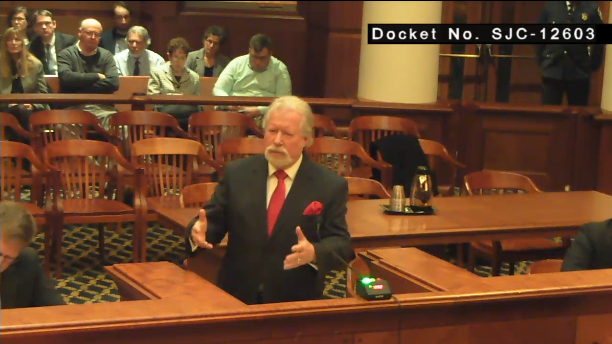
Veteran Foundation attorney Bruce N. Cameron argued at the Massachusetts Supreme Court on behalf of four educators challenging coercion from union bosses to join and support a union.
BOSTON, MA – Union officials offered four Massachusetts educators a “choice”: support union partisan politics or lose any voice and vote in their workplace conditions.
Instead of waiving their First Amendment right to refrain from supporting the union, the educators sought free legal aid from the National Right to Work Foundation to challenge union bosses’ coercion in court.
Earlier this year, veteran Foundation staff attorney Bruce N. Cameron delivered arguments at the Massachusetts Supreme Judicial Court, challenging as unconstitutional the state law that grants union officials the power of monopoly bargaining privileges which the union uses to compel support for partisan politics.
Forced Unionism: ‘Not What America Is About’
The four plaintiffs have exercised their right to refrain from union membership. Plaintiff Dr. Ben Branch is a finance professor. His colleague and fellow plaintiff, Dr. Curtiss Conner, is a chemistry professor, both at the University of Massachusetts Amherst.
Plaintiff Dr. Andre Melcuk is Director of Departmental Information Technology at the Silvio O. Conte National Center for Polymer Research at the University. Melcuk was born in the Soviet Union and opposes the union based on his dislike of collectivist organizations.
Melcuk compared his experience with the union with growing up in the Soviet Union, and noted that the expectation to “pick up the sign and march in step” with the union’s representation and political ideology was eerily similar.
“That’s creepy,” he said. “That is not what America is about.”
Plaintiff Deborah Curran is a long-term teacher in the Hanover Public Schools. The union officials who claim to “represent” her attempted to invalidate her promotion to a position mentoring new teachers and pushed to have her investigated and suspended. She ultimately spent nearly $35,000 of her own money battling union officials just to protect her job.
The educators argue that Massachusetts state law violates their First Amendment rights by granting union officials monopoly bargaining privileges, which are then used to gag non-members from having a voice and a vote in their working conditions.
Educators Ask Court to Declare Union’s Coercive Power Unconstitutional
In the June 2018 Janus victory, the U.S. Supreme Court declared that forcing any public sector employee to pay union dues or fees violates the First Amendment. The educators’ case points out that denying workers a voice in their workplace, unless they are union members, is another form of compulsion to support a union, and should be ruled a violation of the First Amendment.
“I would like everybody’s First Amendment rights to be protected against what I view as this intrusion on their right to free speech,” said Branch. “They’re trying to speak for me and they’re not speaking for me.”
“These are dedicated educators who are being forced to choose between losing their voice in the workplace or paying tribute to union bosses who clearly do not have their best interests in mind,” said Mark Mix, president of the National Right to Work Foundation. “Although the Foundation-won Janus decision upheld public sector workers’ First Amendment right to choose whether or not to pay union fees, union officials still seek to twist workers’ arms into funding Big Labor’s coffers. A clear ruling is needed to uphold these educators’ right to refrain from union membership without fear of retaliation or coercion.”





