
Orange County Lifeguards Push for Rehearing of First Amendment Challenge to Union Scheme Trapping Them in Union Membership
Restrictions will trap lifeguards in union membership and full dues payments for almost four years after they opted out of union
Orange County, CA (May 16, 2022) – California lifeguard Jonathan Savas and 22 colleagues are pressing for a rehearing of their federal civil rights lawsuit before an en banc panel of judges of the U.S. Ninth Circuit Court of Appeals. Savas and the others are suing the State of California and the California Statewide Law Enforcement Association (CSLEA) union for violating their and their coworkers’ First Amendment right to abstain from forced union membership and compelled financial support.
Savas and his colleagues are asserting their rights under the National Right to Work Foundation-won 2018 Janus v. AFSCME U.S. Supreme Court decision, in which the Court declared that no public sector worker can be forced to bankroll a union without voluntarily waiving their First Amendment right to abstain from union payments.
A so-called “maintenance of membership” requirement enforced by CSLEA union bosses and the State of California is forcing the lifeguards to both remain union members and supply full dues payments to the CSLEA union against their will. Savas and the other plaintiffs sent messages resigning their union memberships and ending dues authorizations on or around September 2019, but union officials denied their requests, alleging they have to remain full members until 2023. Despite Janus, a three-judge panel of the Ninth Circuit ruled that this requirement does not violate the First Amendment.
Lifeguards’ Attorneys: ‘Maintenance of Membership’ Requirements Have Been Unconstitutional for Decades
Savas’ attorneys criticize the Ninth Circuit panel’s giving a pass to “maintenance of membership” requirements as contradicting Janus, and note that forcing dissenting employees to pay full union dues was unconstitutional even under Abood, the 1977 Supreme Court decision which Janus overruled. The lifeguards are receiving free legal representation from staff attorneys with the National Right to Work Legal Defense Foundation and the Freedom Foundation, along with Mariah Gondeiro of Tyler Bursh, LLP.
“The Supreme Court recognized decades prior to Janus, in Abood, that it violates the First Amendment for government employers and unions to require dissenting employees pay full union dues…If maintenance of membership requirements could not survive constitutional scrutiny under Abood,” Savas’ attorneys argue, the requirements are definitely foreclosed by the higher level of First Amendment protection applied in Janus.
Savas’ en banc request also refutes the Ninth Circuit panel’s claim that the lifeguards somehow “contractually consented to the maintenance of membership requirement.” Savas’ attorneys point out that the dues deduction authorization form that the lifeguards signed only vaguely alluded to the presence of the “maintenance of membership” requirement in the union contract with their state employer, and never explicitly informed the lifeguards what that requirement was.
On that same point, Savas’ attorneys point out that “the panel’s contract-law analysis is wrongheaded because Janus requires a constitutional-waiver analysis.” Janus requires that employees voluntarily waive their First Amendment right not to make dues payments before such payments are extracted. Savas’ attorneys state “[t]here is no evidence the Lifeguards knew of their First Amendment rights under Janus or intelligently chose to waive those rights.” Indeed, many of the lifeguards could not have known about those rights because they signed the dues deduction authorization forms before the Supreme Court decided Janus.
“Even if such evidence existed, any purported waiver would be unenforceable…because a four-year prohibition on employees’ exercising their First Amendment rights under Janus is unconscionable,” Savas’ attorneys continue.
Ninth Circuit Panel Ruling Completely Inconsistent with Janus, Rehearing Required
“So-called ‘maintenance of membership’ requirements have been unconstitutional for decades, and it’s outrageous that courts have looked the other way and allowed CSLEA union bosses to infringe Savas’ and his fellow lifeguards’ First Amendment rights under the guise of such restrictions for so long,” commented National Right to Work Foundation President Mark Mix. “A rehearing of Savas’ case is necessary so the plain meaning of Janus can be applied. Otherwise the Ninth Circuit will not only have ignored Janus, but turned back the clock over half a century on workers’ right to refrain from union membership.”
Foundation Battles Union Restrictions on First Amendment Rights at Ninth Circuit
The following article is from the National Right to Work Legal Defense Foundation’s bi-monthly Foundation Action Newsletter, January/February 2021 edition. To view other editions or to sign up for a free subscription, click here.
Cases challenge coercive, anti-Janus “escape periods” concocted by union bosses
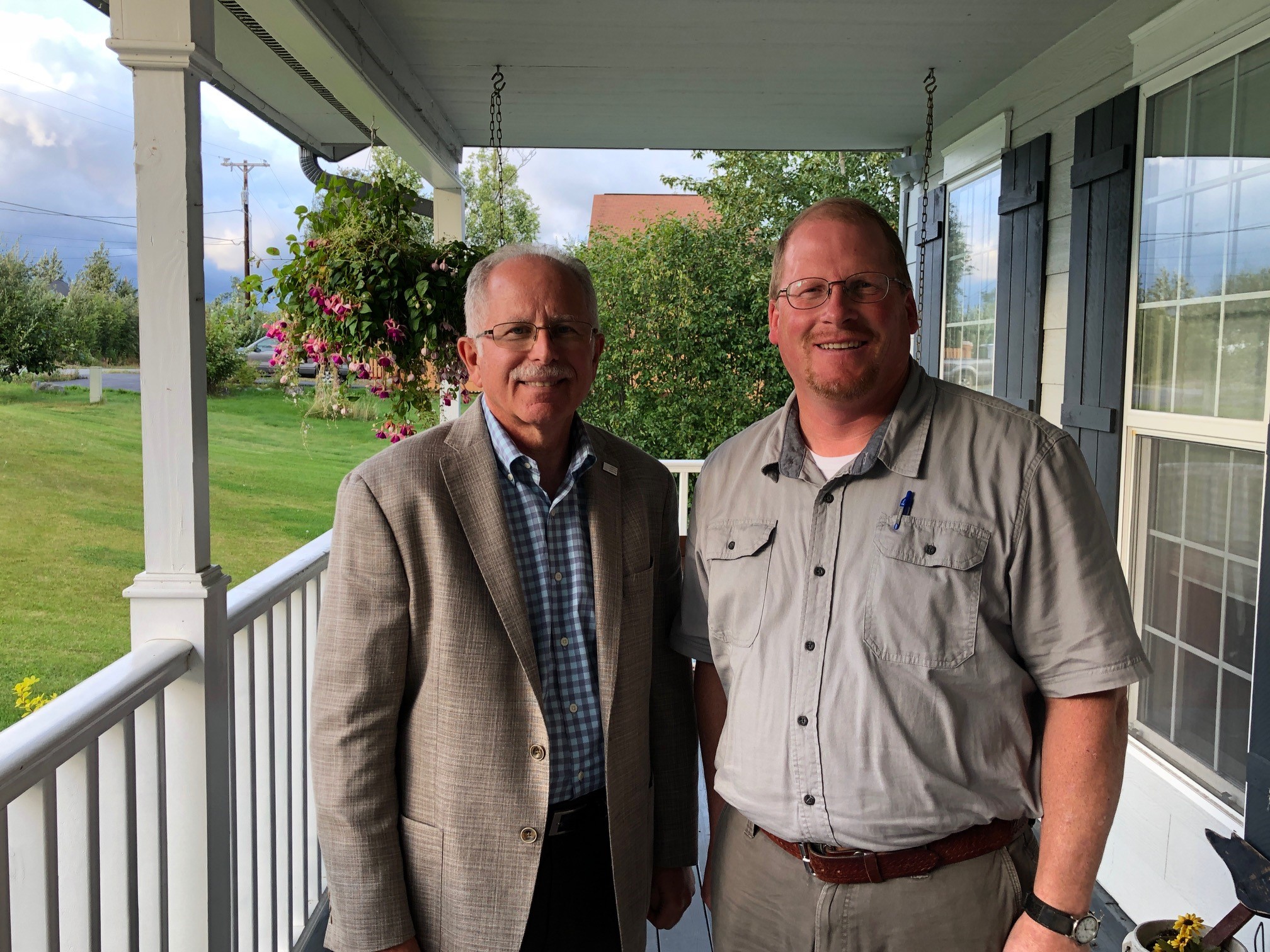
Christopher Woods (right), seen here with Mark Janus, is taking up the latter’s fight by challenging an ASEA union boss scheme that traps workers in union payments even after they have dissociated from the union.
SAN FRANSCISO, CA – The 2014 National Right to Work Foundation victory for Pam Harris in the Harris v. Quinn Supreme Court case established that union bosses violate the First Amendment when they skim dues from homecare providers’ state subsidies without their consent. Now, seven California homecare providers have just appealed to the Ninth Circuit Court of Appeals their federal lawsuit against Service Employee International Union (SEIU) Local 2015 officials for continuing to skim dues in violation of their rights.
According to their suit, SEIU honchos enforced a phony “escape period” on the homecare providers, illegally limiting the time in which they could stop the deductions. The providers’ suit says this contravenes the U.S. Supreme Court’s ruling in Janus v. AFSCME. The Court not only held that the government cannot force individuals to subsidize union activities as a condition of employment, but also that government agencies can only deduct union payments after receiving a clear and knowing waiver of their First Amendment right not to make such payments.
Dues-Skim Scam: SEIU Took Dues Without Informing Providers of Rights
Although the plaintiffs, Delores Polk, Heather Herrick, Lien Loi, Peter Loi, Susan McKay, Jolene Montoya and Scott Ungar, are not public employees, they were designated as such solely for the purpose of monopoly unionization. Then that was used as justification for the State of California to skim union dues from their payments at the behest of SEIU officials. The seven participate in the In-Home Support Services (IHSS) program, which allots Medicaid funds to those who provide home-based aid to people with disabilities.
Polk and the other plaintiffs recount in the lawsuit that SEIU union bosses began taking cuts of their Medicaid subsidies after confusing phone calls or mandatory orientation sessions. After the plaintiffs contacted the SEIU attempting to exercise their right to stop the flow of dues, SEIU operatives informed them that they could only opt out of union dues during short union-created “escape periods” of 10-30 days once per year.
The lawsuit also points out that the federal law governing IHSS forbids diverting any part of Medicaid payments to “any other party” besides the providers. In fact, in rulemaking urged by National Right to Work Foundation comments, the federal agency that administers Medicaid confirmed that skimming such payments for unions violates the Medicaid statute passed by Congress.
The seven plaintiffs now seek a ruling that both the taking of union dues without their knowing consent and the policy restricting the providers from ending the dues deductions are unconstitutional. The providers also seek refunds of all money that they and any other IHSS program participants had taken from their payments through the illegal scheme.
Alaska Union Bosses Confine Prison Employee in Unconstitutional Deductions
Also at the Ninth Circuit Court of Appeals, Alaska vocational instructor Christopher Woods recently filed an appeal in his case challenging an “escape period” scheme to block him and other Alaska state employees from exercising their First Amendment rights recognized in Janus.
In a November 2019 email, Woods, who has worked as a vocational instructor at Goose Creek Correctional Center since 2013, informed Alaska State Employees’ Association (ASEA) officials he was exercising his Janus right to stop all union dues deductions. Rather than respect his rights, union officials rejected his request and told Woods that he could only “opt out” and not be a union member with written notice to this office during a 10-day period each year.
Woods persisted on December 2, 2019, submitting to both ASEA officials and the payroll office of the Corrections Department another email asking to cut off dues. Although the payroll office confirmed to both Woods and the ASEA that it had received the request, an ASEA official responded by merely telling the payroll office that she was “still communicating with [Woods] on the matter,” the complaint says. Woods reports in his lawsuit that he has “not received any further communications” from either the ASEA or the payroll office, and that full dues are still being seized from his paychecks.
Foundation String of Triumphs Against Janus Restrictions Unlikely to End
“‘Escape periods’ are shameless union boss-concocted schemes that only exist to keep dues money rolling into their coffers after employees have clearly communicated that they do not wish to support the union,” observed National Right to Work Vice President and Legal Director Raymond LaJeunesse. “Although these arrangements are egregious in any context, trapping homecare providers in dues-skim schemes which deprive them of money they receive for taking care of the disabled is particularly unconscionable, and additionally breaches federal law which prohibits those funds from going anywhere other than to the people giving care.
“Whether it’s the landmark victories in Harris and Janus or the eight recent lawsuits in which Foundation staff attorneys have knocked down ‘escape period’ policies and secured refunds of illegal dues for workers, the Foundation has a track record of success in these cases. Union bosses shouldn’t hold their breath in the hopes of keeping seized dues,” LaJeunesse added.
More Workers Ask Supreme Court to Refund Unconstitutional Forced Dues
The following article is from the National Right to Work Legal Defense Foundation’s bi-monthly Foundation Action Newsletter, January/February 2021 edition. To view other editions or to sign up for a free subscription, click here.
Four Foundation-backed cert petitions now filed at High Court with millions at stake
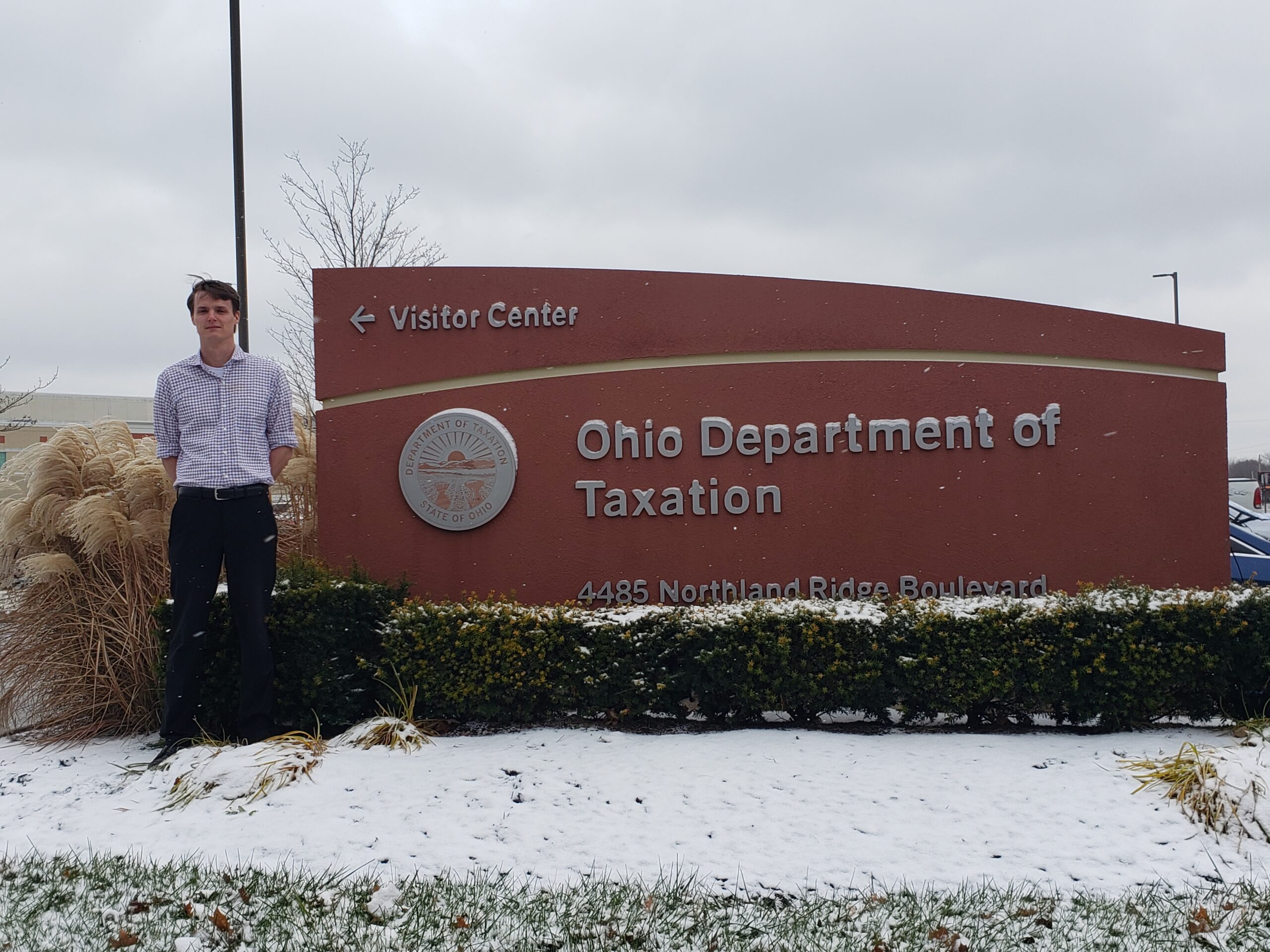
Foundation staff attorneys asked the Supreme Court to hear Nathaniel Ogle’s case, which seeks refunds for him and his coworkers of forced union dues that were seized from their paychecks in violation of the First Amendment.
WASHINGTON, DC – Across the nation, public employees continue to seek free legal aid from National Right to Work Foundation staff attorneys, to fight for their First Amendment rights recognized in the landmark Janus v. AFSCME Supreme Court ruling. Janus was argued and won by Foundation staff attorneys.
Janus affirmed that public employees cannot be required to subsidize union activities as a condition of employment and that union payments can only be deducted with an employee’s freely given consent.
Despite this clear ruling, union bosses have almost without exception refused to return money seized from workers in violation of the First Amendment. In response, Foundation staff attorneys are now assisting workers in more than a dozen cases seeking to force union officials to return illegal forced fees to tens of thousands of employees, with four such cases now pending at the U.S. Supreme Court.
Union Officials Refuse to Refund Illegally Seized Dues Post-Janus
In November, attorneys for Connecticut Department of Energy and Environmental Protection employees Kiernan Wholean and James Grillo filed a petition for writ of certiorari with the Supreme Court. It is asking the Justices to hear their case, seeking back years of union dues that they and their coworkers were forced to pay to Service Employees International Union (SEIU) union bosses in violation of the First Amendment. Their petition follows one filed in October for Ohio Department of Taxation employee Nathaniel Ogle, whose case seeks to require AFSCME union bosses to similarly return forced fees seized in violation of the Janus standard from potentially thousands of Ohio government employees.
With these two new cert petitions, there are now seven pending before the Supreme Court on this issue, four of which were filed for workers by Foundation staff attorneys. That includes the continuation of the original Janus case brought by Mark Janus.
If the Supreme Court decides to hear any one of these cases, a favorable ruling would create another groundbreaking precedent, potentially prompting the return in Foundation cases alone of over $130 million to employees fighting to get back money taken in contravention of their Janus rights.
Wholean and Grillo, who are not members of SEIU,
originally filed their case in 2018 in the U.S. District Court for the District of Connecticut shortly before the High Court decided Janus. The State ceased deducting dues from their paychecks for SEIU following a letter to the State Comptroller from a National Right to Work Foundation attorney, which threatened legal action for any dues deductions from non-members that continued after Janus.
However, SEIU union officials continue to refuse to refund dues that they took from Wholean, Grillo and other non-members in violation of the Janus First Amendment standard before the decision, even though they knew the employees never consented to pay.
Ogle filed his case at the District Court for the Southern District of Ohio just after Janus was decided. Like Wholean and Grillo, he was never a member of the union but had mandatory union fees deducted from his paychecks. The Ohio affiliate of the national AFSCME union has around 30,000 public employees across the Buckeye State under its bargaining monopoly. If a class is eventually certified in Ogle’s case, it could potentially include thousands of workers.
Foundation Attorneys: High Court Must Reject Union Attempts to Dodge Janus
Lower courts in these and other lawsuits have accepted union lawyers’ so-called “good faith” contentions for letting union bosses keep the dues collected in violation of the non-members’ constitutional rights. This is at odds with the Supreme Court’s Janus ruling, which did not proscribe retroactive relief. Indeed, it observed that union officials have been “on notice” for years that mandatory fees likely would not comply with the High Court’s heightened level of First Amendment scrutiny, articulated in the 2012 Supreme Court decision in the Foundation’s Knox v. SEIU case.
Foundation staff attorneys point out in the petitions before the Supreme Court that a “good faith” defense has never existed under Section 1983 of the Civil Rights Act of 1871, the statute under which these lawsuits are brought. Section 1983 specifically imposes liability on those who violate the constitutional rights of others while acting “under color of ” existing law.
Not all judges, however, have been convinced by union officials’ dubious “good faith” argument for keeping the unconstitutionally seized payments. In Wenzig, another Foundation-backed case, a majority of a Third Circuit panel denied the existence of such a defense. In a supplemental brief, Foundation attorneys cited the confusion among lower courts as a significant reason the court should hear the continuation of Janus.
“With seven petitions on this issue now pending with the High Court and more to be filed soon, it is time the Supreme Court hears this issue and ends the denial of justice for tens of thousands of non-member government employees whose First Amendment rights were violated,” commented National Right to Work Foundation President Mark Mix. “Section 1983 of the Civil Rights Act, the federal statute under which all these cases were filed, was specifically intended to allow individuals to remedy the deprivation of their rights when it occurs under color of law. It’s outrageous that union bosses have thus far been allowed to keep money seized in violation of the First Amendment because it was authorized by then-existing but unconstitutional law.
“That result is especially specious because, as the Supreme Court recognized in Janus, union bosses have been ‘on notice’ since 2012 that forcing government employees to pay union fees was likely unconstitutional,” Mix added.
Cases Seeking Millions in Refunds of Forced Fees under Janus Move Forward
The following article is from the National Right to Work Legal Defense Foundation’s bi-monthly Foundation Action Newsletter, November/December 2020 edition. To view other editions or to sign up for a free subscription, click here.
Split Appeals Court decision bolsters petition for Supreme Court to take up issue
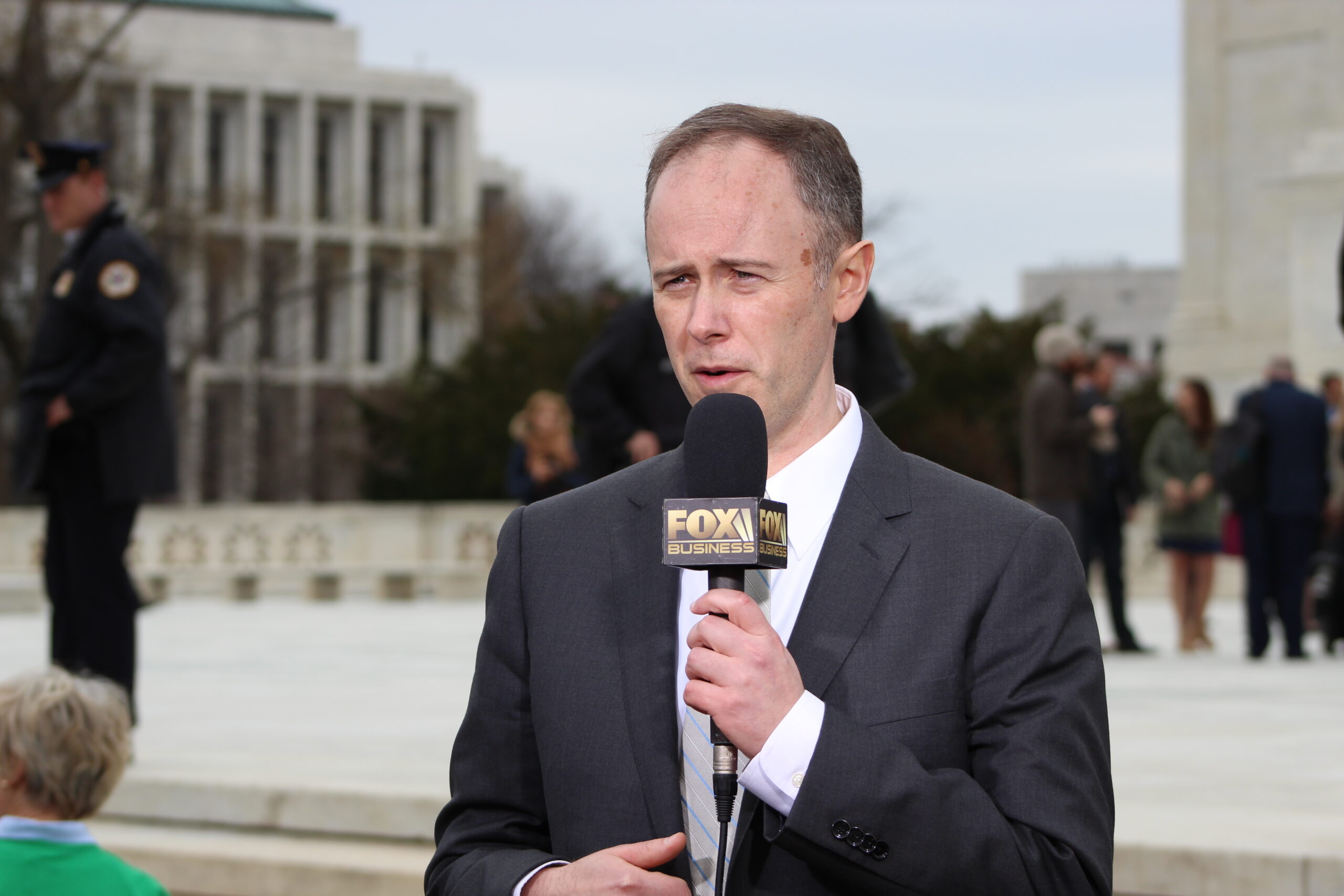
Veteran Foundation staff attorney William Messenger made history when he argued and won the Janus case before the High Court in 2018. He still represents Janus and others demanding forced-fee refunds.
PHILADELPHIA, PA – A National Right to Work Foundation-backed class-action lawsuit for Pennsylvania state employees seeking refunds of unconstitutionally seized union fees resulted in a split decision from the U.S. Third Circuit Court of Appeals in August. This ruling cast serious doubt on a favorite union boss argument used to avoid refunding dues seized in violation of workers’ First Amendment rights.
The employees were defending their rights under the landmark 2018 Foundation-won Janus v. AFSCME Supreme Court ruling. In Janus, the Court sided with former Illinois child support specialist Mark Janus and agreed with Foundation staff attorneys that requiring any public sector worker to pay union dues or fees as a condition of employment is a First Amendment violation. The Court also ruled that union dues can only be taken from public servants with their affirmative and knowing consent.
The plaintiffs in Wenzig v. Service Employees International Union (SEIU) Local 668 are seeking a ruling that SEIU officials must refund dues taken from employee paychecks in contravention of this standard before the Janus ruling came down. Union bosses used, as they have done in almost all similar cases, a dubious “good faith” argument to justify not refunding the dues to the victimized workers. In the split decision, two of the three judges rejected the so-called “good faith” theory.
Supreme Court Asked to End Lower Court Confusion on Janus Refunds
Foundation staff attorneys cited the growing confusion among federal judges on forced-union-fee refunds as a vital reason the Supreme Court should hear the continuation of Janus v. AFSCME. In a supplemental brief, Foundation attorneys wrote that Wenzig “supports granting review here because a majority of the Third Circuit panel rejected the good faith defense recognized by the Seventh Circuit here and by the Second, Sixth, and Ninth Circuits.”
“The Court should finally resolve this important issue and hold there is no good faith defense to Section 1983,” the brief adds. Section 1983 is the federal law requiring that those who deprive people of their constitutional rights “under color of any statute . . . shall be liable to the party injured.”
This September, Foundation staff attorneys also filed the final reply brief supporting the Supreme Court petition in Casanova v. International Association of Machinists (IAM), Local 701, another case seeking review from the High Court. It also cites the Third Circuit’s split decision. Plaintiff Benito Casanova, a Chicago Transit Authority employee, seeks to get back money that IAM bosses took from his paycheck and the paychecks of his colleagues in violation of their First Amendment rights prior to the Janus decision.
Foundation Leading Worker Efforts to Reclaim Fees Seized Against Janus
The workers in these cases and many others are collectively fighting for millions of dollars in pilfered money to be returned to them. Foundation attorneys currently represent these public servants in nearly 20 similar cases, together pursuing about $130 million in refunds to workers.
“Given the clarity of the Janus First Amendment standard, it’s bewildering that federal judges have not yet widely discredited union boss arguments that serve only to deny public sector workers refunds of money that the High Court itself ruled should have never been taken from them in the first place,” observed National Right to Work Foundation President Mark Mix. “The High Court must swiftly disabuse lower courts of their misunderstandings and provide justice to workers who have been waiting years for their hard-earned money to be returned.”
In the News: “Foundation Sues to Give Public Employees Their Right Not to Pay Union Dues”
The National Right to Work Foundation-won Janus v. AFSCME U.S. Supreme Court decision allows public employees to stop paying dues or fees to a union at any time they choose. Janus affirmed that the First Amendment protects government workers from supporting a union against their wishes.
But ever since the Janus decision in June 2018, many union bosses have refused to comply with the High Court’s decision. So Foundation staff attorneys have filed dozens of cases across the country to enforce the Janus decision and compel union bosses to respect the First Amendment rights of the workers they claim to “represent.”
Journalist Mark Tapscott recently reported on a number of these cases for The Epoch Times, including a newly filed case for a police officer serving on the front lines in Las Vegas:
Las Vegas Police Officer Melodie DePierro is the latest in a growing line of public sector employees suing in federal court to demand recognition of their rights under a 2018 Supreme Court decision.
DePierro’s action was filed in the U.S. District Court for Nevada against the Las Vegas Metropolitan Police Department (LVMPD) and the local Police Protective Association (PPA) union.
In Janus v American Federation of State, County and Municipal Employees (AFSCME) decided by a 5-4 vote in June 2018, the high court ruled that public sector employees cannot be forced to pay union dues in the form of agency fees without being given a chance to consent or refuse the deduction.
DePierro noted in her suit that the department’s monopoly bargaining agreement with the union only allowed a 20-day window of opportunity to request agency fee refunds and that she had never agreed to the deduction in the first place.
Right-to-Work advocates cheered Janus as a landmark decision that would prompt millions of employees at all levels of government to demand an end to hundreds of millions of dollars in agency fees that helped fund partisan union political activities with which they disagreed.
…
“Instead of respecting her First Amendment Janus rights, PPA union bosses have decided to keep imposing an unconstitutional policy on her just to keep her hard-earned money rolling into their coffers,” NRTWLDF President Mark Mix said in a statement announcing the suit.
“The High Court made perfectly clear in Janus that affirmative consent from employees is required for any dues deductions to occur. Yet PPA union bosses are clearly violating that standard here,” Mix said.
…
A week before the DePierro filing, NRTWLDF attorneys issued a special notice to more than 28,000 Ohio state employees advising them of their right not to pay agency fees. The notice was part of a settlement of the foundation’s suit against the state government and the Ohio Civil Service Employees Association, AFSCME Local 11 (OCSEA).
Other Janus suits currently working their way through the courts include NRTWLDF actions against the Chicago Teachers Union, the Alaska State Employees Association (ASEA), the United Teachers of Los Angeles (UTLA), California Service Employees International Union (SEIU), the University Professional and Technical Employees (UPTE) union and the University of California, and the Township of Ocean Education Association (TOEA), New Jersey Education Association (NJEA) and the National Education Association (NEA) unions. The latter suit has reached a federal appeals court.
Read the entire article online at The Epoch Times here.





