
St. Louis-Area Worker Battles Illegal Union Threats to Get Non-Members Fired
The following article is from the National Right to Work Legal Defense Foundation’s bi-monthly Foundation Action Newsletter, March/April 2025 edition. To view other editions of Foundation Action or to sign up for a free subscription, click here.
After divisive strike, IAM bosses demand non-members pay illegal ‘reinstatement fee’ to work

Robert Jacobs, an employee of power management company Eaton, filed federal charges showing IAM bosses clearly can’t manage their power: They are threatening union non-members with hundreds in illegal fees.
TROY, IL – “They’re threatening our jobs and livelihoods.”
This is how Robert Jacobs, an employee for power management company Eaton Corporation, described how International Association of Machinists (IAM) union bosses were treating him and his colleagues who dissented from the union’s agenda in an interview with the St. Louis Business Journal.
IAM officials ordered hundreds of Eaton employees at its St. Louis-area facility to strike in October 2024, which alienated many workers and made them question union bosses’ motives. Jacobs described seeing union agents take photos of his license plate during the strike and how he suspected union agents were following him home.
IAM Anti-Worker Activity Only Increased After Disruptive Strike Order
But for Jacobs and other workers, that was only the beginning of IAM’s coercive conduct. After the strike concluded, many Eaton employees chose to exercise their right to resign their union memberships. Even in states like Illinois that lack Right to Work protections, private sector workers are free to end their union memberships, even if union officials enforce a contract that requires non-members to pay some fees as a condition of employment.
Instead of respecting this right, IAM union officials began retaliating against those who wanted to cut ties with the union. With free legal assistance from the National Right to Work Foundation, Jacobs slammed the IAM with federal charges for threatening to get him and other employees who resigned union membership fired unless they pay hundreds in “reinstatement fees” concocted by the union. The National Labor Relations Board (NLRB) is now reviewing his charges.
“I and several of my colleagues don’t want to be part of the IAM union, but we are required by law to pay fees to union bosses just to keep our jobs,” commented Jacobs.
“That’s already something that we don’t want to do. But IAM officials are going even further and hitting us with hundreds of dollars in made-up fees just because we exercised our right to not be union members.”
IL Worker: Mandatory ‘Reinstatement Fee’ Not Permitted by Federal Law
Under federal labor law, which the NLRB is charged with enforcing, private sector employees have an absolute right to resign union membership. This right is codified in the National Labor Relations Act (NLRA), and was affirmed by landmark U.S. Supreme Court decisions such as General Motors v. NLRB.
Federal law further spells out that neither employers nor union officials can compel private sector workers to participate in union activities or refrain from such activities.
According to Jacobs’ federal charge, which was filed on the last day of 2024, “the Union is presently threatening Charging Party and [other employees who resigned from the union] with termination if they fail to pay a $306 ‘reinstatement fee’ by January 2025.” The charge argues that the IAM union is violating Eaton employees’ rights under Section 7 of the NLRA, which safeguards employees’ “right to refrain from any or all of ” union activities.
According to the Business Journal, IAM officials’ letter demanding this payment was what prompted him to contact Foundation attorneys. “[I]f you do not remit the total sum indicated in the enclosed letter within 30 days from receipt of this letter, the Union will be required to seek your termination from employment,” the letter read.
“Instead of seeking to win Eaton employees’ voluntary support, IAM union officials have decided to effectively extort the workers they claim to ‘represent,’” commented National Right to Work Foundation Vice President and Legal Director William Messenger. “Threatening to terminate workers if they don’t pay a fee which is apparently intended to punish those who don’t want union bosses speaking for them tarnishes employee rights and freedom.
“While we’re confident that Foundation attorneys will help Mr. Jacobs prevail in beating this illegal scheme, this case shows what self-interested union bosses will do to demand fealty from workers, and why all American workers deserve the Right to Work freedom to cut off financial support for such union hierarchies,” Messenger added
Puerto Rico Police Bureau Employees Foil Anti-Janus Scheme
The following article is from the National Right to Work Legal Defense Foundation’s bi-monthly Foundation Action Newsletter, November/December 2024 edition. To view other editions of Foundation Action or to sign up for a free subscription, click here.
Federal court strikes down discrimination against workers at the Puerto Rico Police Bureau who exercised First Amendment rights
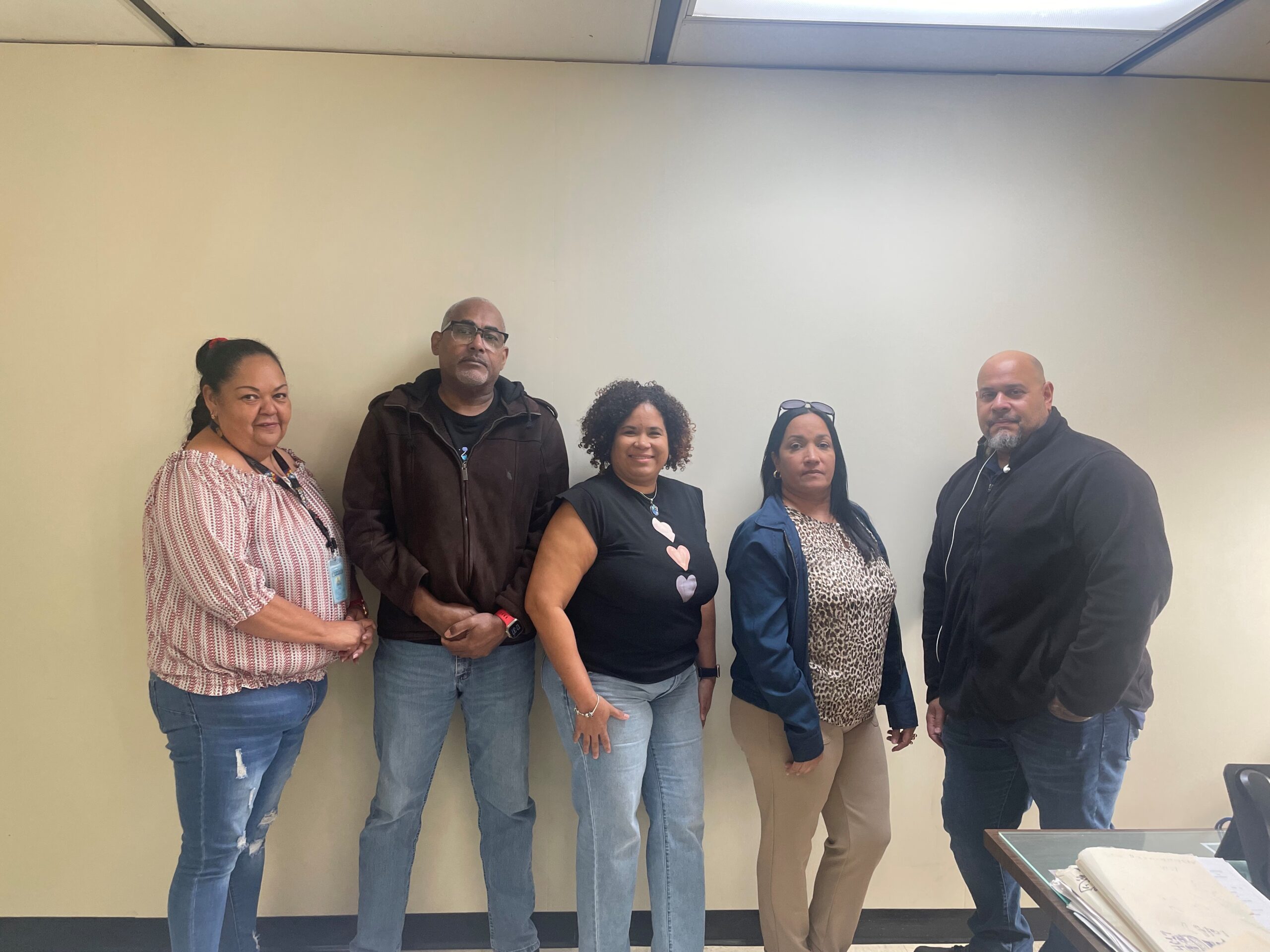
Vanessa Carbonell (center) and other employees of the Puerto Rico Police Bureau won big at the Puerto Rico District Court in September 2024. Their Foundation-won decision forces their employer and the union to stop violating their Janus rights.
SAN JUAN, PR – The National Right to Work Foundation’s 2018 victory at the U.S. Supreme Court in Janus v. AFSCME opened new horizons for employee freedom across the country. For the first time, the Justices recognized that the First Amendment prohibits union bosses from forcing public sector employees to join a union or pay dues as a condition of employment, and that union bosses can only take dues from a worker’s paycheck with their affirmative consent.
Foundation attorneys’ efforts to enforce the landmark decision yielded a big victory this September for a wide swath of civilian employees at the Puerto Rico Police Bureau (PRPB). In a class action federal lawsuit, more than a dozen PRPB employees charged officials of the Union of Organized Civilian Employees with violating their Janus rights by stripping them of an employer-provided health benefit because they refused to join the union.
A recent decision from the District Court of Puerto Rico found in favor of the employees’ arguments, stating that their employer had indeed taken away the health benefit because the employees exercised their right to not join or pay dues to the union.
Scheme Forced Workers to Join Union or Lose Access to Better Healthcare
“This is either retaliation for exercise of non-union members’ post-Janus non-associational rights under the First Amendment under the Constitution or simply discrimination,” said the Court.
According to lead plaintiff Vanessa Carbonell and her colleagues’ original lawsuit, they all exercised their Janus right to opt out of the union at various points after the 2018 Janus decision. They each began noticing that as dues ceased coming out of their paychecks, they also stopped receiving a $25-a-month employer-paid benefit intended to help employees pay for better health insurance.
The lawsuit demonstrated that PRPB officials cut the benefit off to employees who refused union membership — a clear case of discrimination against employees who exercise their First Amendment right to abstain from union affiliation.
Union and Employer Must Stop Discrimination
The District Court’s decision, in addition to declaring that the ploy by PRPB and the Union of Organized Civilian Employees is unconstitutional, orders an injunction to stop PRPB officials from continuing to withhold the benefit from Carbonell and other employees.
“Janus enshrined a very simple First Amendment principle: That union officials need to convince public employees to support their organization and activities voluntarily,” commented National Right to Work Foundation Vice President Patrick Semmens.
Michigan Meijer Employee Hits Supermarket with Federal Charges for Forcing Him to Join UFCW Union or Be Fired
Charges come as more workers challenge union bosses’ forced-dues power in wake of Michigan Right to Work repeal
Sault Ste. Marie, MI (June 11, 2024) – Joseph Arnold, an employee at the 3 Mile Road branch of Meijer in Sault Ste. Marie, has just slammed the supermarket’s management with federal charges for threatening to fire him if he didn’t complete a United Food and Commercial Workers (UFCW) union membership form. Arnold filed the charges at Region 7 of the National Labor Relations Board (NLRB) with free legal aid from National Right to Work Foundation staff attorneys.
The NLRB is the federal agency responsible for enforcing federal labor law in the private sector. Under federal law and U.S. Supreme Court decisions like General Motors v. NLRB, neither union officials nor employers can compel workers to maintain formal union membership as a condition of getting or keeping a job.
This applies even in non-Right to Work states like Michigan, where union bosses have legal privileges to enforce contracts that require workers to pay union dues or fees as a condition of employment. Employees in non-Right to Work states who choose to abstain from formal union membership also have the right under the Foundation-won Communications Workers of America v. Beck Supreme Court decision to object to paying union fees for anything unrelated to the union’s bargaining functions, such as political activities.
In contrast, in Right to Work states like neighboring Indiana and Wisconsin, all union financial support is strictly voluntary.
With the demand that Arnold sign a UFCW membership form or else be fired, Meijer officials appear to be imposing both full union membership and full union dues payments on him. Other workers have reported receiving similar demands to join or be fired.
Workers Across Michigan Challenge Forced-Dues Schemes
“Even though Michigan isn’t a Right to Work state anymore, that doesn’t give my employer agency to dictate my options,” commented Arnold. “Through ignorance or intent, Meijer threatening my job because I don’t want to associate with the union is unacceptable. If Meijer truly respects our rights they would present us with all options, as it is the job of the union to advocate my interests with my employer, not the job of my employer to advocate the interests of the union with me.”
Since the state’s Right to Work law was repealed earlier this year, Foundation attorneys have handled a flurry of cases for Michigan workers seeking to end coercive union influence in their workplaces. One such case involves illegal UFCW practices at a Kroger in Milford, Michigan, where employee Roger Cornett has levied federal charges against both the union and the store for jointly enforcing a scheme that forces employees to contribute to the union’s Political Action Committee (PAC) to stay employed.
Elsewhere in Michigan, Grand Rapids-area security guard James Reamsma is currently defending his and his coworkers’ recent “deauthorization vote” to nullify the forced-dues power of a United Government Security Officers of America (UGSOA) union. The UGSOA currently holds monopoly bargaining power over security guards posted at government buildings across Western Michigan, including in Sault Ste. Marie. Even though more of Reamsma’s colleagues voted for the deauthorization of the UGSOA than against it, litigation continues over the results. Reamsma’s case is one of many where Michigan workers are seeking to end union bosses’ power to compel payment of union dues or fees, and return to voluntary dues payments, as was protected under Michigan’s popular Right to Work law.
“Based on the cases that Foundation attorneys have already fielded in the short time that Michigan’s Right to Work law has been repealed, it’s clear that Michigan workers need more protection from coercive union power, not less,” commented National Right to Work Foundation President Mark Mix. “Union officials and complicit employers will often push the boundaries of what’s legal in an attempt to extend union power over workers regardless of whether they want or asked for the union.”
National Right to Work Foundation Issues Special Legal Notice to Infinity Healthcare Employees Amid SEIU Strike Threat
Foundation warns workers that those wishing to continue caring for patients during a strike should resign their memberships before returning to work
Chicago, IL (September 2, 2023) – The National Right to Work Legal Defense Foundation has issued a special legal notice to the approximately 1,000 Illinois nursing home workers who may be impacted by Service Employees’ International Union (SEIU)-Healthcare Illinois union officials’ planned strike order. If SEIU officials order the strike, employees from 11 Infinity Healthcare nursing facilities in the Chicago area will be ordered off the job.
The legal notice informs Infinity Healthcare workers of their rights, including their right to not abandon their patients and to keep working despite the union-ordered strike. The notice discusses why workers across the country frequently turn to the National Right to Work Foundation for free legal aid in such situations.
“This situation raises serious concerns for healthcare employees who believe there is much to lose from a union boss-ordered strike,” the notice reads. “Employees have the legal right to rebuff union officials’ strike demands, but it is important for them to be fully informed before they do so.”
The full notice is available at www.nrtw.org/infinity
The notice outlines the process that Infinity Healthcare workers should follow if they want to exercise their right to return to work during the strike and avoid punishment by union bosses, complete with sample union membership resignation letters. The notice reminds workers that SEIU union officials have no disciplinary power over workers who are not union members, and advises Infinity Healthcare employees who wish to work during the strike to resign their memberships at least one day before returning to work.
“That is the best way to avoid potential union fines and other discipline,” the notice says.
Further, the notice reminds employees of their rights to cut off all union dues payments in the absence of a monopoly bargaining contract with the nursing home company. The notice encourages employees to seek free legal aid from the Foundation if they experience union resistance as they attempt to exercise any of these rights.
“Infinity Healthcare employees are likely aware of the impact this strike may have on the Chicago senior population, and may rightfully question whether the upcoming union-ordered strike is really best for employees, their families, and their patients,” commented National Right to Work Foundation President Mark Mix. “Infinity Healthcare employees should know they unequivocally have the right to reject union strike orders and continue to care for those in need.”
“Any nursing facility employee who wants to exercise her or her right to rebuff SEIU union officials’ sweeping strike order should immediately contact the Foundation for free legal aid should SEIU bosses violate their legal rights,” added Mix.
SF Security Officer Slams SEIU Union and Allied Universal with Federal Charges for Discrimination & Unfair Labor Practices
Despite informing both management and union of religious objections to union membership and financial support, employer seized money from worker’s paycheck for union
San Francisco, CA (November 10, 2022) – Thomas Ross, a San Francisco-based security officer employed by Allied Universal, has hit union officials affiliated with the Service Employees International Union (SEIU) and his employer with two sets of federal charges for forcing him to join and financially support the union after he told both parties his religious beliefs forbid union support. He is receiving free legal aid from National Right to Work Foundation staff attorneys.
Ross filed both federal discrimination charges, which will now be investigated by the Equal Employment Opportunity Commission (EEOC), and unfair labor practice charges, which will be handled by the National Labor Relations Board (NLRB).
Ross is a Christian and opposes union affiliation on religious grounds. Title VII of the Civil Rights Act of 1964 prohibits unions and employers from discriminating against employees on the basis of religion. Title VII thus forbids forcing individuals to fund or support a union, the activities of which conflict with their religion. It also requires unions and employers to accommodate religious objections to union payments. Yet, according to Ross’ discrimination charges, SEIU union bosses flatly denied a request he made for such an accommodation.
Ross’ unfair labor practice charges, filed at NLRB Region 20, state that SEIU bosses and Allied Universal officials breached basic federal law by telling him that union membership is mandatory. The National Labor Relations Act (NLRA) protects private sector workers’ right to abstain from any or all union activities, and forced union membership is prohibited regardless of an individual worker’s reason for not wanting to affiliate with a union.
California’s lack of Right to Work protections for its private sector workers means that union officials are granted the power to force workers to pay them fees or be fired in workplaces where they maintain power. However, under federal law, employees with religious objections cannot be compelled to pay such fees. In Right to Work states, in contrast, no worker can be fired for refusal to financially support a union.
Union’s Discriminatory Demands Violate Both Title VII and Basic Federal Labor Law
According to his discrimination charges, Ross informed both the SEIU union and Allied Universal when he was hired in 2020 that his religious beliefs disallowed union membership and that he needed an accommodation. In addition to ignoring that request, his charges state that on July 20, 2022, “Allied Universal…demanded that I sign a payroll deduction, join the unions, and pay union dues.”
On August 31, 2022, Ross reminded Allied Universal of his religious objection to paying union dues, but on September 15, 2022, Ross’ “employer stated that union membership was compulsory and deducted union fees” from his paycheck without his consent.
Ross’ unfair labor practice charges state that those deductions violate the NLRA, because that statute prohibits the deduction of union dues and fees unless the employee has signed a written authorization. Ross’ discrimination charges argue that both his employer and the union have also violated his rights “under Title VII of the Civil Rights Act of 1964” and parallel state non-discrimination laws.
Foundation Attorneys Regularly Win Cases for Workers Facing Religious Discrimination
Workers nationwide frequently turn to the National Right to Work Foundation for free legal aid when union chiefs snub their requests for religious accommodations or otherwise discriminate against them based on their religious beliefs.
This past July, Foundation staff attorneys scored a multi-million-dollar jury verdict for former Southwest flight attendant Charlene Carter, whom Transport Workers Union (TWU) officials subjected to ridicule based on her religious opposition to union activities. This March, also with Foundation aid, Fort Campbell custodial worker Dorothy Frame won a settlement gaining a religious accommodation after Laborers’ (LIUNA) union officials unlawfully questioned her religious belief that she could not support financially the union’s political activities.
“The Foundation is proud to help working men and women who courageously stand up for their beliefs even in the midst of union coercion,” commented National Right to Work Foundation President Mark Mix. “However, it’s important to recognize that, regardless of whether an employee’s objection to union affiliation is religious in nature or not, no American worker should ever be forced to subsidize union activities they oppose.”





