
DC-Area Union Kitchen Employees Overwhelmingly Vote to Remove UFCW Union
Workers requested decertification vote amid contentious boycott and picket ordered by union officials against rank-and-file workers
Washington, DC (January 8, 2024) – Employees of five Union Kitchen locations in the Washington, DC, metro area have voted to remove United Food and Commercial Workers (UFCW) Local 400 union officials from power at the chain. The final vote tally was 24-1 in favor of ending UFCW Local 400’s monopoly bargaining power over the workers. Pending certification of the vote result by National Labor Relations Board (NLRB) Region 5 in Baltimore, the employees will be free of the union.
The effort to oust the UFCW union began in July 2023 when Union Kitchen employee Ashley Silva submitted a petition asking the NLRB to hold a union decertification vote among her coworkers, the vast majority of whom backed the petition. She received free legal aid from National Right to Work Foundation staff attorneys.
Because the District of Columbia lacks Right to Work protections for its private sector workers, UFCW union officials had the power to force Silva and her coworkers at the four DC Union Kitchen locations to pay union dues or fees as a condition of keeping their jobs. In contrast, in Right to Work jurisdictions like Virginia (home to one of the affected Union Kitchen locations), union membership and financial support are strictly voluntary. However, in both Right to Work and non-Right to Work jurisdictions, union officials can use their monopoly bargaining power to dictate the work conditions of all employees in a work unit, even those who voted against or otherwise oppose the union. A union decertification vote ends that union monopoly power.
Employees Voted to Remove Divisive Union Despite Union Attempts to Delay Vote Count
Silva and her coworkers’ effort began amid union boss-ordered pickets and boycotts against Union Kitchen Grocery locations, which inflamed tensions among workers. In some instances, union picketers endangered workers by blocking exits, requiring the intervention of police.
“The vast majority of the workers at Union Kitchen are sick and tired of the UFCW’s picketing, harassment of employees, and constant disruptions of our day-to-day work life,” Silva said at the time. “If the union cares at all about what we want, they will respect our wishes and immediately disclaim their interest in representing workers who have overwhelmingly rejected them.”
While Silva and her coworkers cast ballots in the union decertification election in October 2023, tension increased when UFCW union officials used “blocking charges” to stop the votes from being counted. “Blocking charges” are often unverified or unrelated charges of employer misconduct that union officials can manipulate to stall a ballot tally in a union decertification case.
However, as per NLRB rules, if the NLRB does not issue a complaint based on union officials’ allegations within 60 days of a decertification election, the ballots must be counted. NLRB Region 5 did not issue a complaint based on UFCW lawyers’ allegations within the 60-day window, thus allowing the ballot count to proceed.
However, despite the overwhelming 24-1 vote against the union, UFCW officials may still try to manipulate their charges to stop certification of the vote result. The union also challenged eight employee ballots (meaning that 32 workers total likely voted against further union presence), but the number of challenged ballots is not enough to alter the final result of the vote.
“We’re happy that Ms. Silva and her coworkers were finally able to exercise their right to vote out a union that actively worked against their interests,” commented National Right to Work Foundation President Mark Mix. “What’s concerning, however, is the fact that UFCW union officials could still prop up questionable allegations to stall the certification of an election that the very employees they claim to ‘represent’ asked for.”
“That, combined with the fact that UFCW officials’ combative tactics made life harder for Union Kitchen employees, again shows why all American employees deserve the freedom to abstain from funding a union they disapprove of,” Mix added.
“We call on union officials to withdraw their allegations and let the decision of the Union Kitchen workers stand,” Mix concluded.
Workers Nationwide Press NLRB to Scrap Policy Blocking Right to Vote Out Unions
The following article is from the National Right to Work Legal Defense Foundation’s bi-monthly Foundation Action Newsletter, March/April 2021 edition. To view other editions or to sign up for a free subscription, click here.
Foundation cases contend ‘contract bar’ must be eliminated to protect employee freedom
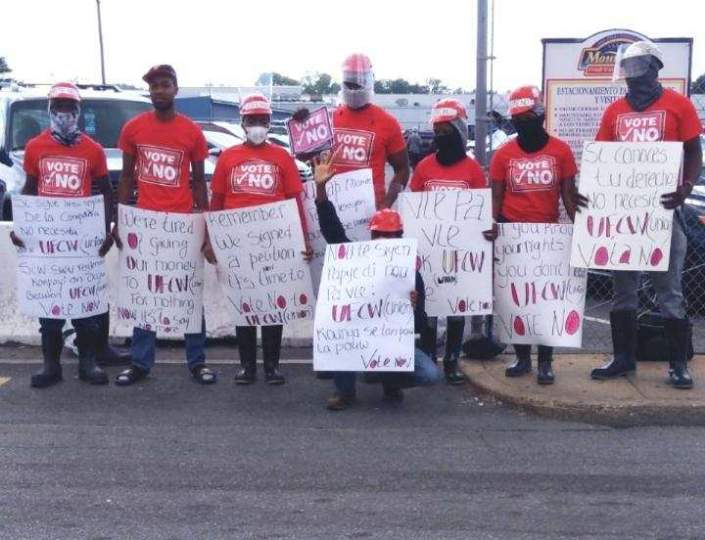
Foundation staff attorneys are assisting Delaware poultry workers in challenging UFCW bosses’ attempts to use the “contract bar” to trap them in union ranks.
WASHINGTON, DC – Foundation attorneys in January filed a Request for Review to the full National Labor Relations Board (NLRB) in Washington, D.C. The Request defends the right of Virginia Transdev workers to have a vote to remove unpopular Office and Professional Employees International Union (OPEIU) Local 2 bosses from power at their workplace.
The Transdev employees, who work at the Fairfax Connector bus service in Northern Virginia, now join Foundation-backed workers in Delaware and Puerto Rico, all of whom are urging the NLRB to eliminate the “contract bar.” That is a non-statutory NLRB policy which forbids employees from exercising their right to vote out an unpopular union in an NLRB-supervised “decertification election” for up to three years after their employer and union finalize a monopoly bargaining contract.
Foundation attorneys point out in each of these cases that the “contract bar” appears nowhere in the National Labor Relations Act (NLRA), the federal law the NLRB is charged with enforcing, and is merely the result of past union boss-friendly decisions by the Board. They also argue that the bar undermines workers’ basic right under the NLRA to remove unions that lack majority support.
“The ‘contract bar’ undermines the fundamental objective of federal labor law: Employee free choice. It makes rank-and-file employees prisoners of an unpopular union, with no way out for up to three years,” commented National Right Work Foundation President Mark Mix. “This inevitably creates an environment in which, as these employees can certainly attest, it’s impossible to hold self-serving union bosses accountable because workers are denied the right to vote them out.”
Unpopular OPEIU Bosses Went Behind Workers’ Backs to Sign Contract
The petitioner in the Transdev workers’ case, Amir Daoud, submitted a petition on November 10, 2020, signed by the necessary number of his coworkers to trigger a “decertification election” in his workplace. This was after news had gotten around that an OPEIU union agent had told some employees in October he had “negotiated a new agreement” with Transdev management and “‘intended’ to sign it without a ratification vote.” Workers had already voted down an earlier union boss-promoted monopoly bargaining contract in June.
Foundation attorneys filed a Request for Review, which notes that the union agent didn’t inform Daoud and his coworkers of when he planned to approve the new contract — until after Daoud filed the petition. The new contract was signed by union agents on October 30 and Transdev representatives on October 31.
NLRB Region 5 in Baltimore dismissed Daoud and his coworkers’ decertification petition on December 22, ruling that the “contract bar” applied because the employees’ petition was submitted just after the new contract was signed, even though the employees had no way of knowing whether or when that signing would occur.
This prompted Daoud to ask the NLRB in Washington to review the case. Because Daoud recently accepted a job with Transdev outside the OPEIU’s monopoly bargaining control, the Request for Review asks the NLRB to recognize his coworker Sheila Currie as the new petitioner to represent the interests of the workers who signed the decertification petition.
The Request exposes the arbitrariness of the “contract bar,” pointing out that the NLRB Regional Director applied it “merely because the Union ‘won the race’ and signed the contract ten days” before Daoud submitted the petition, even though the petition clearly demonstrated the employees’ interest in voting the union out.
VA and Puerto Rico Cases Follow Groundbreaking Effort by DE Poultry Workers
The Virginia Transdev employees, and a Puerto Rico armored transit guard who submitted a similar Request for Review on behalf of his coworkers with Foundation aid in January, are now battling the “contract bar” like Delaware Mountaire Farms poultry worker Oscar Cruz Sosa and his coworkers. For almost a year now, Cruz Sosa and his fellow employees have been fighting United Food and Commercial Workers (UFCW) union bosses’ attempts to use the “contract bar” to block their valid petition for a decertification vote. The Mountaire employees are now waiting for the NLRB to issue a ruling on their case.
In that case, UFCW officials claim that the “contract bar” should apply to bar any elections at Mountaire, despite an NLRB Regional Director’s decision allowing the vote because the union contract contains an invalid forced-dues clause.
When the UFCW bosses asked the full NLRB to review the Region’s order allowing the election, Cruz Sosa’s attorneys filed a brief urging that, if the Board granted review, it should use the opportunity to review the entire non-statutory “contract bar” policy. The Board is now doing just that. The UFCW union bosses are even arguing that the impounded ballots already cast by Mountaire workers should be destroyed, claiming the election should never have been held.
The Requests for Review submitted by Foundation staff attorneys for the Puerto Rico guard and Virginia Transdev employees each request that the NLRB should either grant review or least hold the case until a decision is issued in Cruz Sosa’s case.





