
NC Miners Fight Biden-Era Policy Trapping Workers in Unions They Oppose
The following article is from the National Right to Work Legal Defense Foundation’s bi-monthly Foundation Action Newsletter, March/April 2026 edition. To view other editions of Foundation Action or to sign up for a free subscription, click here.
New majority at federal labor board can eliminate ‘blocking charge’ policy
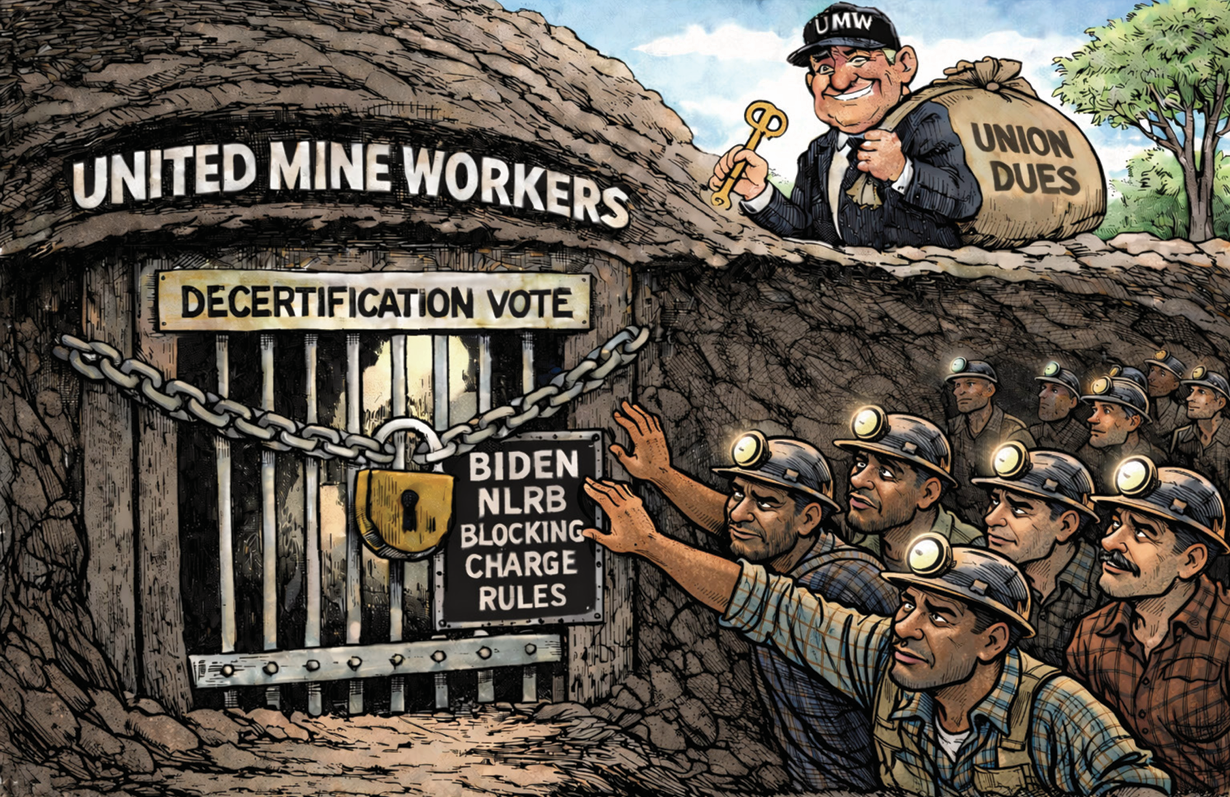
The Biden NLRB’s “blocking charge” policy serves only to trap workers under union “representation” that they’ve rightfully sought a vote to oust. But courageous miners in North Carolina are now taking a stand against this unfair policy.
SPRUCE PINE, NC – Known by the moniker “The Mineral City,” Spruce Pine is famous for being the origin of a large amount of the world’s high-purity quartz, a key component in manufacturing semiconductors. But now, it’s also the source of a legal challenge that could reshape the American labor law landscape in favor of worker freedom.
Blake Davis, a miner for The Quartz Corp., is challenging a Biden era National Labor Relations Board (NLRB) policy that is blocking him and his coworkers from voting in a worker-requested election to remove United Mine Workers (UMW) union officials from their workplace. This policy, called the “blocking charge” policy, hands union officials the power to stymie the union removal (or “decertification”) process simply by filing unproven, unsubstantiated, or unrelated “unfair labor practice” charges at the NLRB alleging employer misconduct.
Filing: ‘Blocking Charge’ Policy Clashes With Federal Law and Workers’ Rights
Davis collected and submitted a petition for a decertification vote in late 2025, which contained enough of his colleagues’ signatures to trigger a vote under NLRB rules. However, regional NLRB officials have blocked the vote due to the NLRB’s current blocking charge policy.
Davis, with the help of Right to Work attorneys, has now submitted a Request for Review to the NLRB in Washington, DC, which asks the Board to overturn the blocking charge policy and let him and his coworkers vote on whether to remove the UMW union. Since his brief was submitted, the U.S. Senate approved two new presidential appointees to the NLRB, meaning the Board now has a “quorum” and can decide this case and others.
Davis’ Request for Review argues that the NLRB’s blocking charge policy directly conflicts with the text of the National Labor Relations Act (NLRA), the federal law that the NLRB is responsible for enforcing. Davis’ brief contends that the rule lets self-interested union officials unilaterally block an election, even though the NLRA explicitly orders the Board to conduct an election whenever employees submit a valid decertification petition.
Davis’ brief also maintains that the blocking charge rule violates the Administrative Procedure Act (APA) because it is arbitrary and fails to accomplish even its own stated goals. For example, the Board argues the rule is necessary to stop “coercive elections” from happening, even though the massive advantages it gives to union bosses in the election process can hardly be considered fair.
The National Right to Work Foundation has long advocated for the NLRB to return to the Election Protection Rule, which prevented many blocking charge delay tactics before the Biden NLRB overturned it in 2024. Under the Election Protection Rule, allegations of misconduct related to a union decertification election could not block employees from exercising their right to vote, and in most cases the rule permitted the vote tally to be released before litigation over the election could occur.
Trump NLRB Can Empower Independent-Minded Workers
“The NLRB’s ‘blocking charge’ policy serves only to let union officials stop the workers they claim to ‘represent’ from making a free choice about whether they want that union to represent them,” commented National Right to Work Foundation Vice President and Legal Director Bill Messenger. “Mr. Davis and his coworkers are just the latest victims of these bureaucratic policies that trap workers in forced union ranks.
“If President Trump’s new NLRB appointees are serious about putting American workers back in control of their own livelihoods, reversing this union boss power giveaway is an excellent place to start,” Messenger added.
Over 100 Windstream North Carolina Employees Vote to Free Themselves of Unwanted CWA Union
Workers across 12 North Carolina locations officially free from CWA officials’ ‘representation’
North Carolina (March 18, 2026) – Employees of telecommunications provider Windstream North Carolina LLC have successfully voted Communications Workers of America (CWA) union officials out of power at their workplaces across North Carolina. Windstream worker Grant Diorio kicked off his coworkers’ effort to oust the union by filing a petition with the National Labor Relations Board (NLRB) in January, impacting his work unit of roughly 120 Windstream employees. Diorio filed the petition with free legal aid from National Right to Work Foundation staff attorneys.
The NLRB is the federal agency responsible for enforcing private sector labor law, a task that includes holding votes to install (or “certify”) and remove (or “decertify”) unions. Diorio’s petition contained more than enough signatures from his coworkers to trigger a decertification vote under NLRB rules. In February, the NLRB approved an agreement that set aside three days for in-person voting at several Windstream locations across the state.
The agreement noted that the vote would take place among “[a]ll employees employed by [Windstream] in its Plant, Commercial, or Traffic Department at its Matthews, Marshville, Wadesboro, Waxhaw, Rockwell, Denton, Mooresville, Tryon, Rural Hall, Monroe, and Aberdeen facilities.”
North Carolina is a Right to Work state, meaning state law forbids CWA bosses and other union officials from forcing workers to pay money to the union just to get or keep a job. Diorio and his coworkers enjoyed these protections, but even in Right to Work states, union officials have exclusive “representation” power, which permits them to impose one-size-fits-all contracts on every worker in a unionized workplace, even those who voted against or otherwise oppose the union.
“Even though my coworkers and I have a variety of jobs for Windstream across North Carolina, we agreed that CWA union bosses were not making our working lives any better,” commented Diorio. “I’m glad that, despite the challenges that come with petitioning for a decertification vote to take place at multiple places across the state, we were able to stand firm, secure our rights, and vote this CWA union out. We look forward to being independent!”
Workers Across Country Seeking Union Decertification, but Biden-Era Policies Stand in the Way
Foundation attorneys have noticed a marked increase in worker requests for help in decertifying unpopular unions. NLRB statistics indicate that in 2025 (the last year for which data is available), decertification petition filings are up almost 40% since 2020.
“Mr. Diorio and his colleagues’ situation is an excellent example of what happens when labor law actually works to protect American employees’ individual rights as opposed to frustrating those rights. We were proud to assist them,” commented National Right to Work Foundation President Mark Mix. “Unfortunately, one only needs to look within the state of North Carolina to find an example of union bosses using biased doctrines within federal labor law to shore up their own power, even when it’s clear that workers want a chance to vote the union out. At The Quartz Corp. in Spruce Pine, United Mine Workers union officials have been manipulating unsubstantiated misconduct charges for months to block workers from having a union removal vote they validly requested.
“Luckily, Foundation attorneys are assisting Quartz Corp. employees and many other groups of independent-minded workers across the country in challenging unfair legal barriers to worker freedom,” Mix added. “The Trump NLRB should break from dysfunctional Biden-era policies and end the biased rules that have undermined workers’ explicit right under federal law to vote out unwanted unions.”
Workers in North Carolina and California Ask Federal Labor Board to Nix Policy Letting Union Bosses Block Elections
With new quorum, National Labor Relations Board can eliminate “blocking charge” policy used to stop union removal elections
Washington, DC (January 6, 2026) – Workers in North Carolina and California are pushing the National Labor Relations Board (NLRB) to strike down its “blocking charge” policy, which is preventing them from removing unwanted union officials from their workplaces.
The workers, which include miners employed by The Quartz Corp. in Spruce Pine, NC, and Fresno, CA-based construction materials workers for CalPortland, both backed petitions in late 2025 asking the NLRB to administer votes to remove (or “decertify”) unions from their workplaces. Despite both petitions containing enough signatures to trigger union decertification elections, regional NLRB officials blocked both votes pursuant to the NLRB’s current blocking charge policy. This Biden-era policy permits union officials to stymie the union decertification process simply by filing unproven or unrelated “unfair labor practice” charges at the NLRB alleging employer misconduct.
Quartz Corp. employee Blake Davis and CalPortland worker Darrell Dunlap have both submitted Requests for Review to the NLRB in Washington, DC. These filings ask the Board to overturn the blocking charge policy and let their coworkers’ requested votes to remove the United Mine Workers and Teamsters unions (respectively) go forward. Davis and Dunlap are both receiving free legal aid from National Right to Work Foundation staff attorneys. While vacancies on the NLRB have caused a backlog of cases, the U.S. Senate recently approved two new presidential appointees to the NLRB, meaning the Board now has a “quorum” and can hear these and other cases.
“Blocking Charge” Policy Inconsistent With Federal Labor Law
Dunlap’s Request for Review argues that the NLRB’s blocking charge policy directly conflicts with the text of the National Labor Relations Act (NLRA), the federal law that the NLRB is responsible for enforcing. “Allowing a self-interested party to unilaterally block elections conflicts with [the NLRA], which requires the Board to hold an election” if employees submit a valid decertification petition, Dunlap’s brief says. “The blocking charge policy does not just contravene a clear Congressional command, but also offends the entire structure and purpose of the Act: employee free choice.”
Dunlap’s brief also maintains that the blocking charge rule violates the Administrative Procedure Act (APA) because it is arbitrary and fails to accomplish even its own stated goals. For example, the Request for Review says, NLRB bureaucrats impose the policy without considering key data showing the blocking charge policy has caused substantial delays in the union election process. Furthermore, the Board has argued that the rule is required to stop “coercive elections” from happening – even though its only mechanism for doing this is giving self-interested union bosses massive power to block elections or let them proceed.
Davis’ Request for Review makes many similar arguments, but adds that even if the Board were to uphold the blocking charge policy, regional NLRB officials egregiously misapplied it in his case. As his brief points out, even before he and his colleagues had submitted the union decertification petition, “the union filed a barrage of [unfair labor practice charges],” some of which were just speculation about employer activity aiding the union removal process. Even so, the regional NLRB appears to have blocked Davis and his coworkers’ requested election based on the mere quantity of the union’s charges, without explaining which allegation justified blocking. “By failing to distinguish between allegations that might warrant blocking and those that plainly would not, the Region reduced the rule to a numbers game,” the Request for Review says.
Trump NLRB Can Undo ‘Blocking Charge’ Policy and Empower Independent-Minded Workers
The National Right to Work Foundation has long advocated for the NLRB to return to the Election Protection Rule, which prevented many aspects of blocking charge-related gamesmanship before the Biden NLRB overturned it in 2022. Under the Election Protection Rule, allegations of misconduct related to a union decertification election could not block employees from exercising their right to vote, and in most cases permitted the immediate release of the vote tally as opposed to ordering ballots to be impounded during litigation over blocking charges.
“The NLRB’s ‘blocking charge’ policy serves only to let union officials stop the workers they claim to ‘represent’ from making a free choice about whether a union in their workplace is right for them,” commented National Right to Work Foundation President Mark Mix. “Mr. Dunlap and Mr. Davis speak for countless workers across the country who are trapped under union boss dictates and forced-dues payments because of this rule.
“If President Trump’s new NLRB appointees are serious about putting American workers back in control of their own livelihoods, reversing this union boss power giveaway is an excellent place to start,” Mix added.
Worker Advocate Files Brief Defending North Carolina Law to Strengthen Farm Workers’ Right to Work Protections
National Right to Work Foundation Legal Brief Counters Farm Union Bosses’ Case Seeking Power to Impose Union, Top Down, via Lawsuits
Richmond, VA (February 24, 2022) – The National Right to Work Legal Defense Foundation has filed an amicus curiae brief with the United States Fourth Circuit Court of Appeals in Farm Workers Organizing Committee v. Joshua Stein. This is a federal case brought by union officials seeking the power to impose monopoly union power and union dues deductions on agricultural workers and employers.
The brief defends a 2017 North Carolina law that bolsters farm workers’ Right to Work protections under the state’s longstanding and popular law. The 2017 law was passed to protect workers from having union monopoly representation foisted on them as a result of union-instigated lawsuits. The 2017 North Carolina law protects workers from union monopoly representation, the law also prevents union bosses from gaining the power to have union dues automatically deducted from agricultural workers’ paychecks.
Although they are private sector employees, agricultural workers are not covered by the National Relations Labor Act, which covers most private sector employees across the country. The Foundation brief argues this gives North Carolina the legal authority to prohibit union dues payroll deductions as a means of strengthening the existing protections of the state’s Right to Work law, which applies to agricultural workers in addition to those under NLRB jurisdiction.
The brief cites the fact that the Fourth Circuit Court of Appeals specifically rejected the argument that union officials have a right to payroll deduction in South Carolina Education Association v. Campbell. It also points out that the U.S. Supreme Court rejected union arguments that they had a right to payroll deductions for union political activities in Ysursa v. Pocatello Education Association.
The Foundation brief notes the Farm Labor Organizing Committee (FLOC) has “no more constitutional entitlement to have agricultural employers collect money for it than FLOC has a constitutional entitlement to having the state act as its collection agent.”
The Foundation brief further notes it is “well-established that prohibitions on collective bargaining do not infringe on union constitutional rights because unions have no constitutional entitlement to act as a monopoly bargaining representative.” It follows that North Carolina is well within its authority to protect workers and employers from being subjected to such monopoly “representation” through the misuse of litigation designed to sweep farmworkers under union control.
“Apparently union bosses have become so accustomed to their government-granted monopoly bargaining powers that they believe, incredibly, that the United States Constitution entitles them to impose monopoly unionization on workers unilaterally,” said National Right to Work Foundation President Mark Mix. “Although farm workers, like others, can of course associate with a union if they choose, FLOC union bosses should not be able to abuse the legal process to impose unionization on employees against their will.”
“It is entirely appropriate for North Carolina to protect agricultural workers against having a union imposed on them against their will,” added Mix. “Union association must be fully voluntary, not the result of backroom dealing in lawsuits by union officials designed to force a union on workers from the top down.”





