
IBEW Local 16 Folds in Case Concerning Illegal $1.29 Million Retaliatory ‘Fine’ Threat Against Local Electrician
Union bosses imposed illegal limitations on resigning union membership, told electrician he would be fined for starting new business unless he signed with the union
Evansville, IN (September 30, 2025) – Brian Head, an Evansville-based electrician, has vindicated his federal labor rights against the International Brotherhood of Electrical Workers (IBEW) Local 16 union. Head filed federal charges after IBEW union officials threatened him with a $1.29 million internal disciplinary fine even though he had validly resigned his union membership. He filed the charges at the National Labor Relations Board (NLRB) with free legal aid from National Right to Work Foundation staff attorneys.
The settlement requires union officials to rescind all fines against Head, expunge all records of them, and refrain from interfering with workers who exercise their right to resign their union membership in the future. The union is also required to notify other workers of their legal right to resign their union membership without restriction, and be free of any attempt to impose internal union fines post-resignation.
Fine Threats Came After Electrician Refused to Hand Over Business to Union Power
The NLRB is the federal agency responsible for enforcing the National Labor Relations Act (NLRA) and adjudicating disputes between employers, unions, and individual employees. Head’s charges document that he had resigned his IBEW union membership on March 27, 2025, in a notarized letter that IBEW officials acknowledged receiving. However, the union’s reply letter claimed that “[i]t is a six-month process before the resignation is finally effective.”
The NLRA forbids restricting the right of workers to resign their union memberships. Section 7 of the NLRA enshrines workers’ right to refrain from union membership. Furthermore, union bosses cannot impose discipline or fines upon nonmember workers.
IBEW Local 16 union officials began retaliating against Head after he resigned his union membership and announced he was purchasing a non-union electrical firm. Head refused to sign an IBEW Letter of Assent, which would have likely forced his employees under union control without any kind of worker vote.
Following Head declining to hand over his business to a union he was no longer legally affiliated with, IBEW Local 16 officials sent Head correspondence on May 1 demanding he appear before a union tribunal. Head later received a letter from IBEW Local 16 bosses on June 9 finding him “guilty” of violating the union’s constitution and imposing a “$1.29 Million dollar fine” as a penalty.
Foundation-Won Settlement Forces IBEW to Inform Workers of Rights
An NLRB Regional Director reviewed Head’s charges against IBEW union officials’ overreach, and made a merit determination in his favor, finding that the IBEW Local 16 union officials violated Head’s rights under the NLRA. IBEW union officials quickly decided to back down and settle rather than go to trial against the NLRB and Head’s Foundation lawyers. In addition to expunging their million-dollar-plus retaliatory fine, the settlement details that IBEW bosses must stop informing workers that there are restrictions on the right to resign one’s union membership. Additionally, they must inform all their members of their rights under the NLRA, and post the settlement on the union’s website.
“The Foundation is pleased to have assisted Mr. Head as he challenged IBEW union bosses’ attempt to illegally extort him after he had followed all legal procedures necessary to break free from the union,” commented National Right to Work Foundation President Mark Mix. “IBEW union bosses’ use of strong-arm tactics demonstrates that they value maintaining control over Indiana electricians far above respecting those electricians’ individual rights.
“Whenever union bosses violate the rights of any American worker, Foundation attorneys are ready to assist in their defense,” Mix added.
California Nurse Adds New Claim in Federal Labor Board Case Against United Nurses Association of California
Charge: union officials illegally demanded nurse join union, plus maintain illegal policy that restricts right to cut off funding for political spending
Woodland Hills, CA (September 5, 2025) – Sarah Warthemann, a nurse at Kaiser Permanente, has just filed new charges in her ongoing case against the United Nurses Association of California (UNAC) union challenging union officials’ illegal demands that she pay full union dues or be fired. Warthemann’s charges were filed at the National Labor Relations Board (NLRB) with free legal aid from National Right to Work Foundation staff attorneys.
Her original charges, filed in July, stated that UNAC union bosses illegally threatened her with termination of her employment at the hospital if she did not formally join the union. Now, the amended charges also challenge union policies that require nonmembers to opt-out of paying for union political and ideological activities.
The NLRB is the federal agency responsible for enforcing the National Labor Relations Act (NLRA) and adjudicating disputes between employers, unions, and individual employees. The charges allege UNAC union bosses are violating Warthemann and all other nurses’ NLRA Section 7 right to refrain from participating in or supporting union activities.
Because California lacks Right to Work protections, UNAC union bosses can impose union monopoly bargaining contracts that force employees to pay union dues or fees as a condition of employment. By comparison, in neighboring Right to Work states like Arizona and Nevada, union membership and all union financial support are strictly voluntary.
However, under Communications Workers of America v. Beck, a landmark Foundation-won Supreme Court case, even where forced dues are authorized, union officials cannot compel workers to fund activities unrelated to union bargaining, like union political activities. The charges note that UNAC officials have “repeatedly demanded payment from [Warthemann] for non-chargeable political and ideological expenditures without [her] affirmative consent” and argue that these demands represent illegal coercion under the NLRA.
“As the facts of this case demonstrate, the NLRB needs to step up to protect workers from being trapped into paying full union dues, including the portion used for union political activism,” observed National Right to Work Foundation President Mark Mix. “Union bosses are not above the law, they cannot be permitted to threaten and bully workers into paying dues that go towards union political activities that many workers find objectionable.”
Philly Public Defender Beats Illegal UAW Dues Deduction Scheme
The following article is from the National Right to Work Legal Defense Foundation’s bi-monthly Foundation Action Newsletter, September/October 2023 edition. To view other editions of Foundation Action or to sign up for a free subscription, click here.
UAW boss threatened to reduce workers’ wages for not signing dues card
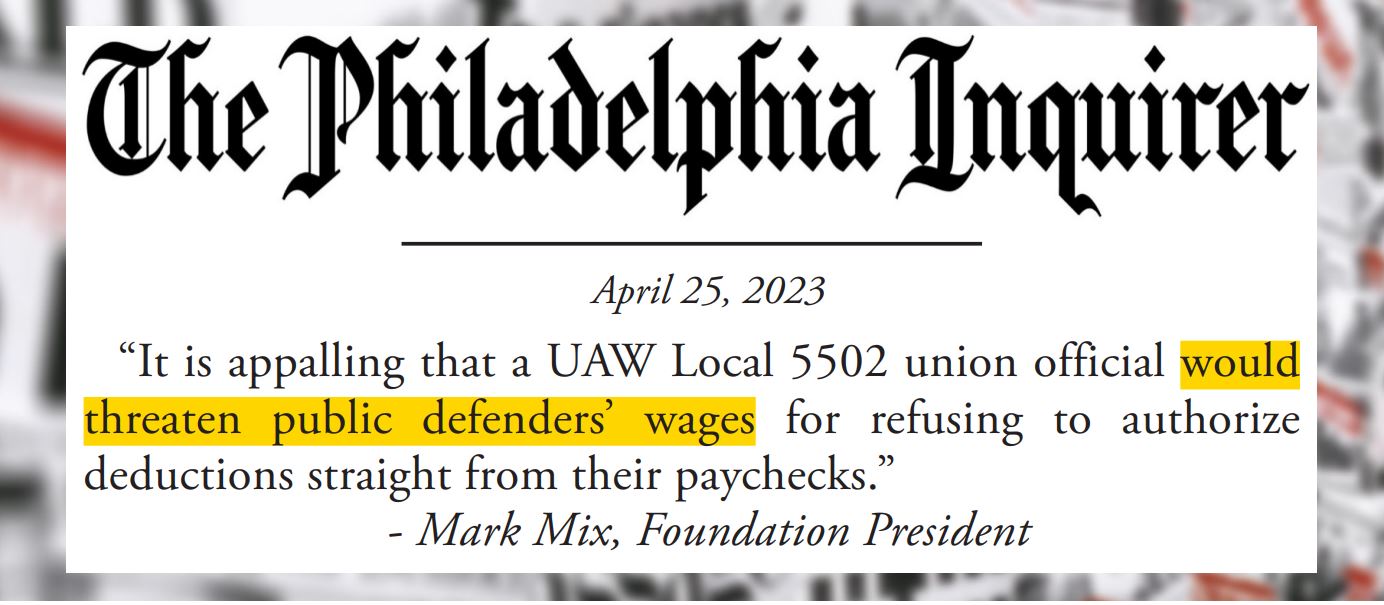
Philly Public Defender Brunilda Vargas surely didn’t feel “represented” by UAW bosses when they sought to reduce her and her colleagues’ pay just for not signing dues cards. Mark Mix expressed the outrageousness of this scheme to The Philadelphia Inquirer.
PHILADELPHIA, PA – Brunilda Vargas, a public defender for the City of Philadelphia, staunchly objected when United Auto Workers (UAW) Local 5502 union bosses sought to gain power over her and her colleagues at the Defender Association of Philadelphia.
After UAW union officials were installed in her workplace, things only got worse for her. A UAW union official threatened Vargas and her coworkers that, if they didn’t sign cards authorizing the direct deduction of union dues from their paychecks, their wages would be reduced. This threat was a blatant violation of federal law.
Vargas challenged UAW officials’ illegal demands with free legal aid from the National Right to Work Legal Defense Foundation. Union bosses quickly backed down, and in June entered into a settlement approved by National Labor Relations Board (NLRB) Region 4 which fully vindicates Vargas’ and her coworkers’ rights.
Public Defender Hits UAW with Federal Charges Following Intimidation
On April 18, 2023, Vargas filed her federal unfair labor practice charge with NLRB Region 4 for the threats made against her and her colleagues at the Defender Association of Philadelphia. UAW officials issued these threats against public defenders who chose not to sign automatic dues deduction authorization forms.
Even though Vargas works in the non-Right to Work state of Pennsylvania and can be forced to pay some union dues as a condition of employment, federal law prohibits forcing workers to authorize automatic dues deductions from their paychecks. Had Vargas lived in a Right to Work state, not only would she have the right to refrain from automatic dues deductions from her paycheck, but she could also refrain from financially supporting the union altogether. In Right to Work states, workers are fully protected from mandatory union membership and financial support, both of which must be completely voluntary.
Settlement Forces Union Bosses to Fully Abandon Illegal Threats
Now, pursuant to settlements, the UAW must email and post notices informing workers that the union will not work with the workers’ employer to reduce wages of nonmembers that do not sign automatic dues deductions forms. The union must also not suggest failure to sign a dues deduction card could lead to a worker’s termination. Finally, the union must not coerce or restrain individuals from expressing their rights under Section 7 of the National Labor Relations Act.
“[UAW] will not threaten objecting non-members that we will notify the Employer it can seek refunds of their contractual salary increases if they do not sign a dues deduction authorization form. Neither employees nor members are legally required to execute a dues deduction authorization form,” the notice reads.
“While we are happy that we were able to help Vargas and her coworkers fight UAW misconduct, this instance is but the tip of the iceberg when it comes to UAW malfeasance,” commented National Right to Work Foundation Vice President Patrick Semmens. “The recent federal probe into UAW officials stealing and misusing workers’ money has sent multiple top UAW bosses to jail, and uncovered a shocking culture of contempt for workers’ rights.”
“Fortunately, the numerous victims of UAW boss abuses need not fight alone,” continued Semmens. “They have an ally in the National Right to Work Foundation.”





