
Dartmouth, MIT, Vanderbilt Graduate Students Challenge Forced Unionism
The following article is from the National Right to Work Legal Defense Foundation’s bi-monthly Foundation Action Newsletter, January/February 2025 edition. To view other editions of Foundation Action or to sign up for a free subscription, click here.
Foundation-backed students defend rights as union bosses seek more power at universities

Ben Logsdon is a Ph.D. student in mathematics at Dartmouth College. But it doesn’t take a genius to realize that union officials’ refusals to accommodate his religious objections just don’t add up.
HANOVER, NH – Just weeks after National Right to Work Foundation staff attorneys triumphed in anti-discrimination cases for Jewish Massachusetts Institute of Technology (MIT) graduate students who sought to stop forced dues payments to a radically anti-Israel union, union officials began creating other problems for university students.
In nearby New Hampshire, Dartmouth graduate student Benjamin Logsdon sought free Foundation legal aid against Graduate Organized Laborers of Dartmouth (GOLD-UE) union officials. The GOLD union — which is an affiliate of the same United Electrical (UE) union involved in the Foundation’s MIT cases — is forcing Logsdon to accept the union’s monopoly “representation” powers against his will, even after he voiced his religious objections to the union’s radical stances on the conflict against Israel.
Grad Students Exposed to Union Coercion & Privacy Violations
Meanwhile, several graduate students at Vanderbilt University in Nashville, TN, are pushing back against an attempt by Vanderbilt Graduate Workers United (VGWU, an affiliate of United Auto Workers) union bosses to impose union control over them and their colleagues. Specifically, three students are seeking to intervene in a federal case in which VGWU union officials are illegally demanding the university hand over the students’ private information to aid in their unionization campaign. Foundation staff attorneys filed motions for intervention for these students in October 2024.
Foundation attorneys are arguing that union officials severely violate students’ rights in both of these cases. However, the reason that union officials are in power on college campuses at all traces back to flawed rulings from the National Labor Relations Board (NLRB) under both the Obama Administration and Biden Administration. These rulings subject graduate students to pro-Big Labor provisions of the National Labor Relations Act (NLRA), which create issues for students’ freedom both inside and outside the classroom.
Logsdon, a Christian Ph.D. student in mathematics at Dartmouth, slammed the GOLD union with federal anti-discrimination charges in September 2024 at the Equal Employment Opportunity Commission (EEOC). According to those charges, shortly after the GOLD union finalized its first monopoly bargaining contract with the Dartmouth administration, he sent a letter to United Electrical General Secretary-Treasurer Andrew Dinkelaker explaining that he objected to being affiliated with GOLD on religious grounds and needed an accommodation.
“I sought to be removed from the UE and GOLD-UE bargaining unit as a reasonable accommodation,” Logsdon’s Foundation-backed charges say.
Dinkelaker refused to offer Logsdon an accommodation that “satisf[ied] [his] religious conscience or beliefs,” according to the charges, which violated his rights under Title VII of the Civil Rights Act of 1964.
Courts have recognized a variety of Title VII religious accommodations over the years for men and women who have religious objections to union affiliation, including paying an amount equivalent to union dues to a charity instead of union bosses. However, Logsdon seeks a different accommodation: to remove himself from union bosses’ control entirely.
At Vanderbilt, three students who identify themselves in legal documents as “John Doe 1,” “John Doe 2,” and “Jane Doe 1” are contending in their Foundation-backed motions for intervention that the Family Educational Rights and Privacy Act (FERPA) forbids the Vanderbilt administration from disclosing their personal information to any third parties without their permission, including the VGWU union.
At the union’s behest, NLRB Region 10 has already hit the Vanderbilt administration with a pair of subpoenas demanding personal student info, while ignoring objections from several students expressing concern at the disclosure.
So far Vanderbilt has resisted the NLRB’s subpoenas, and fortunately a federal court has temporarily allowed the university to refuse to comply with them.
The Foundation-backed students’ motions to intervene argue that the subpoenas “are an attempt to violate FERPA’s protections, privileging union interests over the graduate students[’] privacy rights.” It also points out that FERPA allows students to seek “protective action” if a university receives a subpoena seeking their personal information, as in this case.
The Vanderbilt students and their Foundation attorneys are demanding an opportunity to properly defend their privacy interests under FERPA. Foundation attorneys have already filed Requests for Review asking the NLRB in Washington, DC, to weigh in on the matter.
Union Monopoly Power Has No Place at Universities
“Graduate students around the country are discovering that union bosses don’t respect their individual rights and would rather use students as pawns to force their demands on a university administration, or advance an extreme political agenda,” commented National Right to Work Foundation Vice President and Legal Director William Messenger.
“Union monopoly bargaining is a system particularly ill-suited to an academic environment. Indeed, it is wrong for anyone to have a union monopoly imposed on them against their will and then be forced to pay union dues under threat of termination.”
MIT Graduate Students Defeat Discriminatory Dues Demands From Radical Campus Union
The following article is from the National Right to Work Legal Defense Foundation’s bi-monthly Foundation Action Newsletter, November/December 2024 edition. To view other editions of Foundation Action or to sign up for a free subscription, click here.
Union must cease forced dues, inform thousands of MIT graduate students of right to defund union politics
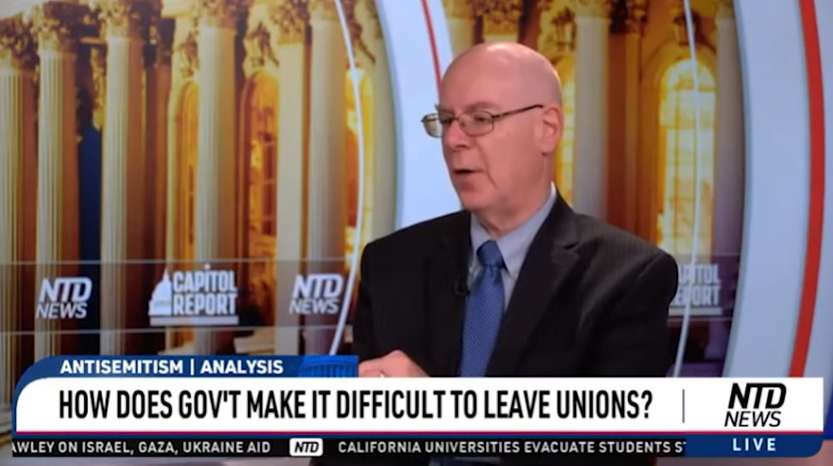
Foundation staff attorney Glenn Taubman, who aided the MIT graduate students in their legal victory, told NTD News his phone is “ringing off the hook” because university students and faculty nationwide are seeking ways to defund radical campus unions.
BOSTON, MA – “Jewish graduate students are a minority at MIT. We can’t remove the [Graduate Student Union (GSU)] or disabuse it of its antisemitism. But we also can’t support an organization that actively works toward the eradication of the Jewish homeland, where I have family living now.”
These were the words MIT Ph.D. student Will Sussman used to describe his, and other graduate students’, battle against radical union bosses at his campus, both in a Wall Street Journal op-ed and in June testimony before the U.S. House Committee on Education and the Workforce. GSU union officials gained the legal privilege to force MIT graduate students to pay dues or lose their academic work thanks to biased rulings by the National Labor Relations Board (NLRB) under both President Biden and President Obama. Since then, they’ve wasted no time in forcing even Jewish students with strong objections to the union’s anti-Israel agitating to fund their activities.
Students Battle Anti-Israel Sentiment Boosted by GSU Union Bosses
However, with free legal aid from National Right to Work Foundation staff attorneys, Sussman and his fellow Jewish graduate students Joshua Fried, Akiva Gordon, Adina Bechhofer, and Tamar Kadosh Zhitomirsky fought back against the GSU’s discriminatory dues demands. They each filed federal charges at the Equal Employment Opportunity Commission (EEOC), charging the GSU with denying them religious accommodations required by Title VII of the Civil Rights Act of 1964. Now they’ve won full accommodations that allow them to cut off all financial support for the union.
Separately, Foundation attorneys also filed federal unfair labor practice charges at the NLRB for Katerina Boukin, who objected on political grounds to the GSU’s ideological activity. Boukin sought to exercise her rights under the Foundation-won Communications Workers of America v. Beck Supreme Court decision, which lets workers who abstain from union membership opt-out of paying for the union’s political expenses.
In the wake of the October 7, 2023, attacks on Israel, Sussman and his fellow students experienced a massive wave of anti-Israel sentiment on MIT campus, including from GSU union chiefs.
“The blood had not yet dried when my colleagues at MIT declared, ‘Victory is Ours,’” related Sussman at a congressional hearing on anti- Semitism in unions. “The full-time GSU staff organizer told NBC10 Boston, ‘Those who rebel against oppression cannot be blamed for rebelling against that repression.’”
GSU Union Backed Off Unlawful Demands After Foundation Intervention
Sussman, Fried, Gordon, Bechhofer, and Zhitomirsky each requested in early 2024 that GSU union officials provide them with religious accommodations to paying union dues based on their objections to union officials’ extremist beliefs. Under federal law, such accommodations vary, but often take the form of letting the objector divert the dues from the offensive union to a 501(c)(3) charity instead. The GSU union’s brazen response was that “no principles, teachings or tenets of Judaism prohibit membership in or the payment of dues or fees to a labor union” and that no religious conflict existed because one of the founders of GSU’s parent union was himself Jewish.
The GSU union backed down after Foundation staff attorneys filed EEOC anti-discrimination charges in response to the lack of accommodation. The students have secured full religious accommodations and will pay money to charities of their choice, despite initial pushback from union bosses. The charities include American Friends of Magen David Adom and American Friends of Leket.
Katerina Boukin’s NLRB case was spurred by her disagreements with the union’s political stances on Israel. She stated that she was deeply offended by GSU’s “opposition to Israel and promotion of Leninist- Marxist global revolution” and that “[t]he GSU’s political agenda has nothing to do with my research as a graduate student at MIT, or the relationships I have with my professors and the university administration.”
“[Y]et outrageously they demand I fund their radical ideology,” Boukin said.
Foundation-Won Settlement Informs Students They Can Defund ‘Marxist’ Union
Foundation attorneys won a settlement for Boukin that not only returned illegally-seized dues to Boukin, but also required GSU bosses to inform the entire MIT graduate student body of their rights to invoke the Beck decision.
GSU bosses were forced to declare by email that they will not restrict the ability of those who resign their union memberships to cut off dues payments for political expenses and pay a reduced amount to the union. This email notice went out to approximately 3,000 MIT students.
Legal Protections Should Protect Employees’ Right to Object on Any Grounds
“The Foundation-backed MIT graduate students who fought these legal battles have earned well-deserved victories. But defending basic free association rights shouldn’t require such complicated litigation,” commented National Right to Work Foundation President Mark Mix.
“This ordeal at MIT should remind lawmakers that all Americans should have a right to protect their money from going to union bosses they don’t support, whether those objections are based on religion, politics, or any other reason.”





